
Kp and Iceland's high magnetic latitude
The Kp index is a 0-to-9 scale that measures how disturbed Earth's magnetic field is. It is the number every aurora app leads with, and the Kp index explained in full elsewhere is worth reading if you want the underlying mechanics. What matters for this article is where Iceland sits on the map that Kp describes.
Iceland's mainland spans roughly 64 to 67°N, placing the whole country inside the auroral oval, the ring of peak geomagnetic activity that circles the pole and expands or contracts with solar conditions[2]. That position means Iceland needs far less disturbance than continental Europe to see something overhead. A Kp reading that leaves London and Berlin with nothing at all can still put a visible glow over Þingvellir or the Snæfellsnes peninsula[2].
64–67°N
In practical terms: Kp 5 or above, officially a geomagnetic storm, reliably lights up the whole country given clear sky. Kp 2 to 4 covers most of the nights Icelanders actually go outside and see something. Below Kp 2, you may still catch a faint band low on the northern horizon, but it rarely justifies planning a whole evening around it.
Reading the two maps on vedur.is
Open the vedur.is aurora page and you are looking at two layers stacked on the same interface: a colour-coded aurora activity map and a separate cloud cover map. Reading either one alone gives you half the picture. Reading both together, for the same date and hour, is the entire method this article is built around.
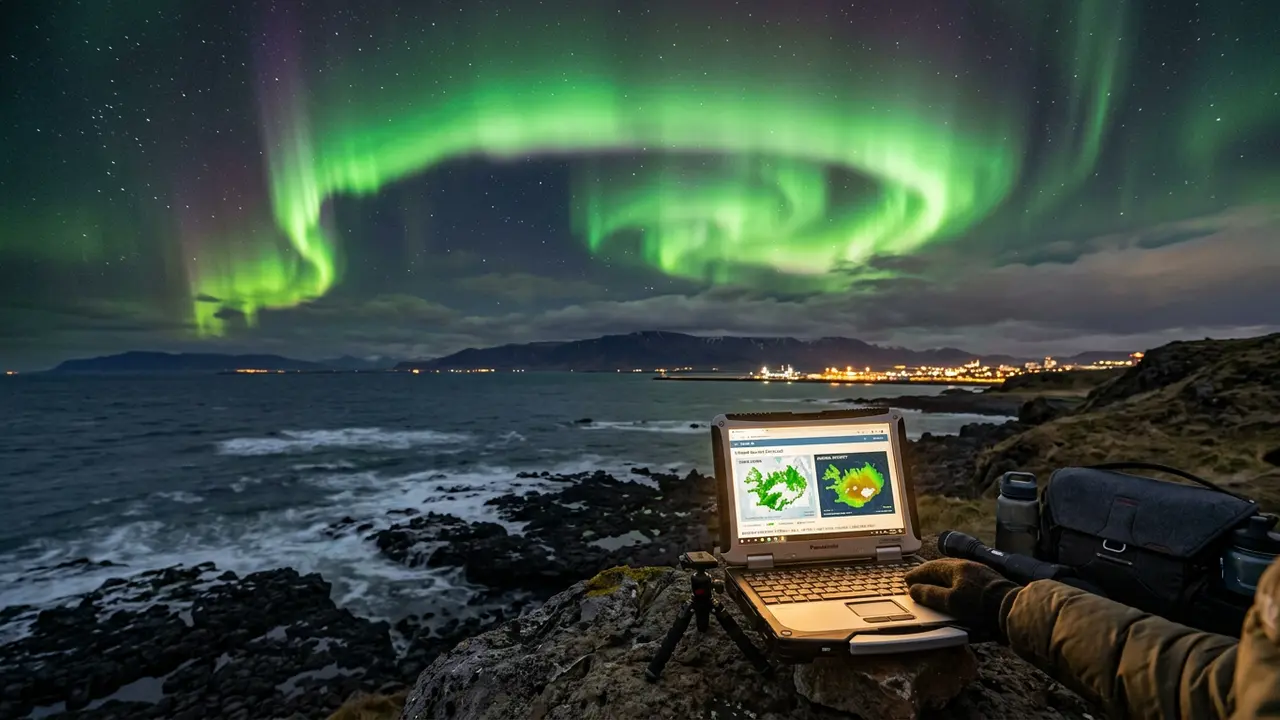
Use the date and time slider along the top of the page to step through the next several nights. Set it to roughly midnight local time, since that is the hour the activity map's scale is calibrated to, and compare the same hour across your candidate nights rather than jumping between different times as you scroll.
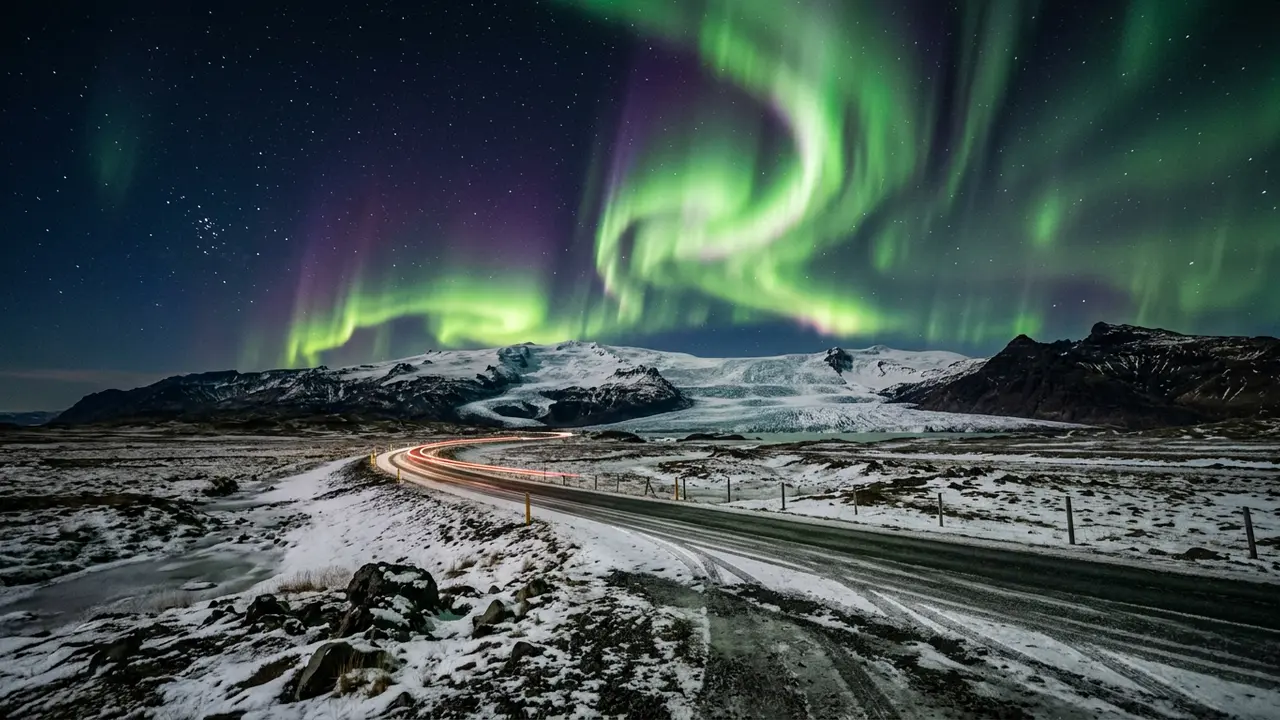
Featured · Destination
Northern Lights in Iceland
Iceland's whole-country aurora guide: best regions to base in, aurora season Sep–Mar, ice caves, winter driving reality, and where cloud cover ends every plan.
The aurora activity map
The activity map uses its own 0-to-9 scale, colour-coded by intensity, and it is not the same number as the global Kp index: it is the IMO's own estimate of how strong the aurora will be over Iceland specifically at the selected hour. Darker shading means stronger predicted activity. A reading of 5 or higher over your region is a genuinely promising sign, provided the second map cooperates.
The cloud cover map
The cloud layer is the feature that makes vedur.is worth using over a generic Kp app. White areas mean clear sky; green and grey shading mean cloud. Aurora forms 80 to 300 kilometres above the ground, far above any weather system, and even a thin cloud deck blocks the view completely, regardless of how strong the geomagnetic activity is underneath it[3]. For the physics of why aurora sits that high in the first place, see the aurora physics explainer. On vedur.is, the moment you see white over your location lined up with a decent activity reading, you have found your night.
Building your go/no-go decision
The workflow that actually works is not complicated, but it has to happen on a schedule, because Iceland's cloud forecast changes faster than most visitors expect. Cloud cover, not a weak Kp reading, is the single most common reason a promising aurora forecast produces nothing[4]. A Kp 6 storm behind an overcast sky is exactly as visible as a Kp 0 night: not at all.
- Seven to ten days out: scan vedur.is for any night where the activity map shows readings of 3 or higher and the cloud layer looks mostly white. Shortlist your top two or three candidate nights.
- The day before: recheck both maps. Iceland's cloud forecast can shift substantially within 24 hours; confirm your shortlisted night and region still look clear.
- Two to three hours before you leave: do the final check. If the white patch has moved, move with it, or reschedule. A frustrating drive under cloud will not improve because you already committed to it.
| Kp forecast | Cloud cover on vedur.is | Verdict |
|---|---|---|
| Kp 5+ (storm) | Clear (white) | Go: strong display likely, drive to your spot |
| Kp 5+ (storm) | Overcast (green/grey) | No-go: a storm behind cloud is invisible, relocate or wait |
| Kp 2–4 (active) | Clear (white) | Go: worth stepping outside, best near new moon |
| Kp 2–4 (active) | Partly cloudy | Maybe: check the regional map for a clearer pocket |
| Kp 0–1 (quiet) | Clear (white) | Low odds: possible faint glow, not worth a long drive |
| Kp 0–1 (quiet) | Overcast | No-go: nothing to see even if activity picks up |
A clear night with a modest Kp reading beats an overcast night with a storm every single time. Plan around the cloud map first and let the activity number break the tie between two otherwise-equal spots. This workflow decides which specific night to go once you're already in Iceland; for which weeks of the season give you the best odds before you even open vedur.is, see best time for northern lights in Iceland.
Common Iceland aurora forecasting mistakes
A handful of mistakes account for most of the disappointed aurora trips in Iceland, and nearly all of them come from reading one map instead of two, or reading either map only once.
- Chasing Kp and ignoring the clouds. A strong storm forecast is meaningless if the cloud layer over your location is grey. Check the cloud map first, and let the activity number break the tie between two otherwise-equal spots.
- Assuming one region's forecast covers the whole country. Reykjavík being overcast says nothing about Akureyri or Vík. Iceland's regional weather varies enough that driving one to two hours toward a clearer patch is often the difference between seeing the aurora and not.
- Checking the forecast only once. Iceland's cloud forecast updates continuously, and the Kp reading itself refreshes every three hours[5]. A forecast checked at noon can be stale by 9pm.
- Ignoring the moon. A bright moon washes out a faint display the same way it washes out the Milky Way. For the full framework on timing a trip around moon phase and darkness, see how to see the northern lights.
Vedur.is vs NOAA SWPC vs aurora apps: which tool for which job
Vedur.is should be the only tool you check daily once you are in Iceland, but two others are worth knowing about as secondary references, not replacements.
NOAA's Space Weather Prediction Center (SWPC) runs the global 3-day Kp forecast and the OVATION model behind most consumer aurora apps, driven by real-time solar wind data and refreshed roughly every 30 minutes[6]. It is useful for planning a trip weeks out, before Iceland-specific cloud data means much, and as a sanity check if vedur.is's activity map looks unusually high or low. It was not built for Iceland's coastal weather, so treat it as background reading, not your nightly decision tool.
Consumer apps such as the ones covered in the aurora forecast apps guide mostly repackage that same NOAA feed into a friendlier interface. For destinations without a dedicated national forecast, they are often the best option available. In Iceland specifically, they add a layer between you and the one forecast built for this exact coastline, so keep them as a backup rather than your primary source.