
The new-moon window: how many nights you actually get
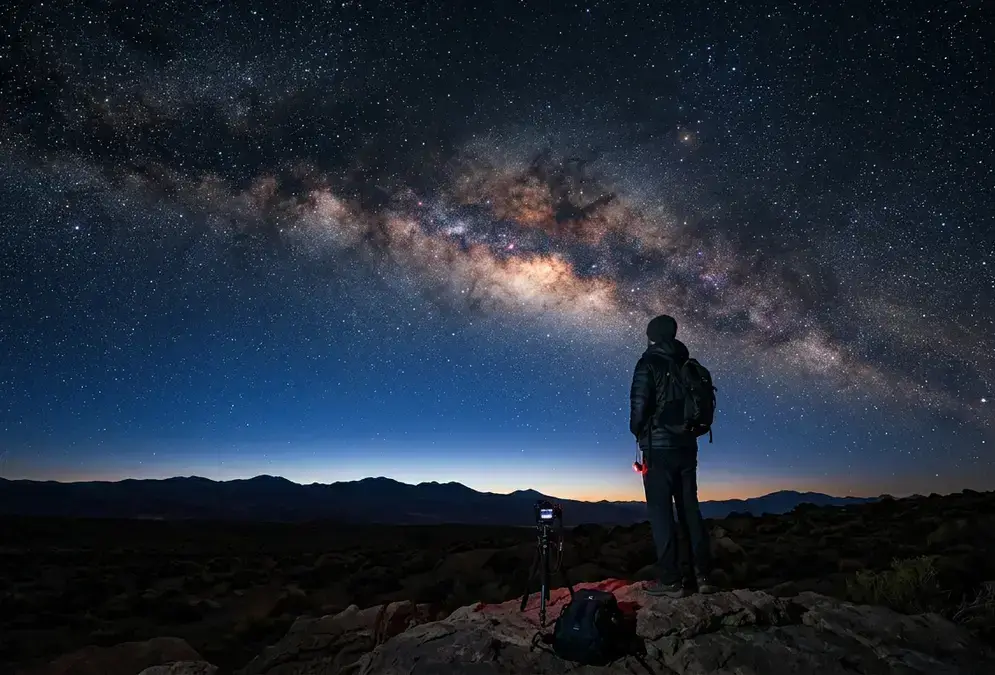
New moon is the baseline every stargazer plans around first, and the reason is mechanical, not superstition. On a new moon, the Moon sits directly between Earth and the Sun, showing its unlit far side toward us and reflecting essentially no light back. That means the sky stays moonless from dusk straight through to dawn[1]. With no moonlight competing against starlight, faint deep-sky targets and the dust lanes running through the Milky Way's core show up clearly instead of washing out under even a slim crescent.
You don't need to land on the exact date of new moon to get a good night out of it, though. Roughly four to five nights centered on new moon are commonly cited as giving reliably dark, moonless skies from dusk to dawn[2]. Treat that range as a planning heuristic rather than a fixed law: the real number shifts slightly with your latitude and the season, and, as the next section covers, a well-timed crescent moon can stretch a usable dark-sky window well past five nights on either side.
4-5 nights
If dark adaptation and finding an actually dark sky still feel like open questions, stargazing for beginners is worth reading before any of this. It covers the basics that matter more than moon phase on your very first night out, including how to read a light-pollution map. For a deeper read on why those maps show the patterns they do—the orange domes over cities, the dark pockets in rural areas—what light pollution is breaks down the four types and how each one affects what you see overhead.
Moonrise and moonset: why a crescent isn't automatically a wash
Moon phase alone doesn't decide whether a night is dark. What actually matters is when the Moon is above the horizon relative to when you're outside. A crescent, a half moon, even a three-quarter moon can still leave you with a genuinely dark sky if moonrise or moonset falls within roughly 45 to 60 minutes of your session[3]. Once the Moon drops below the horizon, its brightness stops mattering, no matter how bright it looked an hour earlier.
That reshuffles the usual advice for one specific case. A full moon does wash out faint deep-sky targets and the Milky Way's dust lanes, without exception. It's still a legitimately good night for the Moon itself, bright planets, and prominent double stars, none of which need a dark background to look good[4]. Whether a full-moon night counts as 'wasted' comes down entirely to what's actually on your list that night.
| Moon phase | Sky impact | Best target that night |
|---|---|---|
| New moon | Moonless all night | Faint deep-sky objects, the Milky Way's core |
| Crescent (moonrise/set near twilight) | Dark for most of the session | Milky Way, if timed against moonrise/moonset |
| Quarter / half moon | Sky bright for part of the night | Bright targets early, darker sky once it sets |
| Full moon | Sky bright most or all of the night | The Moon itself, planets, bright double stars |
Before writing off an entire week because it falls near full moon, pull up a moonrise and moonset table for your real date and location, not a rough mental estimate. A late-rising last-quarter moon, for example, can still leave three or four fully dark hours right after sunset before it clears the horizon.
Galactic-core season: Northern vs Southern Hemisphere
The galactic core is the dense, bright hub of the Milky Way toward the constellation Sagittarius, the wide, textured band that shows up in nearly every dramatic Milky Way photograph. Whether it clears your horizon at all depends entirely on the time of year, and that calendar splits sharply by hemisphere.
From the Northern Hemisphere, the core is generally visible from February through October, with the strongest stretch running May through August and peak visibility in June and July[5]. Early in the season it rises low toward the southeast; by midsummer it sits due south around local midnight; by early autumn it's setting toward the southwest before disappearing behind the Sun for the winter months.
- February
Core rises low in the southeast
The start of the visible season in the Northern Hemisphere.
- June-July
Peak season, core due south
Highest visibility and contrast of the year.
- October
Core sets in the southwest
Last visible stretch before it disappears behind the Sun for winter.
From the Southern Hemisphere, the season runs considerably longer, roughly January through November, and the core climbs much higher overhead than it ever manages from northern latitudes[6]. That higher angle isn't just a nicer view: less atmosphere between you and the core means less haze and distortion softening the image, naked-eye or through a lens.
At peak season the core stays above the horizon for most of the night[7], so almost any dark, moonless hours will do. Once the timing is sorted, how to photograph the Milky Way covers the camera or smart-telescope settings for actually capturing what's now overhead.
Transparency and atmospheric seeing are not the same thing
Transparency and atmospheric seeing get used interchangeably by beginners, and they describe two genuinely separate problems. Transparency is how much starlight actually reaches your eyes or your camera's sensor without being scattered or absorbed along the way, driven mainly by cloud cover, humidity-linked haze, dust, and smoke[8]. Seeing is atmospheric turbulence: shifting pockets of warm and cool air blurring fine detail overhead, independent of whether the sky above you is cloud-free or not.
A simple way to hold the two apart: transparency is how clear the water in a pool looks, seeing is how still its surface is[9]. A perfectly clear night can still have miserable seeing if the air above you is churning, and a slightly hazy night can have rock-steady seeing. For naked-eye and wide-field targets like the Milky Way, transparency is the variable that matters. For sharp telescopic detail on a planet or a tight double star, seeing takes over.
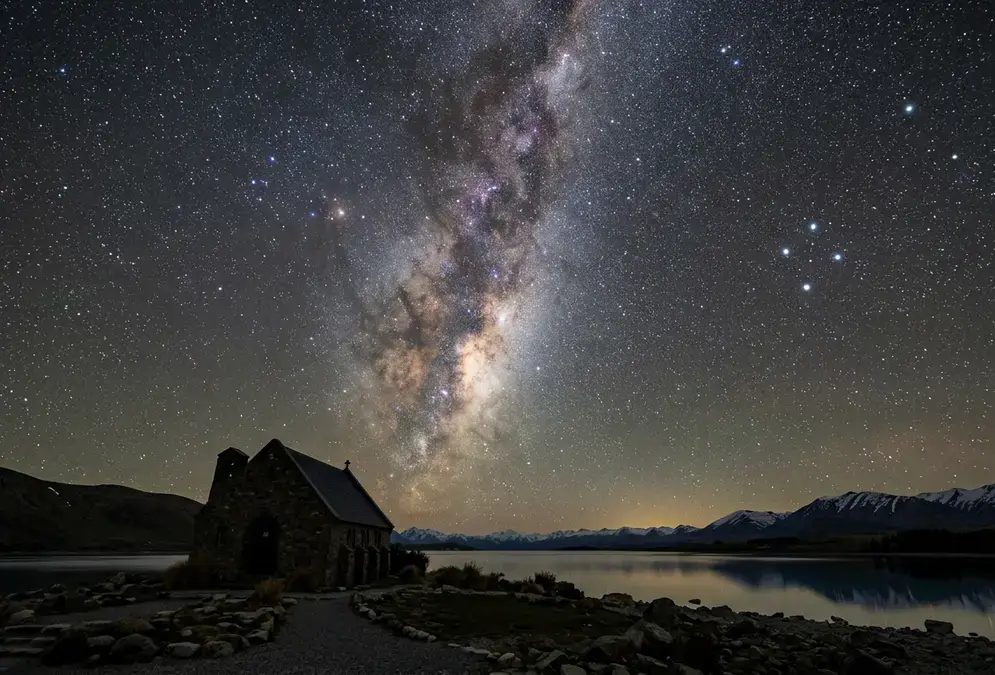
Featured · Destination
Aoraki Mackenzie Stargazing
Aoraki Mackenzie is one of only four Gold Tier Dark Sky Reserves on Earth: Bortle 2 skies over Lake Tekapo, the Southern Cross, and Mount John Observatory tour.
Seeing is hard to judge from the ground before you go out, but there's a decent proxy: fast winds at high altitude, commonly measured around the 200 hPa level, roughly 12 kilometers up, correlate with poor seeing at the surface, while calmer upper-level winds tend to mean steadier images[10]. A forecast that shows jet-stream speed is a small, underused check most beginners skip entirely.
Reading a cloud forecast: Clear Outside and Clear Sky Chart
None of the moon-phase or galactic-core math matters if a bank of cloud rolls in at ten o'clock. Generic weather apps built for umbrellas and commutes aren't built for this: they don't break cloud cover down by altitude, and they never mention moonrise, twilight, or seeing at all.
Clear Outside, a free tool built specifically for astronomy, gives a 7-day hourly breakdown of low, medium, high, and total cloud cover for your exact coordinates, alongside moonrise and moonset, sunrise and sunset, and the times civil, nautical, and astronomical twilight begin and end that night[11]. It also flags upcoming ISS passes, which costs nothing to glance at while you're already checking the sky.
Clear Sky Chart does a similar job with a longer track record among amateur astronomers, forecasting cloud cover, transparency, and seeing specifically for known observing sites rather than the nearest city center[12]. The two tools overlap enough that checking either one beats checking neither, and checking both catches the nights where they disagree.
Run the check twice: once a day or two out to plan around, and again the same afternoon before you commit to driving anywhere. A forecast that looked clear on Tuesday can flip completely by Thursday night, and both of these sites update far more often than the weather icon on your phone's home screen.
If your home sky rarely cooperates at all, best dark sky parks in the world lists certified sites worldwide where a clear, dark night is closer to the default than the exception.
Timing the night: twilight, true darkness, and putting it together
Astronomical twilight is the last stretch of dusk and the first stretch of dawn, defined as the period when the Sun sits between 12 and 18 degrees below the horizon[13]. Only once the Sun passes that 18-degree mark does the sky reach true darkness, the point where faint stars and the Milky Way stop competing against residual sunlight.
How long that takes after sunset depends heavily on where you are, not just what time it is. Near the equator, astronomical twilight lasts around 70 minutes; at roughly 40 degrees latitude, it stretches closer to 90 minutes at the equinoxes, and considerably longer near midsummer at high latitudes[14]. A rough rule of thumb, wait 90 minutes after sunset, is a reasonable default at mid-latitudes and wrong almost everywhere else. Check it for your own coordinates rather than trusting a number that worked somewhere else.
Put the four pieces together and a good night stops being luck:
Recommended tours
Tours are selected for quality, not commission. I earn a small fee if you book — at no extra cost to you.


- A moon that's new or below the horizon during your session
- The galactic core above the horizon, if that's what you're chasing
- A same-day forecast checked for your exact coordinates, not last night's guess
- Enough time past sunset for true darkness to actually arrive
For a worked version of that math applied to one specific place, best time to visit Atacama for stargazing walks through how season and moon phase interact month by month in one of the driest, darkest skies on Earth.
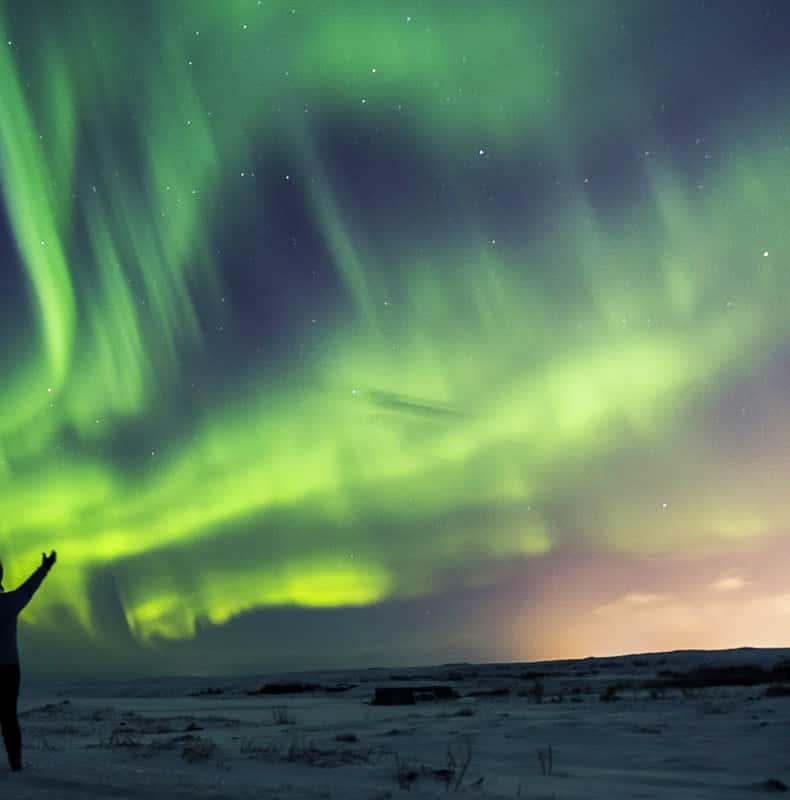
The same four-variable checklist carries over to specific night-sky events: how to see the northern lights applies it to aurora forecasting, and the meteor showers guide applies it to the year's peak dates.