
What people report hearing, and why scientists doubted it
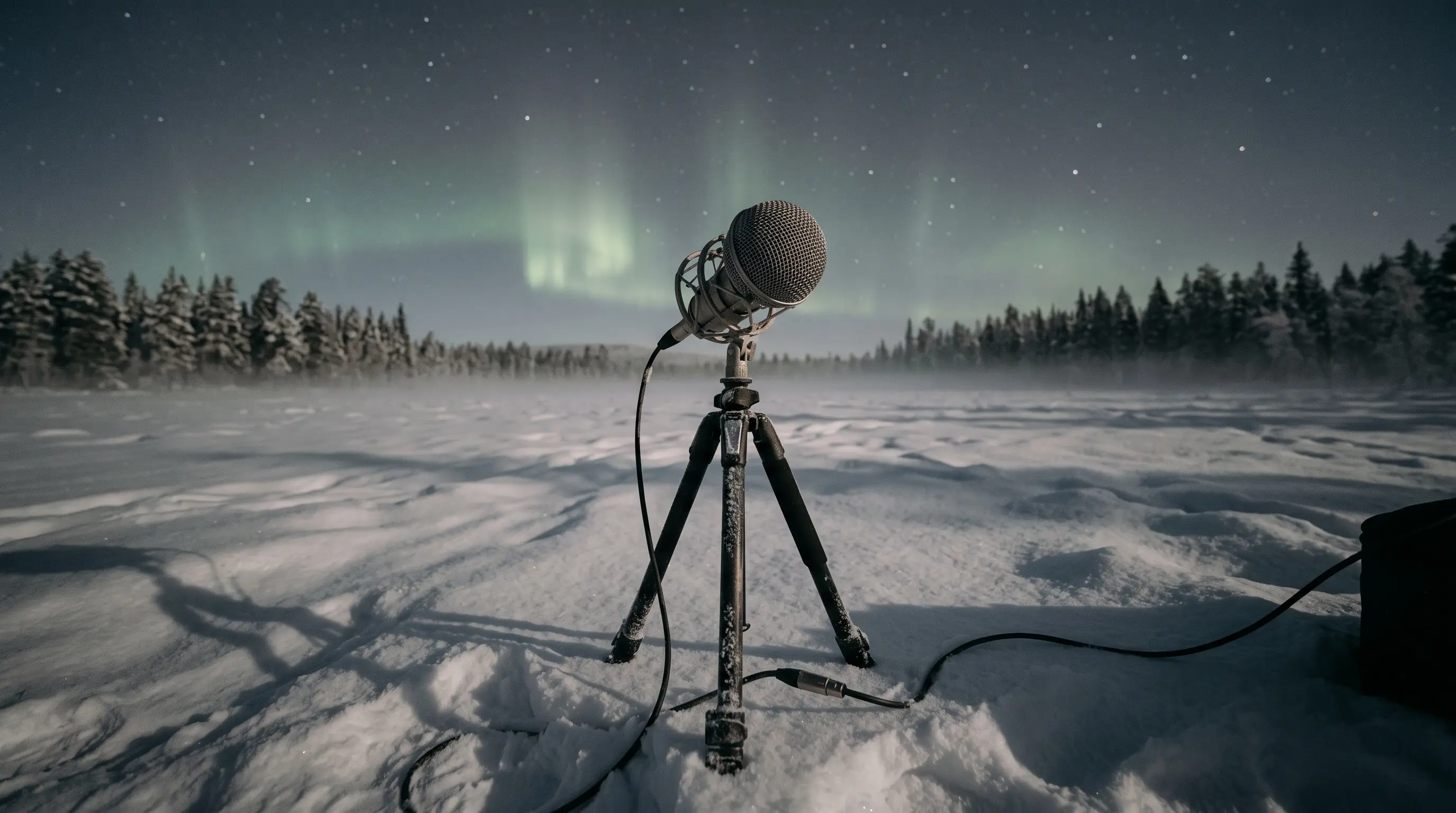
People have described aurora sounds for a very long time: a clap, a snap, a crackle out of an otherwise quiet sky[4]. Sámi, Inuit, Tlingit and Aboriginal Australian accounts all mention faint rustling or snapping during strong storms[5]. Those accounts come without dated, named examples, so they cannot be checked.
One named, dated account in Laine's paper is William C. Baker's. The Queen's University, Kingston, professor described a mid-winter night in 1884 or 1885[32] and likened the sound to "the crumpling of stiff paper"[33]. It reaches us through Laine's 2022 conference paper.
The record has always had a skeptical wing. The naturalist Alexander von Humboldt, weighing reports of silence from polar explorers, called auroral noise extremely doubtful in Cosmos[6]. Unto K. Laine, the Aalto University acoustician behind the modern recordings, notes in his own conclusions that most geophysicists consider the sounds an illusion[7].
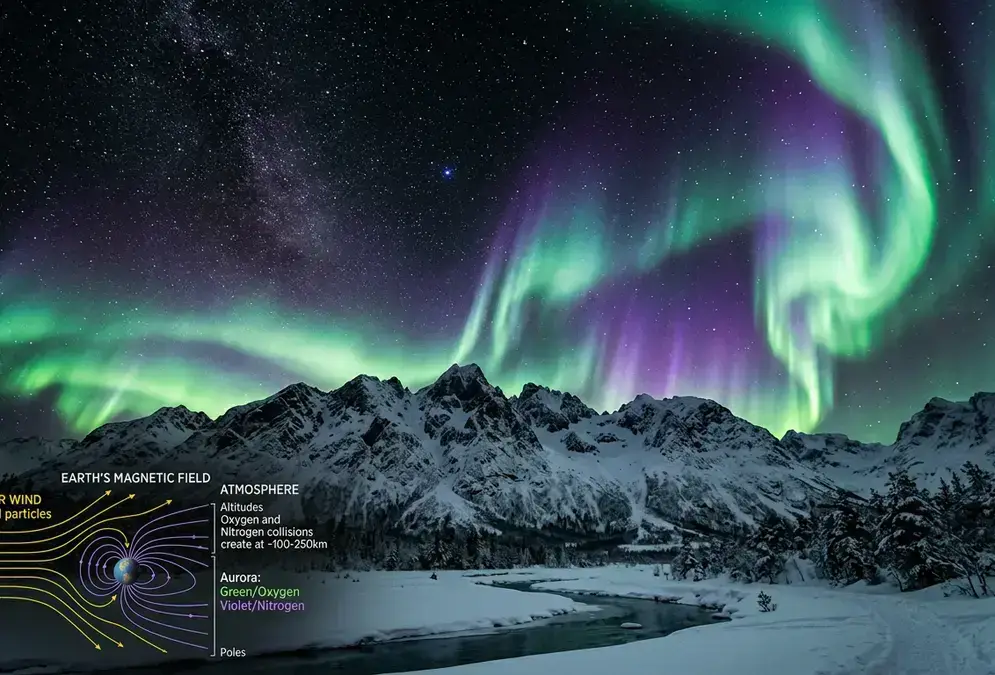
Physics gives the doubters a fair point. The glow forms so high that the air there is too thin to carry audible sound[8]. Whatever makes the noise, it is not the glowing curtain, which is one more product of the solar-wind chain behind what causes the northern lights.
Even when the effect is real, it is not dependable. Sounds do not turn up during every outburst, and they are usually brief and faint, demanding careful listening and little background noise[9]. The old advice about whistling or yelling at the lights is a separate matter: that is folklore, told in Sámi aurora legends, and no recording described here involves it.
The recordings that put the source 70 metres up
Serious acoustic fieldwork began with the Aurora Acoustics Project, a partnership formed around 1999–2000 between the Sodankylä Geophysical Observatory and the Helsinki University of Technology[10]. Aalto University's Laine then led the work behind the figure everyone quotes: in 2011, a sound source tied to the aurora was localised in the sky for the first time, about 70 m from the ground[11].
The method was triangulation. Laine's group compared the same clap as captured by three microphones at a site with high auroral activity[12]. The results were presented as a conference paper at the International Congress on Sound and Vibration in Vilnius in July 2012, not as a journal article[13].
The 2011 sample was small. Twenty-one short events stood out from the background noise, the best ten were analysed, and three reached all three microphones[38][39]. Three independent distance methods averaged 70 m and the altitude came out at 60 to 70 m[40][41], with no error bars quoted for either figure. The distance step also assumes that each magnetic event belongs to a particular sound event[42].
A second dataset came from Fiskars, in southern Finland, on 17 and 18 March 2013 at -20 °C. Laine logged hundreds of sound events and picked the 60 loudest, those whose sources sat directly above his microphone array[14]. Magnetic pulses that preceded the sounds put their sources near 75 m[15], and the Finnish Meteorological Institute's own measurements that night placed the inversion layer at the same height[16].
Set side by side, the two results are different kinds of evidence:
- 2011, triangulation: three microphones, three of ten analysed events heard on all three, source about 70 m up, reported in a conference paper[11][39]
- 2013, Fiskars, 17 and 18 March at -20 °C: the 60 loudest of hundreds of events, source about 75 m up from the preceding magnetic pulses, matching the inversion layer height measured that night[15][16]
How an inversion layer could make crackles
Laine's account starts with a lid. A temperature inversion layer hinders the vertical movement of electric charge, so charge accumulates at it[18]. When a geomagnetic storm arrives, the stored charge discharges, and the discharge is the pop or crackle[19].
The proposed discharge is a corona discharge, the process behind the buzz or hiss you can hear from high-voltage power lines[20]. That idea was published in 2016, five years after the first localisation[21].
Featured · Destination
Abisko Stargazing
Abisko's rain-shadow microclimate keeps skies clear when nearby Arctic spots cloud over. Aurora season, the Sky Station, ICEHOTEL, and getting there by train.
It also dissolves a puzzle. The lights sit 80 to 100 km away, so how can anyone hear them? Because the sound is not coming from there[22]. Put the two heights side by side and the source is well over a thousand times lower than the light.
The hypothesis makes testable predictions. Even a small wind can stop an inversion layer forming, which would mean no sound on a breezy night[23]. The only check is indirect: on the 2022 recording night a weather station about 90 km away logged 2 to 3 m/s of wind while sounds were still being recorded[45], so the prediction is untested rather than refuted. Frost cracking is not the explanation either: Laine has recorded the sounds at 8 °C, with no frost present[24]. He stresses that the idea does not rule out other mechanisms[25].
Event counts follow geomagnetic activity with a delay. In Laine's January 2022 recording, a multi-variable regression model, with event counts shifted 21 minutes and a 32-minute window, reached r = 0.95[43]. A separate, simpler correlation between geomagnetic activity and event counts gave r = 0.44, with a large p-value (0.38) that makes it statistically insignificant[44]. Both analyses link magnetic activity to how many sounds occurred, not to how loud any one was.
What it sounds like, how loud, and when you would hear it
The recordings capture a modest range of noises[26]:
- small crashes or claps
- whispers or hisses
- crackles and pops
- a rarer type Laine likens to an empty oil barrel being struck with something hard[27]
Measured from the ground, the sound pressure level can reach about 60 dB, roughly an air conditioner's hum[2]. That is quiet enough that a coat zip or an idling engine will bury it.
Featured · Article
What Causes the Northern Lights? The Science Explained
Solar wind collides with Earth's magnetic field, funneling charged particles toward the poles, where they excite oxygen and nitrogen into glowing color.
Laine's best-case conditions are dry air with low temperatures, or a very still, clear night[28]. Those are wind questions as much as aurora questions. The Kp index tells you how disturbed the geomagnetic field is, but it says nothing about whether the air at your spot is calm, and calm is what the theory needs.
How often you would hear one is the loosest number here. In a four-hour recording on 25 and 26 January 2022, Laine manually selected 60 candidate events[34] and concluded such sounds are much more common than previously thought[35]. He also notes that aurora was probably not visible in southernmost Finland that night[36], and it is one author, one night, one site. A ten-hour frost-night recording at Fiskars captured roughly 300 events[37].
How settled is it, and what to do with that before a trip
Later work added a twist: the crackle sequences share rhythmical patterns tied to the Schumann resonances, the electromagnetic resonances of the atmosphere[29]. That points toward an electrical origin but does not prove the inversion-layer mechanism. Laine presented it at ICSV26 in Montreal in 2019[47], using 25 events from September 2001 and March 2012 recorded at different southern Finnish locations with different equipment[46].
Outside Finland the reception is cooler. A NASA Goddard space physicist said she knew of the work but found it hard to judge, because it had not been published in an interdisciplinary way[30].
Another researcher offered a mundane alternative: her own recordings of humming seemed to come from a long livestock fence, which suggests that fences and wires near a viewing spot can muddy any listening report[31].
Recommended tours
Tours are selected for quality, not commission. I earn a small fee if you book — at no extra cost to you.


The 70 m localisation has not been independently reproduced in the sources reviewed. An independent researcher's 2021 arXiv paper on meteor sounds treats the Schumann link as Laine's claim and says that, if confirmed, it hints that global processes are involved[48].
My position comes from the data, not from a night under the lights. I have never seen an aurora, so I have no listening report to add, only a read of the evidence. In the eight-night Tromsø plan I keep costing out, the budget goes to cloud margin and forecasts. Sound gets no line. If a crackle comes, it is a bonus.