Inuit and Greenlandic accounts: the dead at play
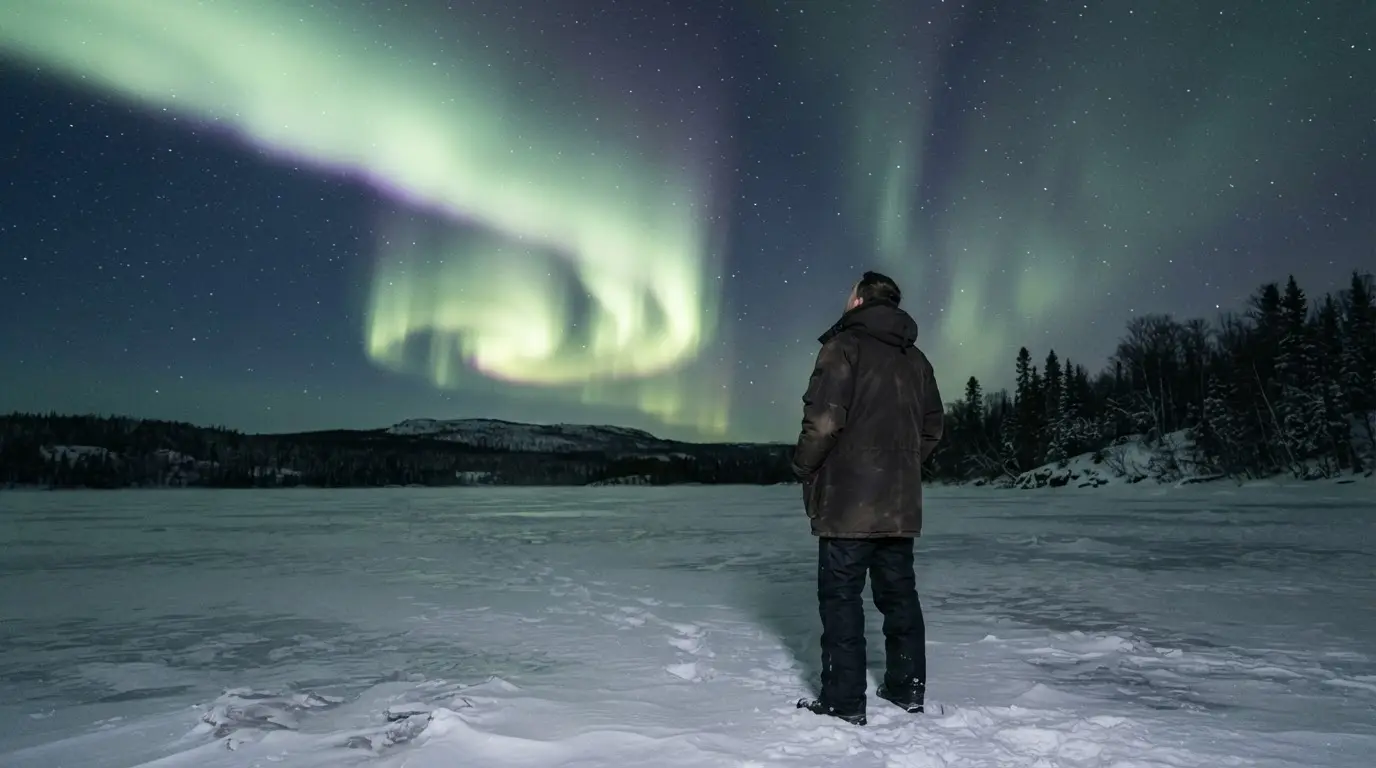
The best-documented Arctic account was written down by Knud Rasmussen on the Fifth Thule Expedition and published in 1929. Among the Iglulik Inuit of the Canadian Arctic, he recorded, the dead spend their afterlife in the sky at their favorite game, a ball match played with a walrus skull, and the aurora is that match as the living see it.[5]
Rasmussen's informants also gave a piece of field advice that most travel writing leaves out. Whistle back at the lights when you are out alone at night, and curiosity will draw them closer.[6] Whether the lights make any sound at all is a different question, and do the northern lights make a sound takes it on directly.
In Greenland the same image sits inside the name, aksarnirq, which means ball player.[1]
Not every Inuit account is playful. One version, set down without a named collector or date, has the spirits struggling over a walrus head, with the lights' streaming in opposite directions as the visible proof,[8] and it reserves the highest heaven, the one in the aurora, for people who die in the hunt, are murdered, die by suicide, or are women who die in childbirth.[7] Inuit of the Hudson Strait, in far northern Quebec, saw the lights as torches carried by spirits who were guiding the newly dead to paradise.[9] That account also names no collector or date; the nearest trail is a 1970 popular book, Aurora, Man, Myth and Magic, as Holzworth relays it.[30]
These are accounts from particular communities, written down or relayed at different dates, so none of them speaks for every Inuit community.
Armies in the sky and the fox that lit the fells
Armies and battles recur in the few northern European accounts that Holzworth's folklore survey turned up.[31] The volume Mythology of All Races devoted to Finno-Ugric and Siberian peoples, Uno Holmberg's, published in 1927,[32] records the Sámi of Finland (its term, Finnish Lapps, is now considered offensive) as taking the lights for dead soldiers, still fighting one another in the air as spirits.[10]
On the Estonian island of Osel, in the same volume, the heavens were said to open on holy nights, and anyone looking up might see two armed men straining to fight until God held them apart.[11] Both entries sit on page 81 of the 1964 reprint.[33] What strikes me about both is how little they have to do with fire. The lights are people, restrained or unrestrained, and the sky is a place where the dead go on with what they were doing.
Featured · Destination
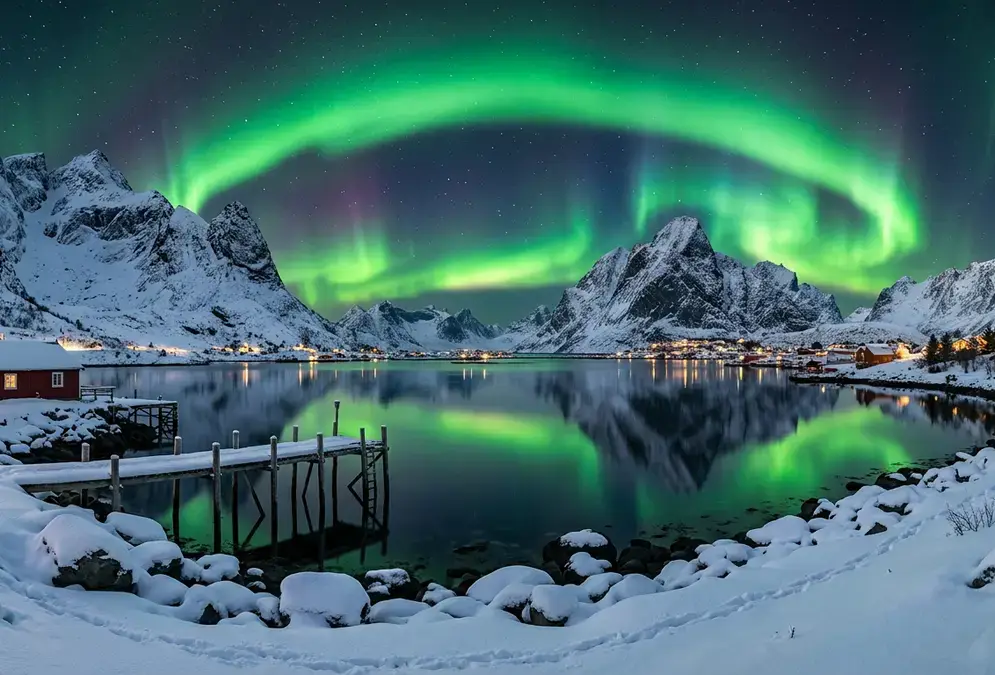
Northern Lights in Tromsø
At 69.6°N inside the auroral oval, Tromsø sees aurora at Kp 2. Peak season November–February. Best viewing spots, tour advice, and aurora forecast strategy.
Finland's own word, revontulet, grew out of folk stories about the tulikettu, the fire-fox.[12] That makes it a Finnish tradition rather than a Sámi one, and the two get confused constantly. The North Sámi word is guovssahasat, which Pekka Sammallahti, a professor of Sámi at the University of Oulu, notes also means the Siberian jay.[13]
The Sámi legends themselves belong to Sámi voices, and Sámi legends of the northern lights sorts the Finnish fire-fox from the Sámi tradition, while the Tromsø Sámi aurora legend follows the story on the Norwegian coast.
Fire and ghosts: Ottawa, Fox, Aboriginal and Māori traditions
Across the Atlantic, the lights turn into signs rather than scenes. In an Ottawa tradition from Manitoulin Island, written down by J. C. Hamilton in 1903, the culture hero Nanahboozho promises that he will now and then light great fires in the north, visible from afar, as a token of his regard for people.[14] William Jones, recording Fox traditions in 1911 and 1912, heard the opposite: ghosts of slain enemies struggling to rise, and an ill omen of war and pestilence.[15] One continent, a gift in one telling and a threat in the next.
Move to the southern hemisphere and the palette changes, and the story follows it. The astronomer Duane Hamacher's 2013 survey drew on 26 literary sources covering 13 identified Aboriginal groups plus five unidentified, and it ties the red lights seen from Australia to fire.[34][2][16] None of its accounts comes from north of the Tropic of Capricorn.[35]
The Gunai of Gippsland, in eastern Victoria, saw aurorae as bushfires in the spirit world, in an account Hamacher cites to Massola (1965).[36] Another Gunai story gives the fire a culprit: the sky ancestor Mungan Ngour, furious that initiation secrets had leaked, threw a great fire down to destroy the Earth, and the people saw it as an aurora.[17] For the Dieri, an aurora warned of punishment for breaking the law, which made fear of the lights a tool for keeping people in line.[18] When Dieri people at Cooper's Creek, South Australia, watched a display in 1869, they called it a Kootchee, an evil spirit, making a large fire, as Smyth recorded in 1878.[37]
The Māori of Aotearoa New Zealand had a gentler name, Tahunui-a-rangi, and pictured the lights as the campfires of ancestors reflected in the sky.[19] Hamacher's account of it, cited to Elsdon Best (1955), comes from a Whanganui man who was interviewed in 1869.[38] The same South Island sky carries other Māori stories too, among them the Aoraki creation legend.
What the Norse and Chinese sources actually say
Three claims turn up in almost every roundup of aurora myths, and each loses its footing when you go to the text:
- Valkyries and their flashing armor come from Bulfinch's Mythology; nothing in Old Norse literature supports the link.[3]
- Bifröst as the aurora is contradicted by Snorri's Prose Edda, where the gods' bridge is the rainbow and the narrator tells his listener he has seen it.[4]
- Revontuli as an ancient name is doubtful: the Finnish Meteorological Institute's fire-fox page says the name apparently spread in the Christian era, on an explanation borrowed from the Bible.[20]
What the Norse world does give us is a thirteenth-century shrug. The word norðrljós first appears in the Norwegian King's Mirror, written around 1250, after the Viking Age had ended.[21] Its author, writing about the lights the Greenlanders see, admits he has no clear knowledge of what they are.[22] I trust that admission more than any borrowed legend.
Featured · Article
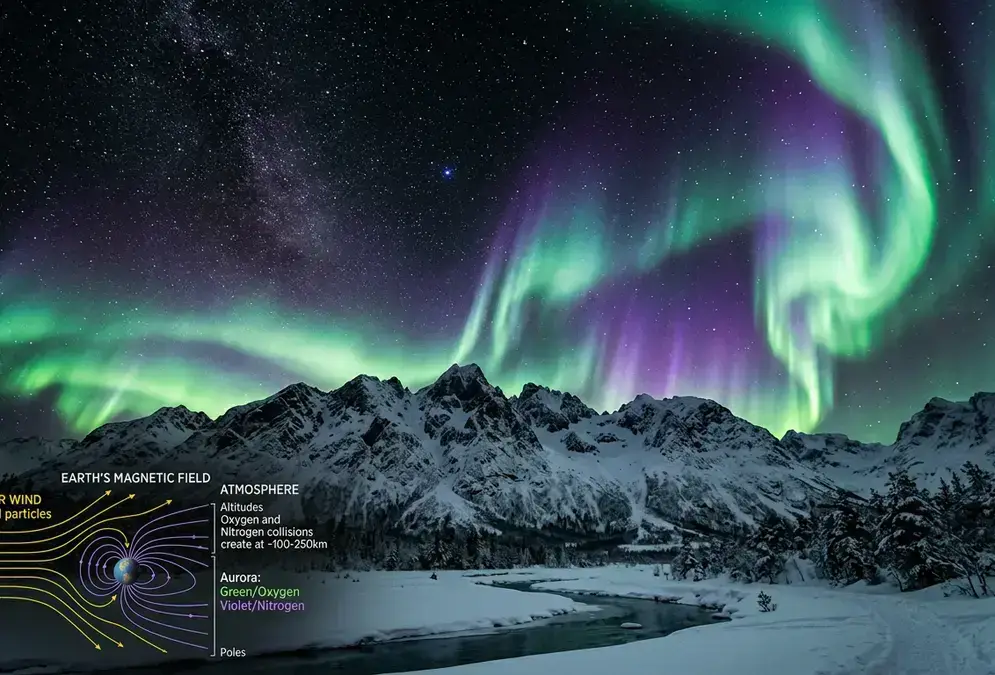
What Causes the Northern Lights? The Science Explained
Solar wind collides with Earth's magnetic field, funneling charged particles toward the poles, where they excite oxygen and nitrogen into glowing color.
Recommended tours
Tours are selected for quality, not commission. I earn a small fee if you book — at no extra cost to you.
China's contribution is a record, not a myth. The Bamboo Annals mention a five-coloured light in the northern sky that a 2022 study by Marinus van der Sluijs and Hisashi Hayakawa, published in Advances in Space Research, identifies as the oldest known reference to a candidate aurora.[23][39][40] The next oldest candidates, inscribed by Assyrian astronomers on cuneiform tablets in 679-655 BCE, are some three centuries younger.[41] The likeliest years, once the dating is run through up-to-date reconstructions of Chinese chronology, are 977 or 957 BCE.[24] "Candidate" is the researchers' word, and it is a fair one.
So the honest ledger is a Norse admission of ignorance and a tenth-century BCE sighting from China. Armored maidens and rainbow bridges are decoration added later.
What the lights are, and why the stories split
The explanation that survives all these stories is not mysterious. The Sun continuously blows charged particles into the solar system, the solar wind, and when that flow meets Earth's magnetic shield the released energy rains down on the atmosphere.[25] Energetic electrons follow the magnetic field to the poles and excite oxygen and nitrogen, much as in a neon light, producing a glow that forms 80 to 500 km above the surface.[26][27]
Colour comes down to which gas is struck and how high. The most common colour is green, produced when oxygen is excited by electrons around 100 km up,[28] yet the Australian fire accounts start from red, the colour aurorae tend to show from there.[2]
Set side by side, the Inuit traditions are more festive, while the Aboriginal ones tie the lights to fire, death, blood and omens.[29] Between about 60 and 75 degrees latitude the aurora can be seen on more than half the nights of a year,[42] while over Australia it is rare and typically restricted to far southern regions such as Tasmania and Victoria.[43] My own reading, and it is only that, not a scholar's finding, is that frequency matters as much as culture: a sky that performs most winter nights invites a ball game, and one that flares once in a generation invites a warning.
| Tradition | What the lights are | Recorded by |
|---|---|---|
| Iglulik Inuit, Canadian Arctic | The dead playing ball with a walrus skull | Knud Rasmussen, published 1929 |
| Sámi of Finland | Dead warriors still fighting in the air | Uno Holmberg, Mythology of All Races vol. 4, 1927 |
| Ottawa, Manitoulin Island | Great fires raised by Nanahboozho as a sign of regard | J. C. Hamilton, 1903 |
| Fox | Ghosts of slain enemies, an ill omen | William Jones, 1911-12 |
| Aboriginal Australian | Fires in the cosmos; punishment for breaking the law | Smyth 1878 (Dieri), Massola 1965 (Gunai), via Hamacher 2013 |
| Māori | Campfires of ancestors (Tahunui-a-rangi) | Elsdon Best, 1955, via Hamacher 2013 |
Northern Norway has a strong claim to where the physics was first worked out, which is why Tromsø is billed as the birthplace of aurora science. I have never seen an aurora in person, so I read these accounts against the physics rather than against memory. The physics explains the light; it will never explain why Rasmussen's informants whistled back at it.