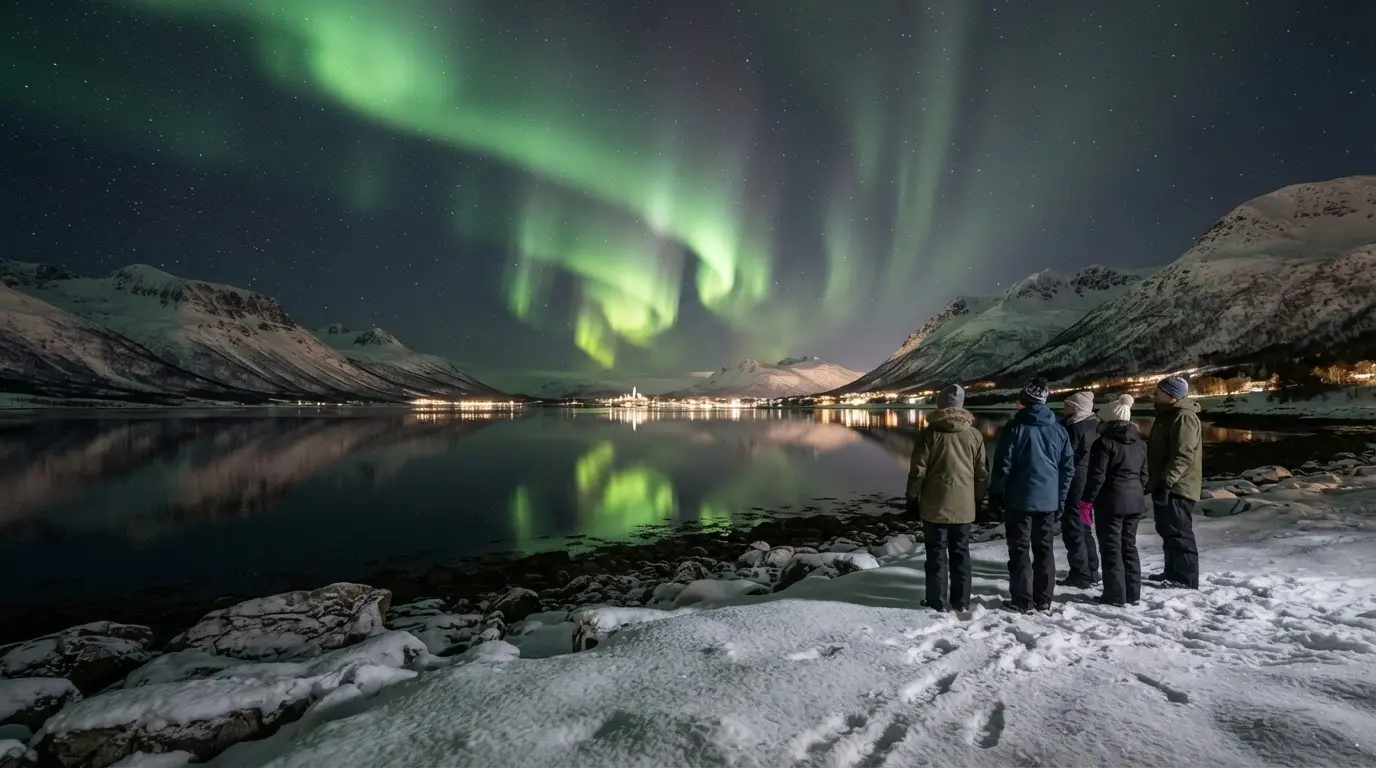

What the sources say: pointing, noise and whistling
Start with what is actually written down. Björkliden, a mountain resort in Swedish Sápmi, describes a guovssahas tradition in which challenging the light by making noise, whistling or pointing could cost you your life, because the light might come down and take you away[1]. That is a resort's folklore page, not an ethnographic record, so I treat it as a pointer rather than proof.
Nothing I found says waving. The word that recurs is pointing, then whistling, then noise in general. "Don't wave" is how the warning tends to reach visitors, a fair shorthand for throwing an arm at the sky, but I cannot show you a Sami source that states it as a rule.
The same page glosses guovssahas as "the light that can be heard" and calls it a powerful, living being bound up with the souls of ancestors[2]. That changes how the etiquette reads: less superstition, more manners toward relatives. The fire-fox legend and the wider whistling and joik taboo are covered in Sami legends of the northern lights, so I will not retell them here.
A Sami healer's account: silence, rebellion and a rowing boat
The most vivid testimony I could find comes from Åsa, a Sami healer interviewed by Imelda Almqvist on Substack. She is one voice, and I will not stretch her account past that. As a child, she says, she and the other children would hide from the lights and sit completely silent under a turned-up rowing boat[3].
Silence was the point. Whistling is the sound she is bluntest about[4], and in what I read she describes no gesture-by-gesture rulebook, only quiet.
“Whistling at the Northern Lights was completely inappropriate and even dangerous. Your presence was immediately detected and you could be abducted.[4]”
She is also frank that it did not hold. As teenagers, she says, they rebelled, yelling greetings at the lights and staring openly at them[5]. That is evidence in its own right: even inside the community that told the story, young people tested the taboo, which is why I would never write that all Sami avoid this.
Her reading of the tale is practical. Sami parents prefer to keep their children within sight and supervision[6]. In the dark and cold, a child absorbed by a sky full of colour is a child not watching where they step, and that safety logic holds whether or not you share the belief. If you are bringing kids, carry that part over first.
Living and dead as one family: why the caution, and why it varies
In the Sami worldview as reference works describe it, the living and the departed were regarded as two halves of the same family[7]. Read that way, lights tied to ancestors call for the courtesy you would show relatives you cannot see, and wariness about noise follows from it.
The belief was never uniform. Traditional Sami religion varied considerably from region to region within Sápmi[8], the strongest reason not to carry any single testimony to Tromsø as if it were settled local custom. For another place where Sami language shapes how visitors read the landscape, see the Sami meaning behind Abisko's name.
Featured · Article
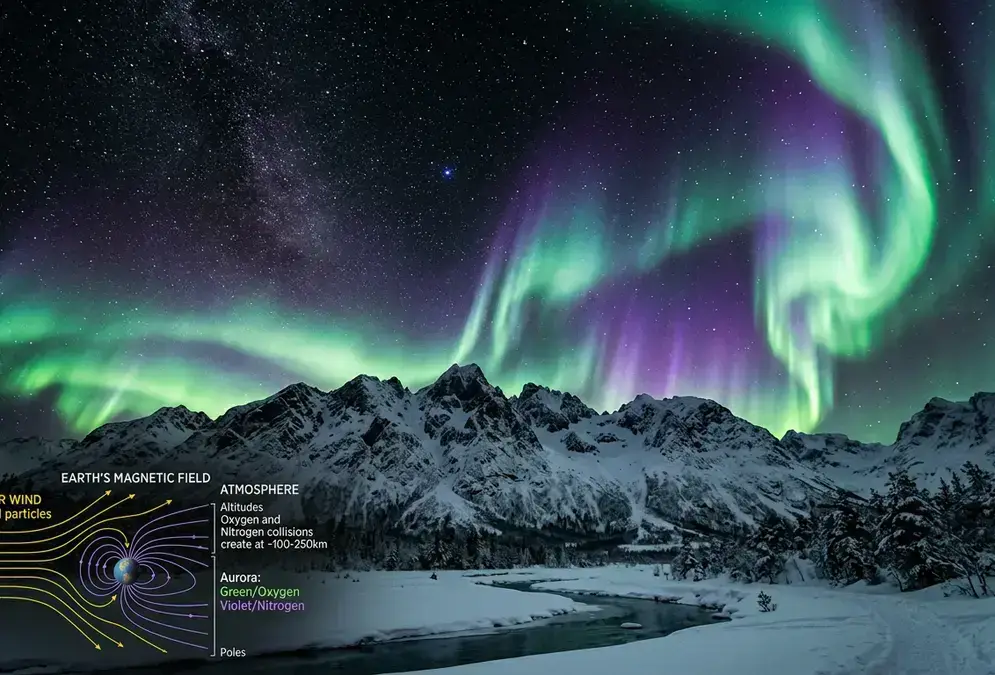
What Causes the Northern Lights? The Science Explained
Solar wind collides with Earth's magnetic field, funneling charged particles toward the poles, where they excite oxygen and nitrogen into glowing color.
Even the myths differ. One strand, reported in general reference works, has the lights as the blood of the dead who bled to death cutting themselves[9], a very different image from souls watching over the living. Two stories under one sky; hold both loosely.
What is actually overhead: the solar wind version
None of this competes with the physics, and the physics changes what you look for. The aurora is the light show after a geomagnetic storm in space[10], and the raw material is the Sun itself, which continuously sends out charged particles known as the solar wind[11].
Earth's magnetic field does not let that wind in. It flows around the barrier and stretches the field into a shape NOAA's scientists liken to a giant raindrop, round side toward the Sun and a long tail pointing away[12].
Featured · Destination
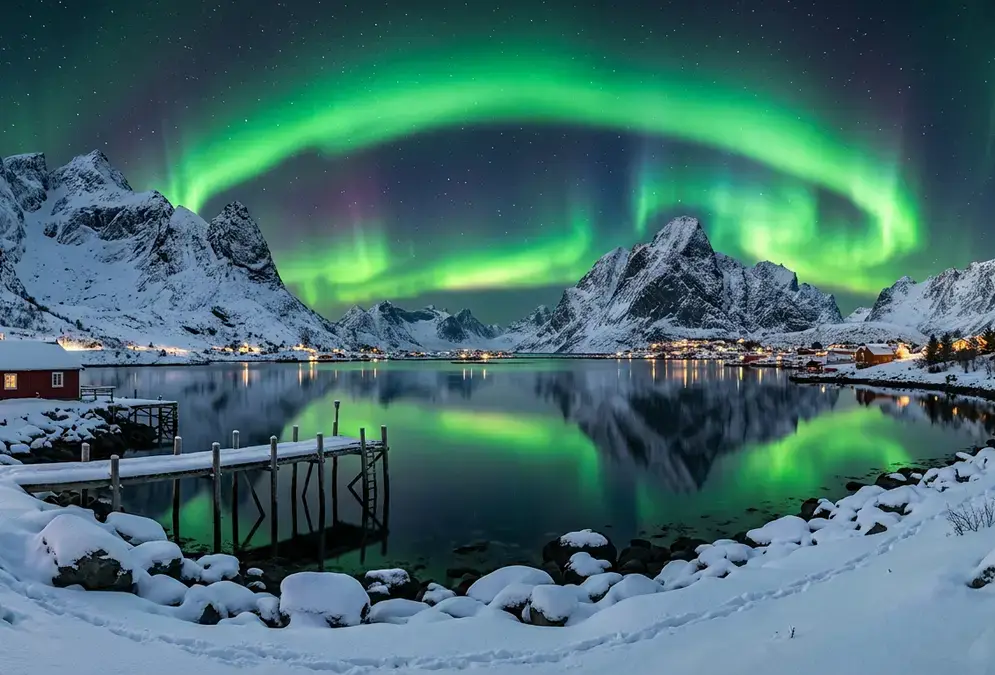
Northern Lights in Tromsø
At 69.6°N inside the auroral oval, Tromsø sees aurora at Kp 2. Peak season November–February. Best viewing spots, tour advice, and aurora forecast strategy.
Some of the particles are accelerated along field lines to the polar regions. There they collide with oxygen and nitrogen atoms in the upper atmosphere and make them glow[13].
The colour you will photograph most is green, produced when electrons excite oxygen at around 100 km up[14]. The glow sits in a ring roughly 10° to 20° from the magnetic poles[15], which is why the same high latitudes keep turning up on aurora itineraries. Activity swells and ebbs on a roughly 11-year cycle, with more auroras near solar maximum[16].
Tromsø's own part in this science is a story of its own: see how Tromsø became a birthplace of auroral science. The point here is narrower. A whistle cannot nudge a solar wind, but the belief was never a claim about particle physics. It is a claim about how to behave near something your ancestors may be part of, and the two do not compete.
Behaving well on a Tromsø aurora outing
I haven't stood under a Tromsø aurora yet, so this is the sourced version, not a field report. The Tromsø University Museum is the sensible daytime anchor: one permanent exhibition explains the northern lights and the many myths around them[17]. The museum's exhibition manager, quoted in Scan Magazine, credits Kristian Birkeland, the Norwegian professor who demonstrated his auroral theory with plasma chambers just over a century ago[18].
On timing, the museum's exhibition manager calls January one of the best months, with Tromsø city spectacular on clear nights[19]. That is a museum's view, not a forecast. For odds and how many nights to book, use the Tromsø northern lights FAQ.
The etiquette that follows from everything above is modest, and I would apply it whether or not you share the belief:
- Keep your voice low once the lights start, and leave the whistling and shouting out of it.
- If you need to show someone where to look, describe it ("over the ridge, left of the bright star") instead of stabbing a finger at the sky.
- Keep children within sight, close, on dark and icy ground.
- Ask your guide how they feel about it before you joke about it.
Skip the whistling joke
Don't whistle or shout at the lights for a laugh, and don't film someone who does. The belief is held by living people, and a tour group is a poor place to find out who among them takes it seriously.
Standing quietly is a cold activity, so dress for it: how to dress for an Arctic winter in Tromsø covers the layers.