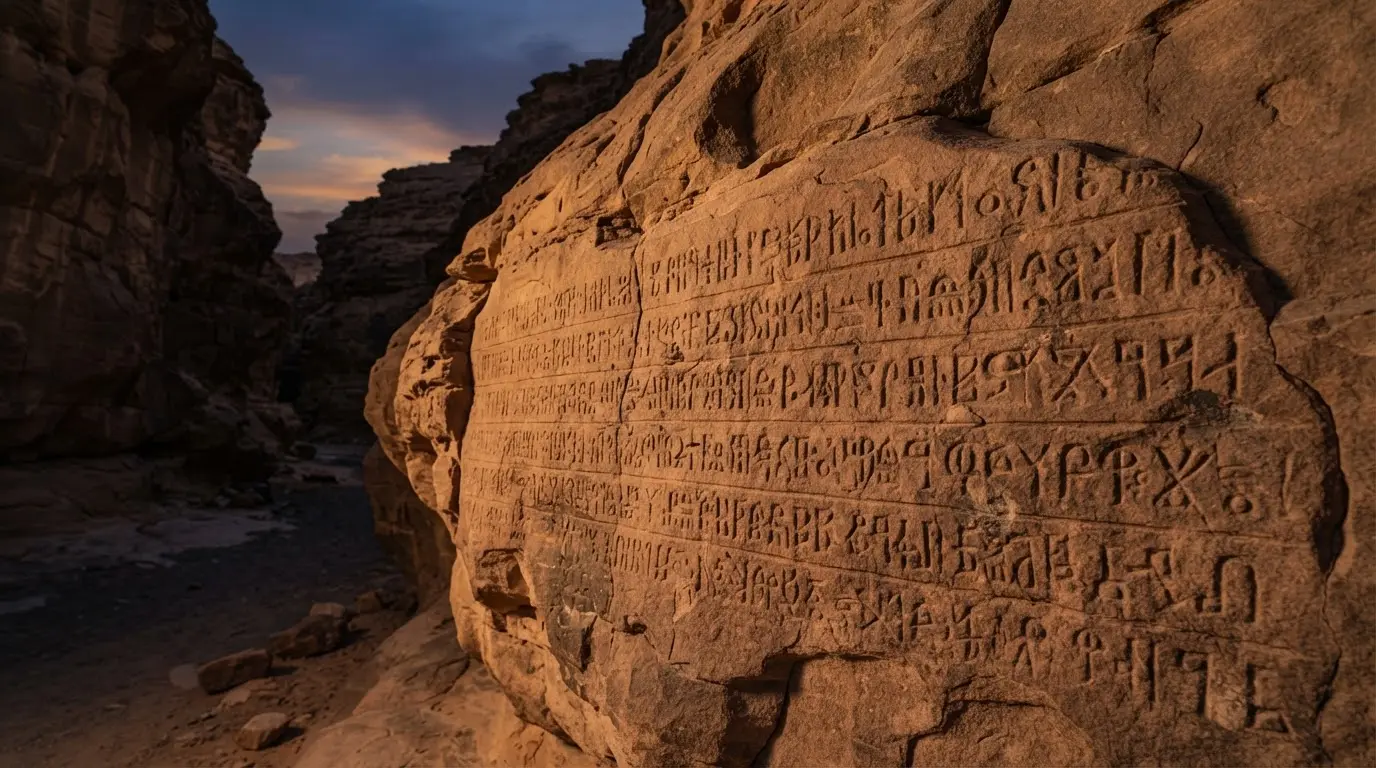

What Jabal Ikmah is, and why it is called a library
Jabal Ikmah is a sandstone canyon along the AlUla-Hail road in Saudi Arabia's Madinah Province[2]; the flight and transfer into town are covered in getting to AlUla. UNESCO describes its texts as "the largest concentration of well-preserved Dadanitic inscriptions in the world"[3]. The Royal Commission for AlUla announced the Memory of the World listing on 24 May 2023[4].
The nickname is AlUla's open-air library, and it oversells the place. The texts run through Aramaic, Dadanitic, Thamudic and Minaic[5], but a National Geographic feature produced as paid content for the Royal Commission says the site began as a place of worship rather than study[6]. Dadanitic largely omits vowels[7], so names tend to reach us as consonant skeletons: Wshh, Tlmy, Dmn.
Featured · Destination
AlUla Stargazing
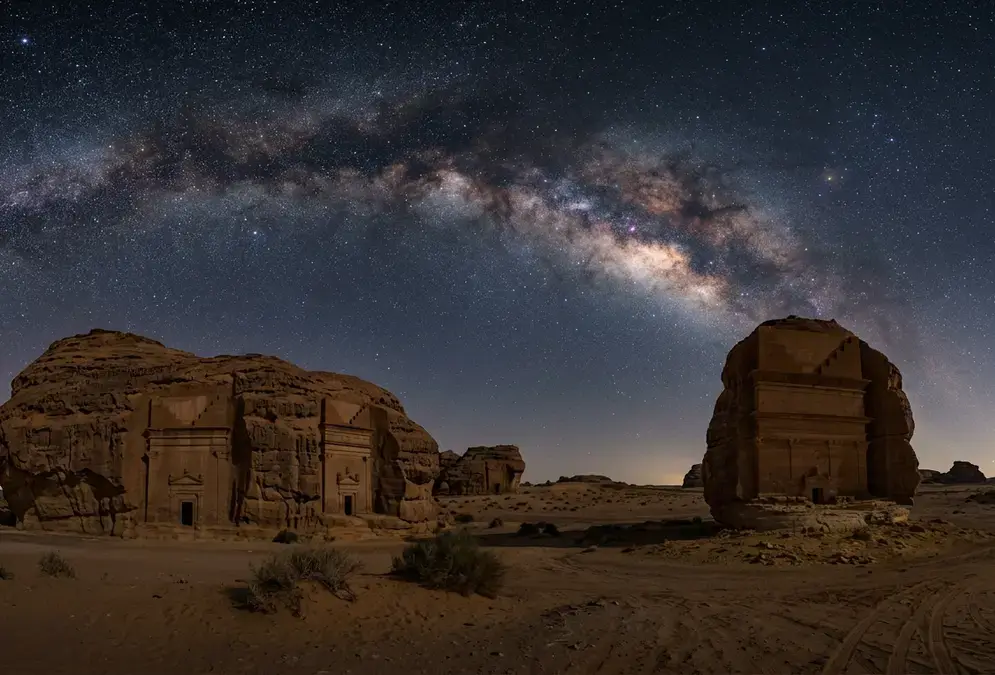
Stargaze above Hegra's 2,000-year-old Nabataean tombs in AlUla, the Gulf's first DarkSky-accredited Dark Sky Park. When to go, where to stay, and how to plan.
What the inscriptions actually talk about
UNESCO lists the themes as society, religion, rituals, agriculture and memorials[8]. In practice that is a settlement's prayers and paperwork: burial and religious rites, farming, and who held what[9]. Women appear as property owners, land holders and ritual participants[10], a detail that surprised me more than any missing star chart.
Trade money helps explain the offerings. AlUla sat on the Incense Route, which moved frankincense and myrrh between southern Arabia and Egypt[11]. The National Geographic feature suggests some traders recorded offerings to the Lihyanite god Dhu Ghaybat, sometimes alongside prayers for reward and favor[12].
Two texts show the register. Wshh, son of Wdd, performed the zll ceremony for Dhu Ghaybat and asked the god to favor him and his descendants[13]. Ssn, a priestess, organized the same ceremony for the sake of her palm trees[14]. That second one is a harvest petition addressed to a god, nothing more celestial than that.
What they never say about the sky
Here is the gap. I read UNESCO's descriptions, the Royal Commission's announcement and the translated examples published so far, and none says a Jabal Ikmah text concerns astronomy, a star or a calendar. UNESCO's theme list has no astronomy entry[8].
The timekeeping that does appear is political. Formal texts date a ceremony by the king's regnal year, as in the ceremony performed in year 20 of Tlmy[17], and Lihyanite offerings and events were generally dated that way[18]. A regnal year needs no month names and no sky-watching, only a count from a coronation. It also leaves scholars stuck: the local texts rarely mention well-dated outside events, so no settled chronology exists[19], and when Tlmy ruled, and over what area, is still open[20].
Nor is there evidence that Dhu Ghaybat, the god named in the ceremonies, was a sky god. The Lihyanites worshipped him and rarely turned to other deities[21], and every account I read frames him through offerings, priesthood and palm groves. Nothing I found calls him astral.
That does not prove the Dadanites ignored the sky. A society that ran caravans and irrigated palms had reasons to track seasons. But no source I read shows how, or that it was written on this rock, and a word-by-word search of the published texts for month or star terms is the test that would settle it. I have not run one.
Where AlUla's documented sky evidence sits
The documented calendar evidence in this corner of Arabia is Nabataean, and generally later. Nabataean inscriptions in the northwestern Hejaz use a calendar derived from Babylon[22]. That is a different people, a different script and mostly a different site: Hegra, where UNESCO notes Lihyanite, Thamudic, Nabataean, Greek and Latin writing side by side[23]. Jabal Ikmah itself holds a few Nabataean texts among its Dadanitic majority[24], but a Nabataean line in a Dadanite canyon is not a Dadanite calendar.
I have kept Hegra's tomb evidence out of this piece; Hegra's Nabataean star gods carries that sourcing.

Featured · Article
What Causes the Northern Lights? The Science Explained
Solar wind collides with Earth's magnetic field, funneling charged particles toward the poles, where they excite oxygen and nitrogen into glowing color.
So there are two bodies of evidence, separated by people, script and site: Dadanite ritual texts at Ikmah, Nabataean calendar and tomb evidence at Hegra. In the sources I checked, nothing supports tours that merge them into "the ancient astronomers of AlUla".
Visiting, and where to put the sky in your trip
I have not been to AlUla, so I cannot tell you what the canyon is like, and I could not source current opening hours, permits or ticketing for Jabal Ikmah. Check the official AlUla visitor channels before you build a day around it. It is one of five focal points of the Journey Through Time Masterplan[25], which puts it on the visitor circuit; the specifics are theirs to confirm.
The wider Dadan district is also being built out, with a site expected to draw two million visitors a year by 2035[26]. Expect that to change what a visit looks like.
I would plan Ikmah as the culture half of a day and keep the dark-sky half separate. For the night, the best stargazing spots in AlUla covers where to go. For the daylight hours, what to do in AlUla beyond stargazing sets Ikmah among the alternatives. If you are still weighing the cost of the whole trip, is AlUla worth it for stargazing makes that case honestly.