
The Royal Commission for AlUla: the body behind the investment
AlUla doesn't run its own tourism board the way most destinations do. It runs a national one. The Royal Commission for AlUla (RCU) is the Saudi government body chartered to protect and develop the AlUla region, and its mandate reaches well past hotel permits and marketing budgets: archaeology, conservation, education, the arts, and tourism infrastructure all sit inside the same commission.
That's a different governance model than the municipal parks department running most of the world's dark-sky destinations. When AlUla adds an astronomy centre or extends a nature reserve's boundary, the decision runs through the same body responsible for excavating the tombs at Hegra and restoring the mudbrick village at AlUla Old Town, the heritage core covered in AlUla Stargazing, not a separate tourism authority negotiating around a heritage agency's calendar.
RCU frames its work as part of Saudi Arabia's wider Vision 2030 agenda, the country's long-running push to diversify its economy beyond oil and build out tourism, culture, and knowledge-sector industries. Exactly how much of that push is earmarked for AlUla specifically isn't public information, and any dollar figure floating around elsewhere is worth treating with some skepticism until RCU states one directly. What is public is the pattern: one government commission, moving in the same direction, across archaeology, land protection, and astronomy at once.
That single-commission model also sets AlUla apart from how other dark-sky destinations get built. NamibRand Nature Reserve in Namibia earned its Gold Tier certification through a private consortium of landowners funding conservation with tourism levies, no government agency involved at all. Aoraki Mackenzie in New Zealand runs through a public national-park authority with a narrower conservation brief. AlUla is neither: a single sovereign commission holding heritage, land protection, and astronomy policy under one roof, which is a track record worth understanding before deciding how seriously to take a destination this new.
Hegra's 2008 UNESCO inscription: the credibility AlUla built on
Astrotourism didn't arrive at AlUla first. Heritage did, more than a decade before anyone in Riyadh talked seriously about telescopes.
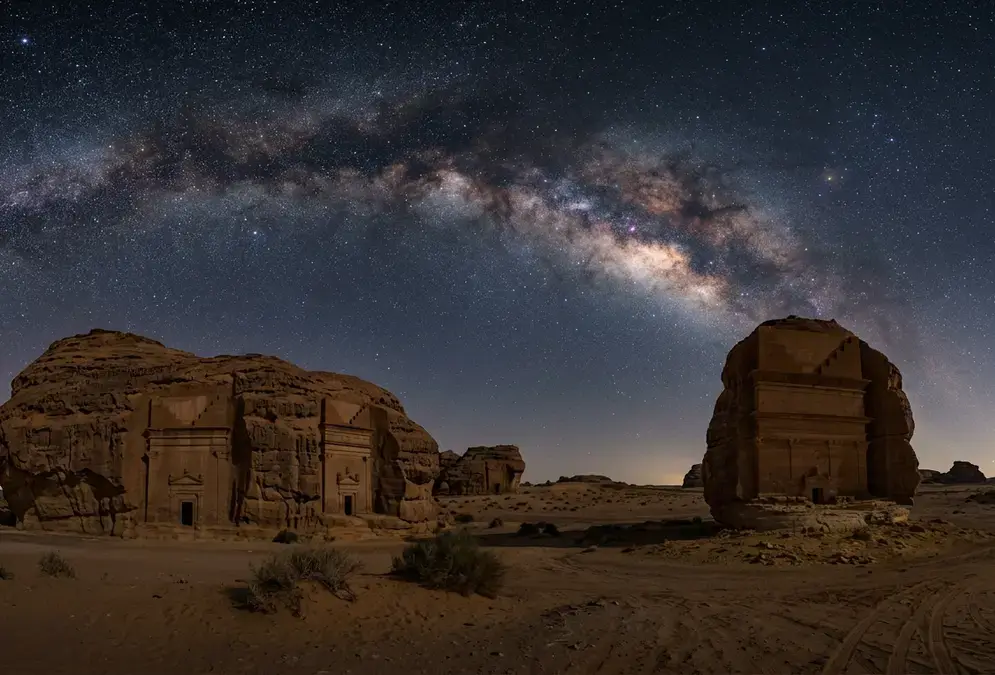
In 2008, UNESCO inscribed Hegra (also written Mada'in Salih) as Saudi Arabia's first World Heritage Site[1], the country's inaugural entry on a list that held nothing else within its borders at the time. UNESCO's own listing describes Hegra as the first World Heritage property ever inscribed in the Kingdom and the largest conserved site of Nabataean civilization south of Petra, Jordan[2], the same Nabataean builders who carved Petra's rose-colored facades a few hundred kilometers to the north.
The scale backing that credibility is concrete. Hegra holds well over a hundred monumental rock-cut tombs, many of them decorated, carved into standing sandstone outcrops across the open desert rather than a single cliff face. That's not a ruin visitors glimpse from a viewpoint; it's a site substantial enough to anchor a UNESCO designation on its own, long before any astrotourism ambition entered the conversation.
2008
That distinction matters for the astrotourism case built on top of it. A government doesn't fund an astronomy centre and expand a nature reserve's dark-sky protections around a site with no proven cultural weight behind it. Hegra gave RCU sixteen years of UNESCO-backed credibility before the first Dark Sky Park application ever went in, a track record no newer astrotourism destination gets to start with.
October 2024: how AlUla became the Gulf's first Dark Sky Park
Sixteen years after Hegra's UNESCO inscription, AlUla added a second, very different kind of accreditation.
In October 2024, DarkSky International named AlUla Manara and the AlGharameel Nature Reserve as the first Dark Sky Park sites in Saudi Arabia and the entire Gulf region[3], per Experience AlUla's own tourism site. It's a formal designation, not a marketing claim. DarkSky International measures sky darkness and outdoor-lighting compliance against its own published standards before it certifies a Dark Sky Park anywhere, and AlUla's two reserves cleared that bar before any ribbon got cut.
For visitors, the practical result runs through one bookable product built specifically around the certified zone: this evening excursion, a guided 4x4 evening that ends in a campfire dinner under the accredited sky. It's currently the only stargazing experience in AlUla carrying both an official DarkSky accreditation and a public booking page, which is exactly the pairing a destination needs before it can call itself an astrotourism authority rather than just a dark desert with a good marketing department.
Featured · Destination
AlUla Stargazing
Stargaze above Hegra's 2,000-year-old Nabataean tombs in AlUla, the Gulf's first DarkSky-accredited Dark Sky Park. When to go, where to stay, and how to plan.
The certified zones sit apart from Hegra's tombs themselves, a detail worth separating from the heritage story. AlUla Manara and AlGharameel are dedicated dark-sky reserves in their own right, not simply "the sky above Hegra" rebranded with a certificate. That distinction is part of why the designation reads as a deliberate infrastructure decision rather than an incidental byproduct of protecting the tombs: RCU built and certified dark-sky zones as their own project, running alongside the heritage protections instead of folded into them.
What the accreditation actually measures
DarkSky International doesn't hand out a Dark Sky Park designation for remoteness alone. Applicants have to meet published standards for measured sky darkness and outdoor-lighting control, verified before certification, not simply claimed by whichever destination is pitching for one. AlUla hasn't published an exact Bortle-scale reading for either certified zone, but clearing those standards is the baseline the October 2024 designation confirms.
The expansion: AlUla's dark-sky footprint more than doubles
An October 2024 ribbon-cutting is rarely the end of a designation like this, and AlUla's wasn't.
DarkSky International later extended the certification to cover Sharaan National Park and the Wadi Nakhlah Nature Reserve, on top of the original AlUla Manara and AlGharameel zones. The combined protected area now covers 6,146 square kilometers[4], reflecting what Arab News described as the expanded scope of AlUla's environmental protection efforts. Following that expansion, AlUla now ranks third globally by area within DarkSky International's Dark Sky Park category[4], a scale few certified parks anywhere in the world approach.
Size alone doesn't make a Dark Sky Park meaningful, but it does say something about intent. A government that stopped at one reserve and one ceremony would have gotten the same headline either way. Doubling the protected footprint afterward reads less like a tourism campaign and more like a land-use commitment measured in decades, not press cycles.
| Before expansion | After expansion |
|---|---|
| AlUla Manara + AlGharameel Nature Reserve only | Adds Sharaan National Park + Wadi Nakhlah Nature Reserve |
| First Dark Sky Park in Saudi Arabia and the Gulf | Ranked third globally by area in the Dark Sky Park category |
| Protected zone limited to two reserves | Combined protected area of 6,146 sq km |
Compare that to how most Dark Sky Park stories unfold elsewhere: a single reserve earns certification, a press release goes out, and the story mostly ends there for years. AlUla's expansion barely got the same fanfare as the original October 2024 announcement, which is itself a small tell. A government treating a designation as ongoing land-use policy, rather than a one-time tourism headline, doesn't need to throw a party every time the boundary grows.
AlUla Manara: the astronomy centre behind the ambition
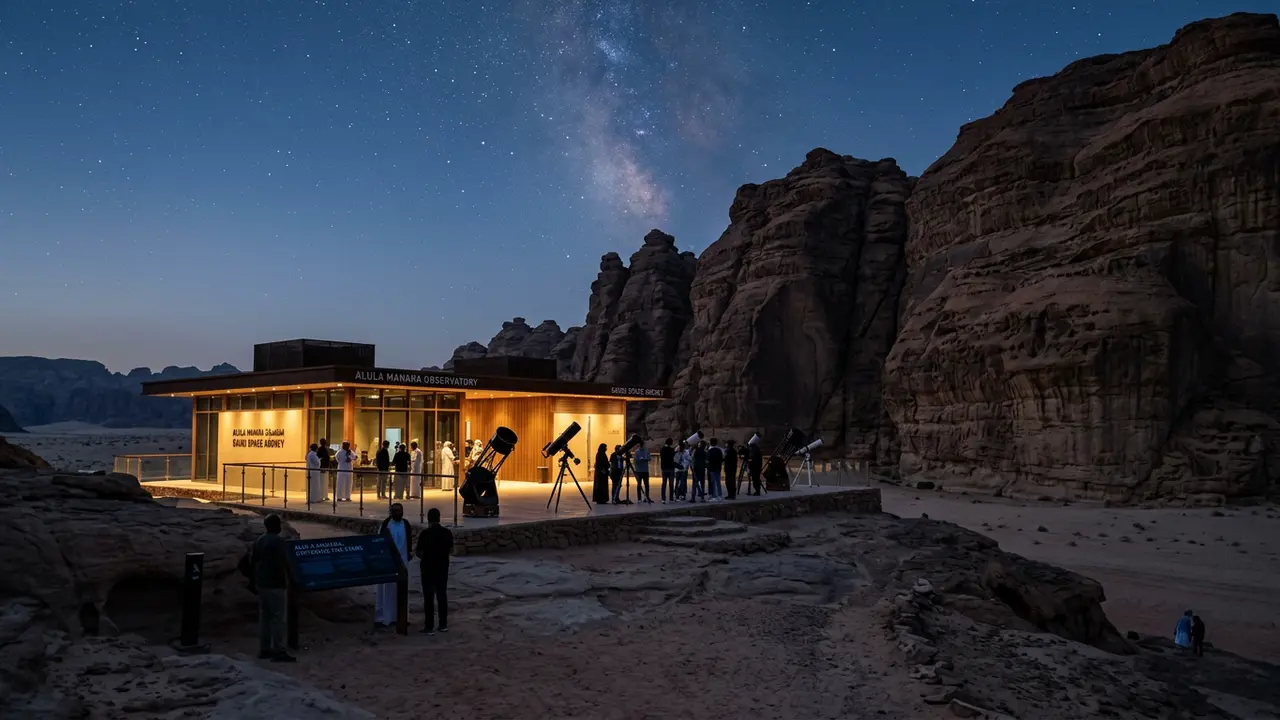
The Dark Sky Park designation protects a stretch of desert. AlUla Manara is the infrastructure RCU is building on top of it.
Manara is an astrotourism centre under development within the AlUla region, designed by Heatherwick Studio[5], the architecture practice behind Little Island in New York, Azabudai Hills in Tokyo, and Coal Drops Yard in London. RCU's own framing, reported by Arab News, places the project inside the Kingdom's wider ambitions to strengthen its position in astronomy, scientific research, innovation, and sustainable destination development under Saudi Vision 2030[5].
Recommended tours
Tours are selected for quality, not commission. I earn a small fee if you book — at no extra cost to you.
Coverage of the project describes an astrotourism destination built around a planetarium and public stargazing infrastructure rather than a single fixed viewing spot, positioned as a research-and-visitor facility rather than a resort-style stargazing add-on. Specific technical details, exact telescope specifications, research partnerships, and distance from AlUla's historic core, haven't been confirmed through a source solid enough to state as fact here, so this piece won't guess at them.
RCU's own plans reportedly include dark-sky lodging built directly into the Manara site, alongside the observatory, which would eventually put an overnight stay and a research-grade telescope on the same patch of desert. Nothing about that timeline is confirmed publicly yet, so treat it as a stated ambition rather than a bookable date.
For travelers weighing a trip now, the closer, bookable version of this ambition is offered by properties like this wellness-oriented resort, which already runs guided telescope sessions inside the same reserve boundary Manara is being built to anchor. Manara is the long-term research play; the lodges already booking stargazing sessions are what a visit actually looks like while that infrastructure gets finished.
What "still under construction" means for a 2026 trip
Nothing about Manara changes what's bookable in AlUla today. The observatory and its telescopes are a multi-year build, not a 2026 line item. A trip planned this year or next runs through the reserves and the lodges already operating inside them, not the astronomy centre still taking shape elsewhere in the region.
Why the Saudi government is building this at all
None of this reads like a single tourism-board initiative, because it isn't one. Hegra's UNESCO status, the Dark Sky Park designation, its expansion, and Manara's research partnerships all trace back to the same government commission working toward the same Vision 2030 goal: building tourism and knowledge-economy sectors that don't depend on oil.
Coverage of the designation has framed it in exactly those terms. DarkSky International's leadership has tied the designation directly to conservation and responsible-tourism goals, and RCU has called it a major boost toward building what the Commission describes as a new astro-tourism ecosystem[6]. Both halves of that framing, heritage protection and economic diversification, are doing real work in AlUla's case rather than sitting in a press release as filler.
“Dark Sky Places play a vital role in preserving wildlife habitats, safeguarding cultural heritage, and promoting responsible astrotourism, which supports and diversifies local economies.”
What that means for a traveler weighing a trip now: AlUla isn't astrotourism's finished product yet. Manara is still under construction, and the destination is younger on this front than Chile's Atacama or Namibia's NamibRand. What it already has, UNESCO status since 2008, a formal Dark Sky Park designation since October 2024, and a government commission actively expanding both, is more institutional backing behind a dark sky than almost anywhere else building an astrotourism identity from scratch. For the ground-level version of where that sky is actually bookable today, Best Stargazing Spots in AlUla covers it.
How AlUla's institutional backing compares
NamibRand's dark-sky credibility rests on a private landowner consortium funding conservation through tourism levies, no government agency in the chain at all. Aoraki Mackenzie's rests on a public national-park authority with a conservation brief, but no UNESCO heritage site sharing the same sky. AlUla is the one destination on this shortlist where a single sovereign commission holds heritage protection, land-use policy, and astronomy development under one roof, and where a UNESCO World Heritage Site and a Dark Sky Park designation cover the same stretch of desert at once.