
Two darkness credentials: one certified, one built by physicists
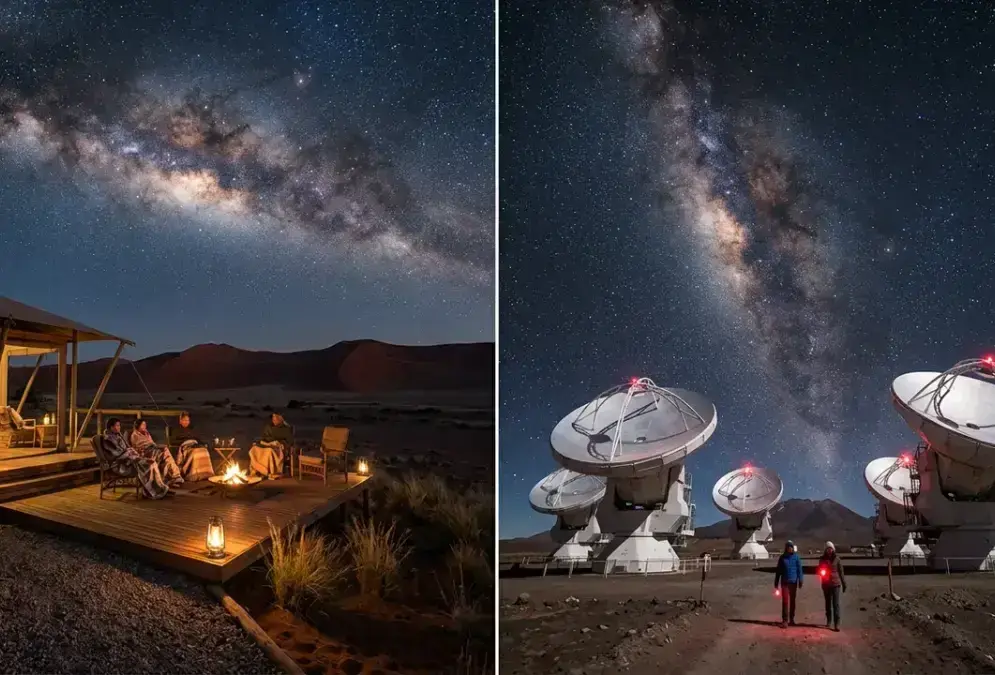
NamibRand and the Atacama Desert solve the same traveler's problem, a genuinely dark sky, from opposite directions. One is a certified conservation reserve with lighting rules written into every lodge's lease. The other has no dark-sky certification at all, and doesn't seem to need one: its sky is proven by the telescopes parked on top of it.
NamibRand earned Gold Tier status in May 2012, when DarkSky International (then the International Dark-Sky Association) endorsed it at the darkest and strictest category the organization awards[1]. It was only the second reserve on Earth to reach that tier, and the designation carried a double first: the first International Dark Sky Reserve in Africa, and the first in any developing nation[2]. Gold Tier sits at the top of DarkSky International's full ratings ladder for reserves[3], which is why NamibRand still markets itself, accurately, as Africa's only International Dark Sky Reserve[4].
The Atacama carries no equivalent certificate. Search for a formal DarkSky International reserve, park, or community designation covering San Pedro de Atacama or the wider desert, and you won't find one. What the region has instead is the kind of proof a certification exists to summarize in the first place: the European Southern Observatory built the Very Large Telescope on Cerro Paranal, and the international ALMA partnership built its array on the Chajnantor plateau, choosing this stretch of desert over every other candidate site on the planet. NamibRand's darkness is an audited, managed claim. Atacama's is a claim astronomers already made with billions of dollars of hardware.
Where the trip actually happens: safari lodge versus desert town
The two trips are built around completely different daily rhythms, and that shapes the itinerary more than either region's sky rating does.
NamibRand runs as a safari-lodge stay with astronomy folded in as an evening program. Properties such as Wolwedans and Kwessi Dunes pair morning and evening game drives across desert-adapted wildlife with guide-led stargazing sessions after dinner; at Kwessi Dunes, individual rooms open directly onto the sky, so the program doesn't even require leaving bed[6]. For the reserve's full lodge lineup and seasonal notes, see NamibRand Nature Reserve.
Featured · Destination
NamibRand Nature Reserve
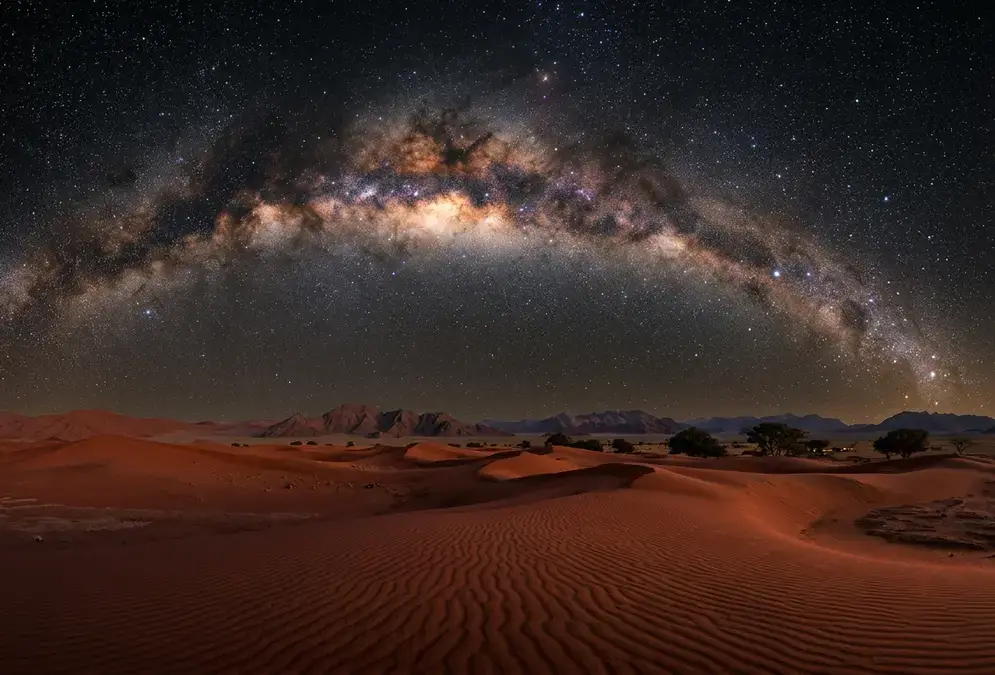
NamibRand is Africa's only Gold Tier Dark Sky Reserve: extreme Namib Desert isolation, the Southern Cross, Magellanic Clouds, and luxury safari lodges.
Atacama runs as science tourism centered on San Pedro de Atacama as a base town. Day tours cover the salt flats and geysers of the surrounding altiplano, and separate commercial operators run the after-dark telescope sessions, distinct businesses from the lodges you sleep in. Layered on top of that commercial tour scene sits something NamibRand has no equivalent of: two of the world's most important research observatories, open to the public on a limited, advance-booked basis. Nobody drives past ALMA on a game drive; visiting it is its own separate trip, planned around a specific weekend slot.
Altitude and atmosphere: the physics behind each region's claim to darkness
Altitude does real work in Atacama that it doesn't do at NamibRand at all.
ALMA, the Atacama Large Millimeter/submillimeter Array, sits at roughly 5,000 metres on the Chajnantor plateau and is the largest land-based astronomical observatory ever built: 66 antennae that combine into a telescope array about 16 kilometres across[7]. It's a working scientific facility, not a museum piece, and it offers free public visits on weekend mornings when operations allow.
Paranal Observatory, home to the European Southern Observatory's Very Large Telescope (VLT), sits lower, at 2,635 metres, roughly 130 kilometres south of Antofagasta and about 600 kilometres from San Pedro itself[8]. The VLT's résumé includes tracking the orbital motion of planets around a black hole and capturing the first-ever direct image of an exoplanet, the kind of observing conditions that only extreme altitude and extreme dryness together make possible.
NamibRand's own elevation is unremarkable by comparison, a low-lying stretch of Namib Desert plain rather than a mountain plateau. Its darkness has nothing to do with altitude and everything to do with what isn't there: no nearby town, no highway glow, no light dome pressing up from the horizon in any direction. For how Atacama's dryness and altitude combine into the driest air on Earth, Why Is the Atacama Desert the Driest on Earth? covers the atmospheric mechanics in full.
Getting there, and what a night out actually costs
Distance is part of the decision on both ends, and it plays out differently.
NamibRand sits roughly 368 kilometres south-southwest of Windhoek: a 4-5 hour self-drive, or about 1 hour 15 minutes by light aircraft from the capital's Eros Airport[9]. Whichever way you arrive, you're committing to at least half a day of travel before the lodge's first game drive, and there's no meaningful shortcut. This is a remote-reserve trip, not a day excursion.
Recommended tours
Tours are selected for quality, not commission. I earn a small fee if you book — at no extra cost to you.
Atacama's access runs through a different bottleneck. Most visitors fly into Calama, then transfer by road to San Pedro de Atacama, and the desert's altitude means the first day is better spent resting than booking anything ambitious -- on my own first trip there, 2,443 m cost me most of an evening before I'd even thought about a telescope. NamibRand asks nothing like that of you; the full Atacama Desert Stargazing guide covers season, lodging, and the day-excursion circuit in more detail. Once you're acclimatized, the after-dark tour scene is easy to book and comparatively affordable: commercial operators such as SPACE Observatory, Atacama Lodge, and Ahlarkapin typically charge USD 50 to 90 for a 2-3 hour guided session with telescope viewing and a laser-pointer constellation tour[10]. NamibRand's astronomy program isn't priced separately at all; it's folded into the lodge's nightly rate, which starts considerably higher than anything in San Pedro's town-based tour market.
$50-90
What you'll actually do once you're there
NamibRand's days are built around wildlife, not the sky. Game drives cross gravel plains and red dunes past oryx and springbok, and the reserve's astronomy sessions happen after dinner, led by lodge guides or, at some properties, a visiting astronomer. Nothing here demands prior knowledge; you eat, and someone hands you a naked-eye tour of the southern sky before the telescopes come out.
Atacama's days run the opposite way: the night sky is the reason people come, and the daytime excursions are the filler between one dark-sky session and the next. Guided tours to Valle de la Luna, the El Tatio geysers, and the altiplanic lagoons fill the hours before sunset, and the evening telescope session is the appointment everything else is scheduled around. For travelers weighing whether the whole trip is worth the altitude and the cost, Is the Atacama Desert Worth It for Stargazing? covers the tradeoffs in more detail.
Neither region asks you to be an astronomer to enjoy it, but they ask for different kinds of patience. NamibRand rewards travelers happy to let the sky be one part of a longer safari day. Atacama rewards travelers willing to build an entire trip's schedule around it.
NamibRand rewards travelers happy to let the sky be one part of a longer safari day.
How to choose: a decision framework
There's no honest version of this comparison that ends with one winner. NamibRand and the Atacama Desert both deliver a genuinely dark sky; they just get you there through completely different trips, at different price points, with different daytime hours to fill. What decides the right pick isn't which sky is darker, it's which trip you'd rather be on. For month-by-month timing once you've picked a region, Best Time to Visit Atacama for Stargazing covers Atacama's calendar in detail.
| Factor | NamibRand | Atacama |
|---|---|---|
| Dark-sky status | Gold Tier International Dark Sky Reserve (2012) | No formal Dark Sky Reserve designation |
| Darkness source | Reserve-wide lighting rules, extreme remoteness | High-altitude, low-humidity siting proven by ALMA and Paranal |
| Trip framing | Safari lodge stay, astronomy as evening add-on | Science tourism, town-based with separate tour operators |
| Night-sky access | Included in the lodge's nightly rate | Commercial tours, roughly $50-90 for 2-3 hours |
| Research observatory access | None on-site | ALMA (free weekend visits) and Paranal (booked tours) |
| Getting there | 4-5hr drive or ~1h15 flight from Windhoek | Fly to Calama, then transfer to San Pedro |
Pick NamibRand if
- You want wildlife and stars in the same trip, not stargazing as a stand-alone activity
- You'd rather stay at one lodge for several nights than move between day tours
- A certified Gold Tier reserve, and the lighting discipline that comes with it, matters to you
- Budget isn't the deciding factor and you're comfortable with a half-day of travel from Windhoek either way
Pick Atacama if
- You want the option of visiting a working research observatory, even on a limited public-visit basis
- A cheaper, more flexible night-tour market, booked separately from your lodging, appeals to you
- You're comfortable with an altitude-adjustment day before diving into excursions
- You'd rather build a trip around salt flats, geysers, and the sky than around wildlife