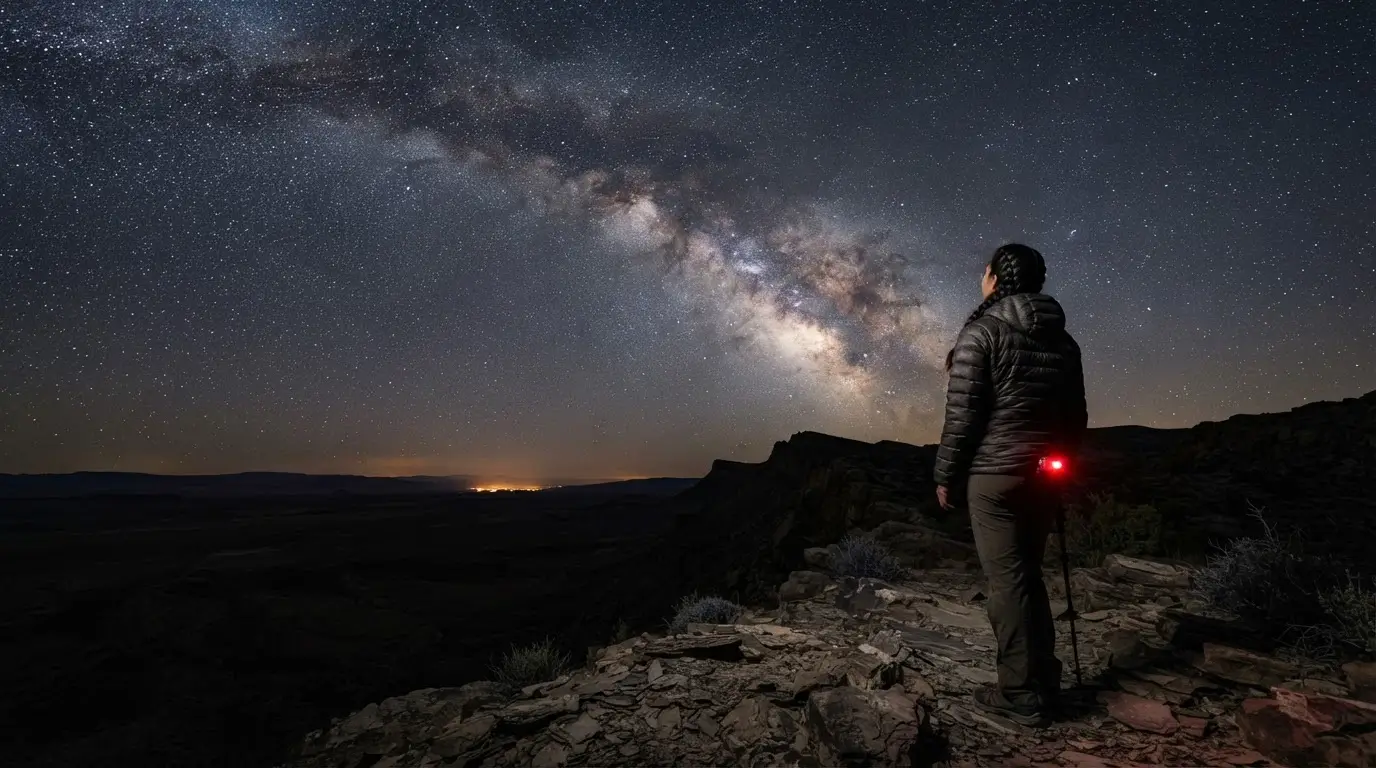
Why Is It Called the Milky Way? Hera's Spilled Milk
I've seen dark skies firsthand in the Atacama altiplano, Namibia's NamibRand Nature Reserve, and Morocco's Merzouga dunes; every other destination I write about is built from measured Bortle and SQM data, cloud climatology, and primary sources like park services and the International Dark-Sky Association.
In this article
Jump to a section
The myth: Heracles, Hera and the spilled milk
From galaxias to via lactea to Milky Way
Featured · Destination
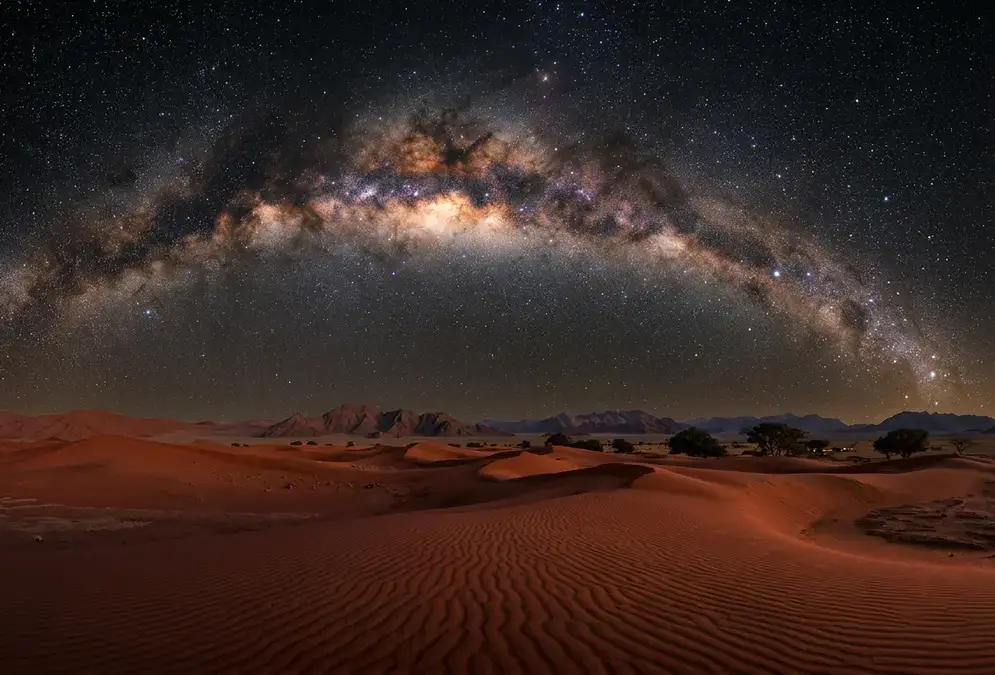
NamibRand Nature Reserve
NamibRand is Africa's only Gold Tier Dark Sky Reserve: extreme Namib Desert isolation, the Southern Cross, Magellanic Clouds, and luxury safari lodges.
Roads, rivers and birds: what other cultures saw
- The Greeks and Romans also saw a road, travelled by the Sun or the gods.[17]
- Spain and Portugal call it the Road to Santiago, after the pilgrim route to Santiago de Compostela.[18]
- The commonest Arabic name is the Straw Way, after straw dropped by farmers heading home from the fields.[19]
- Finland, Estonia and the Baltic states call it the Birds' Path, because migrating birds seem to follow its arc.[20]
- The Lakota name is the Spirit Road and the Cheyenne name the Hanging Road.[21]
- In China it is the Silver River, where the Cowherd and the Weaver Girl, Altair and Vega, meet once a year on the seventh day of the seventh lunar month.[22]
- In India it is the Heavenly Ganges.[23]
- Quechua and Aymara speakers say every earthly river flows into the celestial river Mayu, which replenishes them.[24]
Dark constellations: the names written in the gaps
Featured · Article
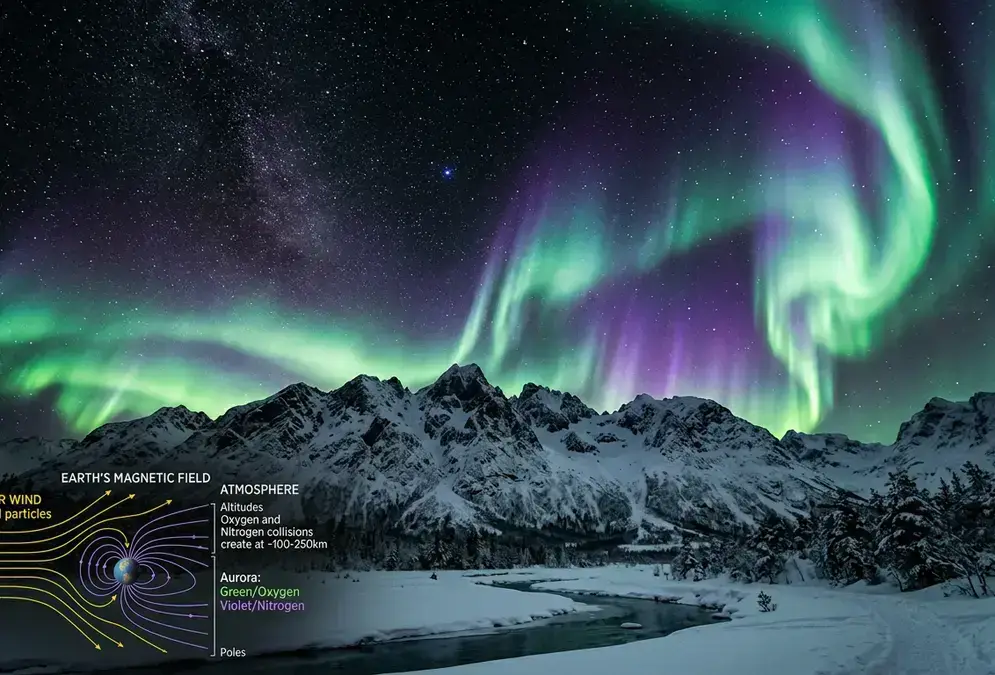
What Causes the Northern Lights? The Science Explained
Solar wind collides with Earth's magnetic field, funneling charged particles toward the poles, where they excite oxygen and nitrogen into glowing color.
The sky that named the galaxy is fading
Recommended tours
Tours are selected for quality, not commission. I earn a small fee if you book — at no extra cost to you.
- Pick a night near the new moon, or one where the moon rises late.[31] From the northern hemisphere, summer and fall evenings are the season.[32]
- Drive 20 to 30 miles or more from the city limits,[33] and treat Bortle 3 or 4 as the minimum for a good evening.[34] Certified places make the choice easy: Aoraki Mackenzie in New Zealand, which describes itself as the largest reserve in the Southern Hemisphere,[35] Galloway Forest Park in Scotland[36] or Zion in the United States.[37]
- Switch off your lights and give your eyes 20 to 30 minutes.[38] One glance at a phone screen or a streetlight restarts the clock.[39]
- Look for the dark lanes before the bright band, the habit the Andean and Australian names were built on.
- Set expectations by Bortle class. At 4 the band is still impressive but loses most of its structure,[40] at 5 it looks washed out overhead[41] and at 2 it is richly structured to the naked eye.[42]
Frequently asked questions
What is the Greek myth behind the Milky Way's name origin?
What does galaxy mean in Greek?
What is the Latin name for the Milky Way?
Who first used the term Milky Way in English?
Why do so many cultures call the Milky Way a road or a river?
Can everyone see the Milky Way today?
Sources
42 references Show Hide
- wordorigins.org (opens in a new tab)
“a story that is recorded in Pseudo-Erastothenes’s Katasterismoi (Constellations), a text from the first century C.E. but which draws upon earlier sources”
- wordorigins.org (opens in a new tab)
“Galaxy appears in English by the close of the fourteenth century.”
- arxiv.org — 1609.01041 (opens in a new tab)
“The Milky Way is hidden from more than one-third of humanity, including 60% of Europeans and nearly 80% of North Americans.”
- cal.byu.edu (opens in a new tab)
“the sons of Zeus could be divine only if they were suckled by Hera.”
- thereader.mitpress.mit.edu (opens in a new tab)
“she flung the baby from her breast and some of her milk spilled out across the heavens.”
- wordorigins.org (opens in a new tab)
“When Hera discovered the trick, she pushed Herakles away and the remaining milk was spilled, forming the Galaxy.”
- Wikipedia — Milk of Hera (opens in a new tab)
“either Zeus or his son Hermes took the infant and brought him to Hera, who was sleeping”
- Wikipedia — Milk of Hera (opens in a new tab)
“some of the milk's portion that was released fell down on the earth, and transformed into a lily”
- Wikipedia — The Origin of the Milky Way (opens in a new tab)
“The Origin of the Milky Way is a painting by the Italian Renaissance master Jacopo Tintoretto, in the National Gallery, London”
- Wikipedia — Milk of Hera (opens in a new tab)
“the milk was not Hera's at all”
- Wikipedia — Milk of Hera (opens in a new tab)
“The ancient Greek word for 'Milky Way' and 'galaxy' both is γαλαξίας, literally meaning "milky"”
- thereader.mitpress.mit.edu (opens in a new tab)
“Roman writers also adopted the Greek word galaxías, which then made its way through medieval Latin into English.”
- wordorigins.org (opens in a new tab)
“Galaxias appears in Anglo-Latin by the twelfth century, and parallel borrowings of the word are found in many present-day European languages.”
- wordorigins.org (opens in a new tab)
“Se yonder, loo, the Galaxie, Which men clepeth the Milky Wey For hit is whit (and somme, parfey, Kallen hyt Watlynge Strete).”
- wordorigins.org (opens in a new tab)
“This passage is also one of the earliest known to use the phrase Milky Way.”
- wordorigins.org (opens in a new tab)
“It wouldn’t be until the twentieth century that astronomers recognized galaxies, including our own Milky Way, for what they are”
- thereader.mitpress.mit.edu (opens in a new tab)
“The Greeks also saw in the Milky Way a road traveled by either the Sun or the gods.”
- thereader.mitpress.mit.edu (opens in a new tab)
“In Spain and Portugal, for example, the Milky Way is known as “The Road to Santiago” (Camino de Santiago)”
- thereader.mitpress.mit.edu (opens in a new tab)
“after the sheafs of straw dropped by farmers on their way back from the fields.”
- thereader.mitpress.mit.edu (opens in a new tab)
“which is called the “Birds’ Path” (e.g., Linnunrata in Finnish or Paukščių Takas in Lithuanian).”
- thereader.mitpress.mit.edu (opens in a new tab)
“from the Lakota “Spirit Road” (Wanáǧi Thacháŋku) to the Cheyenne “Hanging Road” (ekutsihimmiyo).”
- thereader.mitpress.mit.edu (opens in a new tab)
“can only meet once a year, on the seventh day of the seventh lunar month”
- thereader.mitpress.mit.edu (opens in a new tab)
“In India, the Milky Way is known as the “Heavenly Ganges””
- thereader.mitpress.mit.edu (opens in a new tab)
“Andean peoples of South America, including the Quechua and Aymara, believe that all terrestrial rivers flow into the celestial river, Mayu, which then replenishes them.”
- thereader.mitpress.mit.edu (opens in a new tab)
“Separated by oceans, centuries, and cultural barriers, people have time and again reached for the same images.”
- thereader.mitpress.mit.edu (opens in a new tab)
“A Hawai’ian tale recounts how the demigod Ka-ulu flung the Chief of Sharks into the sky, where his shattered body formed the Milky Way.”
- thereader.mitpress.mit.edu (opens in a new tab)
“The Andean people of South America see “dark constellations” in the shadowy parts of the Milky Way: a snake, a toad, a tinamou bird, and a llama suckling her baby.”
- arxiv.org — 1306.0971 (opens in a new tab)
“the emu (Cairns & Harney 2003; Massola 1963), consists not of stars but of the dark clouds within the Milky Way, and is important in many different cultures across Australia.”
- arxiv.org — 1609.01041 (opens in a new tab)
“This atlas shows that more than 80% of the world and more than 99% of the U.S. and European populations live under light-polluted skies.”
- nps.gov — Lightatlas (opens in a new tab)
“With the loss of dark sky views, the ancestral stories of celestial phenomena that so richly express our connection to these orbiting bodies are all but forgotten.”
- nps.gov — Stargazing (opens in a new tab)
“The best time to view our galaxy is during the new moon phase, or at times when the moon rises late in the night.”
- nps.gov — Stargaze (opens in a new tab)
“The Milky Way is our home galaxy and is best seen in summer and fall evening skies.”
- science.nasa.gov (opens in a new tab)
“So heading outward from town, at least 20 to 30 miles from the city limits, is key.”
- science.nasa.gov (opens in a new tab)
“For most of us, getting to a Bortle-class 3 or 4 location is dark enough for a great evening of stargazing.”
- darkskyreserve.org.nz (opens in a new tab)
“The Aoraki Mackenzie International Dark Sky Reserve is the largest reserve (4,367㎢) in the Southern Hemisphere.”
- DarkSky International (opens in a new tab)
“The park is one of the very best places to observe the night sky in the UK”
- nps.gov — Sunset stargazing (opens in a new tab)
“As an International Dark Sky Park, Zion protects our incredible dark skies for present and future generations by not degrading the night with artificial light.”
- nps.gov — Nightskyetiquette (opens in a new tab)
“It takes 20-30 minutes for the human eye to maximize its ability to see in very low light conditions.”
- nps.gov — Stargazing (opens in a new tab)
“However, this process starts over each time you look at a bright object, such a streetlight, phone screen, tablet, or even the Moon.”
- novac.com (opens in a new tab)
“The Milky Way well above the horizon is still impressive but lacks all but the most obvious structure.”
- novac.com (opens in a new tab)
“The Milky Way is very weak or invisible near the horizon and looks rather washed out overhead.”
- novac.com (opens in a new tab)
“The summer Milky Way is highly structured to the unaided eye, and its brightest parts look like veined marble when viewed with ordinary binoculars.”