
The Sun: where the aurora's energy comes from
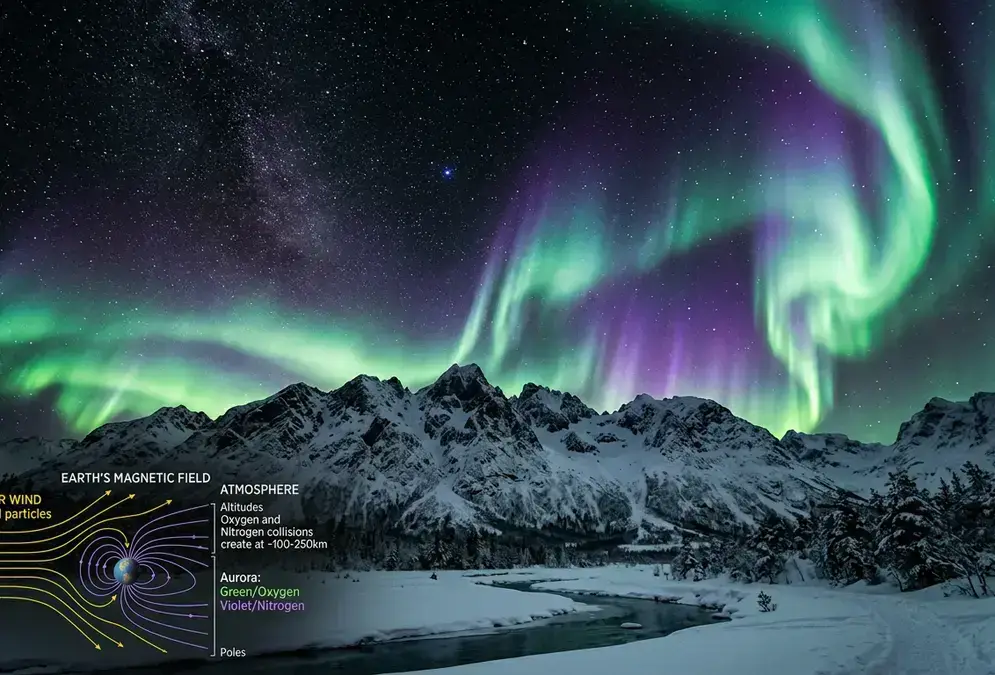
Aurora doesn't start in the sky. It starts on the Sun, where the outer atmosphere, the corona, constantly sheds charged particles into space. That outflow is the solar wind, a stream of electrons and protons that drags a stretched-out piece of the Sun's own magnetic field along with it, known as the interplanetary magnetic field (IMF)[1].
Most days, that wind blows at a fairly steady pace. Two things speed it up and thicken it. A coronal mass ejection (CME) is a large eruption of plasma and magnetic field off the Sun's corona, and a coronal hole is a region where the Sun's magnetic field opens outward instead of looping back on itself, letting a faster stream of solar wind escape almost continuously[8]. Both raise the speed and density of the wind heading toward Earth[2].
Neither event does anything dramatic on its own. What matters for the aurora is what happens a few days later, when that faster, denser wind and its tangled magnetic field slam into Earth's own magnetic shield. Space-weather forecasters watch the Sun for both kinds of event because that collision is the leading advance indicator forecasters watch for. Centuries before anyone had a name for solar wind, a 13th-century Norwegian text already tried to explain the same lights, weighing three rival physical theories and refusing to pick a winner.
Earth's magnetosphere and the reconnection that lets particles in
Earth is wrapped in its own magnetic bubble, the magnetosphere, and under normal conditions it deflects most of the solar wind before it ever reaches the atmosphere. Energy from the solar wind still piles up against that bubble, and during a geomagnetic storm, a lot more of it does[3].
The real gatekeeper is direction, not just speed. Earth's magnetic field points north near the equator. If the interplanetary magnetic field arriving from the Sun tips south, a condition scientists call a negative Bz, the two fields can link up and merge instead of sliding past each other. That merging, called magnetic reconnection, briefly opens a gap in Earth's defenses exactly where the two fields meet[7].
Featured · Destination
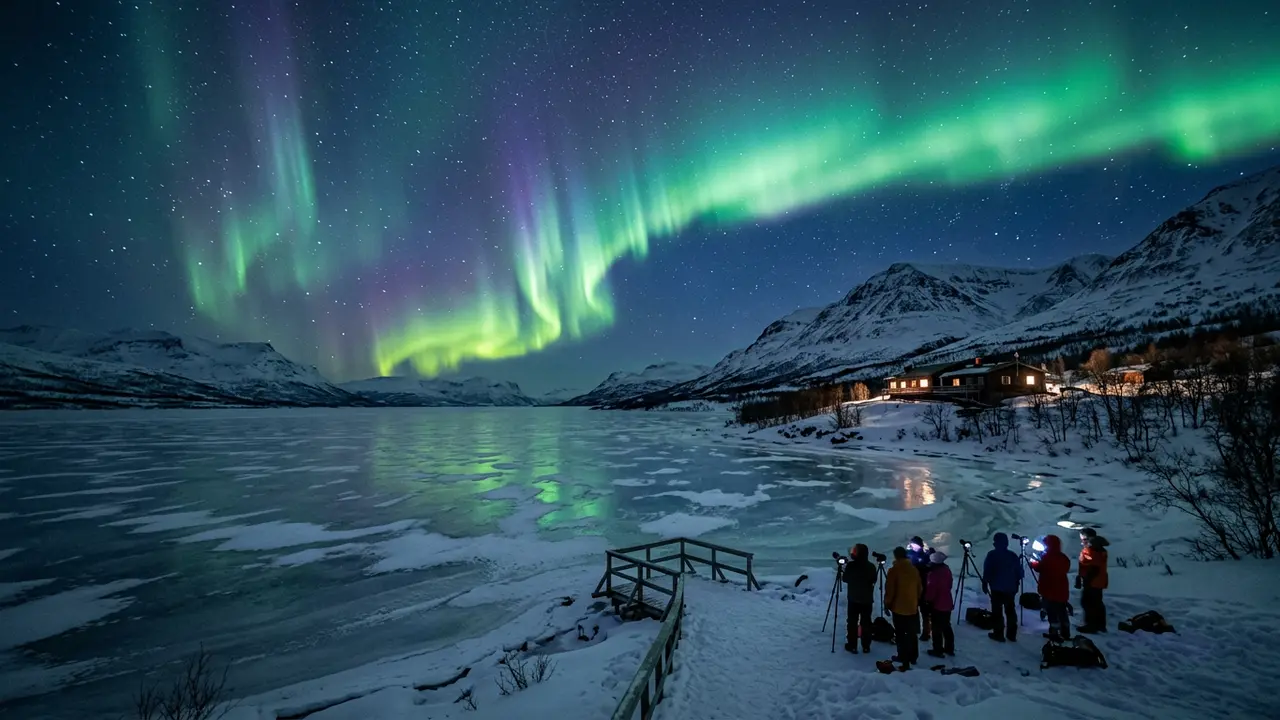
Abisko Stargazing
Abisko's rain-shadow microclimate keeps skies clear when nearby Arctic spots cloud over. Aurora season, the Sky Station, ICEHOTEL, and getting there by train.
Solar wind particles and energy pour through that gap and collect in the magnetotail, the stretched-out night side of the magnetosphere. From there, accelerated electrons get funneled down along magnetic field lines toward the north and south magnetic poles[4], which is why the aurora shows up as a ring around each pole instead of appearing at random across the sky. That process can repeat many times during a single storm, which is why an active aurora night rarely holds steady, brightening, fading, and brightening again over the course of a few hours. The Kp index is the number that tracks how disturbed Earth's magnetic field gets during one of these storms.
Excitation and emission: why the atmosphere lights up
Everything so far happens in the dark. The light begins when those funneled electrons slam into oxygen and nitrogen atoms and molecules roughly 100 kilometers and higher above the ground[6]. Oxygen and nitrogen aren't hit by chance: they're simply the two gases that dominate Earth's upper atmosphere at auroral altitudes, so they're what the incoming electrons collide with most often.
A collision doesn't destroy the atom. It knocks one of the atom's electrons into a temporarily higher energy state, what physicists call an excited state. Atoms don't stay excited for long: within a fraction of a second, the electron drops back to its resting position and releases the extra energy it absorbed as a tiny packet of light, a photon[6].
That's the entire mechanism, and it's the same one lighting up a neon sign. A neon tube uses an electric current to excite neon gas sealed inside glass tubing; the aurora uses a beam of solar electrons to excite oxygen and nitrogen sealed inside Earth's own atmosphere. Multiply that single collision by the countless electrons raining down across an active auroral oval, and the result is a curtain of light bright enough to see from the ground, and sometimes from orbit.
The colors: which gas, and how high up
Color depends on two variables: which gas absorbs the collision, and how high up it happens.
Atomic oxygen produces the aurora's most familiar shade, a yellow-green glow at a wavelength of 557.7 nanometers, produced between roughly 120 and 400 kilometers in altitude[4]. The same oxygen atom can also emit red light at 630 nanometers, but only above 300 kilometers[4]. That red emission needs a slower release of energy, one that denser, lower-altitude air interrupts before it finishes; higher up, where atoms sit farther apart, the release has room to complete. Because it's fainter and the human eye is less sensitive to that wavelength, the red fringe tends to show up only during stronger activity.
557.7 nm
Molecular nitrogen adds a third color: blue and purple light along the lower edge of a bright curtain, typically only during the most intense geomagnetic storms[6]. A quiet, moderate aurora usually stays green from top to bottom. A strong one adds red high above and violet along the base, the full range of color visible in a single curtain.
The auroral oval, its southern twin, and the solar cycle
All of this activity concentrates inside a specific band called the auroral oval, a ring centered on each magnetic pole rather than the geographic one. Under quiet conditions, the best viewing sits between roughly 65 and 70 degrees magnetic latitude, and the ring isn't perfectly centered on the pole: solar wind pressure pushes it about 15 degrees off the pole on the daylight side and about 23 degrees off on the night side[6]. During a major storm, the whole oval swells and drops toward the equator, which is how the aurora occasionally reaches places that almost never see it otherwise.
Every step described above plays out just as faithfully at the opposite end of the planet. Aurora australis, the southern lights, forms an almost identical ring around the southern magnetic pole and brightens or fades in step with its northern counterpart, since one solar wind event drives both at the same time[6].
Recommended tours
Tours are selected for quality, not commission. I earn a small fee if you book — at no extra cost to you.



None of this runs at a constant rate. Solar activity rises and falls on a roughly 11-year solar cycle of sunspot activity, and coronal mass ejections grow both more frequent and more powerful as that cycle nears its peak and for a few years after[6]. That's the underlying reason some years bring a run of headline storms and others stay quiet, even though the physics chain connecting the Sun to the sky above your head never changes.
Once a storm is forecast, how to see the northern lights explains when and where to actually look. For how different cultures explained the same lights before the physics was known, see aurora myths around the world.