
How the northern lights actually form

The aurora borealis begins millions of kilometers away, in the outer atmosphere of the Sun. The solar wind, a constant stream of charged particles blowing outward from the Sun, carries a tangled magnetic field with it. When that field lines up the wrong way against Earth's own magnetic shield, the two fields snap and reconnect instead of sliding past each other.
That process, called magnetic reconnection, opens a temporary gap in Earth's magnetosphere and funnels charged particles down along magnetic field lines toward the poles. The particles pile up in the upper atmosphere, then release energy in a rapid brightening called a substorm, the flickering, shifting light that makes the aurora look alive rather than static.
What actually glows is oxygen and nitrogen, not the charged particles themselves. Incoming electrons collide with atmospheric gas, kick its electrons into a higher energy state, and the gas releases that energy as light on the way back down: the same basic process behind a neon sign[1].

100-200 km

Roughly the altitude band where colliding oxygen atoms produce the aurora's most common yellow-green glow.
The strongest displays trace back to coronal mass ejections (CMEs), huge eruptions of solar plasma: the fastest, Earth-directed CMEs can reach Earth in as little as roughly 15 hours[1]. That lag still gives forecasters a window to issue a storm watch before the aurora actually shows up. Milder, coronal hole-driven activity tends to recur on a rhythm tied to the Sun's own rotation, producing quieter, more predictable nights than a CME ever does.

Why aurora colors change with altitude

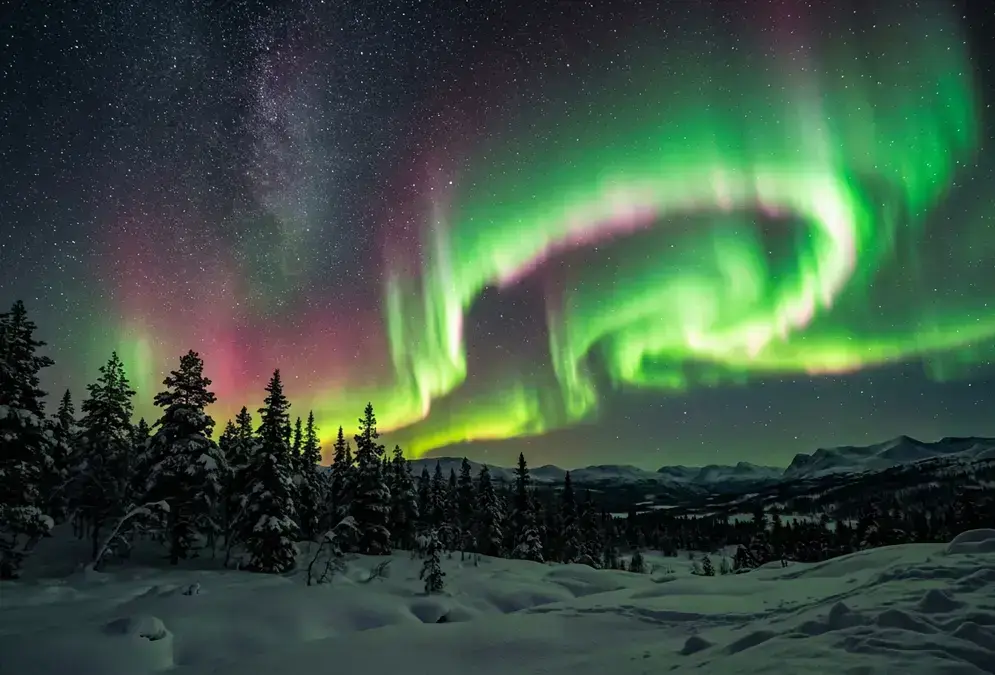
Color depends on which gas gets hit and how high up the collision happens. Oxygen produces the aurora's signature yellow-green glow at roughly 100 to 200 kilometers up, and a deeper red above about 200 kilometers, where thinner air lets an excited oxygen atom hold its energy longer before releasing light[1]. Nitrogen adds a blue or purple fringe along the lower edge of a bright display, usually only visible during a strong storm.

CMEs vs coronal holes: a wave versus a tap left open

A CME hits like a wave: a short, sometimes dramatic window of intense activity, then a return to quiet. A coronal hole stream behaves more like a tap left slightly open, milder and more predictable. Both raise your odds of a display, but a CME is the one worth rearranging a trip around.

The auroral oval and the magnetic latitude you actually need

The aurora doesn't ring the globe evenly. It sits inside a shifting halo called the auroral oval, a band that circles each magnetic pole at a magnetic latitude of roughly 65 to 70 degrees during quiet conditions[6], a different line entirely from geographic latitude, because Earth's magnetic pole doesn't line up with its rotational one.
During a geomagnetic storm, that oval swells and pushes toward the equator. A quiet night keeps the aurora tucked up near the pole, invisible from anywhere but the highest latitudes; a strong storm can drag the same glow down into places that almost never see it. That's why the same spot can go from a near-guaranteed show most clear nights to nothing at all, purely based on how active the Sun happens to be that week.
A quiet night keeps the aurora tucked up near the pole, invisible from anywhere but the highest latitudes; a strong storm can drag the same glow down into places that almost never see it.
Because the oval follows magnetic latitude rather than geographic latitude, two places at the same line on a map can have very different odds. Parts of northern Scandinavia and Canada sit closer to the magnetic pole than their geographic latitude alone suggests, one reason those high-latitude regions built entire tourism seasons around the aurora.

Reading a Kp index aurora forecast

The single most useful number for aurora forecasting is the Kp index, a scale from 0 to 9 that measures how disturbed Earth's magnetic field is over a rolling three-hour window; a reading of 5 or higher officially counts as a geomagnetic storm[3]. Kp 0 to 2 means quiet conditions and an aurora tucked close to the pole; each step above 5 pushes the oval further from the pole and closer to lower latitudes.

Featured · Destination

Abisko Stargazing

Abisko's rain-shadow microclimate keeps skies clear when nearby Arctic spots cloud over. Aurora season, the Sky Station, ICEHOTEL, and getting there by train.

Treat any specific Kp-to-latitude figure as a rule of thumb, not a guarantee. Local darkness, cloud cover, and distance from city lights all change what a given Kp value looks like on the ground. As a general pattern, quiet-to-moderate Kp keeps the show confined to high-latitude regions, and only the rarer Kp 8 or 9 storms reliably push a visible glow down toward mid-latitudes[2].
NOAA's Space Weather Prediction Center runs the free forecasting tools worth bookmarking. Its OVATION model powers a 30-minute aurora forecast that maps expected visibility across a real-time image of the globe, rather than reducing the whole planet to a single number[4]. A companion multi-day outlook shows the Kp trend further out, useful for deciding whether a trip is worth booking, though the short-range forecast is what actually decides which specific night to go outside.

Why a rigid Kp-to-latitude table doesn't work

Space weather is lumpy, not linear. A moderate Kp 5 storm arriving at local magnetic midnight, lined up with a lucky pocket of solar wind, can outperform a technically higher Kp reading that peaks at the wrong hour or over the wrong side of the planet. Use Kp as a directional signal, not a lookup table, and lean on the real-time forecast over a number someone printed once.

Timing your trip: darkness, the equinoxes, and the solar cycle

None of the Kp forecasting matters if the sky isn't dark enough to see the result. At high latitude, that means avoiding the months of near-continuous daylight around the summer solstice. Across most high-latitude regions in the Northern Hemisphere, the reliable viewing season runs roughly from late August through mid-April, when nights grow long enough for true darkness to return.
Geomagnetic activity itself isn't spread evenly across the year either. Storms cluster somewhat more often around the spring and autumn equinoxes, a pattern known as the Russell–McPherron effect: near the equinoxes, the tilt of Earth's magnetic field lines up more favorably with the magnetic field carried by the solar wind, making reconnection easier to trigger[8].
Timeline
  1. Late August

    Viewing season begins

    Nights grow long enough at high latitudes for true darkness to return.

  2. September equinox

    Geomagnetic activity ticks up

    The Russell–McPherron effect favors more frequent storms near the equinox.

  3. March equinox

    A second activity peak

    The same magnetic alignment repeats in spring, six months later.

  4. Mid-April

    Viewing season ends

    Nights get too short and too light for the aurora to stand out.

Moon phase matters here the same way it does for any other night-sky viewing. A bright moon washes out a faint, low-Kp aurora much like it washes out the Milky Way, though a genuinely strong storm can overpower moonlight entirely. Check when to stargaze if planning around lunar phase isn't already a habit.
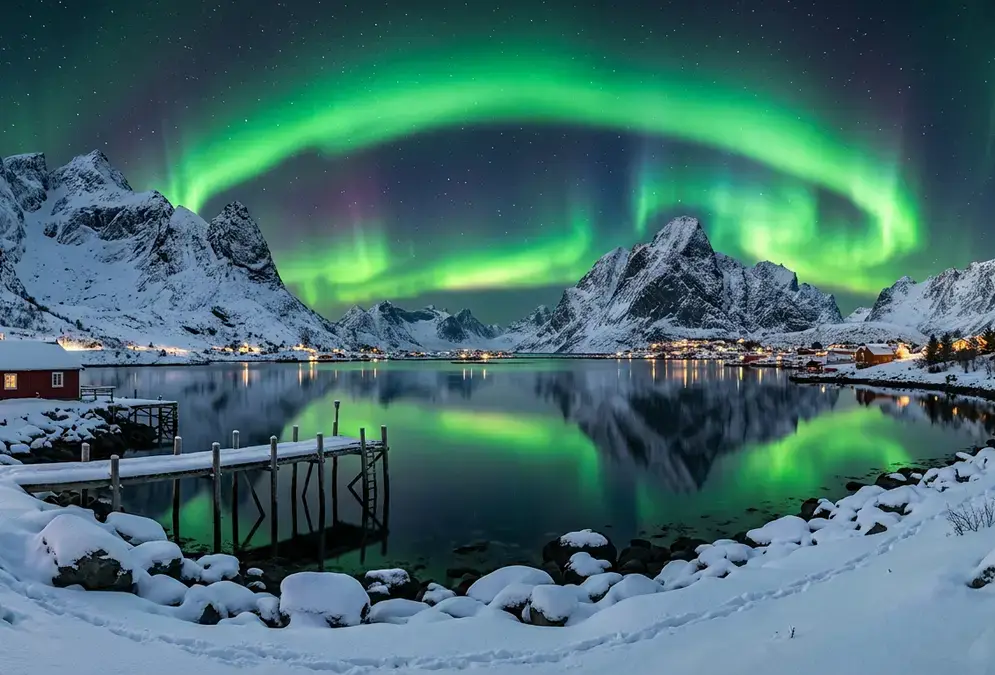
A wide band of green and violet aurora arching over a snow-covered ridge at high latitude, the kind of moderate geomagnetic storm visible during the dark-season viewing window.

A wide band of green and violet aurora arching over a snow-covered ridge at high latitude, the kind of moderate geomagnetic storm visible during the dark-season viewing window.

Solar activity also runs on an 11-year solar cycle[7] of rising and falling sunspot activity, with more frequent, more intense storms during the active years and quieter stretches in between. Rather than timing a trip to a specific point in that cycle, check the forecast for your actual travel dates. Even a quiet stretch of the cycle produces strong individual storms, and an active one still has calm weeks.

Planning your first aurora-hunting trip

Budget more than one night. Even inside a strong viewing season, a single evening carries real odds of clouds, a quiet Kp reading, or both at once. Most experienced aurora chasers plan for multiple consecutive nights in a high-latitude region rather than a single overnight trip, and treat any one clear, active night as a bonus rather than a guarantee.
Watch the clock as much as the sky. Aurora activity tends to peak around magnetic midnight, the point when your location sits most directly beneath the tail of Earth's magnetosphere, close to solar midnight but shifted by your specific longitude. On the ground, that generally means the best viewing window falls within an hour or two of local midnight, roughly 10 PM to 2 AM[5]. That's not right after sunset, so resist giving up early on a quiet-looking evening.

Read next · Article

Stargazing Gear for Beginners: Binoculars to Telescopes

New to stargazing gear? This guide breaks down binoculars, telescopes, and smart telescopes, so you know what to buy first and what to skip for right now.

Cloud cover is the variable most first-timers underrate. A perfect Kp forecast is worthless under an overcast sky, so check the local cloud forecast the same day, not the week before, and stay flexible enough to drive toward a clearer patch of sky if your first spot socks in. If reading a night-sky forecast is new to you, stargazing for beginners covers the basics.

What to expect: naked eye vs camera, and first-timer mistakes

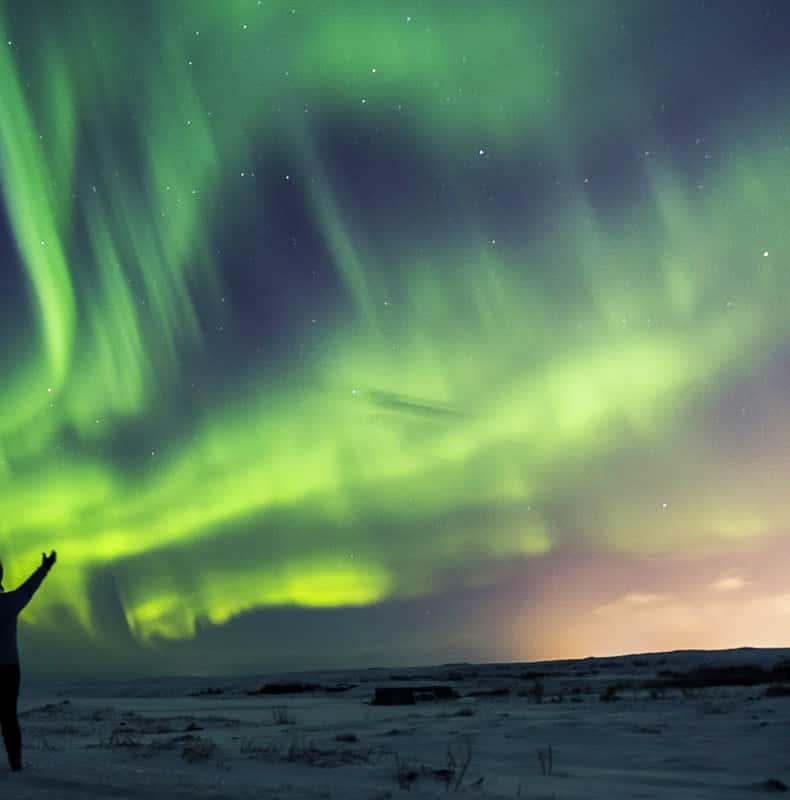
Set your expectations before you go outside. To the naked eye, a moderate aurora often looks like a pale grey-green glow or a faint arc low on the horizon, closer to drifting smoke than the saturated green curtains in photographs. Only a genuinely strong storm produces the vivid color and fast movement visible to the unaided eye; most nights reward patience with something quieter and still worth watching.
A camera sees more than your eyes do. A modern phone's night mode, or any camera capable of a multi-second exposure, gathers light the way your retina simply can't, pulling out color and structure invisible in real time. That gap between what you saw and what your photo shows isn't a broken camera or a lucky shot: it's how long-exposure photography works, the same principle behind how to photograph the Milky Way.
A handful of avoidable mistakes account for most disappointing first trips:
  • Chasing a single "guaranteed" night. No forecast is certain enough to bet an entire trip on one date; build in several nights instead.
  • Watching the Kp number and ignoring the clock. A great Kp reading at the wrong hour, well before magnetic midnight, can still produce a quiet sky.
  • Skipping the cloud forecast. The best geomagnetic storm in years is invisible under an overcast sky.
  • Giving up after twenty minutes. Aurora activity pulses in and out over an evening; a quiet stretch often precedes the best display of the night.
  • Expecting camera colors with your bare eyes. A faint grey-green glow that photographs as vivid green is a successful sighting, not a disappointing one.