
What a meteor shower actually is
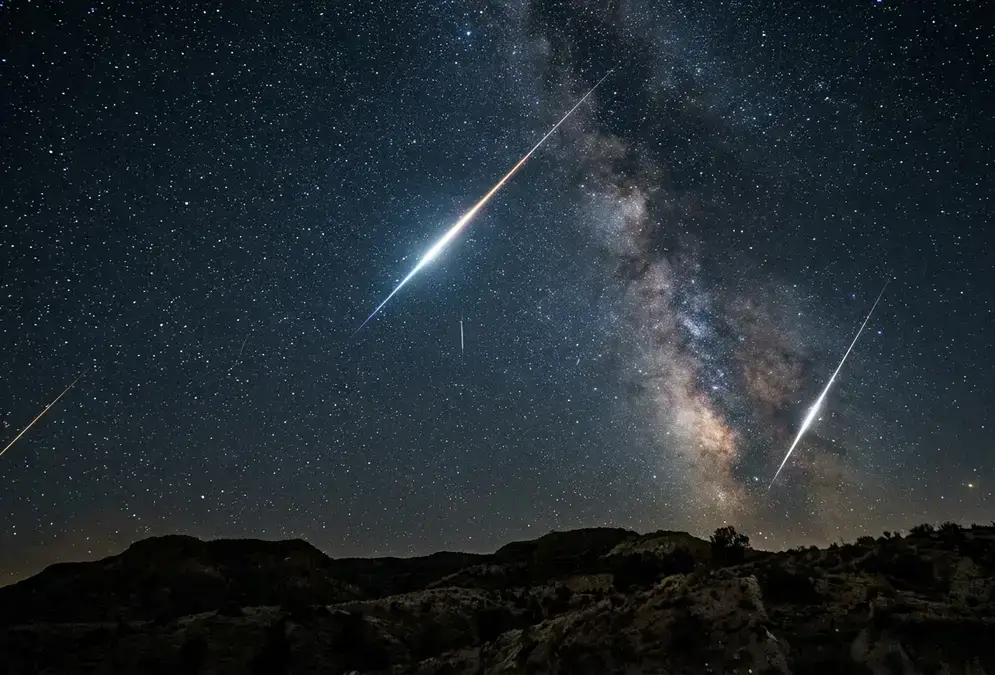
A meteoroid is a small fragment of rock or ice drifting through space, usually no bigger than a grain of sand or a pebble. When one hits Earth's atmosphere, friction burns it up in a fraction of a second at speeds that typically run somewhere between 11 and 72 kilometers a second depending on the geometry of the collision, and the streak of light you see is the meteor, commonly called a shooting star. Almost none of that fragment survives the trip. On the rare occasion a piece does reach the ground, it's called a meteorite, a separate and much rarer event than the meteors in a shower[1].
Meteor showers happen because Earth's orbit crosses a debris stream, a trail of dust and grit shed by a comet, or occasionally an asteroid, over thousands of past orbits. Earth passes through the same point in its own orbit at the same time every year, so the same debris stream lights up the same stretch of sky on close to the same calendar dates[2]. That repetition is the entire reason meteor showers are predictable instead of random.
Every shower is named for the constellation its meteors appear to stream from, called the radiant. Perspective causes this: the meteoroids in a stream travel on roughly parallel paths, and parallel lines converge to a single point when viewed from inside the stream, the same way railway tracks appear to meet at the horizon. The Perseids radiate from Perseus, the Geminids from Gemini, and the pattern holds for the rest of the calendar.
Not every meteor on a given night belongs to the shower, either. Sporadic meteors, ones with no connection to any known debris stream, streak across the sky in the background on any clear night of the year, shower or not. A genuine shower meteor is the one that, if you trace its path backward, points back toward the radiant.
The annual meteor shower calendar
Eleven showers make up the working meteor calendar most stargazers plan around. The dates below are windows, not fixed appointments: a shower's actual peak can land a day or two earlier or later than its long-term average, so check a current-year calendar from the American Meteor Society (AMS) or the International Meteor Organization (IMO) close to your travel date rather than trusting a number printed months in advance[3][4].
The table below lists each shower's peak window, approximate zenithal hourly rate (ZHR), and which hemisphere favors it most. (Each shower's specific parent comet or asteroid, the body responsible for shedding its debris stream, is named in its own event guide, linked below.) Treat the ZHR figures as the commonly cited ranges attributed to AMS and IMO, not a promise of how many meteors you'll actually count; the next section explains why the two numbers rarely match.
Three showers do most of the heavy lifting for casual stargazers. The Perseids in August combine a warm-weather peak with reliably high rates across most of the Northern Hemisphere. The Geminids in December post the year's highest ZHR and hold up better than most showers under mild light pollution, since so many of their meteors run bright. The Quadrantids in January reward anyone willing to brave the cold for a sharp, short peak that's easy to miss if you're not watching the calendar closely. For this year's exact peak nights, moon conditions, and best places to watch, see the Quadrantid meteor shower, Lyrid meteor shower, Eta Aquariid meteor shower, Perseid meteor shower, Orionid meteor shower, Leonid meteor shower, and Geminid meteor shower event guides.
| Shower | Peak (around) | ZHR (approx.) | Best hemisphere |
|---|---|---|---|
| Quadrantids | Jan 3-4 | 100-120 | Northern |
| Lyrids | Apr 21-23 | 10-18 | Northern |
| Eta Aquariids | May 5-6 | 40-60 | Southern favored |
| Southern Delta Aquariids | Jul 29-31 | 15-25 | Southern |
| Perseids | Aug 11-13 | Up to ~100 | Northern |
| Draconids | Oct 8-9 | ~5, highly variable (rare major outbursts) | Northern |
| Orionids | Oct 20-23 | 10-20 | Both |
| Taurids | Nov 5-12 | ~5, bright fireballs | Both |
| Leonids | Nov 17-18 | 10-15 normally (storm years historically reached thousands/hr) | Both |
| Geminids | Dec 13-14 | 120-150 | Northern (decent from South) |
| Ursids | Dec 21-22 | 5-10 | Northern |
How to watch a meteor shower: technique over gear
No equipment beats your naked eye for meteor watching, and that's not a beginner's compromise, it's the correct technique. Binoculars and telescopes narrow your field of view to just a few degrees, while a bright meteor can streak across a third of the sky in half a second. A wide, unaided view catches far more of them than any lens does.
Get away from light pollution before you get serious about counting meteors. City sky-glow buries every faint meteor and leaves only the brightest fireballs visible, so a dark-sky site an hour or more from town routinely shows three or four times as many meteors as the same shower seen from a suburban backyard. If you don't already know how to judge your own sky, stargazing for beginners covers reading a light-pollution map before you commit to a drive.
Timing matters almost as much as location. The hours after local midnight, running into the pre-dawn stretch, consistently beat the evening, because Earth's rotation carries your side of the planet into the direct path of the debris stream during those hours, sweeping up meteors head-on instead of catching them from behind[6]. The shower's radiant also climbs higher in the sky after midnight, putting more of each meteor's visible path above the horizon instead of clipped by it.
A dark-sky site an hour or more from town routinely shows three or four times as many meteors as the same shower seen from a suburban backyard.
Give your eyes 20 to 30 minutes to dark-adapt before you start counting, and skip the phone screen once you're out there: a red flashlight won't undo your dark adaptation the way white light will. Don't stare directly at the radiant. Look 45 to 60 degrees away from it instead, since meteors near the radiant appear short and foreshortened, while the same meteors seen off to the side streak longer and are easier to catch.
None of this matters if cloud rolls in at the wrong moment. Check a same-day forecast for your exact site rather than trusting one checked a week earlier, since a shower's peak night can turn out clear on paper and overcast in reality by the time it actually arrives.
Gear and comfort: what actually helps you last the night
Meteor watching needs less gear than almost any other stargazing activity, which is part of its appeal. No telescope, no binoculars, no camera required, just your eyes and patience.
A reclining chair or a thick blanket on the ground does more for your night than anything sold as dedicated meteor gear. Craning your neck upward for an hour is miserable and cuts a session short long before the meteors do. Lying back with a wide view of the sky is the difference between twenty minutes outside and two hours.
Dress for a colder night than the forecast suggests, even in August. Ground-level heat radiates away fast once the sun sets, and sitting still for an hour drops your body temperature further than walking around would, so bring more layers than feels necessary, plus something warm for your hands and a hat.
Budget 30 to 60 minutes minimum for a session, longer if you can manage it. Meteor rates arrive in clusters with quiet gaps between them, not as a steady drip, so a ten-minute glance from the back door shows most people nothing, shower or not. For a full rundown of what's actually worth packing beyond a chair and a blanket, stargazing packing list covers the rest.
Featured · Destination
Aoraki Mackenzie Stargazing
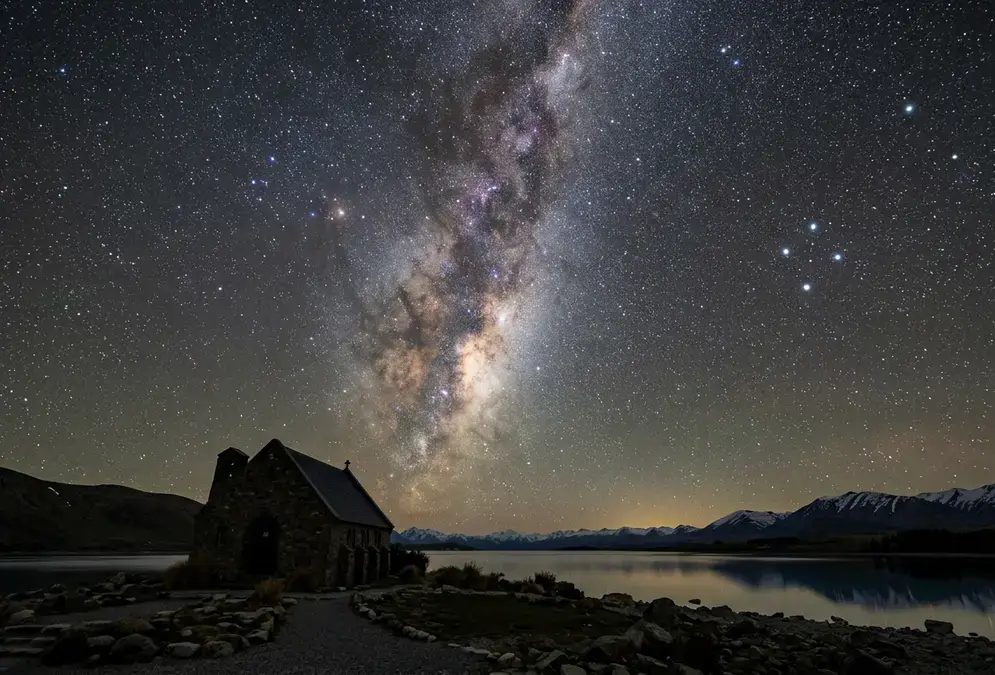
Aoraki Mackenzie is one of only four Gold Tier Dark Sky Reserves on Earth: Bortle 2 skies over Lake Tekapo, the Southern Cross, and Mount John Observatory tour.
If you'd rather capture meteors on camera than just watch them, a wide-angle lens on a tripod firing continuous 15 to 20 second exposures works far better than trying to time a single shot. How to photograph the Milky Way covers the camera settings that carry over directly to meteor photography.
Making sense of ZHR and why the Moon changes everything
The zenithal hourly rate (ZHR) is the number most shower calendars lead with, and it's the single most misunderstood figure in amateur astronomy. ZHR is a theoretical count of how many meteors a single observer would see in an hour under perfect conditions: the shower's radiant sitting directly overhead, a completely clear and moonless sky, and a pristine dark-sky site[5]. Almost nobody observes under all three conditions at once.
Real counts run well below the published ZHR for nearly every session, and that's normal, not a sign anything went wrong. A shower with a ZHR of 100 might realistically show 20 to 40 meteors an hour from a decent site with the radiant only partway up the sky, still a good night, just not the number printed on the calendar.
120-150 ZHR
The Moon is the biggest variable the ZHR figure leaves out entirely. A shower with a high ZHR near a full moon can underperform a much weaker shower happening near a new moon, because moonlight washes out every faint meteor and leaves only the brightest streaks visible. Check the moon phase before committing to a specific peak night; when to stargaze walks through reading a moon-phase calendar alongside a shower's peak date.
A quick way to sanity-check any peak date is to check that night's moon illumination. A slim crescent that sets before midnight leaves the sky dark for a shower's best hours regardless of the calendar date, while a bright gibbous moon up all night can quietly ruin an otherwise perfect peak.
Outbursts, hemispheres, and a disappointing night's most common causes
Not every shower favors the same half of the planet equally. The Eta Aquariids in May put on a noticeably better show from the Southern Hemisphere, where the radiant climbs higher before dawn, while the Quadrantids, Lyrids, Perseids, Draconids, and Ursids all favor the Northern Hemisphere[3]. The Orionids, Taurids, and Leonids perform reasonably well from either side of the equator.
The Taurids post one of the lowest ZHRs on the calendar, typically only around 5, but make up for it with an unusually high share of bright, slow fireballs[3], meteors dramatic enough to notice even through mild light pollution.
A handful of showers occasionally spike into a real meteor outburst, rates running far above their usual ZHR for a few hours, most notably the Leonids and Draconids[4]. These events are rare, largely unpredictable more than a few years out, and not something worth building an annual trip around. Treat the standard ZHR figures as the honest baseline and any outburst as a bonus, not an expectation.
Recommended tours
Tours are selected for quality, not commission. I earn a small fee if you book — at no extra cost to you.


Most disappointing meteor-watching nights trace back to the same handful of avoidable mistakes:
- Going out on or right around a full moon instead of checking the moon phase first
- Watching from a bright suburban or urban site instead of driving to a genuinely dark one
- Giving up after ten or fifteen minutes instead of the full 30 to 60 minutes a session actually needs
- Staring straight at the radiant instead of looking 45 to 60 degrees away from it
Fix the moon phase, the location, and the patience, and almost any shower on the calendar above is worth a night outside. For a longer list of dark, reliably clear places to do exactly that, best dark sky parks in the world is the next stop.