What a guided hunt buys you
A guide sells you mobility with someone else's attention on the road. The driver watches the ice and the reindeer; you watch the sky. One tour listed by Visit Rovaniemi promises to drive wherever the clearest skies are and to refund you or rebook if no aurora shows[4], which is a fair deal, though a refund repays your money and not your evening.
Treat a guarantee as a refund policy, not a forecast. Operators themselves describe a hunt as a lot of driving and waiting that rewards patience[5]. A guide cannot create a gap in the cloud; he can only reach one faster than a hotel balcony can.
What you give up is control. A minibus leaves a spot when the guide decides, and you share the dark with other people's headlamps. Activity-led evenings, where the aurora is a bonus on a husky, reindeer or snowmobile outing, hand you even less say over where you stand. Small-group and photography departures loosen the leash and cost more. Prices vary widely by operator and format, so check each operator's current rate.
Questions worth asking before you pay:
- How many people share the vehicle, and is there a cap?
- How far will the guide drive on a cloudy night, and who decides?
- What exactly is refunded or rebooked if the sky stays closed?
- Are warm clothing and a tripod provided, or do you bring your own?
A guide earns the fee on a marginal night, when a gap in the cloud is some distance away and you would not know which road leads to it.
What self-driving asks of you
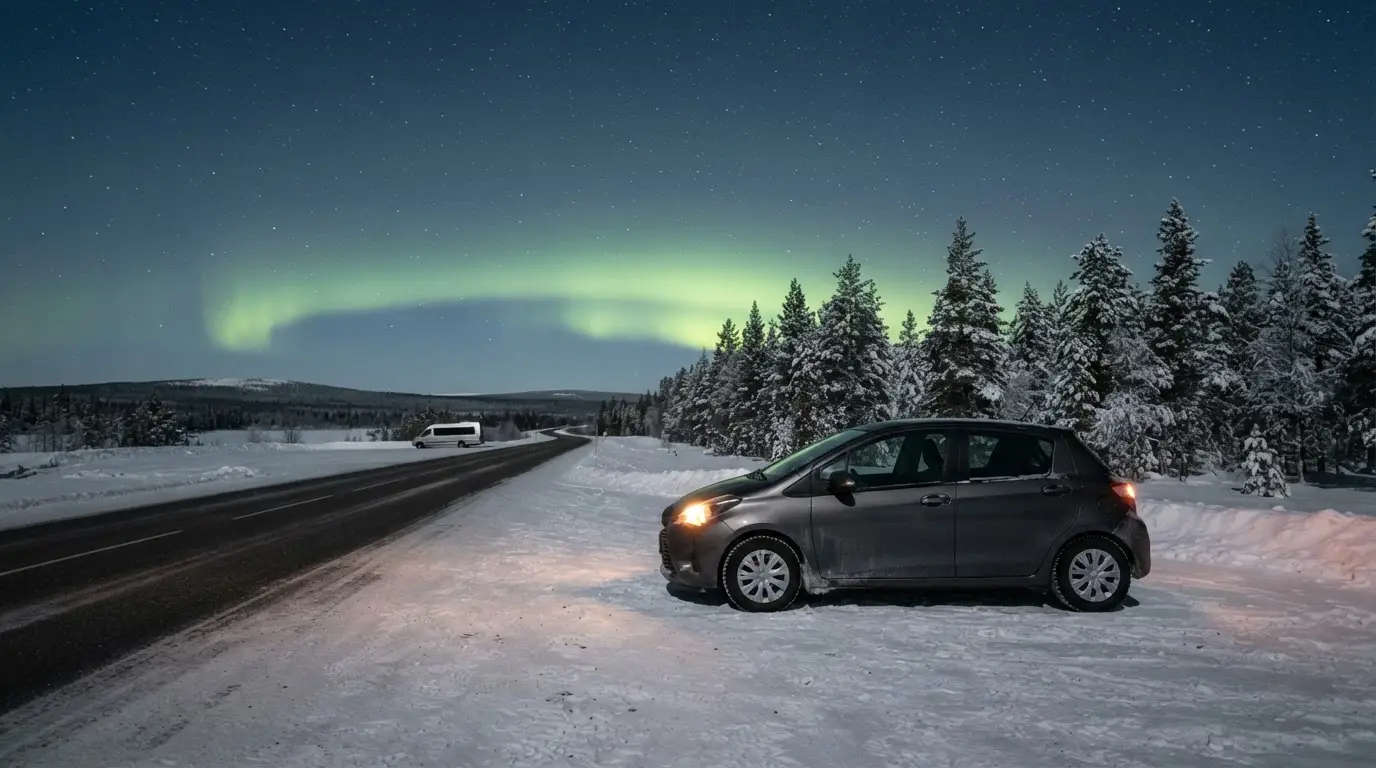
Self-driving trades a fee for responsibility. You get the sky on your timetable and the road in the dark, in winter, under unfamiliar rules. Nothing here is exotic. Most of it is paperwork and attention, and the attention is the part that runs out after a long evening in the cold.
Start with the licence. If it was issued in the EU or EEA, you are covered without further paperwork[6]; if it wasn't, check Traficom's rules for your own country's licence before booking, since a gap tends to surface at the worst moment, usually a roadside stop.
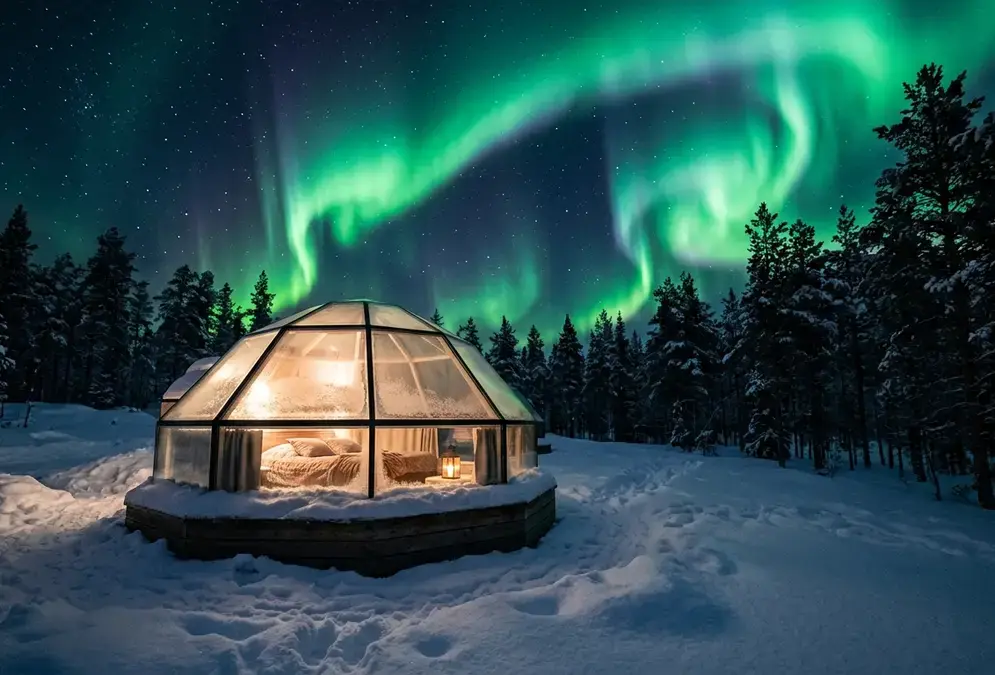
Featured · Destination
Northern Lights in Finnish Lapland
Finnish Lapland's whole-region aurora guide: glass igloos, Santa Claus Village, six bases from Rovaniemi to Inari, aurora season Sep–Mar, no road drama.
Then the tyres. Finland's winter-tyre rule is conditional, not calendar-fixed: winter tyres are to be used according to weather and driving conditions from 1 November to 31 March, and studs are allowed in that window[7]. Summer tyres are tolerated only where roads are not slippery, and the driver is responsible for having winter tyres in winter conditions[8]. If the tyres are studded, they must be on all wheels[9]. Non-studded winter tyres need the three-peak mountain snowflake marking, and since 1 December 2024 an M+S stamp alone no longer counts[10]. The legal tread minimum is 3 mm[11]. Ask what your rental is wearing and look at the rubber yourself.
Roads and reindeer
Finland's road-safety authority advises winter drivers to prefer main roads and not to trust a route planner alone[12]. That advice cuts against aurora chasing, which pulls you toward quiet back roads where the sky is dark and the traffic, and the help, is thin.
Reindeer are the other half of the problem. They graze freely along fells, forests and roadsides[13], and dusk and dawn are statistically the most accident-prone times[14], which is when an aurora chase starts and ends. A 2024 Reindeer Herders' Association release counted 4,000 to 5,000 reindeer injuries a year from train and car traffic in northern Finland, mainly in October, November and December[15]; read it as scale, not a count of crashes.
Drink and the morning after
Dinner is where self-drive plans usually fall apart. Police can make a driver with any detectable alcohol wait at the roadside, even below the legal limit[19]. The next day counts too: a hangover can leave you unfit to drive even when a meter would read zero[20].
An aurora night ends after midnight. A minibus lets you have the wine and the late finish; a rental does not.
What each option costs
I won't print tour prices, because rates move with season, group size and format, and no single figure would hold. The operator's live booking page is the only number worth trusting. What I can do is show where the money goes.
A guided hunt is a per-seat fee. Fuel, tyres, insurance and the tired driver are the operator's problem, and a private or photography-led departure costs more per head than a seat in a large group. That is the whole price tag, and its predictability is the point.
Self-drive is a per-car cost that arrives in pieces. Rental firms set their own terms on driver age, how long you have held your licence, deposit and insurance excess, so read them before comparing headline daily rates. Then add fuel: petrol 95 averaged EUR 2.1 a litre across Finland in July 2026[21], and a chase is a night of detours and idling, not a straight line. Stations can be few and far between in rural areas[22], so a half-full tank is a planning error.
Because a rental is charged per car and a tour per seat, the comparison turns on your own numbers. Multiply the per-seat price by your group size and by the number of chase nights, then set that against the rental quote you actually get, with fuel and the insurance excess added. A solo traveller on a short stay is weighing one seat against a whole car; a group holding a car for the whole trip after getting to Rovaniemi is weighing many seats against one.
Flexibility: chasing clear sky on your own schedule
Flexibility is the strongest case for driving yourself. The decision to go, wait or bail at 10 pm is yours, not the operator's at 6. Aurora is visible around Rovaniemi from late August until mid April[23]; inside that window, cloud is the variable you can drive around and storm strength is the one you cannot.
Rovaniemi is not the only base, and the odds improve as you go north. The Finnish Meteorological Institute puts three nights in four as auroral in northern Lapland, the Kilpisjärvi–Utsjoki area, if the sky is clear enough[24], against every second night in Sodankylä[25]. The catch is distance: Saariselkä is about 260 km by road from Rovaniemi[26] and Inari about 340 km[27]. Chasing that far from a Rovaniemi hotel means a long drive back after midnight, so if the odds matter more than the city, sleep further north and chase from there.
Recommended tours
Tours are selected for quality, not commission. I earn a small fee if you book — at no extra cost to you.
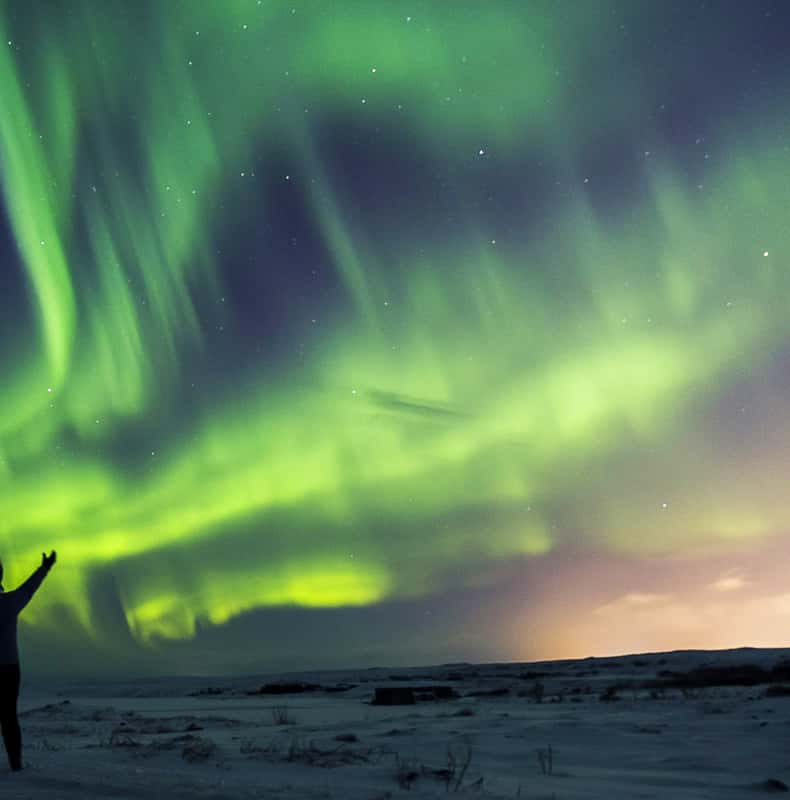
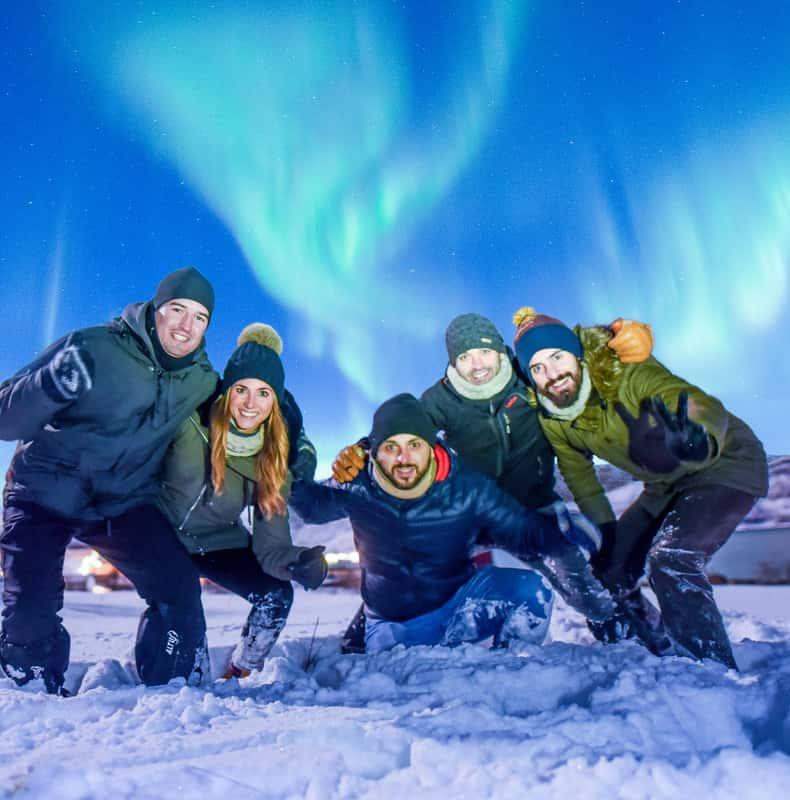
Pair the aurora forecast for Lapland with road data before you commit to a drive. Fintraffic's open data includes more than 470 road weather cameras[28], and its traffic service shows live road conditions and camera views in one place[29]. A clear patch on a cloud map says nothing about whether the road to it is passable. The camera does.
A good guide still beats you in your first week at one thing: knowing which pull-off has the open northern horizon and which road gets cleared. You are guessing; they are not. The compromise is to scout a few spots in daylight and set a turnaround time before you leave, then keep to it.
Do not stop in the carriageway
Finland's road-safety authority asks anyone looking for northern lights to keep their own safety and other road users' in mind[30]. In practice: pull fully into a lay-by or car park, never leave a dark car unlit on the shoulder, and keep the tripod off the road.
Who should book which, and the middle path
The hybrid is the one I'd pick for most trips: rent the car, drive between spots you have scouted, and book a single guided night as insurance. Visit Rovaniemi lists a packaged version, a self-drive product that bundles a car with curated viewing spots and photography tools[31].
Scout the places from the best northern lights spots in Lapland in daylight, when you can see the lay-by and the horizon. In polar night that window is only a few hours around midday[32], so do it on your first afternoon, not your last. I haven't seen an aurora in person yet; the Arctic trip I keep costing has exactly one guided night in it, as cover against a bad local forecast, and every other night self-led.
A quick way to decide:
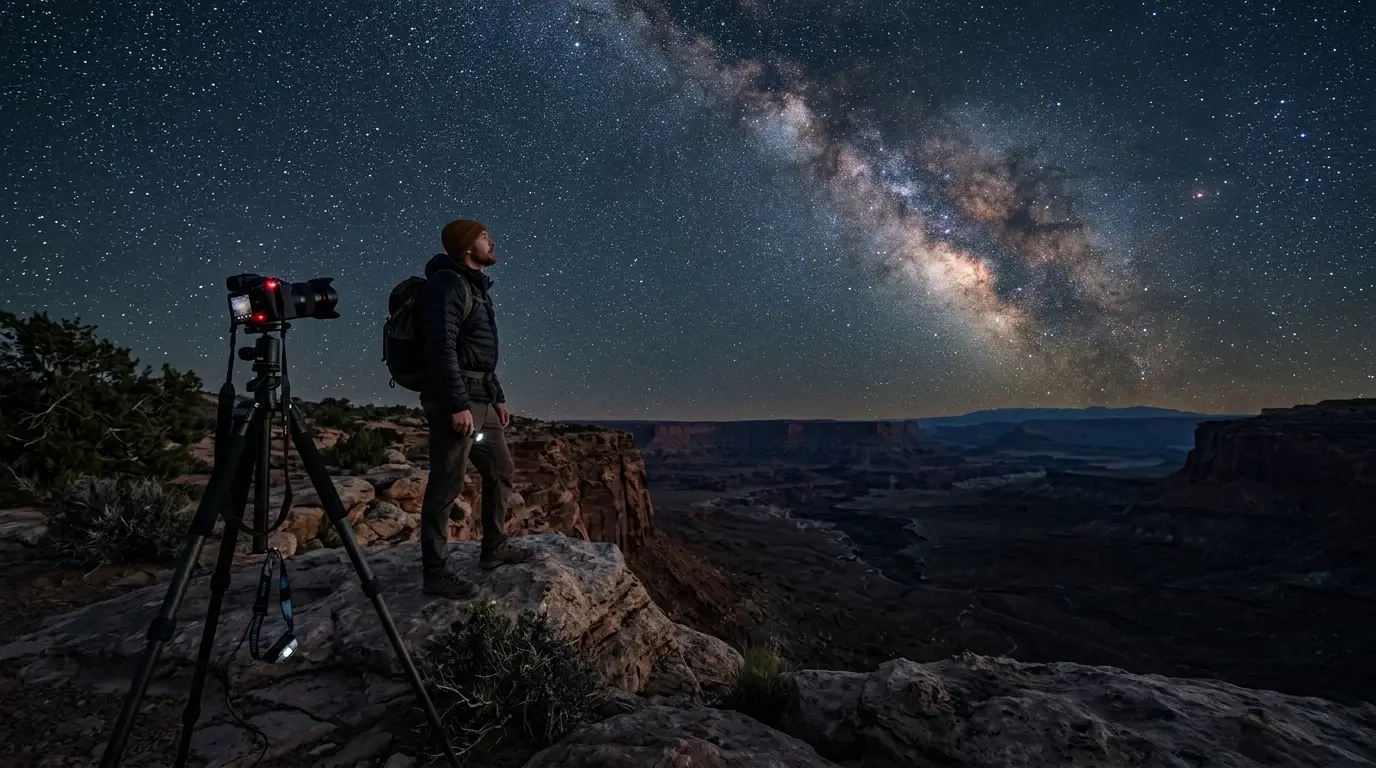
Featured · Article
What Is Astrotourism? The Complete Beginner's Guide
Astrotourism means travel built around dark skies: meteor showers, auroras, the Milky Way. What it means, where to go, and how to plan your first trip.
- Book the guide if this is your first aurora trip, you will drink at dinner, or you have never driven on snow.
- Drive yourself if you have four or more nights, you are at ease on winter roads, and you want to stay put at a spot you like.
- Split it if you are unsure: one guided night first, then your own nights once you have seen how a hunt works.
| Criterion | Guided hunt | Self-drive |
|---|---|---|
| Cost structure | Per seat, set by the operator | Per car, plus fuel; rental terms vary |
| Who handles the road | The guide | You, in the dark |
| Flexibility | The group follows the guide's call | Your call, at any hour |
| Reindeer and ice risk | Carried by the operator | Carried by you |
| After a late dinner | Fine, you are a passenger | Drink-drive rules apply to you |
If the thought of a late drive on an untreated road makes you tense, book the guide and don't apologise for it. If you are comfortable on snow and have the nights to spare, drive.