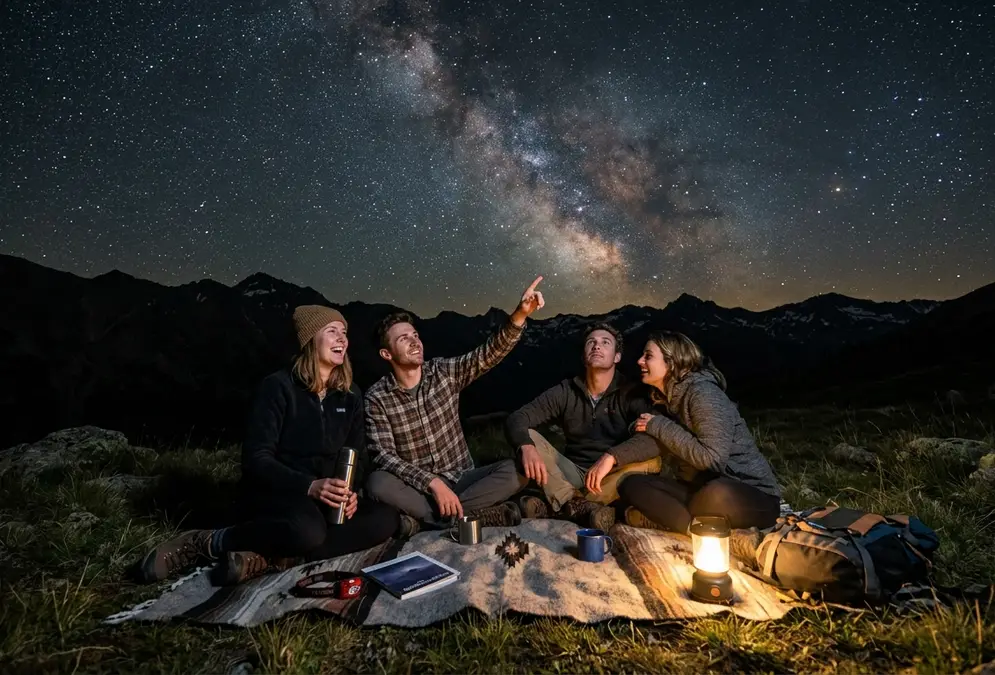
2-3 night itinerary
Your First Dark-Sky Weekend: A 3-Night Star Plan
The easiest way into stargazing: pick a dark site within a couple hours' drive, time it to the new moon, and follow a simple night-by-night plan. You don't need a telescope, and you don't need to leave the country.
Written by
Maya Okonkwo I've seen dark skies firsthand in the Atacama altiplano, Namibia's NamibRand Nature Reserve, and Morocco's Merzouga dunes; every other destination I write about is built from measured Bortle and SQM data, cloud climatology, and primary sources like park services and the International Dark-Sky Association.
Updated Published
Most first stargazing trips fail for one reason, not a bad sky but too little planning aimed at the wrong things. You don't need a Bortle 1 sanctuary on the far side of the world, and you don't need a telescope sitting in the trunk. You need a site dark enough to matter, a weekend that lines up with the new moon, and a clear idea of what to actually look at once you're standing in the dark. This itinerary covers all three, built for a first trip of two or three nights rather than a five-night expedition.
If you want the underlying mechanics first, dark adaptation, the Bortle scale, and why binoculars beat a telescope on night one, read stargazing for beginners before or after this trip. This page is the trip itself: where to go, when to go, what to pack, and what to do each night.
Before you go
- Gear: no telescope needed. A red flashlight and a pair of 7x50 or 10x50 binoculars cover almost everything a first weekend calls for.
- Site: aim for Bortle 4 or darker. A 30 to 60 minute drive out of a mid-sized city commonly drops two or three Bortle classes.
- Timing: book within about five nights of a new moon. Check a moon-phase calendar before you check the weather forecast.
- Cold: night air runs colder than it feels from indoors, and standing still for two or three hours makes it feel colder still. Pack a real layer, even in summer.
Pick a nearby dark site
Location beats gear, every time. Streetlight glow doesn't just add haze on the horizon, it raises the whole sky's brightness until the Milky Way and fainter stars disappear into a flat gray wash, no matter how good your eyes are. Astronomers describe that wash with the Bortle scale, a nine-point ranking from Class 1 (a pristine site dark enough for the Milky Way to cast a faint shadow) to Class 9 (a downtown core where only the Moon and a handful of the brightest planets survive the glow).
You don't have to guess your Bortle class. A light-pollution map like lightpollutionmap.app overlays Bortle ratings on satellite imagery of Earth's night-time lights, so you can compare your backyard against a spot forty minutes down the road before you drive anywhere. That drive is usually worth taking: leaving a mid-sized city and heading 30 to 60 minutes toward open country commonly drops you two or three Bortle classes, often the exact difference between a flat, washed-out sky and one where the Milky Way actually shows up. A Bortle 4 site within two hours of most cities is a realistic target for this trip, no remote expedition required. If a first taste convinces you to plan a bigger trip around a certified destination later, the best dark sky parks in the world covers sites worth a special journey rather than a short evening drive. A short trip doesn't rule out somewhere distinctive, either: Sark, the world's first Dark Sky Island, earned that reputation with no cars and no streetlights at all, and it's reachable by a 50-minute ferry from Guernsey rather than a long-haul flight.
Time it: the new-moon window
Moon phase decides more about your weekend than the forecast does. A full moon is bright enough to wash out faint stars, dim meteors, and any hint of the Milky Way, even from a genuinely dark Bortle 2 site. A new moon does the opposite: no moonlight competing with starlight, so objects that vanish on a bright night are suddenly there. Check a moon-phase calendar (timeanddate.com covers any location) for the new moon closest to your planned dates, then build the weekend around it rather than around whichever Saturday happens to be free.
Once you're on site, wait for true darkness before judging the sky. Sunset isn't dark enough: astronomical twilight ends when the sun drops 18 degrees below the horizon, usually 30 to 60 minutes after sunset depending on your latitude and the season. Faint stars and the Milky Way stay washed out until that line passes, no matter how patient you've been.
Two nights a year need no planning beyond a clear sky and no moon: meteor showers. The Perseids peak around August 11 to 13, typically producing 50 to 100-plus meteors an hour under a dark sky, and the Geminids peak around December 13 to 14, widely considered the year's best shower, with rates reaching up to 150 an hour. If your weekend happens to land near either date, build the whole trip around it: no telescope helps you see a meteor, just a reclining chair, a blanket, and dark-adapted eyes pointed up.
Pack light: what you actually need
Leave the telescope at home. A pair of 7x50 or 10x50 binoculars gathers far more light than your eye alone, resolves Jupiter's four largest moons as tiny points, sharpens lunar craters along the terminator, and turns the Pleiades from a smudge into a real star cluster, all with zero setup time and nothing to break. Pair them with a red flashlight, or a white one wrapped in red cellophane, so you can read a star chart or find dropped keys without erasing the 20 to 30 minutes it took your eyes to dark-adapt in the first place.
Beyond that, keep the list short: warm layers regardless of season, since standing still after dark feels colder than the thermometer suggests; a reclining chair or blanket, since neck-craning gets old fast; a free app like Stellarium, or a battery-free planisphere, to tell you what's up before you find it; and snacks or a thermos, since the best sessions run long once your eyes adjust and the sky opens up.
If a hobby is forming rather than just a weekend, two upgrades are worth reading about before you buy anything: the best telescope under $300 once binoculars start to feel limiting, and how to photograph the Milky Way if you'd rather bring home a photo than just a memory. Neither is required for this trip.
“I don't know any sight in nature that's more inspiring than a dark, star-filled night sky”
Your night-by-night plan
N1
Night 1: arrive, dark-adapt, get your bearings
Low pressure, short session, no agenda beyond finding your feet
Get to your site well before dark, set up your chairs while there's still light to see by, and eat before the session rather than during it. As dusk turns to real dark, give your eyes 20 to 30 minutes of uninterrupted darkness, no phone screen, before you judge what you can see. That window is non-negotiable: check a bright screen at minute fifteen and the clock restarts.
Once adapted, start easy. If the Moon is up and not too bright, look along its terminator, the line between light and shadow, for crater detail sharp enough to surprise a first-timer. Identify a planet by its steady, unflickering glow (stars twinkle, planets mostly don't), and pick one constellation, the Big Dipper year-round in the Northern Hemisphere, Orion in winter, the Summer Triangle in summer, to anchor yourself for the rest of the weekend. Keep it short if travel has left you tired. Two more nights are coming.
Don't chase the Milky Way on night one
You're still learning the site and your own dark adaptation. Save the deeper targets for night two, once you're comfortable with what's around you.
N2
Night 2: the marquee night
Closest to the new moon, and the night this whole weekend is built around
By now your eyes know the drill and the site no longer feels unfamiliar, so push further. Bring the binoculars to bear on the Moon's terminator for real crater relief, hunt Jupiter's four Galilean moons as tiny points strung alongside the planet, and find the Pleiades star cluster, a smudge to the naked eye that resolves into dozens of individual stars through glass. Try averted vision: look slightly to the side of a faint object instead of straight at it, since the light-sensitive rod cells in your peripheral retina catch dim light your central vision misses.
If your site is Bortle 4 or darker and it's the right season, roughly May through August in the Northern Hemisphere and the opposite months south of the equator, look for the Milky Way's galactic core: a bright, dusty band rising from the horizon, sometimes bright enough on the darkest sites to hint at real structure. If a meteor shower falls inside your window, spend twenty or thirty minutes just reclining and watching; nothing about a meteor rewards a telescope or binoculars, only a clear sky and patience.
N3
Night 3 (optional): slow down and decide
The stretch night, if you booked three, for revisiting favorites without an agenda
If you have a third night, treat it as a reward lap rather than a checklist. Revisit whatever impressed you most on night two, whether that's a planet, a cluster, or the Milky Way, and spend longer at it than you allowed yourself the first time. This is also the easiest night to try a phone photo: modern smartphones shoot a recognizable Milky Way shot in Night mode with nothing more than a small tripod and a manual focus on the brightest star in frame.
Use the drive home to decide whether this was a one-off weekend or the start of something. If it's the latter, that's the moment a telescope purchase actually makes sense, once you know roughly what you like looking at and how often you'll go back outside to look at it.
Frequently asked questions
Do I need a telescope for my first dark-sky weekend?
No, and buying one before this trip is the most common way beginners waste money. A pair of 7x50 or 10x50 binoculars needs no setup, no collimation, and no learning curve, and it already resolves lunar craters, Jupiter's four largest moons, and star clusters that look like a smudge to the naked eye. Save the telescope decision for after you know you'll keep going back outside; my guide to the best telescope under $300 is there when that day comes.
How far do I need to drive to find a dark enough sky?
There's no fixed number, but 30 to 60 minutes out of a mid-sized city commonly drops you two or three Bortle classes, often the difference between a washed-out sky and a genuinely dark one. Check a light-pollution map like lightpollutionmap.app before you drive anywhere; it overlays Bortle ratings on satellite imagery so you can compare a few candidate sites from your couch. Aim for Bortle 4 or darker if you want a real shot at the Milky Way.
How do I find the new moon date for my trip?
Check a moon-phase calendar, timeanddate.com covers any location worldwide, for the new moon closest to your planned weekend, then count backward from there before you book. Plan to arrive within about five nights of that date on either side; once the moon is more than half lit, its glow starts washing out fainter stars and the Milky Way even from a genuinely dark site.
What should I look at on the very first night?
Give your eyes 20 to 30 minutes of uninterrupted darkness before judging what you can see, using only a red flashlight if you need light at all. Once adapted, start with the Moon if it's up (look along the terminator, the line between light and shadow, for crater detail), then find a planet by its steady, non-twinkling glow, and pick one easy constellation, the Big Dipper or Orion depending on the season, to get your bearings.
What if the forecast turns cloudy on my planned night?
Check a clear-sky forecast for your exact site, not just the nearest town, the same day you plan to go; a thin high haze that looks harmless from a window can flatten contrast on stars you'd otherwise see easily. This is the real argument for booking two or three nights instead of one: a spare night roughly doubles your odds of catching at least one clear sky inside your new-moon window.
Will I actually be able to see the Milky Way on a beginner weekend?
It depends on season and site darkness more than skill. The galactic core, the brightest, most photogenic part of the Milky Way, sits highest overhead roughly May through August in the Northern Hemisphere and the opposite months south of the equator. You'll also need a Bortle 4 sky or darker for the core to show real contrast; a Bortle 5 to 6 site closer to town still gives you excellent views of the Moon, planets, and brighter star clusters even if the core stays faint.
Further reading