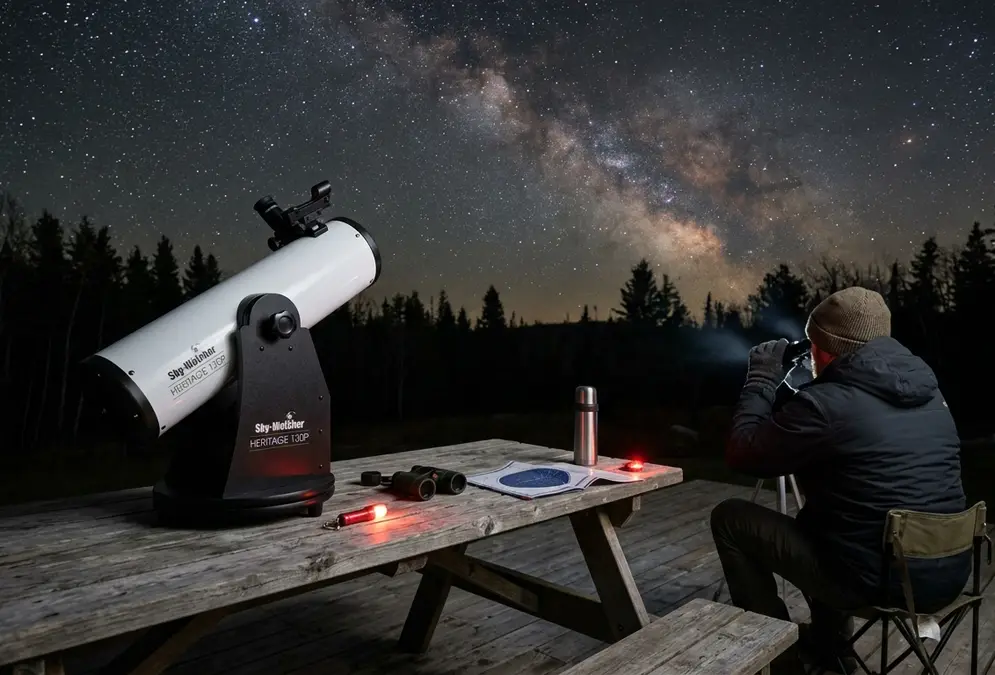
Sky-Watcher Heritage 130P tabletop Dobsonian, the best telescope under 300 dollars, set up on a table under a dark starry night sky

Best Telescope Under $300: What Actually Matters

A 130mm Dobsonian outperforms any $300 refractor for light-gathering power. Here's which telescopes are worth buying, which specs matter, and what to skip.

Our top pick

Sky-Watcher Heritage 130P

Best overall

The Sky-Watcher Heritage 130P wins because its 130mm mirror gathers roughly three and a half times the light of a 70mm refractor, at a street price of $200 to $300 that undercuts its own $305 list price. Its tabletop Dobsonian mount is inherently steadier than an aluminum tripod at this budget, and its forgiving f/5 optics won't punish a beginner's imperfect collimation.

A 130mm mirror gathers roughly 3.5 times the light of a 70mm lens: aperture decides what you'll see, not the magnification printed on the box.

Runner-up: Celestron PowerSeeker 127EQ, the most aperture on this list on a steeper equatorial mount.

The best telescope under $300 is a tabletop Dobsonian, not a refractor on a tripod. Aperture is the spec that actually determines what you will see, and a 130mm Dobsonian gathers more light than any refractor at this price. Every all-in-one kit at a big-box store advertises the same three lies: a magnification number in the hundreds, a paper-thin tripod, and a lens cap sturdier than the optical tube. None of that matters. Three specs decide whether a budget telescope is worth owning: aperture, useful magnification, and mount stability.

Aperture is the diameter of a telescope's main lens or mirror, measured in millimeters, and it is the single spec that determines how much you will actually see. Light-gathering power scales with the square of aperture, not the diameter itself, so a 130mm mirror collects roughly three and a half times the light of a 70mm lens, not just twice as much. Bigger aperture also resolves finer detail and reveals fainter deep-sky objects: star clusters, galaxies, nebulae. Magnification is a function you control with eyepieces; aperture is fixed the day you buy the scope. Buy the aperture, not the box art.

Magnification is aperture-dependent too, just not the way the box claims. The rule amateur astronomers actually use: useful magnification tops out at roughly 1.5 to 2 times the aperture in millimeters. A 130mm scope has a realistic ceiling around 195x to 260x, on a very good night, with steady air and good optics. Push past that and you are just magnifying blur: atmospheric turbulence and the mount's own wobble degrade the image faster than more magnification can reveal detail. A 130mm Dobsonian at 150x, in focus, on a still night, shows more of Saturn's rings than the same scope wobbling at 675x ever will.

Focal ratio is the focal length divided by the aperture: a scope with a 650mm focal length and 130mm aperture is f/5. Lower focal ratios, f/4 to f/6, give wider fields of view and forgiving eyepiece requirements, exactly what a beginner wants for sweeping the Milky Way or hunting star clusters. Higher focal ratios, f/10 and up, suit close-up planetary and lunar viewing but need pricier eyepieces to feel comfortable. None of that matters if the mount shakes. A tabletop Dobsonian's low center of gravity and simple rocker-box design make it inherently more stable than an aluminum tripod at the same price, which is the real reason experienced buyers point beginners toward Dobsonians first.

Ranked list

How we chose

The places on this list were selected against the following editorial criteria.

  • Aperture in millimeters, not the magnification number on the box: light-gathering power scales with the square of the aperture, so a 130mm mirror gathers roughly three and a half times the light of a 70mm lens.
  • Useful magnification tops out around 1.5 to 2 times the aperture in millimeters. A 130mm scope realistically reaches 195x to 260x on a very good night; anything advertised well past that for a given aperture is a marketing number.
  • Focal ratio (focal length divided by aperture): f/4 to f/6 gives a wider field of view for sweeping star fields, f/10 and up suits close-up planetary and lunar viewing.
  • Mount stability matters as much as optics. A tabletop Dobsonian's low center of gravity beats a wobbly aluminum tripod at the same price.

All picks at a glance

  • Sky-Watcher Heritage 130P

    Best overall
    Price
    $200–$300 street
    Why it makes the list
    130mm f/5 tabletop Dobsonian, sets up in under a minute, no tripod needed
  • Celestron PowerSeeker 127EQ

    Best aperture value
    Price
    $199.95
    Why it makes the list
    127mm aperture on an equatorial mount, the most glass on this list
  • Celestron AstroMaster 70AZ

    Best zero-maintenance pick
    Price
    $199.95
    Why it makes the list
    70mm refractor, sealed tube, never needs collimation
  • Sky-Watcher Heritage 150P

    Best if stretching budget
    Price
    ~$355
    Why it makes the list
    150mm tabletop Dobsonian, 20mm more aperture than the 130P
  • Celestron StarSense Explorer DX 130AZ

    Best app-guided on sale
    Price
    $374–$440 street
    Why it makes the list
    StarSense app plus manual alt-az mount with slow-motion controls, 130mm
  • Celestron StarSense Explorer 130mm Dobsonian

    Best app-guided Dobsonian
    Price
    $479.95
    Why it makes the list
    StarSense app on a 130mm tabletop Dobsonian, no tripod
  • Orion SkyScanner 100

    Best ultralight (legacy)
    Price
    Why it makes the list
    Smallest, lightest tabletop reflector on this list, one-handed carry
  • Zhumell Z130

    Best secondhand alternative
    Price
    Why it makes the list
    Budget clone of the Heritage 130P, now hard to find new

Reporter notebook

Insider tips

Pairing tip

Buy a red headlamp with the telescope

The Celestron Night Vision Red Headlamp is a safe default: a true red-only LED around 620 to 630 nanometers, no white-light mode to fumble in the dark, and a typical price of $20.95. A single flash of white light resets 20 to 30 minutes of dark adaptation almost instantly, so a dual-mode camping headlamp with a white setting is a real risk at an eyepiece.

What to bring

Add these before anything else

A red-dot finder (most scopes on this list include one), one wide-field eyepiece in the 24mm to 32mm range, and a simple planisphere cover almost everything a first-year observer actually reaches for. None of them need a battery except the finder, and none of them replace the telescope, they just make it easier to use.

In this guide

8 places
  1. Sky-Watcher Heritage 130P

    Best overall

    $200–$300 street

    The Sky-Watcher Heritage 130P remains the scope most experienced amateur astronomers point beginners toward first. It is a 130mm reflector on a collapsible tabletop Dobsonian mount that sets up in under a minute on a picnic table, car hood, or porch railing. Sky-Watcher officially lists it at $305, but street price at most authorized dealers commonly runs $200 to $300, comfortably inside budget once you shop around rather than buying at list. At f/5, it is forgiving of imperfect collimation and shows a wide enough field for sweeping star fields, with enough aperture for Saturn's rings, Jupiter's cloud bands, and a long list of brighter deep-sky objects.

    Pros

    • Collapsible tabletop design, no tripod needed
    • Forgiving f/5 optics for beginners
    • Shows Saturn's rings and Jupiter's cloud bands

    Cons

    • Official list price of $305 is over budget without shopping around
  2. Celestron PowerSeeker 127EQ

    Best aperture value

    $199.95

    The Celestron PowerSeeker 127EQ puts 127mm of aperture, the most of any model on this list, on an equatorial mount instead of a simple alt-azimuth rocker box, officially priced at $199.95. Equatorial mounts track the sky's rotation more naturally once aligned with the celestial pole, which planetary observers like, but the learning curve is steeper: expect a frustrating first evening before polar alignment clicks. Its larger aperture makes it the better all-around second choice behind the Heritage 130P.

    Pros

    • Most aperture of any model on this list
    • Stays under $300 at official price

    Cons

    • Equatorial mount has a steeper learning curve
    • Expect a frustrating first evening before polar alignment clicks
  3. Celestron AstroMaster 70AZ

    Best zero-maintenance pick

    $199.95

    The Celestron AstroMaster 70AZ is a 70mm refractor on a simple alt-azimuth mount, officially priced at $199.95. It has smaller aperture than any Dobsonian on this list, but a sealed optical tube that never needs collimation, which matters if you want something you can hand to a kid and never touch again. It earns its place for anyone who wants zero maintenance over maximum light-gathering.

    Pros

    • Sealed optical tube never needs collimation
    • Simple alt-azimuth mount, no learning curve
    • Stays under $300 at official price

    Cons

    • Smallest aperture of any Dobsonian on this list
  4. Sky-Watcher Heritage 150P

    Best if stretching budget

    ~$355

    The Heritage 150P is the Heritage 130P's bigger sibling: a 150mm reflector on the same collapsible tabletop Dobsonian mount, no tripod required. It now officially lists around $355, solidly over $300, but the extra 20mm of aperture over the 130P captures noticeably more deep-sky detail. If your budget has fifty extra dollars of give, it is worth stretching for.

    Pros

    • 20mm more aperture than the Heritage 130P
    • Same collapsible tabletop Dobsonian mount, no tripod

    Cons

    • Lists around $355, over the $300 budget
  5. Celestron StarSense Explorer DX 130AZ

    Best app-guided on sale

    $374–$440 street

    The Celestron StarSense Explorer DX 130AZ adds the StarSense phone-cradle app to a manual alt-azimuth mount with dual-axis slow-motion controls, not a motor: you still nudge the tube by hand, the slow-motion knobs just make fine adjustments smoother. Official price is $499.95, with street pricing more commonly $374 to $440. If you find it discounted into that range, it is worth stretching for; at full price, either core pick above shows more sky per dollar.

    Pros

    • StarSense app guides you to targets
    • Dual-axis slow-motion controls for fine aiming

    Cons

    • Official price of $499.95 is well over budget
    • Still nudged by hand, not motorized
  6. Celestron StarSense Explorer 130mm Dobsonian

    Best app-guided Dobsonian

    $479.95

    The Celestron StarSense Explorer 130mm tabletop Dobsonian pairs a similar 130mm-class reflector with a phone-cradle app that overlays where to point the tube, using your camera and star-recognition software. It is manual, not motorized, so you still aim the scope by hand; the app just replaces star-hopping charts for beginners who find them intimidating. It now officially lists at $479.95, well over $300, so it belongs on a wish list rather than a core pick.

    Pros

    • StarSense app replaces star-hopping charts
    • 130mm-class reflector on a tabletop Dobsonian

    Cons

    • Lists at $479.95, well over the $300 budget
  7. Orion SkyScanner 100

    Best ultralight (legacy)

    The Orion SkyScanner 100 was a longtime favorite: the smallest, lightest tabletop reflector on this list, easy to carry one-handed. It has grown hard to find at retail over the last couple of years, so treat any listing you find as legacy stock only, not a current production model.

    Pros

    • Smallest, lightest tabletop reflector on the list
    • Easy to carry one-handed

    Cons

    • Grown hard to find at retail
    • Any listing found is legacy stock only, not current production
  8. Zhumell Z130

    Best secondhand alternative

    The Zhumell Z130, a longtime budget favorite nearly identical to the Heritage 130P, has also become hard to find at retail. If you spot either the Zhumell or the SkyScanner listed secondhand, compare the price carefully against a new Heritage 130P before buying.

    Pros

    • Nearly identical optics to the Heritage 130P
    • Historically a budget favorite

    Cons

    • Also grown hard to find at retail
    • Compare secondhand price carefully before buying

Every scope in this list is real and currently sold, though a couple of once-cheap favorites now cost more than they used to, and one has effectively gone out of production. New tariffs on imported optics from China pushed manufacturer prices up across the board this cycle, which is the honest reason a few models that used to be easy budget picks no longer are. Treat every price above as a snapshot, not a quote, and check the manufacturer's current listing before you buy.

Skip anything that leads with magnification on the box. If a listing's headline number is 525x or 675x rather than the aperture in millimeters, that is a marketing telescope, built to look impressive in a photo and disappoint at the eyepiece. Real astronomy retailers lead with aperture and focal ratio; department-store kits lead with a magnification number because it is the only spec that sounds big.

A few other things are not worth your $300. A long refractor on a flimsy aluminum tripod looks like real astronomy gear in a box photo, but the tripod shakes at the slightest touch and the narrow aperture shows little beyond the Moon and bright planets. A motorized GoTo mount is genuinely useful once you know the sky, but on a first scope it usually means less money spent on aperture and more on a motor and hand controller you do not yet need; learn to star-hop first and add GoTo later if you want it. The bundled eyepieces in ultra-cheap kits, a 4mm eyepiece paired with a 3x Barlow lens, are exactly how inflated magnification numbers get printed on the box, and both pieces are usually the cheapest glass the manufacturer could source. And skip a plain white flashlight or your phone's screen at full brightness at the eyepiece: it undoes twenty minutes of dark adaptation in under a second, which is exactly why a dedicated red headlamp belongs on the accessory list, not the skip list.

None of these mistakes are really about the telescope. They are sequencing problems: get the expectations right before you buy, and the gear underneath is usually fine.

Once you have the scope, timing matters almost as much as aperture. Saturn and Jupiter both reach opposition once a year, the night each planet sits closest to Earth and shows its largest, brightest disc, and that's the best night to point a budget Dobsonian at either one. Check Saturn at opposition and Jupiter opposition for this year's exact dates before planning a planet-watching session.

Frequently asked questions

What's the best telescope under $300 for a beginner?

For most beginners, the Sky-Watcher Heritage 130P is the best telescope under $300 at street price: a 130mm tabletop Dobsonian that collapses for storage, needs no tripod, and shows Saturn's rings, Jupiter's moons, and a long list of star clusters and nebulae. Sky-Watcher's official price is $305, but street price at authorized dealers commonly runs $200 to $300. For a model that stays under $300 at full official price with no shopping around, the Celestron PowerSeeker 127EQ or AstroMaster 70AZ (both $199.95) are excellent alternatives.

What is aperture and why does it matter more than magnification?

Aperture is the diameter of a telescope's main lens or mirror, and it determines how much light the scope can gather. Light-gathering scales with the square of aperture, so a bigger mirror doesn't just show a slightly brighter image, it reveals genuinely fainter objects a smaller scope can't collect enough light to show at all. Magnification just enlarges whatever light the aperture has already gathered.

Why isn't magnification the most important spec on a telescope?

Because magnification is limited by aperture and by the atmosphere, not by the eyepiece you screw in. Useful magnification tops out at roughly 1.5 to 2 times the aperture in millimeters; beyond that, you're magnifying blur, not detail. A '675x' number on a department-store box describes a combination no mount can hold steady and no atmosphere will support.

Should I buy a Dobsonian or an equatorial-mount telescope?

For a first telescope under $300, a Dobsonian is almost always the better choice. It's a simple alt-azimuth mount, up-down and left-right, with no polar alignment required, so you spend your first sessions looking through the eyepiece instead of learning mount mechanics. Equatorial mounts, like the one on the Celestron PowerSeeker 127EQ, track the sky more naturally once aligned, but that alignment step has a real learning curve.

Do I need a computerized (GoTo) telescope as a beginner?

No, and it's often the wrong first purchase. A GoTo motor and hand controller add cost that would otherwise buy more aperture, and learning to star-hop with a paper chart or app builds sky knowledge a GoTo mount skips entirely. Add GoTo tracking later, once you know the sky well enough to appreciate what it's saving you time on.

What's the best red headlamp for stargazing, and why does it need to be red?

The Celestron Night Vision Red Headlamp is a solid, affordable pick because it's red-only, with no white-light mode to fumble in the dark. Red light matters because rod cells, the photoreceptors your eyes rely on for night vision, are much less sensitive to deep red wavelengths around 620 to 630nm than to white or blue light. A white flash resets roughly 20 to 30 minutes of dark adaptation almost instantly; a dim red beam doesn't.

Which telescope accessories actually make a difference for a beginner?

A red-dot finder (usually included), a red headlamp, one additional wide-field eyepiece in the 24mm to 32mm range, and a planisphere cover almost everything a first-year observer needs. Skip a Barlow lens, filters, and a laser collimator until you've spent a season with the scope and know what you're actually missing.

Can I use a tabletop Dobsonian on a balcony or in a backyard with light pollution?

Yes, with realistic expectations. A tabletop Dobsonian works anywhere flat and stable, including a balcony railing shelf, patio table, or a folding table in a backyard. Even in a Bortle 7 or 8 city sky, you'll get good views of the Moon, planets, and the brighter star clusters; faint galaxies and nebulae need a Bortle 4 sky or darker regardless of aperture.

What's the maximum useful magnification for a telescope under $300?

As a rule of thumb, multiply the aperture in millimeters by 1.5 to 2. A 130mm telescope tops out at roughly 195x to 260x on an excellent night with steady air; a 100mm scope tops out around 150x to 200x. Anything advertised well beyond that range for a given aperture is a marketing number, not a usable one.

Further reading

Sources