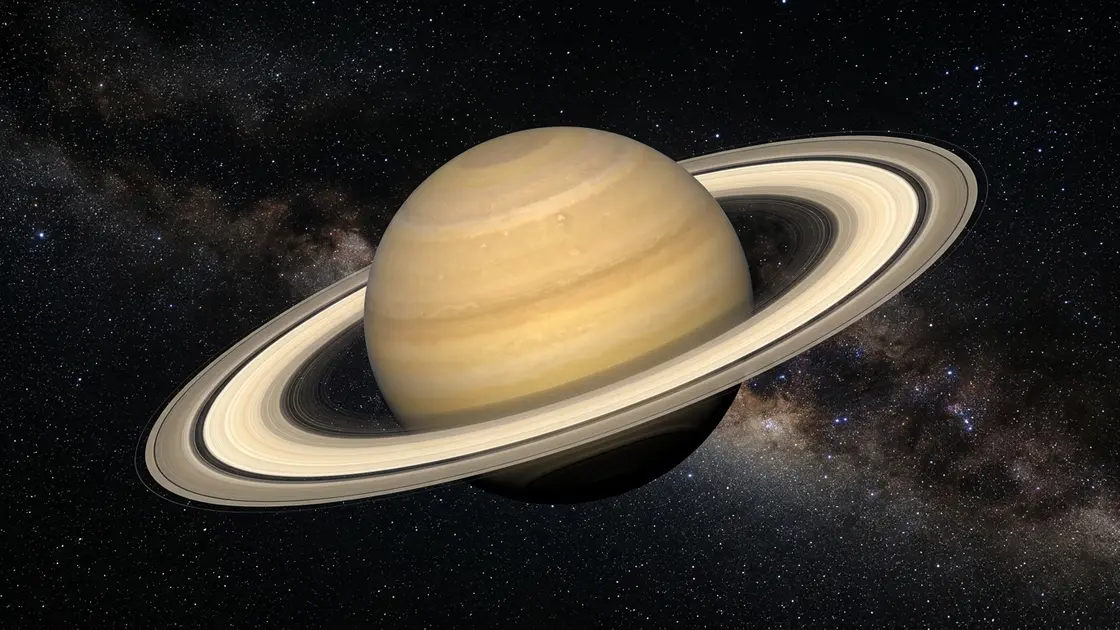
Saturn reaches opposition and its closest approach to Earth on the same day: October 4, 2026, at 12:21 UTC. In local time that is 08:21 EDT, 05:21 PDT, 14:21 CEST, 23:21 AEDT in Sydney and Melbourne (daylight time starts there that same morning) and 22:21 AEST in Brisbane.
The exact minute matters less than the night. Saturn stays near its peak for days either side, and Space.com puts the brightest stretch at September 24 to October 9. I'd pick the clearest forecast that week over the calendar date.
Where to look: Saturn rises in the east around sunset, is highest around local midnight and sets in the west at dawn. It sits in front of Cetus, a faint, star-poor patch of sky, so the brightest steady point of light there is Saturn.
What you'll see:
- Naked eye: a steady, creamy-white point at magnitude 0.3, outshining nearly every star nearby.
- 10x50 binoculars: a small bright oval. No rings.
- Small telescope: the rings clearly separated from the planet, plus Titan as a tiny star.
Why Opposition Night Matters
Opposition happens when Earth, moving faster in its orbit, laps Saturn and passes between the planet and the Sun. Outer planets are always closest to Earth for the year at opposition, and for Saturn in 2026 that means 8.43 AU, roughly 784 million miles, with a disk 19.7 arcseconds across through a telescope. Because the planet rises at sunset and sets at dawn, you get the whole night rather than a narrow slot before sunrise. Everything on either side of the date is a gradual taper from the peak.
The Rings Are Coming Back
Saturn's rings went edge-on to Earth in March 2025 and all but vanished. Crossings like that come every 13 to 15 years, so the next is a long way off. The rings aren't permanent either, though that is a separate story from the tilt. By this October the rings are tilted a little under 10 degrees, showing Saturn's southern face. Sources disagree on the exact figure: EarthSky gives 7.5 degrees, while an ephemeris-based source built on JPL data gives about 9 degrees at opposition. Either way, expect a slimmer ring than the wide-open photos you've seen, and one that keeps opening toward us until 2032.
Naked Eye and Binoculars
You don't need a dark-sky reservation to find Saturn. At magnitude 0.3 it reads as a steady point of light even from a suburban backyard, and it doesn't twinkle the way the stars around it do. Point 10x50 binoculars at it, braced on a tripod if you can, and the planet resolves into a bright oval. That's as far as binoculars go: the rings can't be separated from the disk at this tilt.
What a Telescope Reveals
- 70-80mm aperture: the ring is clearly separated from the planet, and Titan shows as a tiny star beside it.
- 100-130mm aperture, on a steady night: the Cassini Division, the planet's shadow on the rings, and three or four moons.
A 4-inch scope (about 100mm) is the entry point for the Cassini Division, not a guarantee of it. Treat it as a bonus on a night when the air is steady. 130mm is a safer bet, and 150mm is roughly a 6-inch mirror. The limiting factor most nights isn't aperture but atmosphere. Give any telescope 20-30 minutes outside to reach thermal equilibrium with the night air before judging the view, since a scope still cooling blurs fine detail no matter how much glass is pointed at the sky.
Best Nights to Watch
- October 4: opposition and closest approach. The nights of October 3 and October 5 are practically as good.
- September 24 to October 9: the brightest window.
- Through November 2026: Saturn rises earlier each evening and is well placed after dusk.
The Moon is on your side this year. Last quarter falls on October 3, so opposition week has a half-lit Moon that rises late, and new Moon arrives on October 10, giving the darkest nights of the month from about October 8 to 15. The trouble comes later: the Moon passes about 5.7 degrees from Saturn around October 24, two days before the full Moon on October 26, and that glare washes out the fainter ring and cloud-band detail.
Gear Worth Considering
You don't need premium glass to enjoy this opposition. A $50-150 pair of 10x50 binoculars on a tripod adapter gives a steady view of the disk; the best binoculars for stargazing guide covers the options. For the rings themselves, a 70-80mm refractor or a 6-8 inch dobsonian in the $200-400 range delivers the ring view for years, and stepping into the $300-800 range with a 5-6 inch reflector or a quality refractor adds the Cassini Division. Our best telescope under $300 guide is the place to start on a budget. A local astronomy club's loaner scope or a week's rental works just as well for a first look.
Missed October 4?
You haven't missed much. Saturn stays well placed through November and into early 2027, dimming gradually as Earth pulls away, until it disappears into the sunset glare in March 2027. The next opposition is on October 18, 2027, and the rings keep opening toward Earth until 2032, so each year's view gets better, not worse.