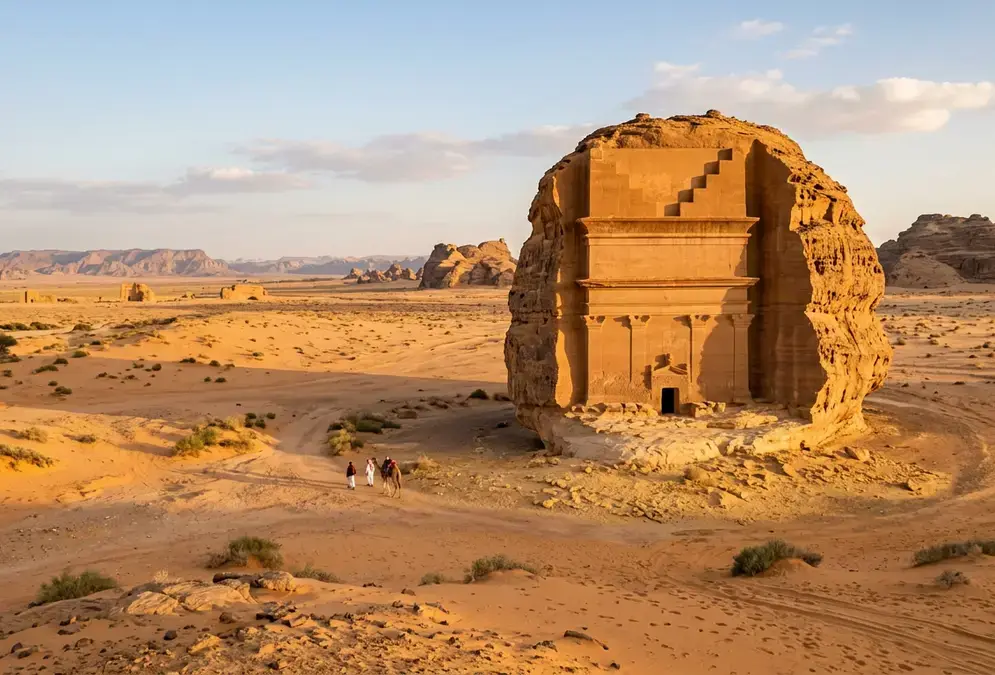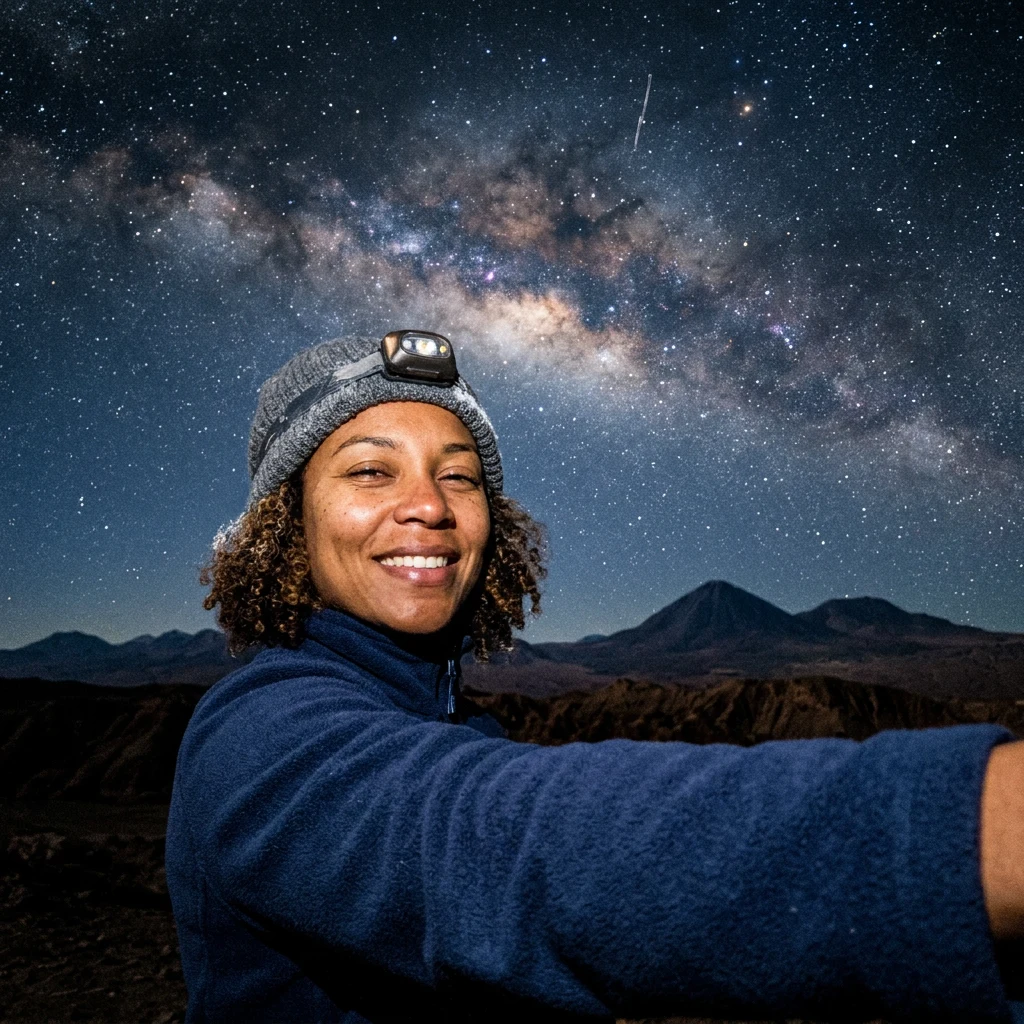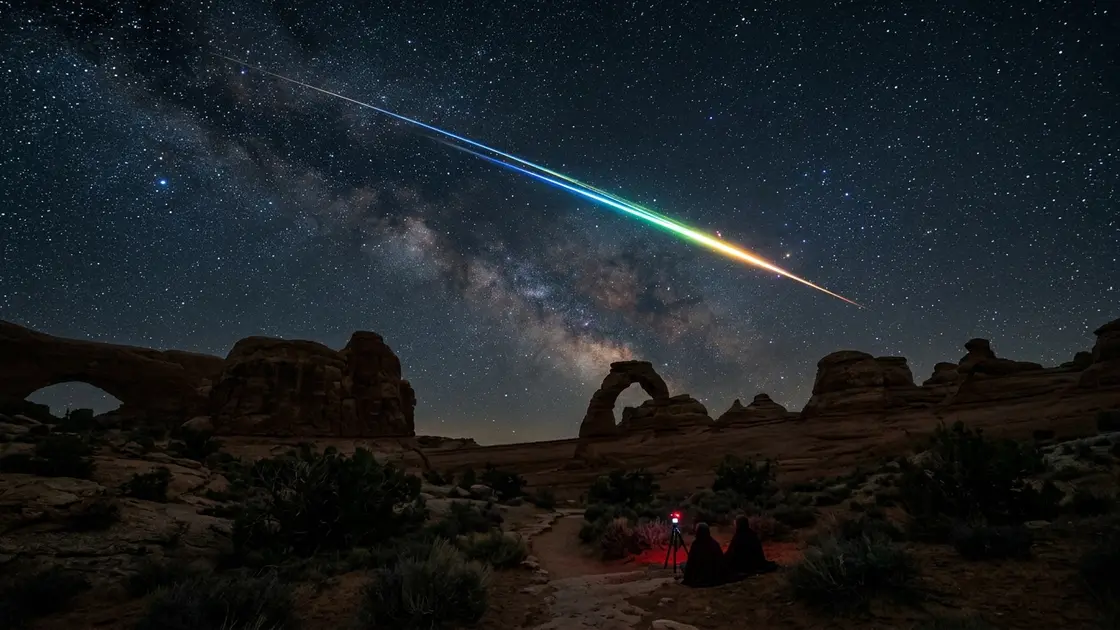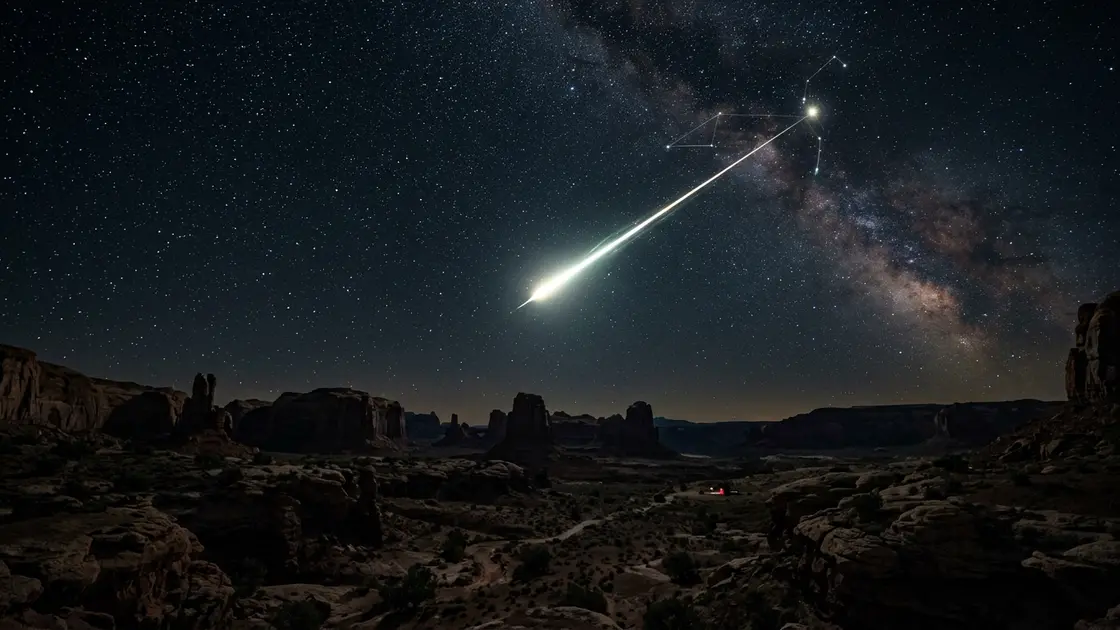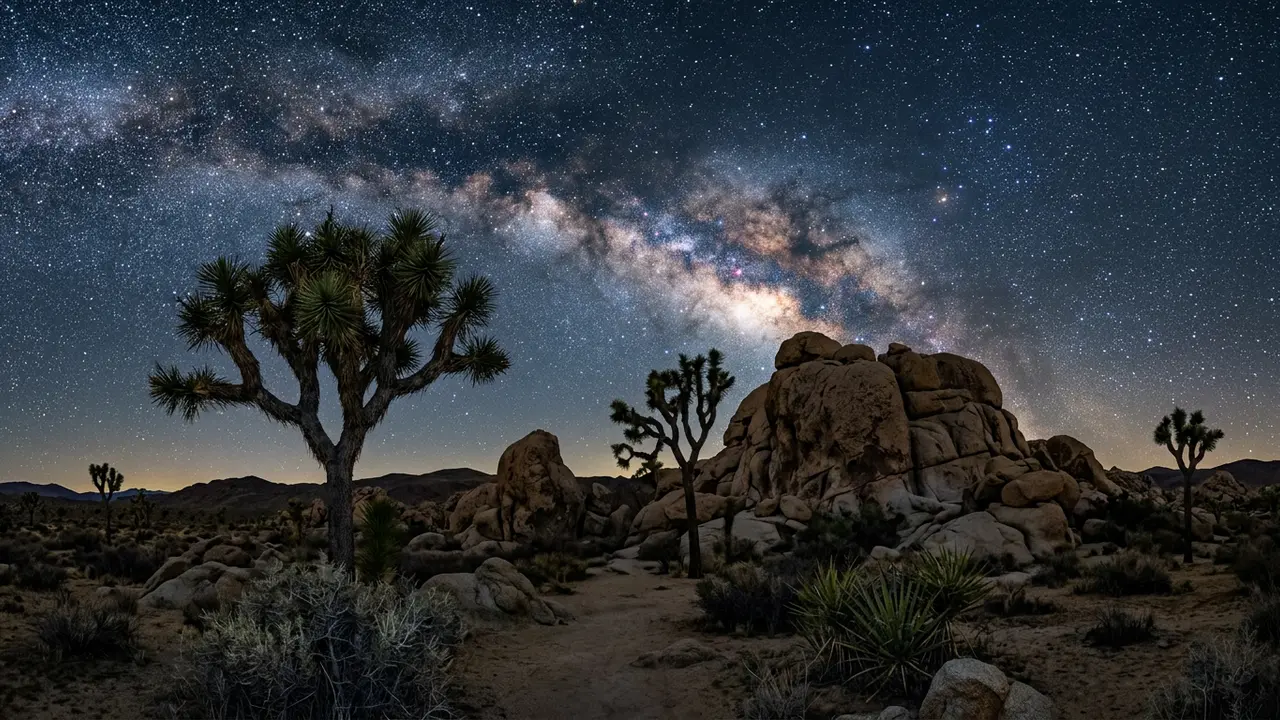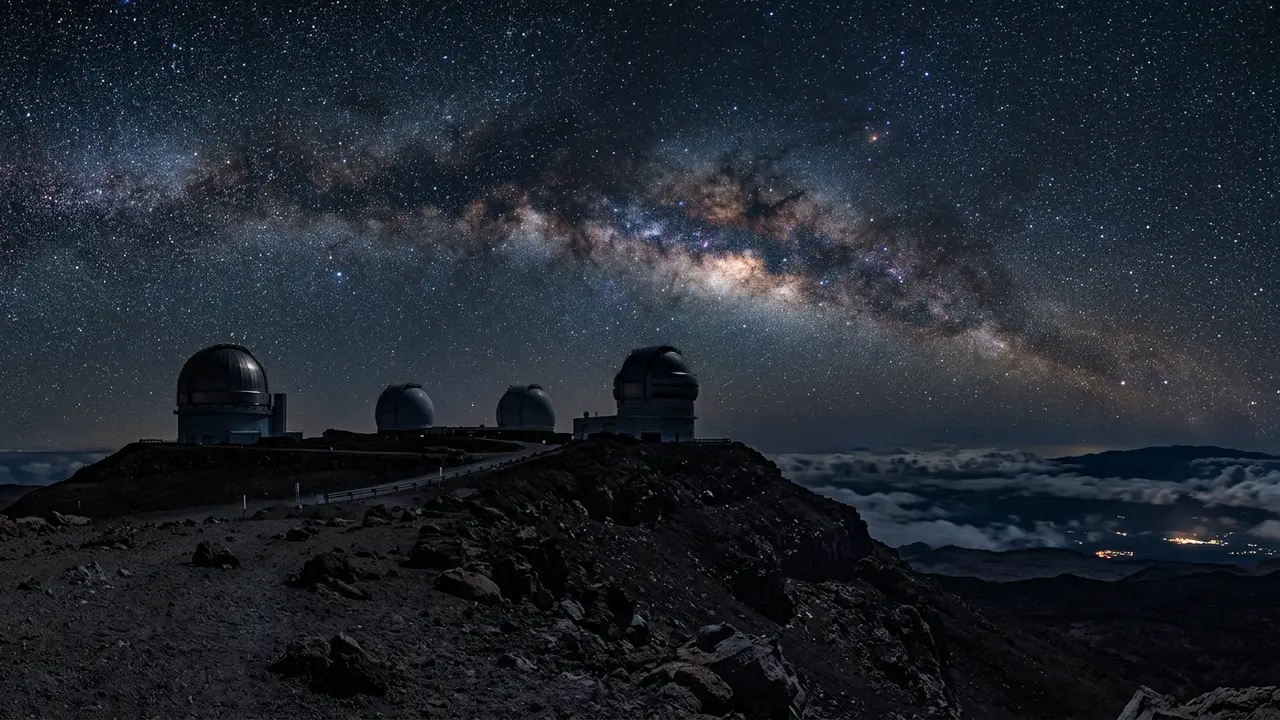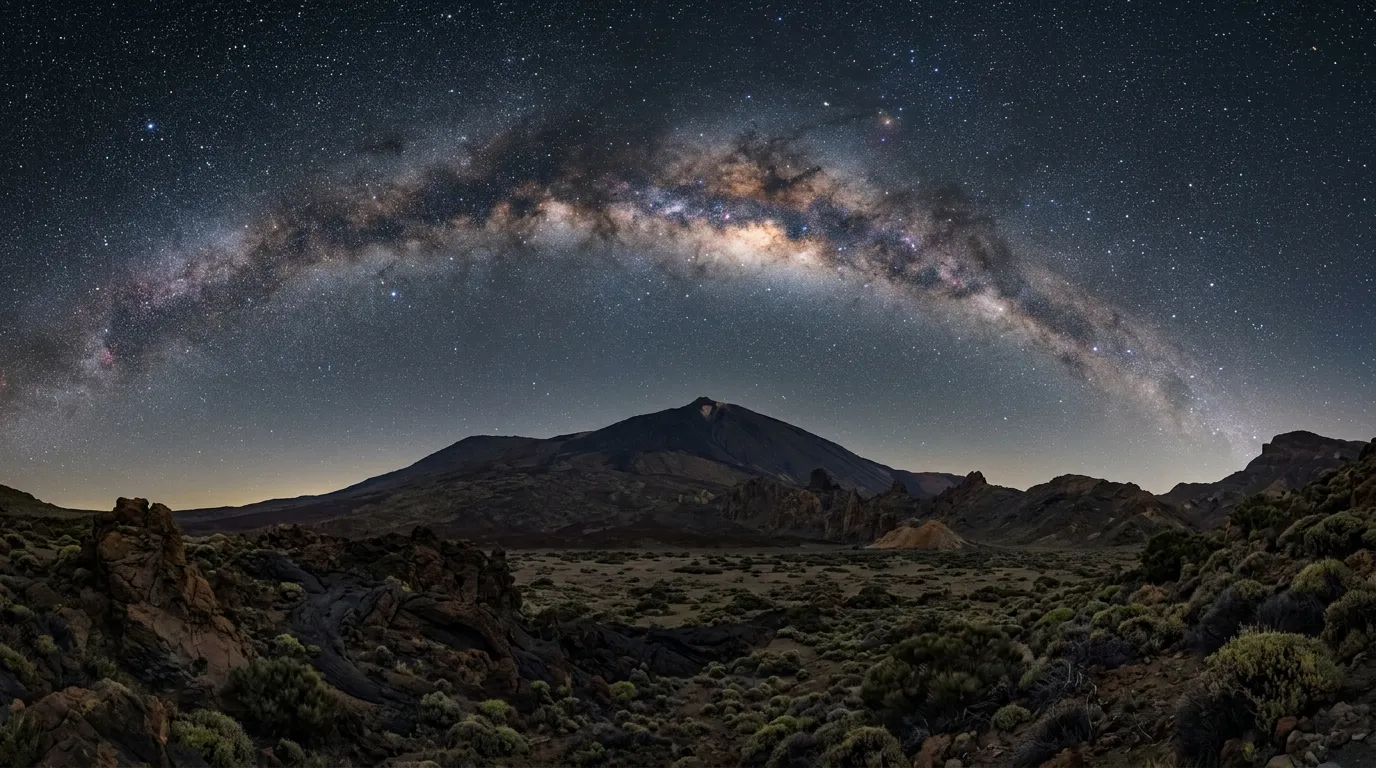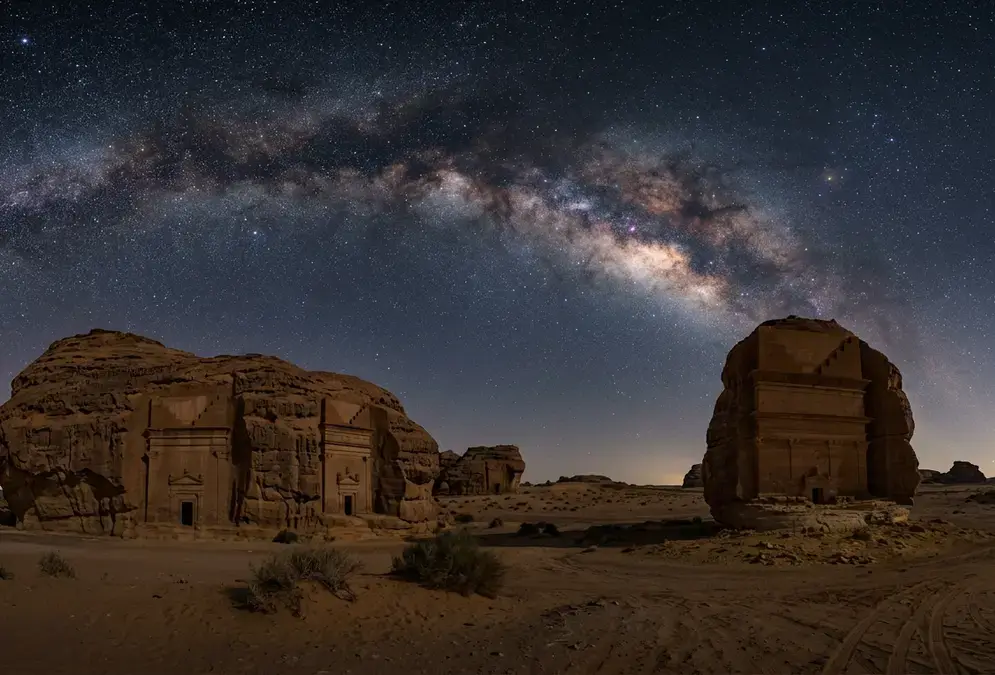
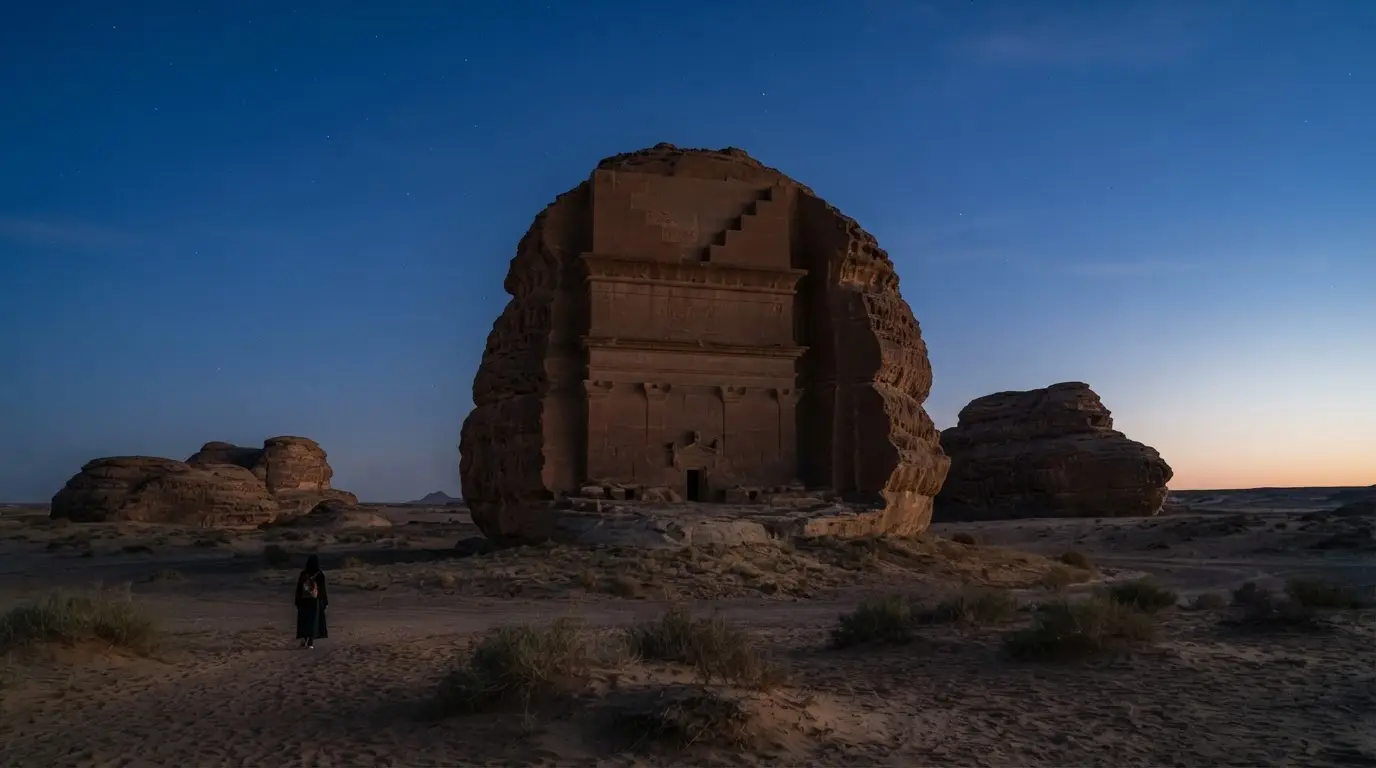
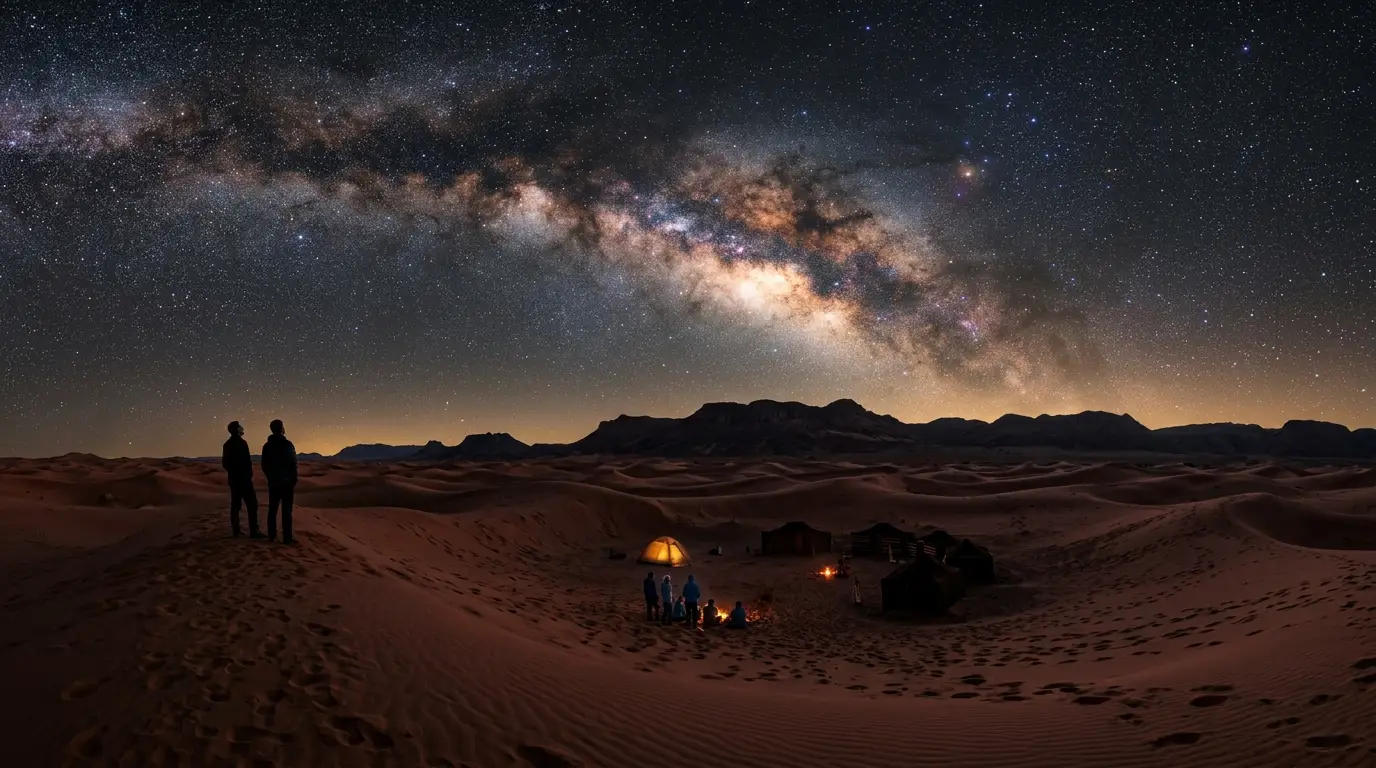
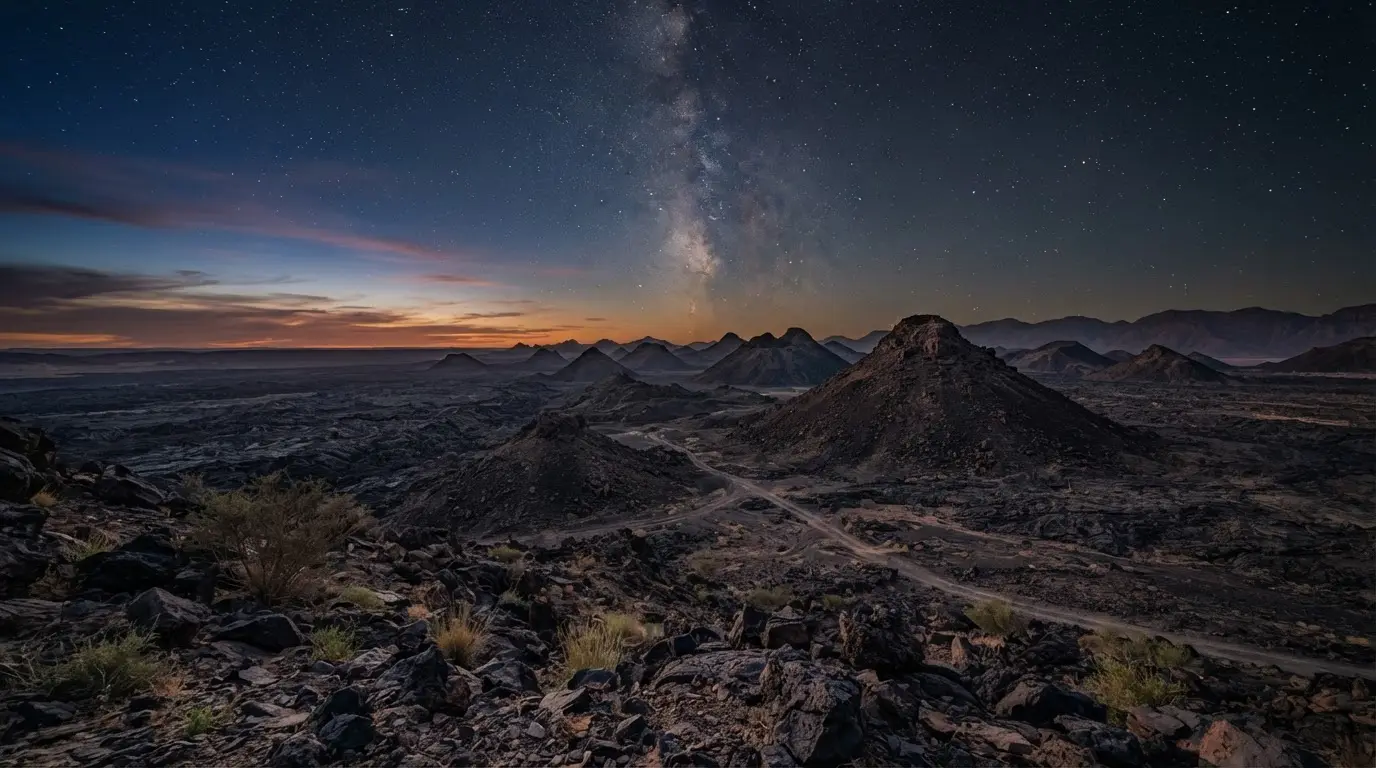
Milky Way arching above the rock-cut Nabataean tombs of Hegra at night, AlUla stargazing destination in Saudi Arabia's desert
stargazing dark sky astrotourism

Stargazing in AlUla: Arabia's Desert Sky Above Hegra

Stargaze above Hegra's 2,000-year-old Nabataean tombs in AlUla, the Gulf's first DarkSky-accredited Dark Sky Park. When to go, where to stay, and how to plan.

Darkness: Bortle 1-2
Latitude: 27°N
Best months: Oct–Apr

Explore AlUla

Photo tour of the lodges, night-sky trips, and guides for this destination.

Dark-sky facts

Darkness
Bortle 1-2
Best months
Oct–Apr
Country
Saudi Arabia
Coordinates
26.61°N, 37.91°E
Designation
AlUla Manara and AlGharameel Dark Sky Park
Night access
Desert dark-sky zones are open year-round; Hegra, Jabal Ikmah, and AlUla's other heritage sites are accessible only via scheduled guided visits booked through Experience AlUla — check current tour times before planning a stargazing night around them.
Costs & fees
Heritage-site visits (Hegra, Jabal Ikmah) require pre-booked guided tour tickets through Experience AlUla, with pricing that varies by package and season; the desert dark-sky zones themselves are free to enter. Confirm current ticket prices directly before booking.

The Milky Way casts a faint shadow. Zodiacal light and airglow are obvious.

This destination rates Bortle 1-2 on the 9-level Bortle dark-sky scale, where 1 is a pristine dark sky and 9 is an inner-city sky. The Milky Way casts a faint shadow. Zodiacal light and airglow are obvious.

On this page

Updated

The Nabataeans cut Hegra's tombs into sandstone cliffs around two thousand years ago, and the night sky above those tombs has changed very little since. AlUla, a desert valley in northwest Saudi Arabia, pairs the country's first UNESCO World Heritage Site with the Gulf's first DarkSky-accredited Dark Sky Park, awarded in October 2024. Ancient rock-cut monuments under a sky dark enough to show the full Milky Way is not a pairing you find at Chile's Atacama or Namibia's NamibRand. AlUla is still an emerging stop on the astrotourism map, not a crowded one, and the Royal Commission for AlUla (RCU) is actively building the infrastructure to change that, including a dedicated astronomy centre 70 km from the historic core. For the strategy behind that investment, see why Saudi Arabia is backing AlUla's dark skies.

This is a heritage destination first. The dark sky is what makes it worth building a stargazing trip around too: you come for Hegra's tombs, Jabal Ikmah's inscriptions, and a desert crossed by incense-trade caravans for millennia, and the sky has been waiting above all of it the whole time, mostly unofficial until DarkSky International made the accreditation formal.

The sky this month

Computed for AlUla at 27°N. Updates nightly.

  • First quarter tonight, 36% illuminated

    Next new moon August 12. The nights either side of it are the darkest of the month.

  • About 7 hours of astronomical darkness tonight

    The sun drops more than 18 degrees below the horizon, so the sky gets genuinely dark for deep-sky viewing at 27°N.

    Hours of astronomical darkness by month at AlUla: January 11 hours, February 10 hours, March 10 hours, April 9 hours, May 8 hours, June 7 hours, July 7 hours, August 8 hours, September 9 hours, October 10 hours, November 11 hours, December 11 hours.

  • Perseids active now

    Peaks August 12. Up to 100 meteors per hour at maximum. The 2026 peak lands on a new moon — a dark-sky year with zero lunar washout.

    See the Perseids guide
New moons August 12 September 10 October 10
Add new-moon reminders Full sky calendar

Where to go stargazing in July

Why stargaze at AlUla, not just visit it

Most people who fly to AlUla come for the archaeology, and that alone is reasonable: Hegra justifies the trip on its own. What changes the calculation is that the same remoteness which kept these sandstone canyons quiet enough to preserve Nabataean tombs also kept the sky above them dark. AlUla sits roughly 300 km north of Medina in a low-population desert basin, historically a caravan-route crossroads rather than a population centre, and that isolation is now protected on purpose. Since October 2024, DarkSky International's accreditation covers two zones: AlUla Manara and the AlGharameel Nature Reserve.

RCU's Naif Almalik called the designation "a major boost" to building what the Commission describes as a new astro-tourism ecosystem. DarkSky International's CEO Ruskin Hartley framed the wider point: Dark Sky Places, he said, protect wildlife habitat and cultural heritage while promoting responsible astrotourism. Both are true here in a way that's genuinely rare: an accredited dark sky sitting directly on top of a UNESCO site, not somewhere near it.

Hegra: Nabataean tombs beneath a desert sky

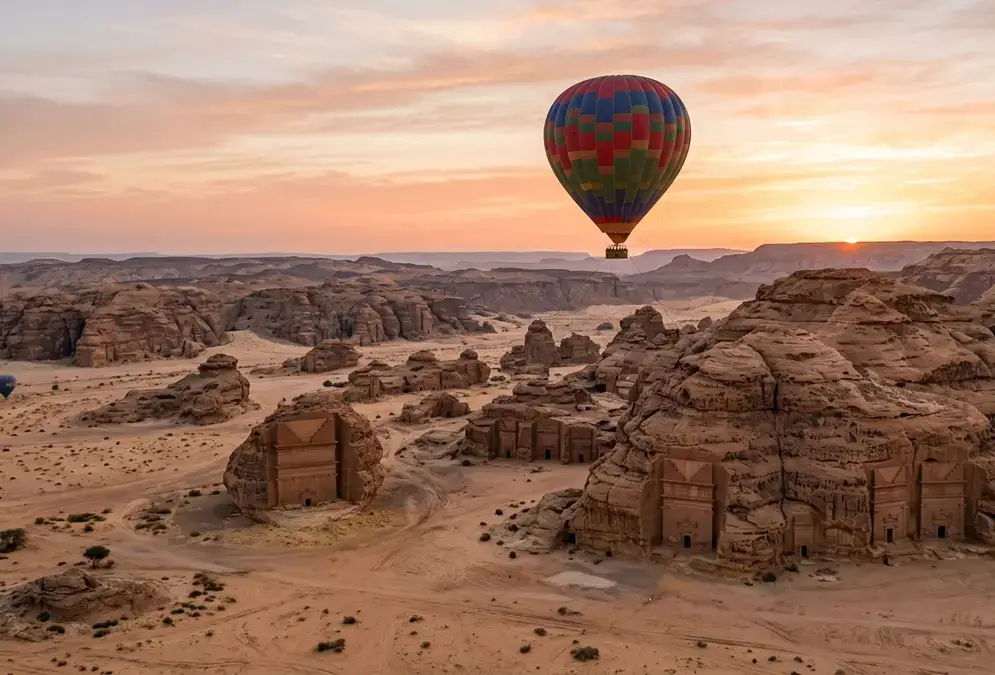
Hegra (also written Al-Hijr, or Madā'in Ṣāliḥ) became Saudi Arabia's first UNESCO World Heritage Site in 2008. It holds 111 monumental rock-cut tombs, 94 of them decorated, carved by the same Nabataean civilization responsible for Petra in Jordan. UNESCO calls it the largest conserved Nabataean site south of Petra itself. The tombs date from the 1st century BC to the 1st century AD, cut directly into standing sandstone outcrops rather than a cliff face, so they read almost like freestanding buildings as you walk among them.

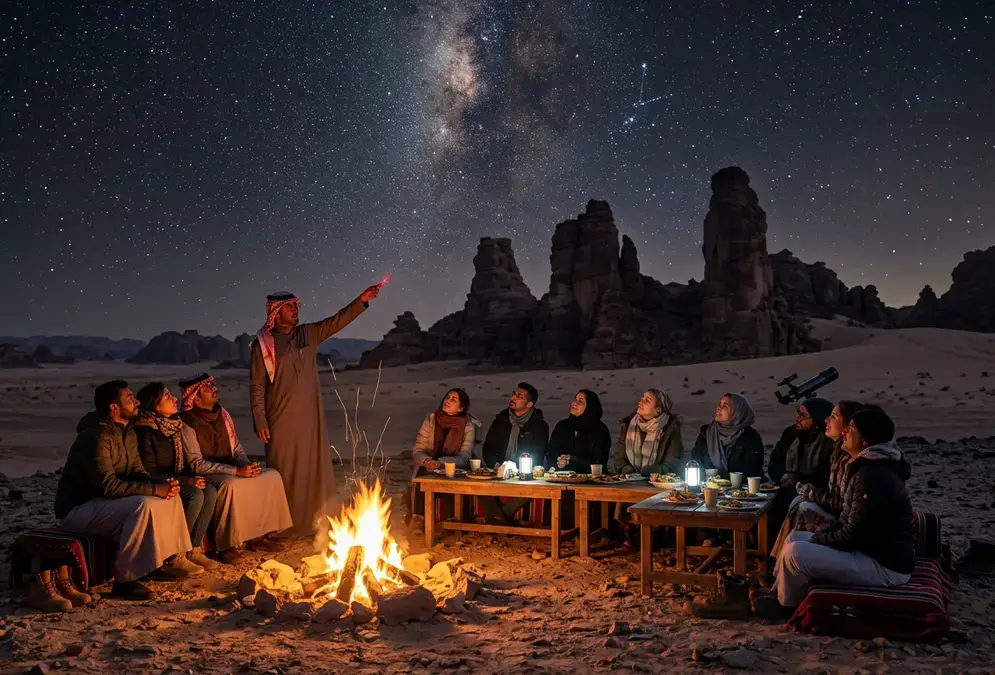
What makes Hegra a stargazing site as much as a heritage one is what's absent: light. The archaeological zone sits well clear of any real settlement, and low light pollution around the tombs allows clear night viewing directly above them. Designated desert camping areas near the site let you pair a daytime tomb visit with a night spent under the same stretch of sky the Nabataeans navigated by, waiting out caravans of their own two thousand years ago. If you'd rather not camp independently, a guided Hegra night tour under the stars covers the same ground with a local operator.

Jabal Ikmah, Wadi AlFann, and AlUla Old Town

Hegra isn't the only reason to build a trip around AlUla's heritage. Three more sites round out a stargazing-and-history itinerary:

  • Jabal Ikmah: an open-air canyon library holding the largest concentration of well-preserved Dadanitic and Lihyanite inscriptions found anywhere, alongside Thamudic, Nabataean, and Minaic scripts. People have left records on these canyon walls since at least the 1st millennium BCE.
  • Wadi AlFann ("the Valley of the Arts"): an RCU-commissioned permanent land-art destination still under construction. The Desert X AlUla exhibition programme, including a 2026 edition, runs as a pre-opening programme ahead of the finished valley.
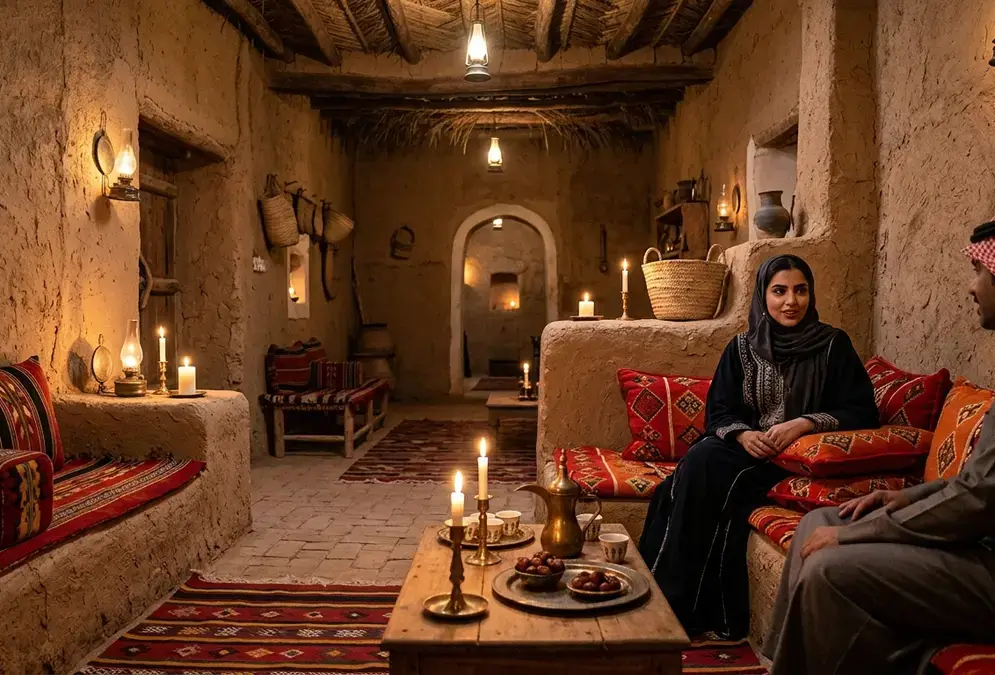
  • AlUla Old Town: a restored mudbrick village, now a dining and visitor hub, close enough to several accommodation clusters to work as a low-effort, low-light-pollution vantage point on a night you'd rather not drive out to the desert.

The Dark Sky Park: AlUla Manara and AlGharameel Nature Reserve

The October 2024 DarkSky International accreditation is what turns AlUla from a place with dark skies into a place with a verified, protected one: the first Dark Sky Park in Saudi Arabia and the entire Gulf region. RCU's stated conservation strategy includes lighting controls and a goal of safeguarding roughly half of AlUla's territory long-term. DarkSky International hasn't published an exact Bortle-scale reading for AlUla's protected zones, but Dark Sky Park status itself means the organization's measured-darkness and outdoor-lighting standards, the same criteria behind a low Bortle-scale rating anywhere else in the world, were already met before the designation.

The accredited zones sit apart from the archaeological sites themselves, which is where AlUla Manara comes in: an astrotourism centre roughly 70 km from AlUla's historic core, built by RCU in partnership with the Saudi Space Agency, King Abdulaziz City for Science and Technology (KACST), and the US-based SETI Institute. It's built around one 4-metre primary telescope and two 2-metre secondary telescopes serving both research and public observation, with dark-sky lodging planned for the site. Until then, book the same skies through the AlUla stargazing experience tour, or, camera in hand, the AlUla desert astrophotography tour.

None of this is finished infrastructure the way Mount John Observatory in New Zealand is. AlUla's is newer, and it's being built specifically around the accreditation rather than the other way round, which makes the destination worth watching over the next few years as much as visiting now.

When to go: cooler desert nights, not clearer skies

October through April is the window, and the reason is heat, not cloud cover. Cool-season daytime temperatures run roughly 20–30°C (68–86°F), comfortable for both sightseeing and standing around after dark. Summer, roughly May or June through September, regularly pushes daytime highs past 40°C (104°F). That's a comfort problem more than a stargazing one: AlUla's skies are described as clear most nights of the year, regardless of season.

If you're building a trip around a specific night at AlUla Manara, or camping near Hegra, pick the cooler months for your own comfort rather than the sky's. Whatever month you land in, check the moon phase separately from the season; a bright moon mutes fine Milky Way detail here the same way it does anywhere else on Earth. For the full month-by-month breakdown, see the best time to go stargazing in AlUla.

Month by month

Book late autumn through early spring. AlUla's desert air stays exceptionally clear all year, so heat, not cloud cover, decides whether a night under the telescope is comfortable or brutal. October through March keeps nights cool enough to stand outside for hours; June through September brings the year's clearest skies but temperatures that make extended stargazing dangerous rather than scenic.

  • January: Peak — Peak comfort and clarity; tourism fully open.
  • February: Peak
  • March: Peak
  • April: Good — Warming fast, crowds thinning, still comfortable at night.
  • May: Good
  • June: Fair — Clearest skies of the year, but dangerous daytime heat.
  • July: Fair
  • August: Off-season — Hottest month; skies clearest, but conditions genuinely unsafe outdoors.
  • September: Fair
  • October: Peak — Season reopens; cool nights return, full services resume.
  • November: Peak
  • December: Good — Cloudiest month of the year, despite peak-season crowds.

Going in January? See what else the sky offers that month

Getting to AlUla

AlUla International Airport (IATA: ULH) sits about 25 km from the city centre, but its route list is thin. Most travelers fly domestically, from Riyadh (roughly 1h45) or Jeddah (about 1h20); international service to ULH has been expanding but remains limited next to Saudi Arabia's major hubs. If Medina is already on your itinerary, flying into Prince Mohammad bin Abdulaziz International Airport there and continuing to AlUla by road is a common alternative worth checking before you book.

Confirm current schedules directly either way. Saudi Arabia's astrotourism infrastructure, AlUla included, is expanding fast enough that route lists from even a year ago can be out of date. For the full airport and road breakdown, see getting to AlUla.

Interactive map — loads as you scroll (requires JavaScript)

Tap a pin to open the lodge, tour, or destination page.

How long to stay

Best season

October through April for cooler, comfortable desert nights; AlUla's skies stay clear most nights year-round, so summer's heat, not cloud cover, is the real constraint

Quietest hours

After Hegra's daytime guided-visit groups clear out; independent desert camping areas near the archaeological zone and around AlUla Manara offer the most solitude after dark

Visit duration

3–4 nights minimum to cover Hegra, Jabal Ikmah, and AlUla Old Town by day, plus at least one clear night reserved for stargazing

Where to stay

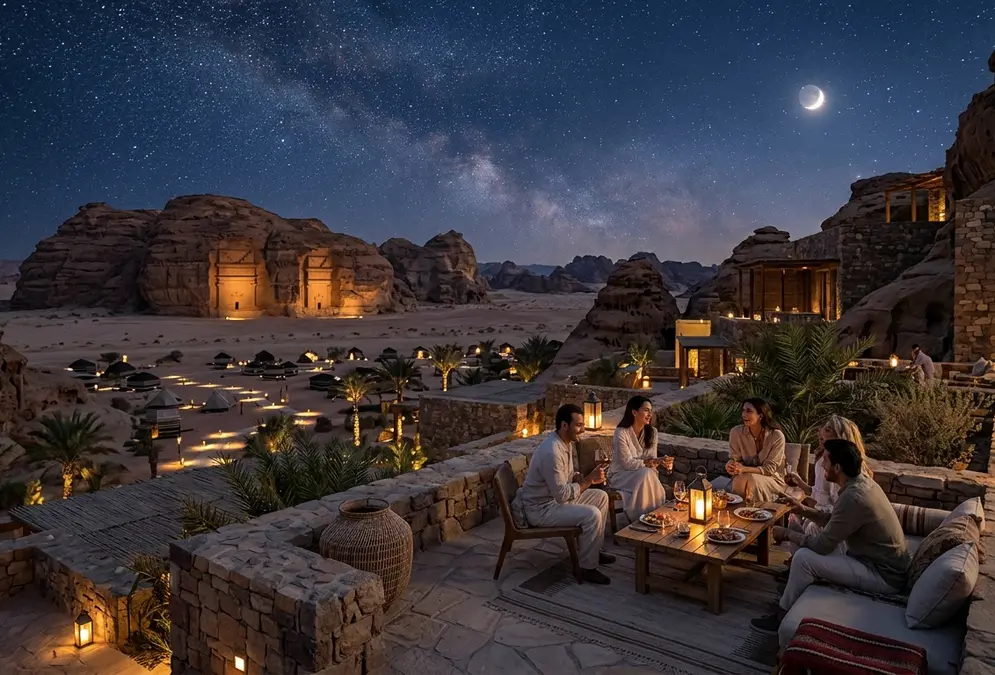
AlUla's hotel stock skews boutique and desert-resort, built to match the sandstone-canyon setting rather than a conventional hotel strip:

  • Our Habitas AlUla, in the Ashar Valley, opened in November 2021 as a community- and wellness-oriented boutique resort.
  • Banyan Tree AlUla, also in the Ashar Valley, set among the same sandstone cliffs and rock formations, with free astronomer-led sessions twice a week.
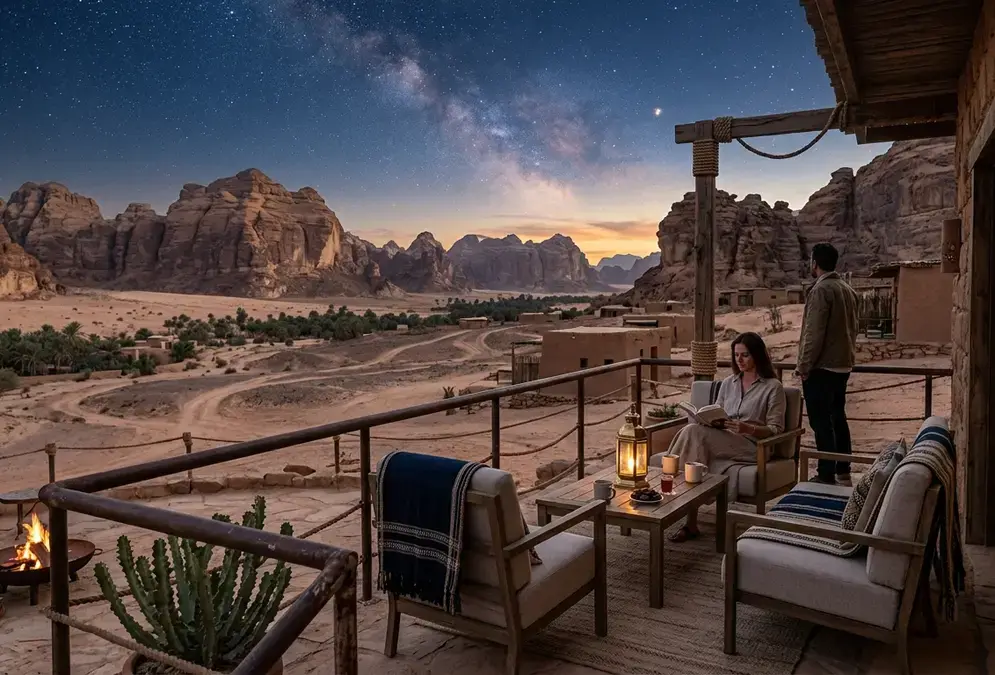
  • Shaden Resort, built among sandstone formations, with a private terrace in every room and several on-site restaurants.
  • Dar Tantora The House Hotel, inside AlUla Old Town's restored mudbrick village, for travelers who'd rather stay close to the dining and visitor hub than out in the valley.
  • Cloud7 AlUla, the valley's value pick, glamping-style stargazing paired with a two-Michelin-starred kitchen.

None of these properties are purpose-built for stargazing the way a dedicated dark-sky lodge in Norway or New Zealand might be, and that's a fair trade for now, given how new AlUla's astrotourism identity still is. For a full head-to-head comparison, see our ranking of AlUla's best desert camps for stargazing. Check each property directly for current room configurations and rates before booking.

Planning your visit

  • Book Hegra through Experience AlUla. Access to the archaeological zone runs through official guided visits rather than independent entry, so build your stargazing plans around whatever slot you secure rather than the other way round.
  • Give yourself three to four nights. That covers Hegra, Jabal Ikmah, and Old Town during the day, plus at least one clear night reserved for AlUla Manara or camping near the desert dark-sky zones; see how many days you need in AlUla for stargazing for the full breakdown.
  • Still deciding if the trip is worth it? Read is AlUla worth it for stargazing before you book.
  • Check current visa requirements before booking. Saudi Arabia's entry policies for international travelers do change, and it's worth confirming directly with an official source rather than assuming last year's rules still apply.
  • Pack for both extremes. Desert days can run warm even in the cooler season, and desert nights drop fast once the sun is down, whatever month you're there.
  • More questions? Our AlUla stargazing FAQ covers guided access, family trips, and Milky Way visibility.
All tours

Top lodges at a glance

3 Luxury

Best best for private-terrace stargazing without a scheduled program

Shaden Resort

Private terrace in all 121 rooms/villas, RCU-affiliated, 28 min from Hegra, from ~USD 330/night

$$$ · from ~USD 330/night (multi-night deal rate, indicative; confirm current pricing) View lodge
4 Modern

Best best value, plus a two-michelin-starred kitchen

Cloud7 AlUla

Casual/glamping-style stargazing, Charcood Restaurant, from ~USD 150/night

$$ · from ~USD 150/night (promotional rates common; confirm current pricing) View lodge
5 Luxury

Best best for heritage character, not stargazing programming

Dar Tantora The House Hotel

30 candlelit mudbrick Dars, no stargazing program, 23 min from Hegra, from ~USD 343/night

$$$$ · from ~USD $343/night (varies by house and season) View lodge
See the full ranking: Best Desert Camps in AlUla for Stargazing

Reporter notebook

Insider tips

Best time

Pick October–April for comfort, not for clearer skies

AlUla's skies stay clear most nights of the year regardless of season, so don't chase a 'best sky' month the way you might somewhere cloudier. The real driver is heat: cool-season nights (Oct–Apr) sit around 20–30°C, while summer daytime highs commonly clear 40°C. Book for comfort, then check the moon phase separately.

Photo spot

Shoot Hegra's tombs after the tour groups leave

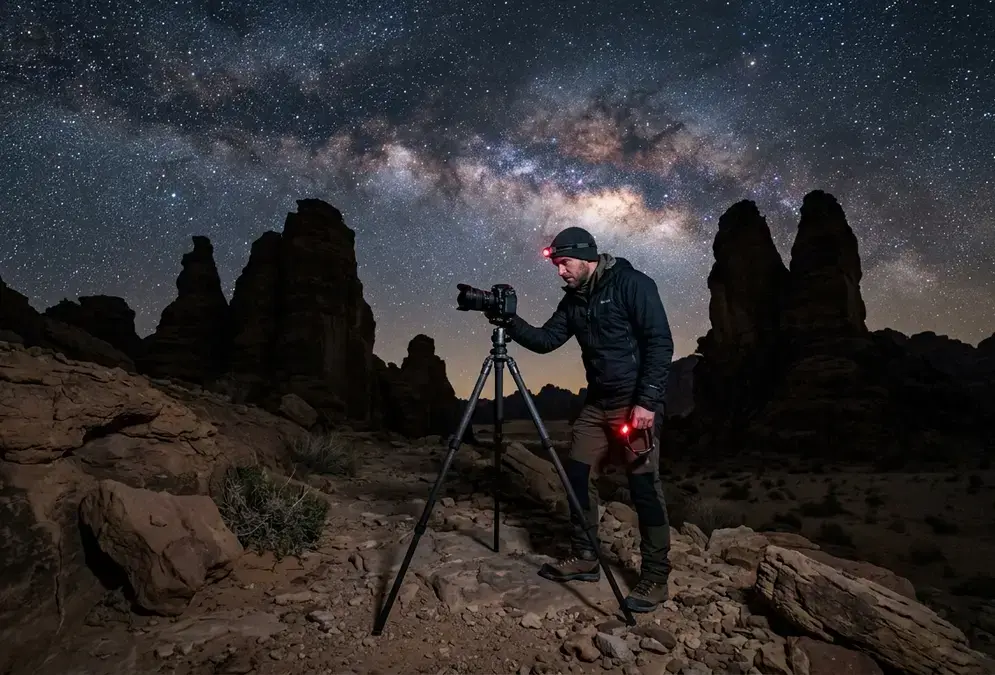
Daytime visits to Hegra move in guided groups on a schedule, so the tombs rarely sit empty in daylight. If your guided access includes a later slot, or your stay includes desert camping nearby, the payoff is the sandstone tombs to yourself with the Milky Way rising behind them, a very different frame from the daytime tour-group shot.

What to bring

Pack for AlUla's big day-to-night temperature swing

Even in the cooler October–April season, desert nights drop hard once the sun goes down. Bring real layers for any night spent outdoors at AlUla Manara or camping near Hegra; daytime warmth won't carry you through a few hours of stargazing after dark.

Frequently asked questions

What is the best time of year to go stargazing in AlUla?

October through April, when cool-season daytime temperatures sit around 20–30°C (68–86°F). It isn't a cloud-cover season change; AlUla's skies stay clear most nights year-round. The constraint is heat, since summer daytime highs regularly pass 40°C (104°F). Check the moon phase separately from the calendar month.

How many days do you need to visit AlUla?

Three to four nights covers the essentials: a day each for Hegra, Jabal Ikmah, and AlUla Old Town, plus at least one clear night reserved for stargazing at AlUla Manara or camping near the desert dark-sky zones. Add a day if you want to see the Desert X AlUla exhibition at Wadi AlFann.

Is AlUla worth visiting for stargazing, or is it mainly a historical site?

Both, and the pairing is the point. Hegra earns the trip on its own as Saudi Arabia's first UNESCO World Heritage Site, and since October 2024 the desert around it carries DarkSky International's Dark Sky Park accreditation, the first in the Gulf. Few destinations combine a major ancient monument with an officially dark, protected sky directly around it.

Do you need a guided tour to stargaze in AlUla, or can you go independently?

Hegra itself is accessible only through official guided visits booked via Experience AlUla, so plan your Hegra-adjacent stargazing around whatever slot you secure. The desert dark-sky zones and AlUla Manara offer more independent flexibility, though options are still expanding; check current offerings before you travel.

Is AlUla family-friendly for a stargazing trip?

It can be. The heritage sites are accessible by guided tour with reasonable walking distances, and desert camping near Hegra suits families comfortable with a warm-to-hot climate and early nights. Confirm age minimums and specific tour logistics directly with operators before booking, since options and requirements vary.

Can you see the Milky Way from Hegra?

Yes. The archaeological zone around Hegra sits clear of any real settlement, and low light pollution allows clear night viewing directly above the tombs. Designated desert camping areas nearby let you extend a daytime visit into a night spent under the same sky the Nabataeans once navigated by.

How do you get from Medina to AlUla?

Fly into Prince Mohammad bin Abdulaziz International Airport in Medina, then continue to AlUla by road, a common routing for travelers combining both stops. Alternatively, fly directly into AlUla International Airport (ULH), served mainly by domestic routes from Riyadh and Jeddah.

Is AlUla an officially certified Dark Sky Park?

Yes. DarkSky International awarded the accreditation in October 2024, covering two zones, AlUla Manara and the AlGharameel Nature Reserve, making it the first Dark Sky Park in Saudi Arabia and the wider Gulf region.

What is Wadi AlFann and is it open to visitors yet?

Wadi AlFann, the "Valley of the Arts," is an RCU-commissioned permanent land-art destination still in development. The Desert X AlUla exhibition programme, including a 2026 edition, runs as a pre-opening programme, so visitors can see work there now even though the finished valley isn't complete.

Further reading

Sources