
The 2027 total solar eclipse: the year's headline event

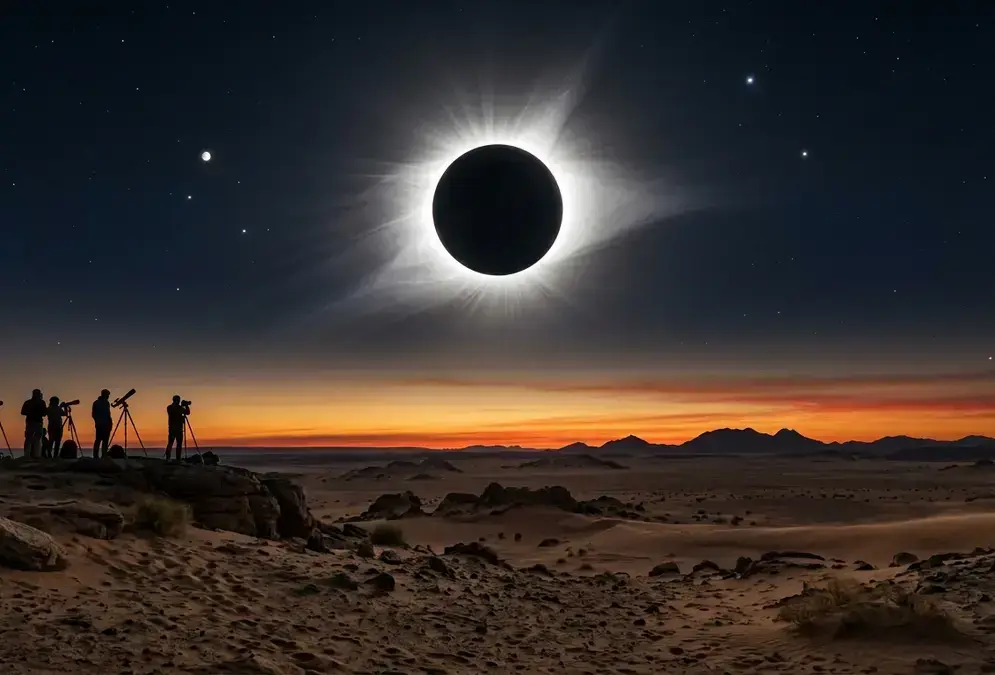
Every event on this calendar earns a look, but only one earns a plane ticket. On August 2, 2027, the Moon's shadow crosses the Strait of Gibraltar, sweeps across North Africa, and darkens the sky over Luxor, Egypt, in what several eclipse trackers are already calling the "eclipse of the century"[1]. It follows just under a year after the August 12, 2026 total solar eclipse over Iceland and Spain, a rare stretch with two total solar eclipses in successive years, though 2027's totality runs nearly three times longer. The full path runs from the eastern Atlantic through Spain and Morocco at the Strait, across Algeria, Tunisia, Libya, and Egypt, then on through Saudi Arabia and Yemen before the shadow lifts off the Earth over Somalia[1]. The eclipse carries a magnitude of 1.079, meaning the Moon's disc comfortably swallows the Sun's, and totality lasts up to 6 minutes 23 seconds at its longest point, over the eastern Sahara[1].
Near Luxor, close to the path's point of greatest duration, totality holds for roughly 6 minutes 22 seconds, the second-longest total solar eclipse of the entire 21st century. That figure comes from eclipse-tracking calculations built specifically for the August 2027 event[2]. The long duration isn't an accident of geography: it happens because the Moon sits near perigee (closest to Earth, so its disc looks largest) while Earth sits near aphelion (farthest from the Sun, so the Sun's disc looks smallest), and both conditions line up for this particular August. The Moon's umbra, the fully shadowed inner cone of its shadow, has to physically touch the ground for totality to happen at all, which is why the same eclipse can look completely different, partial or nothing at all, just outside that narrow line.
Near Luxor, close to the path's point of greatest duration, totality holds for roughly 6 minutes 22 seconds, the second-longest total solar eclipse of the entire 21st century.
For anyone weighing whether to build a 2027 trip around it, this is a rare eclipse that pairs a long totality with land access across multiple countries, rather than the mid-ocean or polar tracks that make many total eclipses logistically brutal. Book accommodation inside the path early. Luxor and the wider Egyptian stretch of the track will fill fast given the duration on offer. For country-by-country totality times and full booking guidance, see the complete 2027 total solar eclipse guide.

Also in 2027: the annular eclipse and three lunar eclipses

August isn't 2027's only eclipse. The year carries five eclipses in total: one annular solar eclipse, one total solar eclipse, and three penumbral lunar eclipses, though only the August event produces true darkness anywhere on Earth[7].

February 6: an annular eclipse over South America and West Africa

Almost six months before the big one, an annular solar eclipse crosses the Southern Hemisphere on February 6, 2027[4]. The path of annularity, the track where the Moon sits too far from Earth to fully cover the Sun and leaves a bright ring around it, runs through Chile, Argentina, Uruguay, and Brazil before crossing the Atlantic and reaching West Africa: Cote d'Ivoire, Ghana, Togo, Benin, and Nigeria[4]. At its longest, the ring lasts 7 minutes 51 seconds, with the Moon covering about 93% of the Sun's diameter at maximum[4]. It won't produce true darkness the way August's eclipse will, but a 93%-covered Sun still dims the daylight noticeably and is worth planning around if the path already lines up with a trip.

Three lunar eclipses, none of them dramatic

2027's lunar side is quieter. All three lunar eclipses of the year are penumbral, meaning the Moon passes only through Earth's outer, partial shadow rather than the darker central umbra, so none produce the dramatic red "blood moon" of a total lunar eclipse.
The deepest is on February 20 to 21, when 93% of the Moon's disc enters the penumbra, visible across Africa, Europe, and much of Asia, with the Americas catching it as the Moon rises and East Asia and western Australia catching it as the Moon sets[5]. July 18 to 19 barely counts: the Moon only clips the very edge of the penumbra, an eclipse so marginal that some trackers list it as a miss rather than an event[6]. August 16 to 17 brings a third, more moderate penumbral eclipse, beginning at 05:24 UTC on the 17th and visible from eastern Australia, the Pacific, the Americas, and West Africa depending on local time zone[7].
None of the three is worth building a trip around. If lunar eclipses are the draw, mark them on the calendar as a bonus and keep the real planning centered on the two solar eclipses above.

The 2027 meteor shower calendar

Meteor showers return every year on predictable dates, and 2027 adds one extra variable on top of the usual peaks: how much moon will be in the sky at the same time. This calendar tracks the eight headline showers of 2027 in order, with the moon condition for each peak night. For how a shower actually works, and how to watch one properly, meteor showers guide covers the mechanics; this section only tracks what's different about 2027.
The year opens strong. The Quadrantids peak on January 3 to 4 with a zenithal hourly rate (ZHR) around 120, and 2027 is a favorable year for it: the Moon is a thin waning crescent on peak night and barely interferes[8]. The Lyrids follow on April 22 to 23 with a much lower ZHR of about 18, and this year the Moon works against it: a bright gibbous moon, just past full, washes out all but the brighter meteors[9]. The Eta Aquariids peak May 5 to 6 with a ZHR around 60 and land close to a new moon, giving essentially dark skies for the peak, a genuinely good year for a shower that already favors the Southern Hemisphere[10].
Shower2027 peakZHR (approx.)2027 moon condition
QuadrantidsJan 3-4~120Favorable, thin waning crescent
LyridsApr 22-23~18Poor, bright gibbous moon just past full
Eta AquariidsMay 5-6~60Favorable, near new moon
PerseidsAug 12-13~60-100Poor to moderate, waxing gibbous moon
OrionidsOct 21-22~20Poor, bright waning gibbous moon
LeonidsNov 17-18~15Poor, bright waning gibbous moon
GeminidsDec 13-14~120Very poor, same night as full moon
UrsidsDec 21-22~10Moderate, moon well past full
Perseids, the year's most-watched shower, peak August 12 to 13. The commonly cited ZHR under ideal dark-sky conditions runs around 100, though some 2027 coverage rounds down closer to 60 per hour as a more realistic observed rate given that year's moon[11]. That moon is the problem: a waxing gibbous moon floods much of the night with light, with full moon following just days later on August 17, so expect a noticeably thinner count than a dark-sky year would give. The Orionids peak October 21 to 22 with a ZHR around 20, landing close enough to October's full moon that a bright waning gibbous moon interferes with much of the night[12]. The Leonids peak November 17 to 18 with a ZHR around 15, again running into a bright waning gibbous moon left over from November's full moon a few days earlier[12].
Multiple meteor trails streaking across a star-filled night sky above a dark horizon, illustrating the night sky calendar 2027 meteor shower season

Multiple meteor trails streaking across a star-filled night sky above a dark horizon, illustrating the night sky calendar 2027 meteor shower season

December closes the year with the sharpest contrast on the calendar. The Geminids, the year's richest shower with a ZHR around 120, peak on the night of December 13 to 14, the same night as a full moon[13]. That's about as bad a pairing as the calendar can produce: expect only the brightest Geminid fireballs to cut through the glare[14]. The Ursids close the year on December 21 to 22 with a modest ZHR around 10, under a moon that's waned back down from that mid-month full moon, giving noticeably darker skies than the Geminids managed a week earlier[12]. A ninth, secondary shower, the Southern Delta Aquariids, also peaks quietly on July 28 to 29 between the Lyrids and Perseids, worth a glance if you're already outside[12].

Planets in 2027: oppositions and elongations

2027 opens with a run of planetary events packed into six weeks, then goes quiet on that front until autumn. Opposition is the point in a planet's orbit where Earth sits directly between it and the Sun, so the planet rises at sunset, stays up all night, and looks its biggest and brightest through a telescope all year[15].
Jupiter reaches opposition on February 11, 2027, a day after passing its closest approach to Earth (perigee)[16], followed just nine days later by Mars on February 19[12]. Both nights are worth a telescope: opposition is when a planet's disc reaches its largest apparent size of the year, since Earth and the planet sit as close together in their orbits as they get. Two fainter outer planets follow later in the year: Neptune at opposition on September 28 and Uranus on November 30[12], both faint enough to need binoculars or a telescope and a star chart rather than a naked-eye glance.

Featured · Destination

Abisko Stargazing

Abisko's rain-shadow microclimate keeps skies clear when nearby Arctic spots cloud over. Aurora season, the Sky Station, ICEHOTEL, and getting there by train.

Saturn reaches opposition in mid-October 2027, with sources splitting between October 17 and October 18[12]. Treat it as an "around October 17 to 18" window rather than a confirmed single date until closer to the event. Around opposition, Saturn's rings, still opening back up after 2025's edge-on year, make it one of the more rewarding telescope targets of the autumn sky.
Venus reaches greatest elongation west on January 3, 2027, sitting 47 degrees from the Sun and rising in the pre-dawn sky as a brilliant morning star, close to its best separation of the entire year[17]. Mercury also cycles through several elongations across 2027, the way it does every year, but because its exact 2027 dates shift with each apparition and weren't independently confirmed against a single source at the time of writing, check a live almanac such as astropixels.com for the date and angle closest to your own travel plans rather than trusting a number printed months ahead. Both inner planets also pass through conjunction with the Sun several times a year, when they sit too close to the Sun's glare to observe at all.

Milky Way season and the year's supermoons

Not every 2027 event has an exact date pinned to it. The Milky Way's galactic core follows the same seasonal pattern every year, 2027 included, because it's tied to Earth's position in its orbit relative to the galactic center rather than anything that changes year to year[18].
From the Northern Hemisphere, the core is visible roughly March through October, with the best window May through August and peak visibility in June and July, when it climbs highest and stays up longest against a dark sky[18]. From the Southern Hemisphere, the season runs longer, roughly February through October, and the core rises earlier and climbs much higher overhead than it ever does up north[18]. June and July are the strongest months from either hemisphere, with the core visible essentially all night around new moon[18]. Once the timing lines up, how to photograph the Milky Way covers the camera settings for actually capturing it.
Timeline
  1. January 3

    Venus at greatest elongation

    Venus reaches its best pre-dawn separation from the Sun for the year, 47 degrees west.

  2. February 6

    Annular solar eclipse

    A ring-of-fire eclipse crosses South America and West Africa.

  3. February 11-19

    Jupiter and Mars reach opposition

    Both planets rise at sunset and stay up all night, back to back within nine days.

  4. August 2

    Total solar eclipse, the year's headliner

    Up to 6 minutes 23 seconds of totality crosses Gibraltar, North Africa, and Egypt.

  5. Mid-October

    Saturn reaches opposition

    Saturn's rings, reopening after 2025's edge-on year, make this a strong telescope night.

  6. December 13-14

    Geminids peak under a full moon

    The year's richest meteor shower collides with the worst possible moon timing.

2027 also carries at least two supermoons, full moons that fall close enough to lunar perigee to look modestly larger and brighter than an average full moon: the Wolf Moon on January 22 and the Snow Moon on February 20[12]. The rest of the year's twelve full moons follow the familiar folk-calendar names, from March's Worm Moon through December's Cold Moon on December 13, the same night as the Geminids' peak[12].
The four seasonal markers land on March 20, June 21, September 23, and December 22 in 2027, all times UTC[12]. Those labels follow Northern Hemisphere convention: readers south of the equator should swap them mentally, so March becomes the autumn equinox and December becomes the summer solstice rather than winter.

How to use this calendar: plan around the moon, not just the date

Every entry above answers "when," but the real planning question is whether the moon will be in the way that night. A shower with a high ZHR next to a full moon can underperform a much weaker shower next to a new moon, the same logic that governs any night-sky trip, eclipse included. Before booking around any single date on this page, run through the same short checklist.
  • Check the moon phase for the actual peak night, not just a shower's reputation
  • Confirm local visibility: an eclipse path, a shower's favored hemisphere, or a planet's position above your own horizon
  • Pull a same-day cloud forecast once the date is close; none of the astronomy matters under an overcast sky
  • For anything eclipse-related, book travel and lodging early, since a path of totality like August 2027's fills up years in advance
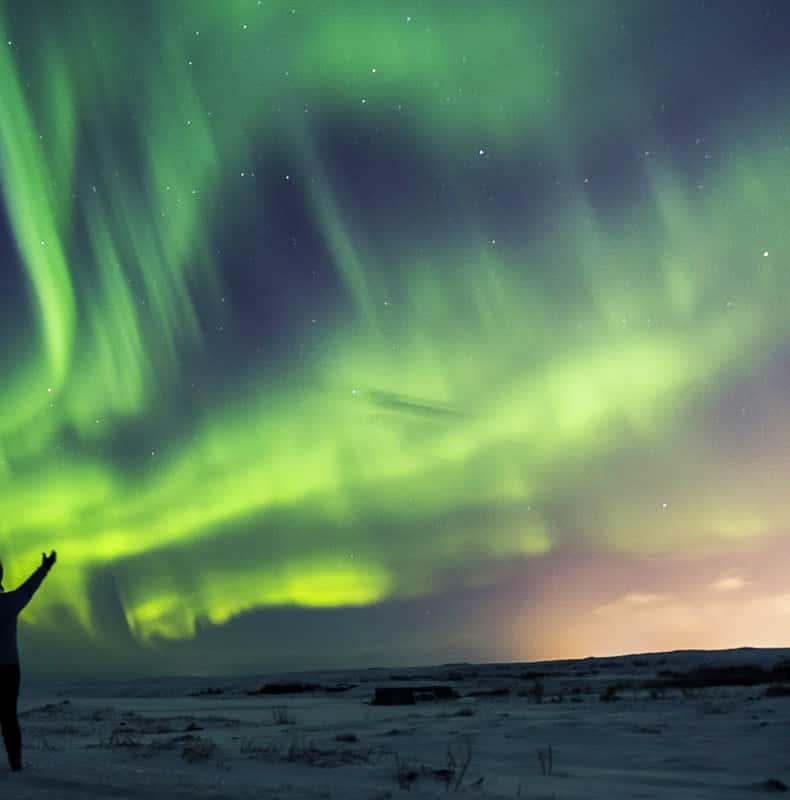
For the deeper mechanics behind any single line above, when to stargaze covers moon phase and galactic-core timing in more depth, and the meteor showers guide explains how to actually watch a shower once a date is picked. If aurora is more the target than eclipses or meteors, how to see the northern lights runs through the separate, far less predictable calendar that governs the aurora.
This page is dated for 2027 and gets rebuilt from scratch for 2028 once the year turns over, since none of these dates carry forward. Bookmark the page itself, not any single date on it.