The path of totality: Spain to the Red Sea
A total solar eclipse crosses three continents in a single narrow band on August 2, 2027. NASA's eclipse-path calculations put the track through the Strait of Gibraltar, then across North Africa and the Middle East and over Somalia, the last landmass it crosses, before heading out over the Indian Ocean, where the path finally leaves Earth's surface near the Chagos Archipelago. The full run of countries the path touches:
- Spain and Gibraltar, at the Strait crossing
- Morocco, Algeria, Tunisia, and Libya
- Egypt, including Luxor and the Red Sea coast
- Saudi Arabia, Yemen, and Somalia
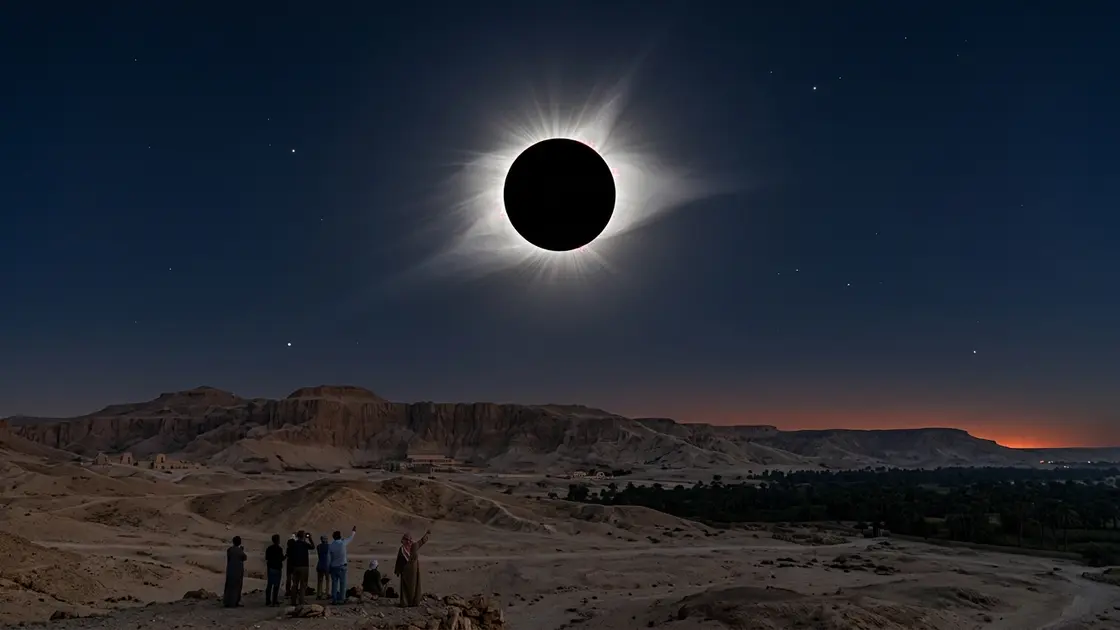
Only the narrow band inside that path sees totality, the brief window when the Moon fully covers the Sun's disc and the sky darkens enough to pick out stars and planets at midday. Step outside the band, even by a short distance, and the result is a deep partial eclipse instead, a different and far less dramatic experience.
Why this eclipse runs so long
Most total solar eclipses last one to three minutes. This one holds for up to 6 minutes 23 seconds at its single longest point, in the Red Sea region of northeastern Egypt southeast of Luxor, according to NASA's path calculations. That sits close to the physical ceiling: the theoretical maximum length any total solar eclipse can reach is about 7 minutes 31 seconds, which puts 2027 near the top of what's geometrically possible at all.
The reason comes down to orbital mechanics lining up on both sides. The Moon sits near perigee, its closest approach to Earth, so its disc looks unusually large against the sky that day. That larger disc takes longer to cross the Sun, stretching out the time the Moon's umbra, the fully shadowed inner cone of its shadow, stays in contact with the ground. Line those factors up and a normally quick crossing becomes an exceptionally slow one.
Where totality is longest: Luxor and the Red Sea coast
The point of greatest duration falls in the Red Sea region of northeastern Egypt, roughly 37 miles southeast of Luxor. In Luxor itself, timeanddate's local calculations put totality starting at 13:02 and ending at 13:08 local time (EEST, UTC+3), a run of 6 minutes 22 seconds. That makes this the second-longest total solar eclipse of the 21st century, and the longest duration visible from land anywhere on Earth until 2114. Space.com's eclipse guide predicts it will become the most photographed astronomical event in history.
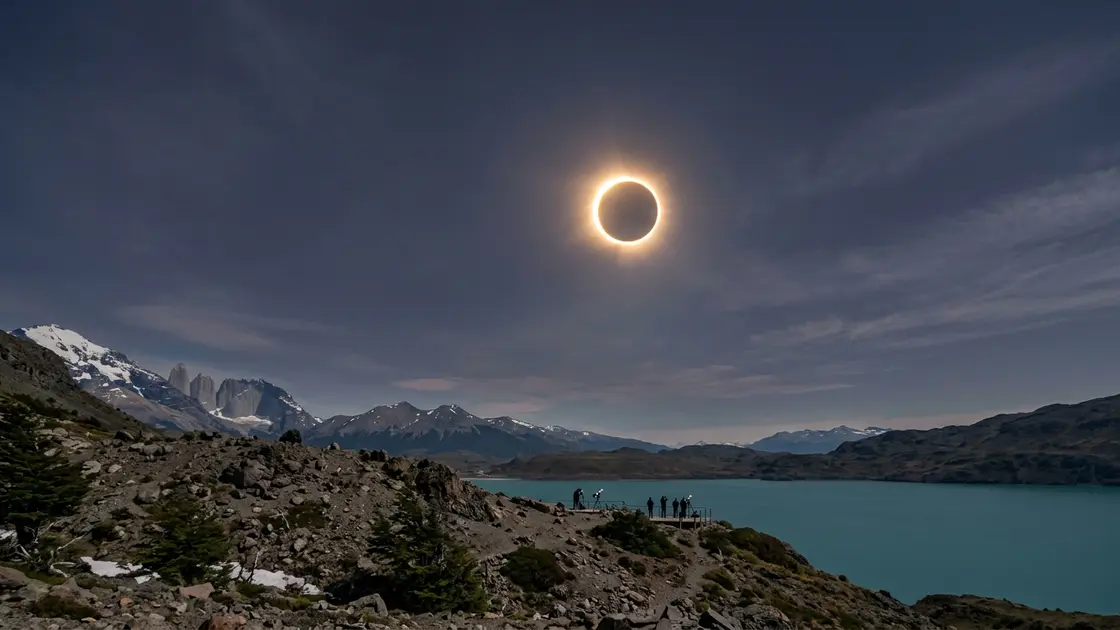
Southern Spain, around Cádiz, and Gibraltar also sit inside the path, with a shorter window of totality than Egypt's maximum. If Luxor's logistics or crowds put you off, the Spanish stretch is the more accessible alternative, at the cost of several fewer minutes inside the Moon's shadow.
Where destination coverage stands (the honest gap)
Dark Skies Atlas doesn't yet have destination pages for Luxor, the Red Sea coast, or southern Spain, the three places that actually sit inside this eclipse's path. The Canary Islands pages already on this site, La Palma and Tenerife, are not in the 2027 path and won't show you totality; don't plan a Canaries trip expecting to see this eclipse from there. Treat this page as the facts and dates for now, and check back as dedicated destination coverage for Egypt and Spain gets built out ahead of 2027.
Planning around the calendar, not just the date
- Start now. A 12-month planning window opens in August 2026, and hotel rooms inside the path are expected to go early given the record duration on offer.
- Confirm your spot sits inside the band. A location even a short distance outside the path sees only a partial eclipse: no darkness, no corona.
- Bring certified eclipse glasses. ISO 12312-2 filters are required for every phase except the seconds of full totality itself.
- Track the weather closer to the date. No amount of destination research beats a same-day cloud forecast; even the best-positioned viewing point is wasted under cloud cover.
August isn't the only eclipse on the 2027 calendar: an annular solar eclipse crosses parts of South America and Africa six months earlier, in February. It's a much smaller-scale event, a "ring of fire" rather than full totality, but worth knowing about if you're mapping out a full eclipse year.
None of that changes when the shadow actually arrives. What changes between now and August 2027 is how full the hotels get, and that clock has already started.
The travelers booking those rooms first are often repeat visitors: eclipse-chasing's small, record-keeping community treats no eclipse as the last one.