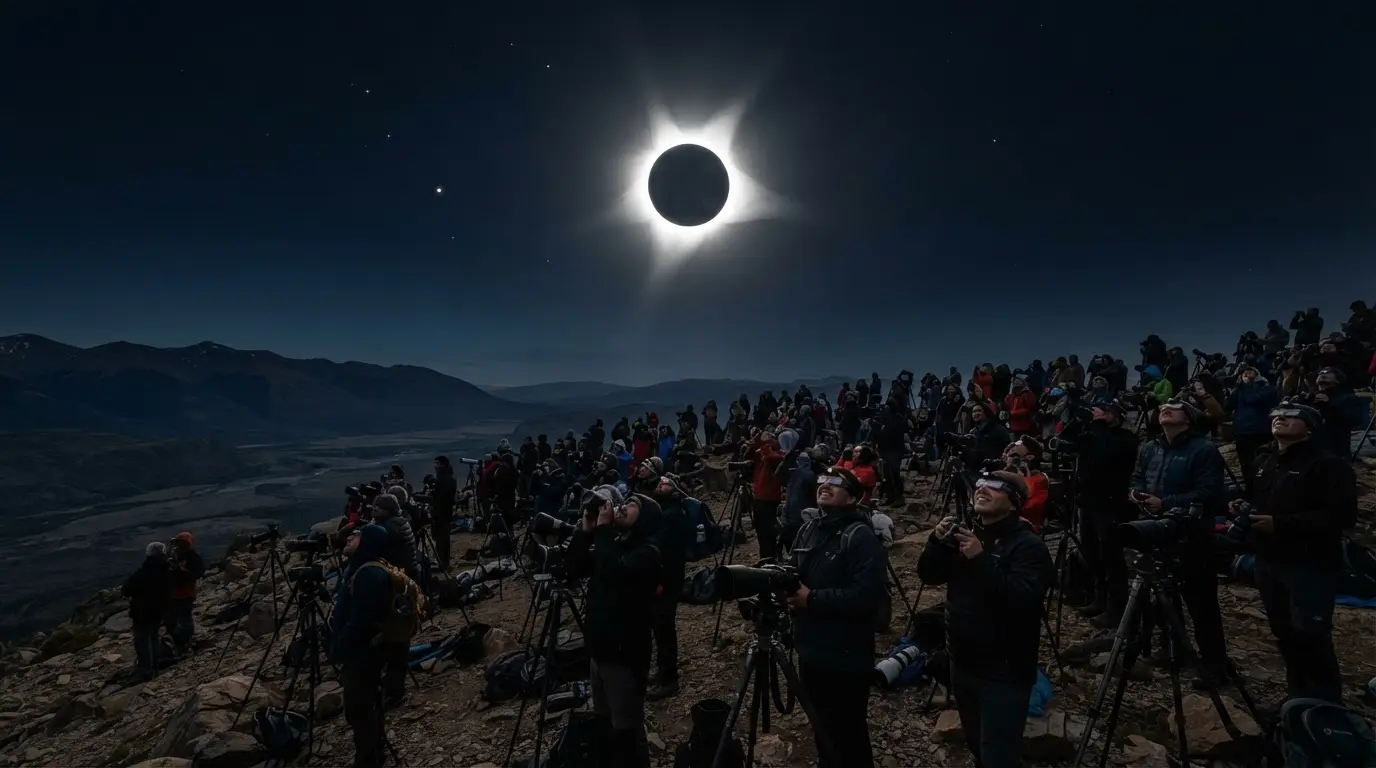

What "Umbraphile" Actually Means
Glenn Schneider saw his first total eclipse in March 1970, at fourteen, and it rerouted the rest of his life even though his actual research had nothing to do with eclipses[6]. Fifty years and dozens of eclipses later, his own total time spent inside the Moon's umbral shadow added up to just under two hours[7]. That's the strange arithmetic of umbraphilia: chasers travel across continents, spend years planning, and burn a career's worth of vacation days, all for a cumulative total measured in minutes.
“Those who have not, may have difficulty in understanding that umbraphillia is not only an addiction, but an affliction, and a way of life. The real raison d'être for many of us.[8]”
That obsession represents the extreme end of what the travel industry now calls astrotourism: trips built around a sky event rather than a destination. What separates an umbraphile from an ordinary astrotourist is the willingness to keep going. A total solar eclipse happens somewhere on Earth roughly every 16 months[9], so there's always another one worth planning a trip around, if you're willing to go wherever it lands.
The Original Eclipse Chasers: Mabel and David Peck Todd
Eclipse chasing existed long before anyone had a word for it, and it went badly more often than it went well. During the Revolutionary War, Harvard mathematics professor Samuel Williams got permission to cross into British-occupied Maine to watch the total eclipse of October 1780[10]; a miscalculation put his group in the wrong spot, and they missed it[11]. Nearly a century later, astronomer Asaph Hall spent months sailing from New York to Siberia to observe the 1869 eclipse[12]. "The bane of eclipse chasers is weather," eclipse historian John Dvorak says[13]. Two centuries on, it still is.
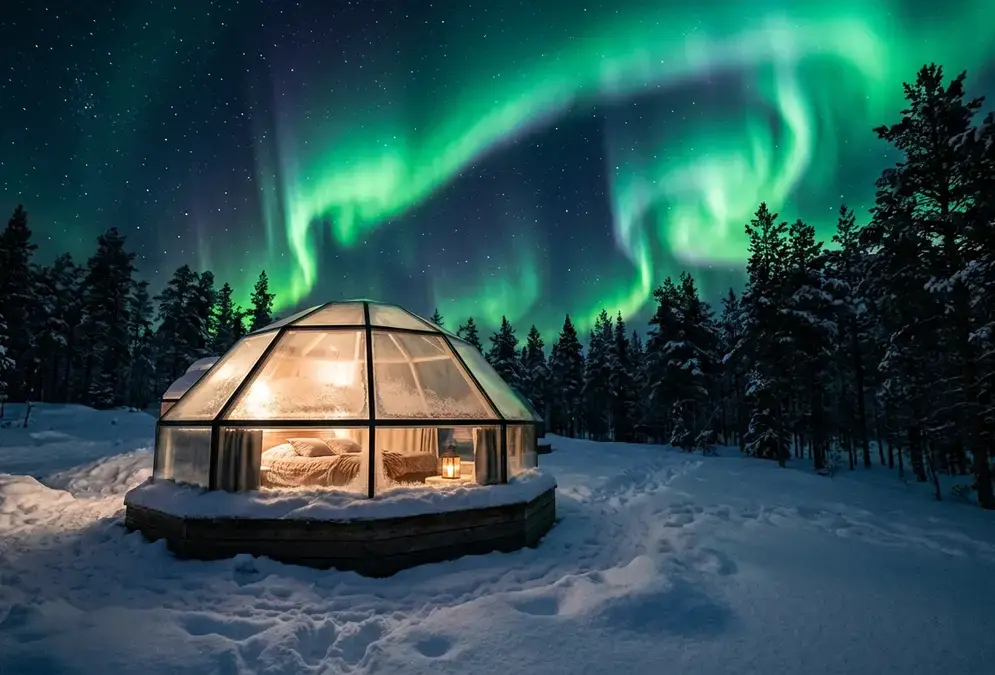
Featured · Destination
Northern Lights in Finnish Lapland
Finnish Lapland's whole-region aurora guide: glass igloos, Santa Claus Village, six bases from Rovaniemi to Inari, aurora season Sep–Mar, no road drama.
A dozen expeditions, mostly clouded out
Mabel Loomis Todd, an American writer and editor, and her husband David Peck Todd, an astronomy professor at Amherst College, spent decades traveling the world together to watch eclipses, starting in 1878[14]. David led the expeditions: a dozen of them in total, reaching five continents and more than 30 countries[15]. The itinerary included three trips to Japan, two to Libya, and stops in Angola, Chile, Brazil, and across Europe and Asia[16]. Almost none of it worked. Todd was clouded out so consistently that his daughter Millicent later met a British astronomer who greeted her with the moniker "Professor Todd of the Cloudy Eclipses"[17]. The repeated failures, and Todd's increasingly erratic behavior, eventually contributed to Amherst forcing him into an indefinite leave of absence in 1917[18]. He's buried in the college's Wildwood Cemetery, under a tombstone engraved with an eclipse, the sun's corona rendered in stone: a monument to the thing he mostly never actually saw[19]. None of it stopped him from going back for more, which is the part later chasers inherited along with the odds against them.
Mabel Loomis Todd, off the astronomer's log
Mabel wasn't just along for the ride. She's separately remembered today for posthumously editing and popularizing the poems of Emily Dickinson[20], work that had nothing to do with her husband's telescopes. But she wrote about the eclipses too, and arguably better than he photographed them. After watching a total eclipse over Japan in 1887, she wrote: "I doubt if the effect of witnessing a total eclipse ever quite passes away. The impression is singularly vivid and quieting for days, and can never be wholly lost"[21]. It's one of the earliest first-hand descriptions of what totality does to a person, decades before her husband's obsession had a name. By 1851, decades before either Todd set out, a daguerreotypist named Johann Julius Friedrich Berkowski had already taken the first correctly exposed photograph of the solar corona, at the Royal Observatory in Königsberg[22], proof the technology was catching up to the obsession just as fast as the obsession was spreading.
The Record Holders: Thirty-Five Eclipses and Counting
The current record for total solar eclipses witnessed by one person is 35, held jointly by Glenn Schneider and John Beattie[3]. They set it together aboard a chartered LATAM Airlines flight into the path over Easter Island on 2 July 2019[23]. Fellow chaser Jay Pasachoff, meanwhile, had witnessed more eclipses overall once you count the partial and annular ones: his total count rises to 70[24]. Schneider dismissed his own record flatly: "this is not a competitive sport... we don't do this for record keeping; it's just one of the incidentals that happens to come along with it"[25].
74 min
The Concorde chase
The record for longest cumulative time spent inside the Moon's shadow belongs to Don Liebenberg, at 2 hours, 35 minutes, and 13.7 seconds, accumulated between 1954 and 2017[4]. Almost half of that total came from a single flight: on 30 June 1973, Liebenberg was part of a team of astronomers who followed an eclipse for 74 minutes aboard the prototype Concorde[26]. That aircraft isn't in a scrapyard. It's on permanent display in eclipse livery at the Le Bourget Air and Space Museum outside Paris, portholes and all[27]. Schneider chased a version of the same trick decades later: his own July 2019 airborne expedition stretched totality past nine minutes, the longest total eclipse anyone has experienced from a commercial aircraft[28].
The shortest eclipse on record
Not every record here is about maximizing. In October 1986, Schneider watched a total eclipse near Iceland that lasted a fraction of a second, likely the shortest total solar eclipse ever seen from Earth[29]. Path geometry cuts both ways: it can hand you nine minutes over open ocean, or take totality away again before you've finished blinking. The two extremes sit only sixteen months apart on the calendar, which is either poetic or just orbital mechanics, depending on your tolerance for meaning-making. Schneider spent his life treating both extremes as data, not disappointment. He died of Lewy body dementia at 69[30].
Why People Become Obsessed With Chasing Shadows
Clinical psychologist Kate Russo didn't ease into eclipse chasing. She saw her first total eclipse in France in 1999 and was converted instantly: "that is the precise moment that I became an eclipse chaser," she says[31]. By 2024 she'd logged 12 total eclipses in locations including Madagascar, Mongolia, and the middle of the Pacific Ocean[32], and turned the rest of her career toward explaining, clinically, what had just happened to her.
Her research links totality to a reliable set of physical reactions: weeping, crying out, goosebumps, chills[33]. She also names something she calls primal fear, distinct from awe, the sense that the natural order has briefly gone wrong: "the primitive parts of our bodies are picking up that things aren't quite right in the natural order of the world"[34]. Awe and fear arriving in the same two minutes is, as far as anyone has actually measured it, the closest thing to a mechanism behind the addiction Schneider described decades earlier without the clinical vocabulary to back it up.
Russo surveyed 67 self-identified eclipse chasers for her book Total Addiction: The Life of an Eclipse Chaser. The average respondent was 46 years old, and 92% were male[35]. What unites them isn't income or astronomy training; it's temperament. "A common uniting factor in serious eclipse chasers is a stronger desire for experiences than material possessions," Russo found[36]. That's the honest answer to why anyone would spend a decade's savings on 120 seconds of darkness: for this specific group of people, the trade was never close.
None of this is why a dark-sky travel site covers eclipse chasing, exactly. But the psychology explains a pattern that shows up constantly in researching this beat: people who plan one trip around a dark sky and then can't stop planning the next one. Eclipse chasers are just the most extreme, best-documented version of a compulsion that shows up in miniature every time someone books a second aurora trip after a cloudy first one.
Inside the Eclipse-Chasing Community Today
Russo has put the number of genuinely hardcore chasers, people who travel specifically for multiple eclipses rather than whoever happens to be visiting when one passes overhead, at somewhere between 200 and 500[5]. That figure predates the 2017 and 2024 American eclipses, both of which pulled millions of new spectators into the path for the first time, so the real number of hardcore chasers today is anyone's guess. I couldn't find a published update to it researching this piece, which says something about how small and undocumented this specific subculture still is, even now.
Bill Kramer, who runs Eclipse-Chasers.com and organizes viewing expeditions, had witnessed 15 total eclipses as of 2017 and put his remaining gaps in oddly specific terms: "I've seen 15 total solar eclipses and it's easier to say I have not gone to the Antarctic and I have not been in South America, although I've been close"[37]. That's the umbraphile mental map: not places visited, but shadow paths crossed off.
Because the best viewing spots are frequently remote or entirely ocean-bound, a dedicated eclipse-cruise and expedition-travel industry has grown up around the hobby[38]. It goes back further than most people assume. In the summer of 1972, 834 passengers and one cat sailed the ocean liner Olympia into the Atlantic on what's considered the first cruise built specifically around a total eclipse[39], a voyage credited with launching the modern eclipse-cruise tradition[40]. That same infrastructure is what will carry the next wave of chasers to Iceland and northern Spain for the total eclipse crossing Iceland and Spain in August 2026, an event paired with a moonless Perseids peak the same night, exactly the kind of double-booking umbraphiles build entire trips around.
How to Actually Chase an Eclipse
You don't need Schneider's fifty years or Kramer's continent-crossing logbook to start. You need to be somewhere inside the path of totality, the band where the Moon's shadow actually touches the ground, which can run up to 166 miles wide[41]. And you need weather that cooperates, which no amount of planning guarantees.
The hobby has gone mainstream fast. The 2024 total solar eclipse over North America alone pulled an estimated 4 to 5 million travelers into the path[42], turning it into the single largest travel day of the year in the United States and generating a roughly $1.5 billion economic boost[43]. Most of those people were not umbraphiles. Some of them almost certainly became one.
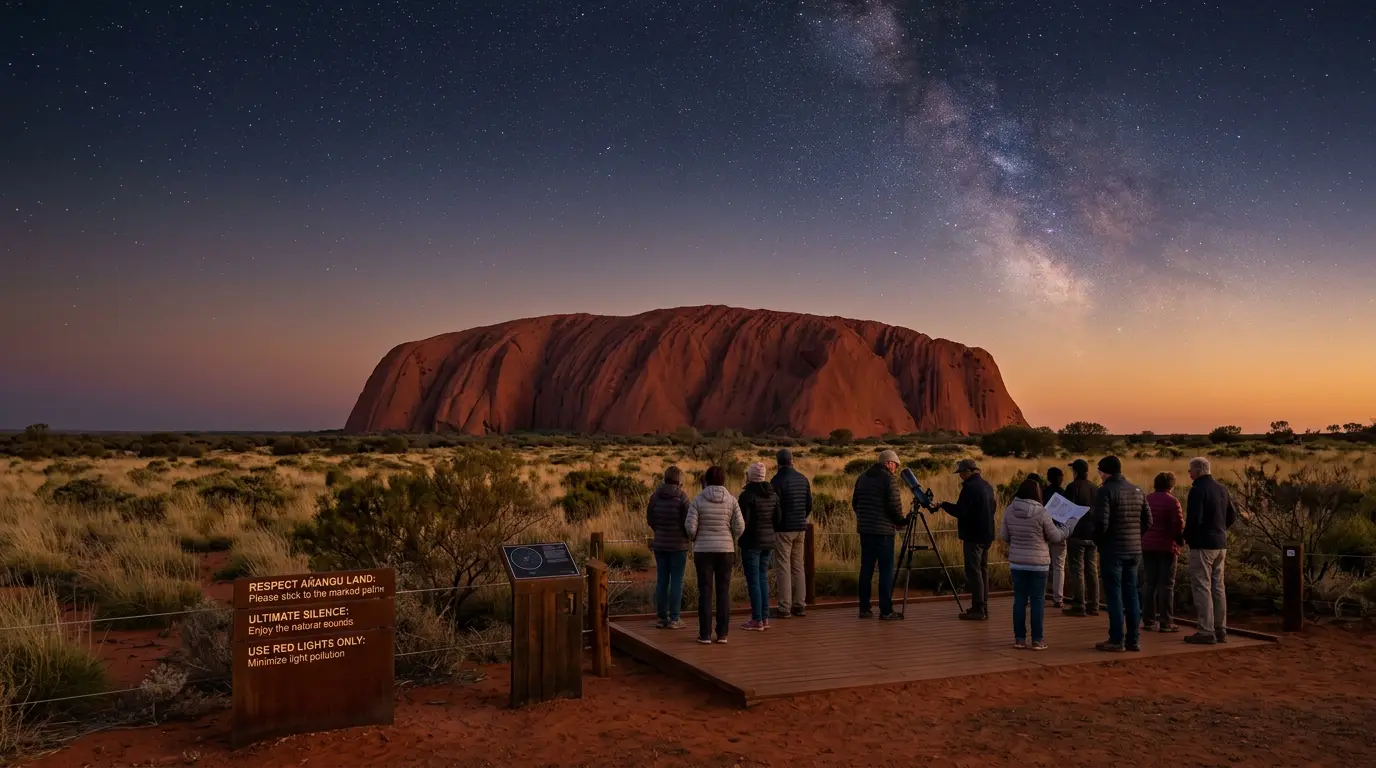
Featured · Article
Uluru Cultural Significance and Visitor Etiquette
Uluru is Anangu land under joint management. Here's why the 2019 climb closure is settled policy, what you can't photograph, and real visitor etiquette.
If you're weighing whether to become one yourself, the next few years don't lack for chances. The total eclipse crossing Iceland and Spain in August 2026 is a reasonable first eclipse for anyone starting close to home. The 2027 eclipse near Luxor, Egypt delivers up to six minutes of totality, among the longest of the century. And six months earlier, February 2027's annular ring of fire over Chile, Argentina, and West Africa is the smaller, cheaper way to test whether the obsession takes hold at all. Most umbraphiles didn't plan to become one either. They just went to look, once.