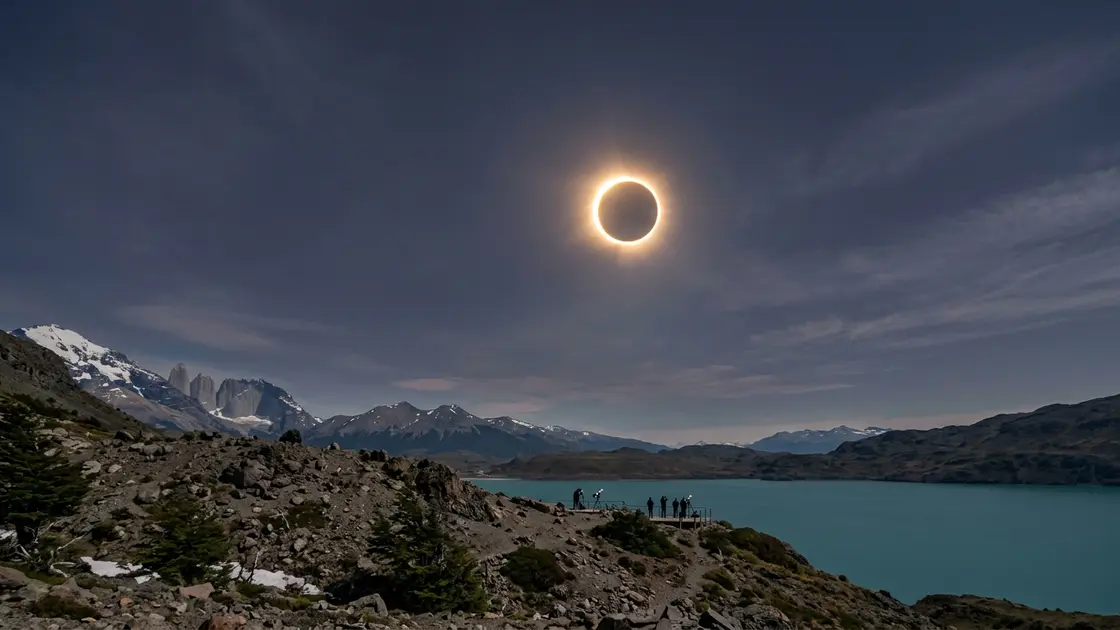
On February 6, 2027, the Moon slides directly between Earth and the Sun without quite covering it. Because the Moon sits near the farthest point of its orbit that day, its disc looks slightly smaller than the Sun's, so a thin, blazing ring stays visible around the edge for as long as the alignment holds. This is an annular solar eclipse, not a total one, and that single difference changes almost everything about how to watch it safely and whether it's worth planning a trip around.
The path: southern Chile and Argentina, then West Africa
The antumbral shadow first touches land in southern Chile and Argentina, then crosses the South Atlantic and reaches West Africa, including Ghana, before the eclipse ends. Along that narrow band, the Moon's silhouette sits centered inside the Sun's disc for a few minutes at a time. Step outside it, even by a modest distance, and the eclipse only ever reaches a partial phase.
- Southern Chile and Argentina: the eclipse's first landfall, at Patagonian latitudes
- South Atlantic Ocean: home to the eclipse's greatest duration, 7 minutes 53.5 seconds, over open water rather than any coastline
- West Africa, including Ghana: Tema New Town, near Accra, sits inside the path as the eclipse crosses back onto land
Beyond that narrow track, a much broader partial eclipse reaches across most of South America, Africa, the Pacific, the Atlantic, and Antarctica. If you're not inside the annular path itself, you'll see a partial bite taken out of the Sun rather than a full ring.
If you already picture Chile as a stargazing destination, that's usually the Atacama Desert, several hundred miles north of this eclipse's path. None of the Atacama's dark-sky infrastructure sits inside the ring-of-fire track this time; the relevant ground here is farther south, closer to Patagonia.
What "ring of fire" actually means, and why it's never safe bare-eyed
An annular eclipse happens because the Moon is near apogee, its farthest point from Earth in a given orbit, so its apparent size shrinks just enough that it can't fully block the Sun's disc. The result, at maximum eclipse, is a bright ring of sunlight surrounding the Moon's silhouette, the ring of fire the event is named for.
The safety consequence follows directly. Because a sliver of the Sun's surface stays exposed the entire time, eclipse glasses (ISO 12312-2 certified) stay on for the whole event, from first contact to last. There's no equivalent to a total eclipse's brief safe window, when the Moon fully blocks the disc and it's safe to look without protection. Looking at the ring itself without certified glasses risks the same retinal damage as looking at an uneclipsed Sun.
Is this the eclipse to build a trip around?
Compare it honestly against the total solar eclipse crossing Spain and Egypt on August 2, 2027, and the annular event comes out clearly second. The August eclipse delivers up to 6 minutes 23 seconds of full totality, when the sky darkens at midday and it's briefly safe to look up without glasses at all. This February event never gives you that. The ring itself is a genuinely striking sight through certified glasses or a properly filtered camera, but it's a photograph of a ring, not the experience of standing inside the Moon's full shadow.
That said, the February eclipse has its own audience: dedicated eclipse chasers who track every annular and total event on the calendar, and photographers after a specific ring-of-fire composition they don't already have. If that's you, southern Chile and Argentina are the more practical of the two land-based viewing options. West Africa's stretch of the path is real, but it comes with fewer viewing tours and less established travel infrastructure built around the event itself.
For anyone weighing a single 2027 eclipse trip, the August total eclipse is the one to prioritize.
Weather and timing to plan around
February is high summer south of the equator, which cuts both ways for Patagonia and southern Argentina: long daylight, but also a stretch of the year with real cloud variability at those latitudes. Check a location-specific forecast in the days before the eclipse rather than relying on historical averages alone. West Africa's coastal skies in February tend to run drier, though local haze and Harmattan dust can still cut into visibility.
None of that changes the date. What changes is how clear the sky is when the ring actually appears.