Red light only: why white light ruins everyone's night vision
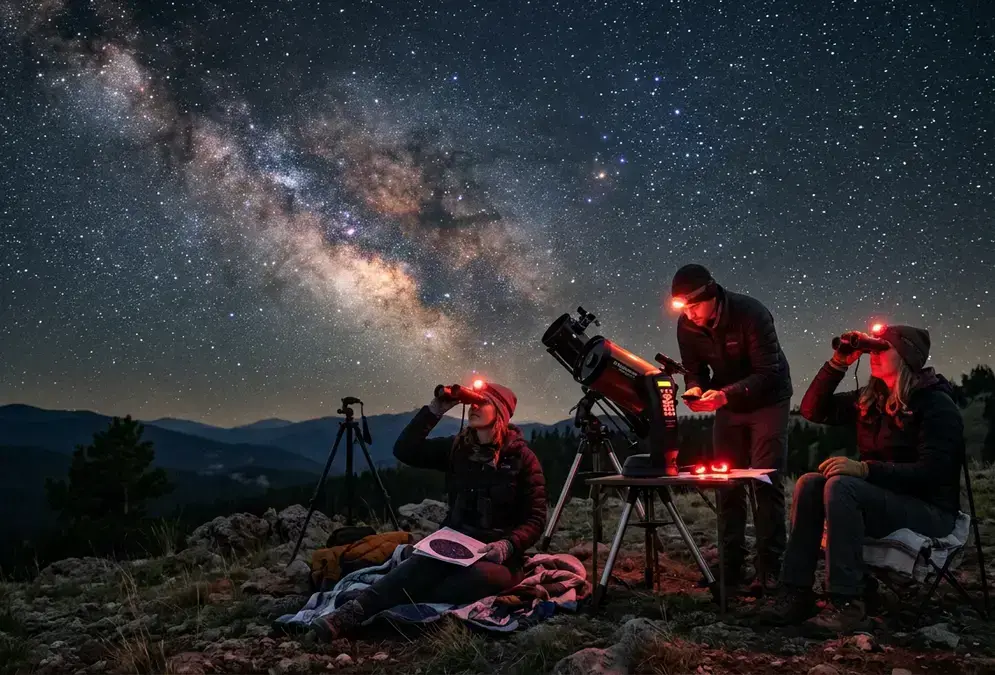
The one rule every dark-sky site enforces, formally or not, is red light only. Your eyes need roughly 20 to 30 minutes[1] of uninterrupted darkness to fully dark-adapt, and a single burst of white light, a phone screen, a flashlight, a car's dome light, resets that adaptation instantly. Not just for you. For everyone standing near you who spent the same half hour earning it.
20-30 min
Stargazing for beginners covers the biology behind dark adaptation in more depth. The etiquette version is simpler: treat every white-light source as something you get to spend once per night, then never again.
This is why experienced observers get quietly annoyed at a car door left open with the interior light blazing, or a phone held up to check a map at full brightness. That reaction isn't snobbery. It's everyone else's night vision getting reset by one five-second mistake.
A few habits keep the rule intact without much effort:
- Use a headlamp or flashlight with a red-light mode, or tape red cellophane over a white one
- Switch your phone to a red or night-mode filter and keep brightness low, or better, leave it in your pocket
- Disable the car's interior dome light before opening the door at a viewing site
- Park facing away from the group and cut your headlights well before you arrive, not after
No spotlights, no laser pointers, no light painting
Certified Dark Sky Places go further than red-light etiquette. They generally prohibit light painting, searchlights, and other unnecessary artificial light inside core observing areas[2], the kind of restriction that separates a casual pull-off from a site DarkSky International has actually inspected and certified. A laser pointer aimed skyward, even briefly, can interfere with someone else's long-exposure camera, and depending on the beam's power and how close you are to a flight path, it can also be illegal.
Arrive before dark and set up early
Fumbling with a headlamp, a tripod, or a car door after dark forces you to use light exactly when everyone around you is dark-adapted and most vulnerable to losing it. Arriving early solves most red-light problems before they start.
If it's your first visit to a site, scout it in daylight: know where the parking is, where the trail edges drop off, and where the restrooms are before you're relying on a dim red beam to find them. Set up chairs, telescopes, and camera gear before sunset, not after, so the only light you need once it's dark is an occasional glance at a star chart.
Featured · Destination
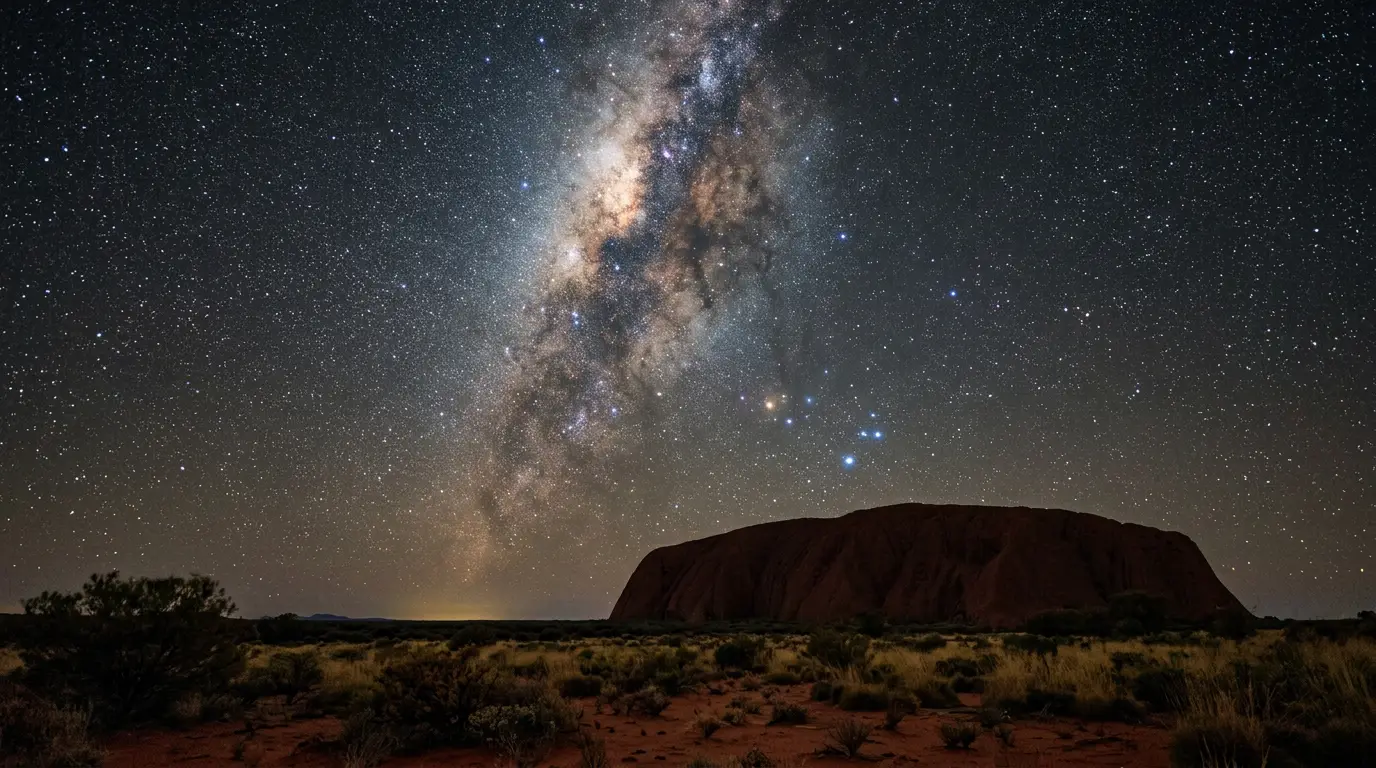
Uluru
Stargaze at Uluru on Anangu-owned, jointly managed land: the Milky Way's core, Magellanic Clouds and Southern Cross over Australia's red-centre outback.
Preparation extends past gear, too. Check the moon phase and the forecast for your exact site, not just your home city's app, before you leave the house; a clear-sky forecast forty-five minutes down the road at elevation can look nothing like the one where you started.
This part is honestly as much for your own comfort as anyone else's. Fumbling with a tent stake or a tripod leg in the dark, without white light to help, is its own kind of frustrating. Do the fumbling in daylight instead.
Bring exactly what you need and leave the rest in the car. A pile of gear you have to dig through in the dark is a pile of reasons to flick on a white light later, so pack light, and pack in the order you'll actually use things.
Leave No Trace on a dark-sky night
Many of the best dark-sky sites sit inside fragile desert, alpine, or high-plateau ecosystems, and recreation pressure on them is rising fast as astrotourism grows. The Leave No Trace Center for Outdoor Ethics organizes outdoor conduct into seven principles[3], and every one of them applies to a night spent under the stars just as much as a weekend backpacking trip.
- Plan ahead and prepare: check the forecast, moon phase, and the site's specific rules before you go
- Travel and camp on durable surfaces: stick to rock, sand, gravel, or an established trail rather than cutting across vegetation or biological soil crust
- Dispose of waste properly: pack out everything, including food scraps and micro-trash, and never leave anything for the morning crew
- Leave what you find: rocks, plants, and artifacts stay where they are
- Minimize campfire impacts: check local fire restrictions, since an open flame ruins night vision as fast as a flashlight and can violate a site's lighting rules outright
- Respect wildlife: many dark-sky sites double as nocturnal-wildlife habitat, and a crowd of stargazers is still a crowd
- Be considerate of other visitors: the one principle that's about etiquette more than environment
The Leave No Trace Center for Outdoor Ethics puts it plainly: the same principles apply everywhere, from a remote wilderness reserve to a neighborhood park to your own backyard[4]. A stargazing field a few miles outside town deserves the same care as a national park's backcountry.
“The Principles can be applied anywhere — from remote wilderness areas, to local parks and even in your backyard.”
Desert biological soil crust, the dark, knobby-looking crust covering undisturbed desert ground, can take decades to recover from a single footprint. It looks like dirt. It is not dirt. Staying on a marked trail costs nothing and protects something that took far longer to form than most visitors have been alive.
Noise and space: sharing the dark with other observers
Astronomy is a shared, quiet activity, and sound carries much further at night than it does in daylight. Keep voices down, especially near an organized star party or a public telescope line where dozens of people are trying to listen for the same thing.
Ask before you walk near someone's telescope or tripod. Bumping a scope out of alignment costs its owner the rest of the night recalibrating, and walking through the foreground of a long-exposure shot can ruin a frame an astrophotographer has been building for twenty minutes. If you want to understand why that shot takes so long, how to photograph the Milky Way walks through the actual exposure times involved.
Space matters as much as sound. A popular overlook or viewing platform fills up fast on a clear, moonless weekend, and crowding someone else's setup, or planting your own gear six inches from theirs, ruins the experience for both of you. Give people room, and expect the same courtesy back.
Kids and dogs are welcome at most sites, but a barking dog or a bored kid running between tripods breaks the same quiet everyone came for. If you're bringing either, plan for it: a leash, a quiet activity, or a spot further back from the crowd where noise matters less.
Music and podcasts belong in headphones, not a speaker. Even a quiet speaker carries across open desert or high plains far enough to annoy someone who drove a long way for silence.
Respect private, protected, and certified land
Many of the best dark-sky sites, Joshua Tree among them, are national parks, reserves, or places certified by DarkSky International as an official International Dark Sky Place[2], plus private ranches and observatories that allow visitors as a privilege rather than a right. What's allowed changes with the type of land you're standing on, and it's worth knowing the difference before you go.
Here's roughly what to expect at each:
| Site type | What to expect |
|---|---|
| Certified Dark Sky Place (Park, Reserve, or Sanctuary) | A 100% dark-sky-friendly lighting commitment, posted curfews or closing hours, and a general ban on light painting and searchlights in core viewing areas |
| National or state park, uncertified | Standard park rules apply; some close to vehicle traffic after dark except at signed night-sky areas |
| Private ranch or observatory | Access is a privilege granted by the owner, not a public right; confirm in advance rather than assuming open land is open to visitors |
| Unofficial pull-off or backyard | No posted rules, but local noise ordinances and trespass laws still apply |
Certification is not permanent, either. DarkSky International reviews certified places on a regular schedule and can revoke the designation if a site stops meeting its lighting and program commitments[5]. That review process is part of why a Dark Sky Place badge means something: it's inspected, not just claimed.
Fees, when a site charges one, are usually modest: a few dollars per vehicle or per person, funding the trails, restrooms, and interpretive signage that make the place usable after dark in the first place. Treat that fee as part of the visit, not a toll to dodge.
Recommended tours
Tours are selected for quality, not commission. I earn a small fee if you book — at no extra cost to you.
This isn't about permission slips so much as basic manners: don't trespass onto a rancher's land to escape a park's crowds, and don't assume the Atacama Desert's reserve curfew doesn't apply to you just because you flew a long way to get there. Private-consortium reserves take this further still: at NamibRand, every partner lodge agrees to the reserve's lighting rules as a condition of operating inside it, so a single guest's headlamp or vehicle lights left on can undercut a protection scheme an entire consortium of landowners built together. Check the specific site's rules before you go, and follow them the way locals do, not the way a tourist wants to.
For a shortlist of certified sites worth planning a trip around, best dark sky parks in the world breaks down the real certification tiers, from small reserves to the most remote sanctuaries, and what each one means once you're standing there at night.
Take the ethic home: reducing light pollution where you live
Protecting one dark sky at a remote site means little if the same visitors go home to unshielded floodlights left on all night. DarkSky International and the Illuminating Engineering Society publish five principles for responsible outdoor lighting[6], and the whole list boils down to one habit: use light on purpose, not by default.
“Light where you need it, when you need it, in the amount needed, and no more.”
The habit breaks into five specific choices:
- Give every outdoor light a clear purpose, rather than leaving one on out of habit
- Direct it only where it's needed, using shielded fixtures that point down instead of sideways or up
- Keep it no brighter than the task actually requires
- Turn it on only when it's useful, letting a timer, motion sensor, or dimmer do the work instead of a switch left flipped all night
- Choose a warm color temperature over the harsh blue-white light common on cheap LED fixtures
None of this requires giving up outdoor lighting for safety or security. A motion-activated, shielded, warm-toned fixture does the job a bare floodlight does, without spilling light sideways into a neighbor's bedroom window or straight up into the sky. That upward spill is sky glow, one of the four components of light pollution, alongside glare, light trespass, and clutter, and each has a different physical cause and a different fix. Swap one fixture at a time if a full overhaul isn't realistic, and support a local lighting ordinance if your town is considering one. Several astronomy clubs and dark-sky advocacy groups also run citizen-science light-pollution monitoring, a low-effort way to turn one good night at a dark-sky site into an ongoing habit.
None of this has to happen all at once. One shielded, motion-activated fixture replacing a bare floodlight measurably cuts the glow a neighbor notices at night, long before an entire street or town gets on board.