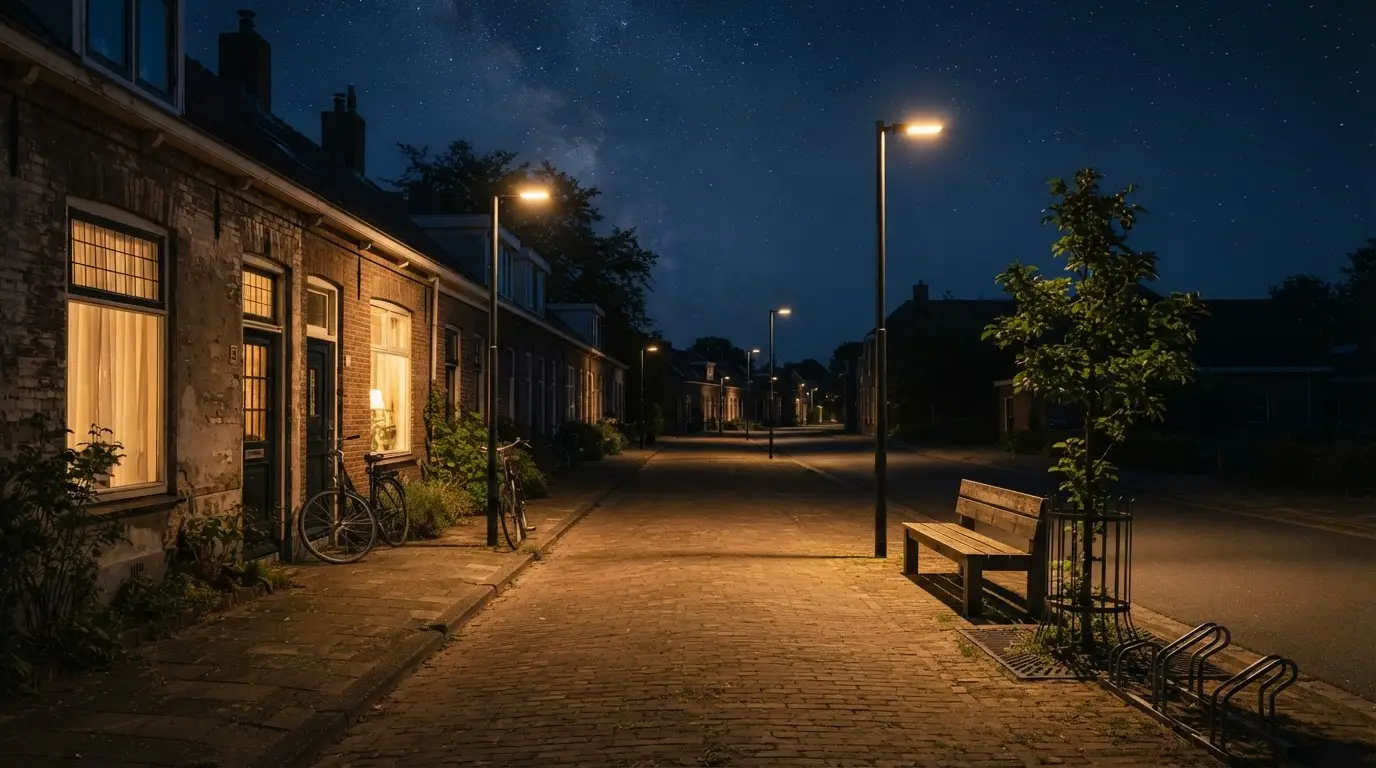

The claim, and the New York trial behind it
For decades the evidence behind "brighter streets, less crime" was thinner than the confidence. A 1997 report to Congress, as quoted in the New York paper, said "we can have very little confidence that improved lighting prevents crime."[4]
Then New York ran an experiment. The NYPD supplied a list of 80 high-priority public housing developments, picked for their elevated crime rates.[5] The working paper's design randomized 40 to receive lights and 40 to serve as controls.[6] The towers ran from March through August 2016.[7]
What 600,000 lumens did not test
The treatment was a light tower, not a lamp on a pole. Each emitted about 600,000 lumens, and the paper itself calls the towers "extraordinarily luminous".[12] For scale, the US Department of Energy gives a nominal 100-watt high-pressure sodium cobra-head streetlight a rated output of about 8,550 lumens, so one tower is roughly 70 of them.[13] The authors add that the lighting "provides far more light than a typical investment in marginal lighting would entail."[14]
The comparison was towers against no added light at all.[15] A great deal of light beat none. As far as I can tell from the working paper, it did not test shielding, colour or per-fixture output, since every tower was the same unit, so a council weighing a fully shielded, warm, dimmable fixture, the kind dark-sky etiquette argues for, has no result from this trial to point to in either direction.
Featured · Destination
Northern Lights in Tromsø
At 69.6°N inside the auroral oval, Tromsø sees aurora at Kp 2. Peak season November–February. Best viewing spots, tour advice, and aurora forecast strategy.
The authors list other limits themselves. The towers were conspicuous enough that the effect "may fold in substantial demonstration effects",[16] and "some uncertainty about the effects of a permanent infrastructure upgrade remains."[17] Base rates were low, about 3.3 outdoor night index crimes per development per six months,[18] so a drop of that size is on the order of one crime per development per half-year.
What happened when England and Wales cut the lights
England and Wales ran the reverse experiment, driven by budgets. Councils switched lights off, dimmed them, turned them off after midnight, or swapped in white LEDs.[21] A national evaluation, reported by Perkins and colleagues in 2015 as an NIHR report, looked for any change in crime. It had usable data from 62 authorities,[2] out of 174 in total.[22]
The report's overall verdict was a null: "no evidence that reduced street lighting was associated with crime."[23] Dimming showed weak evidence of less crime (rate ratio 0.84, 95% interval 0.70 to 1.02), and because that interval spans 1, it falls short of significance.[24] The authors' release also flags part-night lighting as possibly linked to more robbery.[25]
Results were not uniform. Effects varied significantly between police forces,[26] and some residents felt less safe in the dark.[27] Switch-offs were also read as the authority neglecting an area.[28] UCL's Shane Johnson, a co-author, warned that the result "does not mean that this will be the case under all conditions."[29]

Featured · Article
What Causes the Northern Lights? The Science Explained
Solar wind collides with Earth's magnetic field, funneling charged particles toward the poles, where they excite oxygen and nitrogen into glowing color.
Both sets of results can be true. New York compared a great deal of added light with none; England and Wales compared ordinary lighting with reduced lighting, from dimmed to switched off. As far as I can tell, neither tested a fully shielded, lower-output lamp swapped in for a glaring one. For a town that has already rewritten its lighting rules, see Flagstaff, the first dark-sky city; its crime records are where I would look first, and I have not seen an analysis.
Older studies point both ways
Welsh and Farrington's 2008 Campbell review concluded that improved street lighting significantly reduces crime.[30] Night crime did not fall more than day crime, though.[31] They read that as favouring community pride and informal social control over surveillance and deterrence.[32] If daytime crime fell too, seeing offenders better cannot be the whole story. The New York trial counted only outdoor night crime, so it cannot settle the point.
Chicago's alley lighting project complicates things. The city replaced 90-watt alley lamps with fixtures that take 250-watt bulbs.[33] In the one-year before-and-after comparison, reported offenses rose in the upgraded area.[34] The evaluation covered just two eight-square-block areas,[35] and it could not offer a definitive explanation.[36] The report floats more offenses, or more reporting from a more watchful neighbourhood.[37] None of this says light does not work. It says the older evidence is mixed, thin and hard to separate from everything else happening on a street.
What to ask for at the vote
If you want shielded, lower-output lighting, concede first. The randomized trial found that very bright light cut outdoor night crime in high-crime housing, and a speaker who denies it gets discounted on everything else. Then say what it did not test.
DarkSky International's brochure says "there is no clear scientific evidence that increased outdoor lighting deters crime and increases safety."[38] After the New York trial I would not repeat that sentence at a council meeting. Its glare argument is the better one: glare "creates deep shadows, making it more difficult to see",[39] though that is an optical claim none of the crime studies above tested.
Recommended tours
Tours are selected for quality, not commission. I earn a small fee if you book — at no extra cost to you.


So ask for a measured pilot. The New York pilot cost $5,032,632, about $129,000 per development,[40] and its authors reach a benefit-cost ratio near 4 to 1 only if the effect persists.[3] Welsh and Farrington asked for "high quality evaluation designs with long-term followups."[41] A shielded, lower-output pilot in one district, with a matched comparison district and outdoor night crime counted, would add something none of the studies I found has, and it would show whether a bright upgrade's light pollution was needed at all.
Questions to put to the council
- Which crimes will be counted, at what hours, and against which comparison area?
- How bright is the proposed fixture next to the trial's light towers?
- Is it fully shielded and aimed at the ground it is meant to light?
- Who reviews the data, and on what date does the pilot end or become permanent?
- How will residents who feel less safe be heard during the pilot?