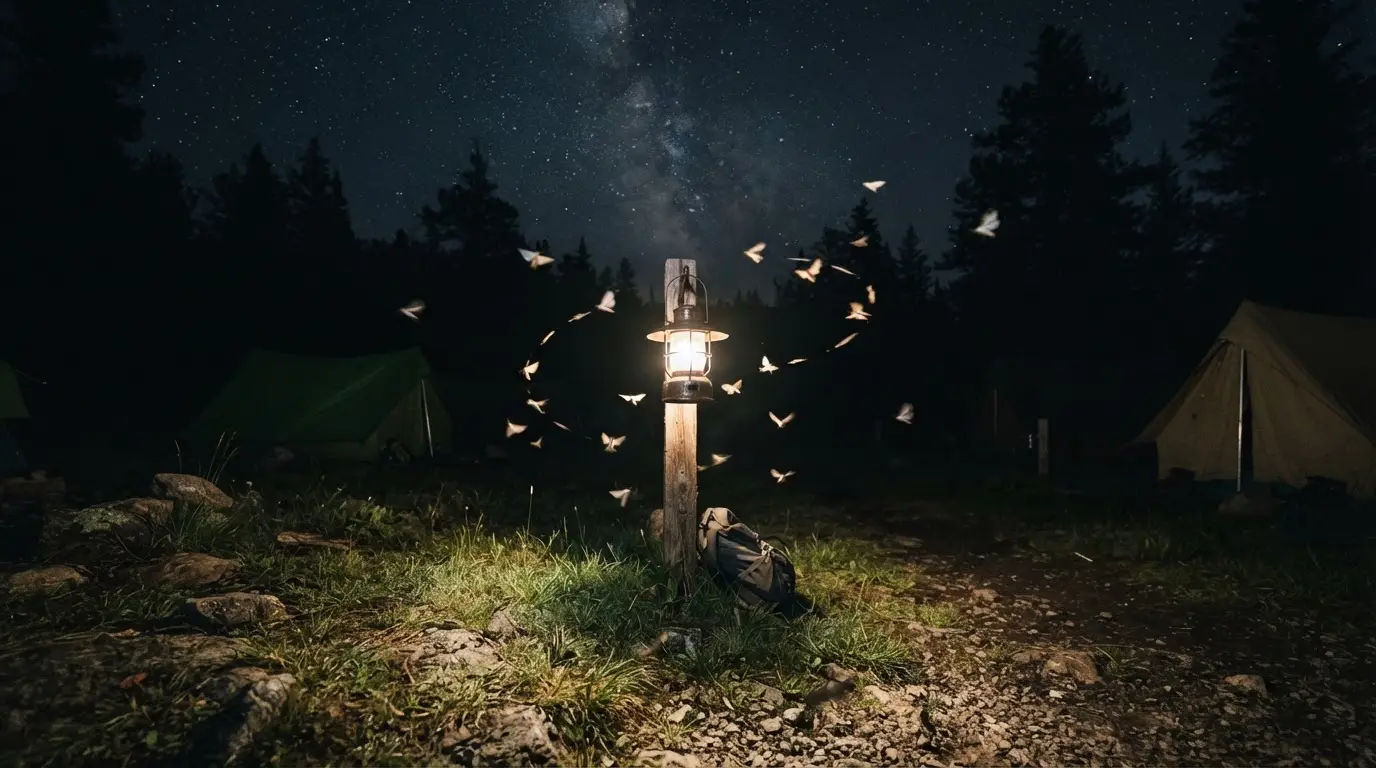

A tilt, not a pull: what the 2024 study found
The paper is "Why flying insects gather at artificial light", published in Nature Communications on 30 January 2024.[4] Samuel Fabian's team at Imperial College London filmed insects in Costa Rica, then tracked them in a lab with motion capture, which let them rebuild each flight path in 3D.[5] The field half alone rests on 477 stereo-video recordings.[1]
Their conclusion is blunt. Imperial's release says flying insects "are not attracted to light, but become disorientated by it as they think it is the sky".[6]
The mechanism is the dorsal light response. Imperial describes it as a behaviour that "keeps their top side to the brightest visual region", which was the sky until people lit up the night.[7] A flyer this small cannot lean on its own acceleration to tell which way is up, so it seems to bet on brightness instead.[8]
Put a lamp close by and the bet goes wrong. The lab marker data caught it directly: the insects tilted their backs strongly toward the source.[9] From there the geometry takes over.
For the wider ecological damage, what is light pollution has a section on wildlife.
How the tilt becomes an orbit, a stall or a crash
At short range, the paper reports, most insects do not fly directly to a light source but orthogonally to it.[10] Imperial's release sorts what followed into three outcomes: orbiting, stalling and inversion.[11]
- Orbiting: the bank from a back-to-the-light tilt swings the insect around the lamp, so it circles and rarely collides.[12]
- Stalling: a steep climb that slows until the insect hangs with no movement left.
- Inversion: the insect flips onto its back and crashes, which tends to happen when it flies directly over a light.[13]
Featured · Destination
Northern Lights in Finnish Lapland
Finnish Lapland's whole-region aurora guide: glass igloos, Santa Claus Village, six bases from Rovaniemi to Inari, aurora season Sep–Mar, no road drama.
The most useful experiment for a garden came from the same paper. The team shone a shrouded UV bulb down onto a white sheet on the ground, and insects inverted and tumbled into it.[14] Shine the same bulb up at a white sheet overhead, a stand-in for a diffuse canopy, and they flew assorted paths beneath it instead of climbing or clustering.[15]
One bulb in one lab arrangement is a clue about direction, not a rulebook. My reading is that light arriving from above, like a sky, gives the back-tilt nothing to loop around, while light aimed at the ground or bounced up from it may keep the trap alive.
Why the heat and moon explanations fall short
You may have heard that moths mistake lamps for flames, or for the moon. Heat is the easy one to retire. Cool lights trap insects too, as the study's authors note in their own write-up for The Conversation.[16] Butterfly Conservation adds that moths favour ultraviolet far above red, a pattern with no obvious link to heat.[17]
The moon story is a celestial compass gone wrong. Under it an insect holds a fixed angle to the light, so its path should spiral inward into a collision. The authors say that doesn't usually match the orbits they see.[18] Butterfly Conservation allows that lights might still disrupt moth navigation, but says this does not fit the short-range attraction people watch at a lamp.[19]
A third idea says insects head for the light as a gap in the foliage. Butterfly Conservation notes that no current research proves it.[20]
None of this closes the case. The same page says there is no clear answer yet.[21] I treat the 2024 paper as the best-fitting account I found, because it explains the orbits where the older ideas cannot, and not as the last word.
What the study does not tell you about your own lamp
The paper gives no distance at which a lamp stops mattering. It says only that this happens at short ranges, and it states that it did not test how range changes attraction.[22] The closest thing to a figure is Fabian's own framing in Imperial's release: "We know what's happening at 1 meter from a light, but what's happening at 100 meters?"[2] The lab tent was two metres across,[23] so none of this is a measured radius for your porch.
A lamp probably catches what is already nearby rather than reeling insects in. Imperial's reading is that insects are not attracted from far away; they become trapped if they fly close.[24] The paper hedges more: its results suggest lights may only trap passing insects rather than draw them in directly from farther away.[25]
Some insects ignore lights entirely. The paper says some tested species seemed immune to light entrapment.[26] Oleander hawkmoths and vinegar flies were the exceptions, and the authors read that as species differences.[27] Oddly, hawkmoths are readily trapped by lights in the field,[28] and the paper leaves that mismatch open. No source I found says what share of moth species never come to a lamp, so I won't guess.
The wavelengths tested were narrow. The paper's Diptera did not tip or crash over a white source, which the authors take to mean the effect is specific to short wavelengths in the Diptera tested.[29] They list spectral tuning of the response as future research,[30] so the paper cannot say whether warm or amber light changes the tilt. Its lab lights were UV and cool-white sources, not the bulbs sold as bug-friendly.
What actually helps around a lamp, camp or garden
I'd rank the options by how well the evidence holds up, not by how easy they are to buy. For artificial light at night, the best one costs nothing.
- Remove the light you don't need. A 2024 review of insect-friendly lighting calls removal of unnecessary light "by far the most effective" mitigation.[31]
- Shield it and aim it down. The paper's authors recommend cutting unnecessary, unshielded, upward-facing lights and ground reflections,[32] and the review calls shielding a "no regrets" action.[33] In a streetlight test matched for intensity and spectrum, careful direction alone significantly reduced insect attraction.[34]
- Use motion-activated lights where you need light only briefly. Insects are too small to trigger most motion detectors.[35] That is an argument from logic, not a measured reduction.
Mind the surface under the lamp
The paper's authors list ground reflections next to upward-facing lights as something to reduce, so a downlight over white gravel or a pale tablecloth may still send light skyward. No source I found measures how much.[32]
A full cutoff fixture is the usual way to do the second item. Smithsonian researchers list it alongside motion activators and dimmers as ways to use light only when and where it is needed.[36]
At a campsite the lamp you need is a headlamp. Monochromatic red light has repeatedly proven minimally attractive to light-attracted insects,[37] and it is also the colour behind why astronomers use red light, for a different reason: it spares dark-adapted eyes. Minimally attractive is not zero.
Planning a tent-based sky trip? The camping Jasper stargazing budget guide shows what one costs.
What is still unproven: warm white, amber, dimming and timers
Warm white is unproven as an insect fix. It is the usual sales line, and the evidence I found does not support it on its own. A household-lighting experiment in England found LEDs drew significantly fewer insects than other bulb types, but no significant difference between cool-white and warm-white LEDs.[38] A 2024 review points at the spectrum instead: ultraviolet draws insects most, blue less so.[39]
Amber is promising, but the result is a trap count in a tropical forest. Smithsonian researchers in Peru fitted amber filters to LEDs and cut the morphospecies drawn to the light by 34% and individual insects by nearly 60%, against white LEDs.[3] It is not a measurement of the back-tilt, and the 2024 paper never tested amber, so I would not promise a backyard lamp the same drop.
Dimming is not a safe answer, and it is the fix I trust least. In the review's evidence, even severely dimmed light, under 5 lux, still significantly altered the foraging of ground beetles.[40] Beetles are not moths. It is still a warning against assuming dim means harmless.
Recommended tours
Tours are selected for quality, not commission. I earn a small fee if you book — at no extra cost to you.


Timers miss the early peak. Most light-attracted insects gather between one and three hours after sunset,[41] so a midnight switch-off arrives after much of the gathering is done.

Featured · Article
Uluru Cultural Significance and Visitor Etiquette
Uluru is Anangu land under joint management. Here's why the 2019 climb closure is settled policy, what you can't photograph, and real visitor etiquette.
Most of these steps pay off twice. The authors' own prescription for nocturnal ecosystems is useful, targeted warm light, no brighter or longer than necessary,[42] and the same habits give skyglow less to work with, in a world where over a third of people cannot see the Milky Way at all.[43] Shielding is also plain dark-sky etiquette, and the Bortle scale rates how much glow a site has left. Given the household result above, I'd spend effort on targeting, not colour temperature.
So: light less, aim what remains at the ground, and treat any promise of a percentage for your own lamp with suspicion. The research supports the first two. It does not yet support the rest.