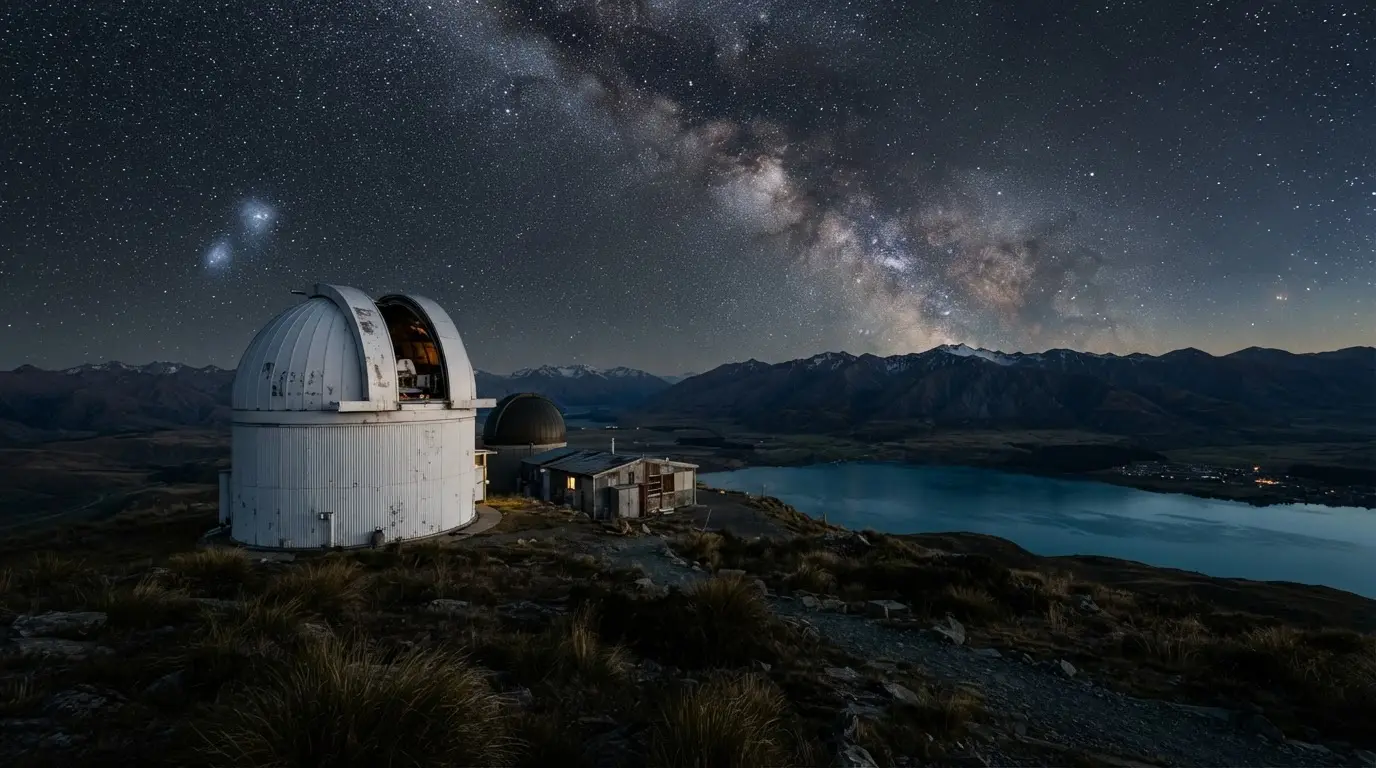
Mt John Observatory History: Sky Atlas to Microlensing Planet

I've seen dark skies firsthand in the Atacama altiplano, Namibia's NamibRand Nature Reserve, and Morocco's Merzouga dunes; every other destination I write about is built from measured Bortle and SQM data, cloud climatology, and primary sources like park services and the International Dark-Sky Association.
In this article
Jump to a section
Mt John Observatory history: a 1965 joint venture on a Tekapo hilltop
What Mt John did before planets: variable and binary stars

Featured · Destination
Aoraki Mackenzie Stargazing
Aoraki Mackenzie is one of only four Gold Tier Dark Sky Reserves on Earth: Bortle 2 skies over Lake Tekapo, the Southern Cross, and Mount John Observatory tour.
How MOA and OGLE caught the 2003 microlensing event
The 1.8 m telescope and what MOA found after 2003
Featured · Article
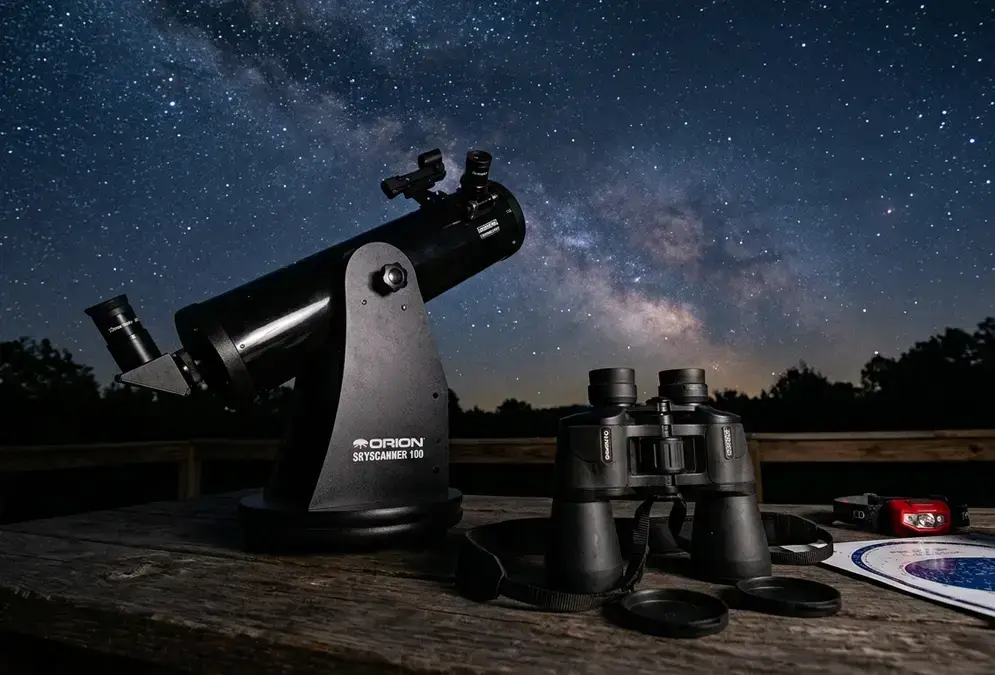
Stargazing Gear for Beginners: Binoculars to Telescopes
New to stargazing gear? This guide breaks down binoculars, telescopes, and smart telescopes, so you know what to buy first and what to skip for right now.
- MOA-2003-BLG-32 peaked at a magnification over 500, then the highest reported, and no planets were detected[45]. It ruled out low-mass planets across a wide region around the lens star[28]: planets 1.3 times Earth's mass were excluded from more than half of the annulus from roughly 2.3 to 3.6 AU[46].
- MOA contributed to the second microlensing planet, OGLE-2005-BLG-71[29]. Dong and colleagues later put it at 3.8 Jupiter masses, 3.6 AU from its host[47], and a 2019 Keck study confirmed that host is an M dwarf[48].
- MOA-2007-BLG-192Lb, reported in 2008, has a best-fit mass of about 3.3 Earth masses, with wide error bars, around a host of about 0.06 solar masses[49]. The parallax signal favoured a sub-stellar host[50], and its authors called the planet "probably the lowest mass exoplanet found to date, aside from the lowest mass pulsar planet"[30].
From research hill to dark-sky reserve
- 1965
Observatory opens
Joint University of Pennsylvania and Canterbury institution.[4]
- 1972
Canterbury Sky Atlas
Early project listed in Hearnshaw's slides.[9]
- 1986
1-m McLellan reflector
Joins the two 60-cm telescopes.[12]
- 1995
MOA established
Nagoya University plus three New Zealand universities.[15]
- 2003
Microlensing event alerted
OGLE on 22 June, MOA on 21 July; deviation 14 to 21 July.[18]
- 2004
Planet announced
Bond et al. published; NASA lists 2004.[23]
- 1 Dec 2004
1.8 m telescope opens
Formal opening; correctors followed in early 2005.[25]
- 2005
1.8 m first light
14 April.[26]
- June 2012
Dark sky reserve proclaimed
Aoraki Mackenzie reserve, over 1,600 square miles.[33]
Recommended tours
Tours are selected for quality, not commission. I earn a small fee if you book — at no extra cost to you.




Frequently asked questions
When was Mt John Observatory founded?
What is the Mt John Observatory history in brief?
Who founded Mt John Observatory?
Did Mt John Observatory discover an exoplanet?
What does MOA stand for, and how does microlensing find planets?
How big is the MOA telescope at Mt John?
How big is the Aoraki Mackenzie Dark Sky Reserve?
Sources
50 references Show Hide
- arxiv.org — 0404309 (opens in a new tab)
“a short duration (~7 days) low amplitude deviation in the light curve due a single lens profile was observed in both the MOA and OGLE survey observations.”
- ar5iv.arxiv.org (opens in a new tab)
“the MOA 0.6-m telescope contributed most of the data to the first confirmed planet by microlensing”
- arxiv.org — 0606038 (opens in a new tab)
“We present the results of HST observations of the host star for the first definitive extrasolar planet detected by microlensing.”
- eprints.utas.edu.au — 23616 (opens in a new tab)
“It was founded in 1965 as a joint institution of the universities of Pennsylvania and Canterbury, though the American participation disappeared after 1980.”
- cambridge.org — 1CB742395A351ABD0351C41BC6BDB48D (opens in a new tab)
“covers over 4300 square kilometres around Mt John University Observatory.”
- crasr.aut.ac.nz (opens in a new tab)
“Established in 1965 in central S Island as a joint project of Univ. of Pennsylvania and Univ. of Canterbury. (Pennsylvania involvement ceased after 1975).”
- crasr.aut.ac.nz (opens in a new tab)
“Frank Bateson (1909-2007) – variable stars. Founder of Mt John Observatory, and RASNZ Variable Star”
- Wikipedia — Frank Bateson (opens in a new tab)
“Bateson was instrumental in the founding of the Mount John University Observatory near Lake Tekapo, assisting the University of Canterbury in finding an appropriate location for the observatory.”
- crasr.aut.ac.nz (opens in a new tab)
“Early project was Canterbury Sky Atlas (1972).”
- scoop.co.nz (opens in a new tab)
“For 25 of his 38 years at Canterbury, he was the director of Mt John Observatory.”
- scoop.co.nz (opens in a new tab)
“There were personality battles, funding shortfalls, a student demonstration and even a destructive fire to contend with as the observatory grew in size and importance.”
- crasr.aut.ac.nz (opens in a new tab)
“Research especially on variable and binary stars, using two 60-cm telescopes, plus 1-m McLellan reflector from 1986.”
- Wikipedia — Mount John University Observatory (opens in a new tab)
“The McLellan telescope is named after Alister McLellan who was the Head of the Department of Physics at University of Canterbury from 1955 to 1985.”
- eprints.utas.edu.au — 23616 (opens in a new tab)
“Mt John Observatory at Lake Tekapo is New Zealand’s only professional research observatory.”
- ar5iv.arxiv.org (opens in a new tab)
“The MOA (Microlensing Observations in Astrophysics) project was established in 1995 as a joint project between Nagoya University, Japan, and the universities of Auckland, Canterbury and Victoria”
- ar5iv.arxiv.org (opens in a new tab)
“Current MOA research includes CCD observations of crowded star fields in the galactic bulge and in the Magellanic Clouds to detect gravitational microlensing events.”
- ar5iv.arxiv.org (opens in a new tab)
“All observations for MOA have so far been made with large CCD cameras mounted on the Boller and Chivens 61-cm f/6.25 Cassegrain telescope at Mt John University Observatory”
- ar5iv.labs.arxiv.org (opens in a new tab)
“was first identified and alerted by the OGLE EWS system (Udalski 2003) on 2003 June 22. It was independently detected by MOA on 2003 July 21 and alerted as MOA 2003–BLG–53.”
- ar5iv.labs.arxiv.org (opens in a new tab)
“seen clearly in both datasets during 2003 July 14–21”
- arxiv.org — 0404309 (opens in a new tab)
“we infer that the secondary is a planet of about 1.5 Jupiter masses with an orbital radius of ~3 AU.”
- ar5iv.labs.arxiv.org (opens in a new tab)
“no firm detections of planets by microlensing have previously been obtained”
- arxiv.org — 0606038 (opens in a new tab)
“This yields a stellar mass of M_* = 0.63(+0.07/-0.09) M_solar and a planet mass of M_p = 2.6 (+0.8/-0.6) M_Jup at an orbital separation of 4.3 (+2.5/-0.8) AU.”
- exoplanetarchive.ipac.caltech.edu — MOA 2003 BLG 053L b (opens in a new tab)
“OGLE-2003-BLG-235L b | 4.3 au | 830 M⨁ | Microlensing | 2004 | Bond et al. 2004 | Confirmed Planet”
- ar5iv.arxiv.org (opens in a new tab)
“In June 2002, one of us (Muraki) was successful in obtaining a grant for a new larger telescope for MOA observations at Mt John.”
- ar5iv.arxiv.org (opens in a new tab)
“The telescope had a formal opening ceremony on 1 December 2004, but the prime focus corrector lenses were not installed until early 2005.”
- ar5iv.arxiv.org (opens in a new tab)
“First light was on 2005 April 14.”
- eprints.utas.edu.au — 01 Hearnshaw.pdf (opens in a new tab)
“By late 2014 the MOA project had been operating for two decades, and for almost one decade with the 1.8-m telescope”
- ar5iv.arxiv.org (opens in a new tab)
“Analysis of high magnification event MOA-2003-BLG-32 to show the absence of low-mass planets over a wide region of space around the lens star (Abe et al. 2004)”
- ar5iv.arxiv.org (opens in a new tab)
“Contribution to the discovery of the second extrasolar planet discovered by microlensing, OGLE-2005-BLG-71 (Udalski et al. 2005)”
- arxiv.org — 0806.0025 (opens in a new tab)
“the planet, MOA-2007-BLG-192Lb, is probably the lowest mass exoplanet found to date, aside from the lowest mass pulsar planet.”
- DarkSky International (opens in a new tab)
“Outdoor lighting controls were first put into place in the area during the early 1980s. They have helped to minimize light pollution not only for the nearby Mt. John Observatory”
- cambridge.org — 1CB742395A351ABD0351C41BC6BDB48D (opens in a new tab)
“It is the first such reserve to be recognized at gold tier level and is the largest dark sky reserve in the world.”
- DarkSky International (opens in a new tab)
“Over 1,600 square miles of New Zealand ʼs South Island have just been proclaimed as an International Dark Sky Reserve, making it the largest in the world.”
- eprints.utas.edu.au — 01 Hearnshaw.pdf (opens in a new tab)
“They were used in the years 1966–1972 at Mt John to produce the Canterbury Sky Atlas (Doughty et al. 1972)”
- eprints.utas.edu.au — 01 Hearnshaw.pdf (opens in a new tab)
“The atlas was recorded on large-format glass plates using a blue-sensitive photographic emulsion. It was one of the first large projects undertaken at Mt John.”
- eprints.utas.edu.au — 01 Hearnshaw.pdf (opens in a new tab)
“the observatory’s main output has been a large number of results on variable stars, binary stars, asteroseismology, minor planet astrometry and gravitational microlensing”
- eprints.utas.edu.au — 01 Hearnshaw.pdf (opens in a new tab)
“about 1000 scientific papers in the astronomical literature that have made use of observations at Mt John”
- eprints.utas.edu.au — 01 Hearnshaw.pdf (opens in a new tab)
“By the end of 2014, 82 University of Canterbury graduate students had earned MSc or PhD degrees using Mt John data.”
- arxiv.org — 1705.07644 (opens in a new tab)
“the first catalogue of eclipsing binaries in two MOA fields towards the Galactic bulge, in which over 8,000 candidates, mostly contact and semi-detached binaries of periods < 1 d, were identified”
- cambridge.org — 4A89BBEC724C3A87A0AD60F4FCEEEA3F (opens in a new tab)
“Our team is currently performing an intensive observing campaign on the α Centauri system using the High Efficiency and Resolution Canterbury University Large Échelle Spectrograph (Hercules)”
- exoplanetarchive.ipac.caltech.edu — MOAMission (opens in a new tab)
“approximately 2,400,000 photometric light curves, acquired from 2006–2014, using the 1.8-meter MOA telescope located at Mount John Observatory in New Zealand”
- exoplanetarchive.ipac.caltech.edu — MOAMission (opens in a new tab)
“data obtained by the MOA collaboration with the 1.8-metre MOA-II telescope at the University of Canterbury Mount John Observatory, Lake Tekapo, New Zealand”
- arxiv.org — 2210.02436 (opens in a new tab)
“qualifies for inclusion in the extended MOA-II exoplanet microlensing sample”
- eprints.utas.edu.au — 01 Hearnshaw.pdf (opens in a new tab)
“Twenty-nine extrasolar planets had been discovered by microlensing, with MOA contributing data to all these discoveries.”
- arxiv.org — 0409043 (opens in a new tab)
“the peak magnification was over 500, the highest yet reported. Continuous observations around the peak enabled a sensitive search for planets orbiting the lens star. No planets were detected.”
- arxiv.org — 0409043 (opens in a new tab)
“Planets 1.3 times heavier than Earth were excluded from more than 50 % of the projected annular region from approximately 2.3 to 3.6 astronomical units surrounding the lens star”
- arxiv.org — 0804.1354 (opens in a new tab)
“the planet has mass M_p = 3.8 +/- 0.4 M_Jup, lies at a projected separation r_perp = 3.6 +/- 0.2 AU from its host”
- arxiv.org — 1909.04740 (opens in a new tab)
“This confirms the tentative conclusion of a previous paper (Dong et al. 2009) that this super-Jupiter mass planet, OGLE-2005-BLG-071Lb, orbits an M-dwarf.”
- arxiv.org — 0806.0025 (opens in a new tab)
“lens masses of M = 0.060 (+0.028 -0.021) M_sun for the primary and m = 3.3 (+4.9 -1.6) M_earth for the planet”
- arxiv.org — 0806.0025 (opens in a new tab)
“the microlensing parallax signal clearly favors a sub-stellar mass planetary host”