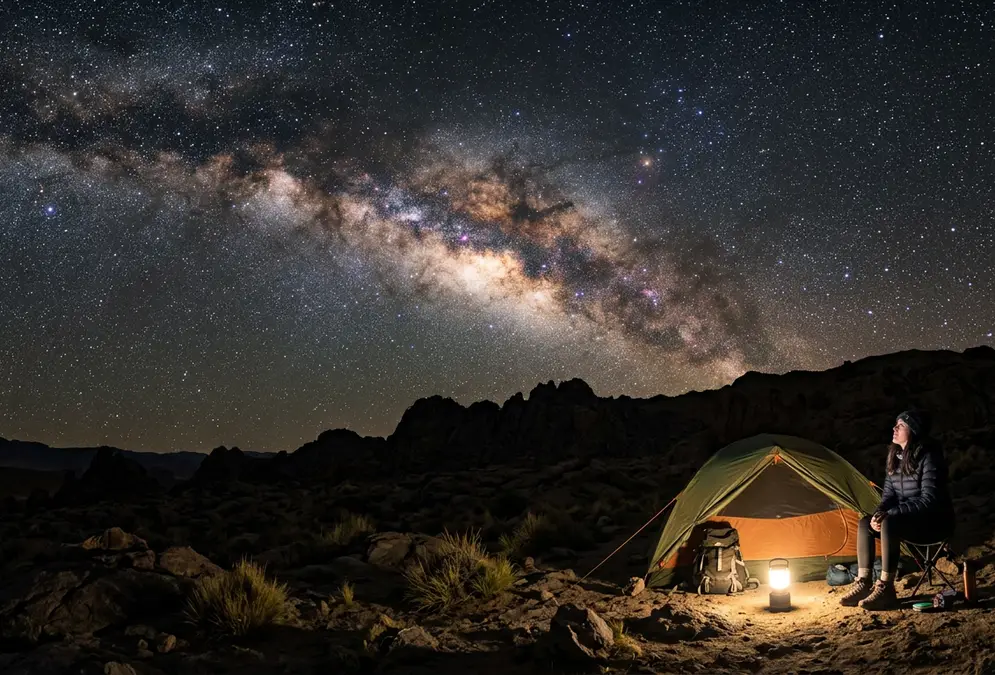
By season
Milky Way Trip: Plan a Galactic-Core Getaway
A planning framework, not a fixed schedule: line up galactic-core season, a new-moon window, and a destination dark enough to matter, then build flexible nights around whichever one moves last.

Written by
Maya Okonkwo I've seen dark skies firsthand in the Atacama altiplano, Namibia's NamibRand Nature Reserve, and Morocco's Merzouga dunes; every other destination I write about is built from measured Bortle and SQM data, cloud climatology, and primary sources like park services and the International Dark-Sky Association.
Updated Published
Most Milky Way trips get planned around flight prices and vacation days first, and a destination gets picked before the season or the moon phase ever enters the conversation. Flip that order and the same money buys a dramatically better trip. Two variables decide whether you see a bright galactic arch or a faint gray smear, regardless of where you go: the calendar, which decides whether the galactic core is even above the horizon, and the moon phase, which decides whether a dark sky stays dark once the core is up. Pick a destination first and you're gambling on both.
This itinerary works in the order those variables actually matter. Settle on a rough travel window using core season and your hemisphere first. Narrow it to a specific week using the new-moon calendar second. Then choose a destination dark enough to show what you came for, and build a flexible run of nights around it rather than one single evening you're hoping goes right. For a fully worked example of that last step, my Atacama itinerary shows what this framework looks like applied day by day to one specific place.
Before you go
- Season: Northern Hemisphere core season runs roughly February through October, peaking May through August; Southern Hemisphere flips it, roughly March/April through September/October, peaking around June through August in that hemisphere's own winter.
- New moon: book within five to seven nights of new moon. The closer to exact 0% illumination, the darker the sky.
- Astronomical twilight: wait until the sun drops 18 degrees below the horizon before judging the sky. Even after sunset looks fully dark, a lingering twilight glow flattens contrast for another 30 to 60 minutes.
- Sky darkness: aim for Bortle 4 or darker at minimum. Bortle 1-2 sites push the same night dramatically further.
Time it: hemisphere, season, and the new moon
The Milky Way's galactic core, the dense central bulge toward Sagittarius, rises and sets on its own calendar just like the sun does, and that calendar depends on your hemisphere far more than most first-time planners expect. From the Northern Hemisphere, the core clears the horizon for a stretch running roughly February through October, with the deepest, longest nights of visibility landing between May and August. On a new-moon night in that peak window, the core stays usably placed for four to six hours before it swings low and dawn twilight takes over.
South of the equator the calendar flips. Destinations around 20 to 30 degrees south, the same latitude band that includes the Atacama Desert and Namibia's NamibRand reserve, see the galactic centre climb far higher overhead, transiting well past 60 degrees altitude during that hemisphere's own autumn and winter, roughly April through September. Near the equator the two windows overlap almost entirely, and the core is visible for most of the year with only a short gap. Get the hemisphere and the season right before anything else; no amount of dark sky puts a horizon-hugging or entirely absent core back into frame.
Once the season is right, the moon decides whether that season actually delivers. A full moon raises the sky's background brightness enough to wash out the core's dust lanes and most deep-sky detail, even from an excellent Bortle 1-2 site. Plan to travel within roughly five to seven nights of a new moon; once the moon passes about half-lit, its glow starts working against you regardless of how dark your destination is on paper. Check a live lunar calendar for the new-moon date nearest your travel window before you book anything else, then count backward from there.
Wait for astronomical twilight, not just sunset
The sky isn't actually dark the moment the sun sets. Astronomical twilight ends when the sun drops 18 degrees below the horizon, typically 30 to 60 minutes after sunset depending on latitude and season. The core photographs and observes best in the hour or two right after that line passes, not the moment the sky looks dim from your hotel balcony.
“a still more glorious dawn awaits — not a sunrise, but a galaxy-rise; a morning filled with four hundred billion suns — the rising of the Milky Way”
Where: a destination dark enough to matter
Season and moon phase narrow your calendar. Destination decides what that calendar actually shows you. The Bortle scale ranks sky darkness from Class 1, pristine enough for starlight alone to cast a faint shadow, to Class 9, the orange wash of a dense city core. Bortle 4 is the practical minimum worth planning a dedicated trip around: dark enough for the core to show real contrast without requiring an expedition. Push further to Bortle 1-2 and the difference isn't subtle: naked-eye limiting magnitude roughly doubles compared to a good Bortle 4 site.
DarkSky International has certified more than 250 places worldwide across four tiers, Sanctuary, Reserve, Park, and Community, and the tier alone doesn't tell you how dark a given site actually is; two Reserves can measure differently on the Bortle scale depending on nearby development. Some of the best galactic-core skies on Earth carry no DarkSky certification at all: an observatory region kept dark by altitude, near-zero humidity, and remoteness rather than a conservation program. The best dark sky parks in the world works through a shortlist by hemisphere if you're still deciding where to point the trip.
As a worked example, the Atacama Desert sits at roughly 23 degrees south, reaches Bortle 1-2 with close to 330 clear nights a year, and puts the galactic core nearly overhead during its own autumn and winter, May through August. None of that matters on a full-moon week. Line up a destination's own peak season with a new-moon window in your travel month, and the same sky that photographs unimpressively on the wrong week becomes the reason people change their travel plans to come back.
A flexible multi-night structure
There's no single correct night-by-night schedule here, because the destination, the season, and your own tolerance for cold or altitude all change the details. What doesn't change is the shape: arrive before the darkest window, stack your best nights in the middle, and leave room for weather to be wrong.
1
Arrival: land before the new moon
Two to three nights ahead, any destination
Aim to arrive two to three nights before the new-moon date you identified in your planning. That buffer absorbs travel fatigue, gives you a warm-up night or two under a sky that's already fairly dark, and, if your destination sits at altitude, gives your body time to adjust before a demanding night outside. Arriving on or after new moon and hoping the whole trip lines up is the single most common planning mistake: by night three or four a waxing crescent is already climbing back into the evening sky.
2
The middle nights: your darkest window
Two or three nights closest to exact new moon
The two or three nights closest to exact new moon are the ones to protect. This is where a guided observatory session, a serious photography attempt, or simply the longest stretch outside under the sky belongs. If you're shooting rather than just looking, how to photograph the Milky Way covers the settings and timing that make the difference between a washed-out frame and a shot worth keeping, on a phone, a DSLR, or a smart telescope.
3
A buffer night: insurance against weather
At least one extra night beyond your minimum
Even the driest deserts on Earth have the occasional cloudy night, and a single-night trip has no way to absorb one. Build in at least one extra night beyond your minimum, and treat any night the forecast turns as a reason to swap it for a daytime activity rather than the whole trip. A four to five night stay, checked against the same-day forecast rather than a two-week-out prediction, is enough to absorb one bad night and still walk away with a genuinely dark sky.
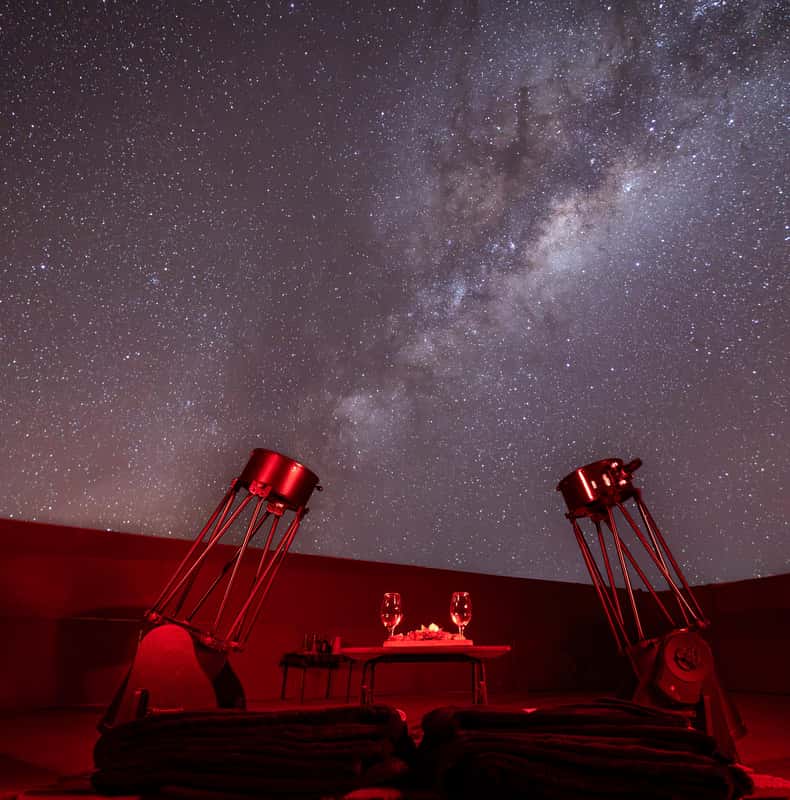
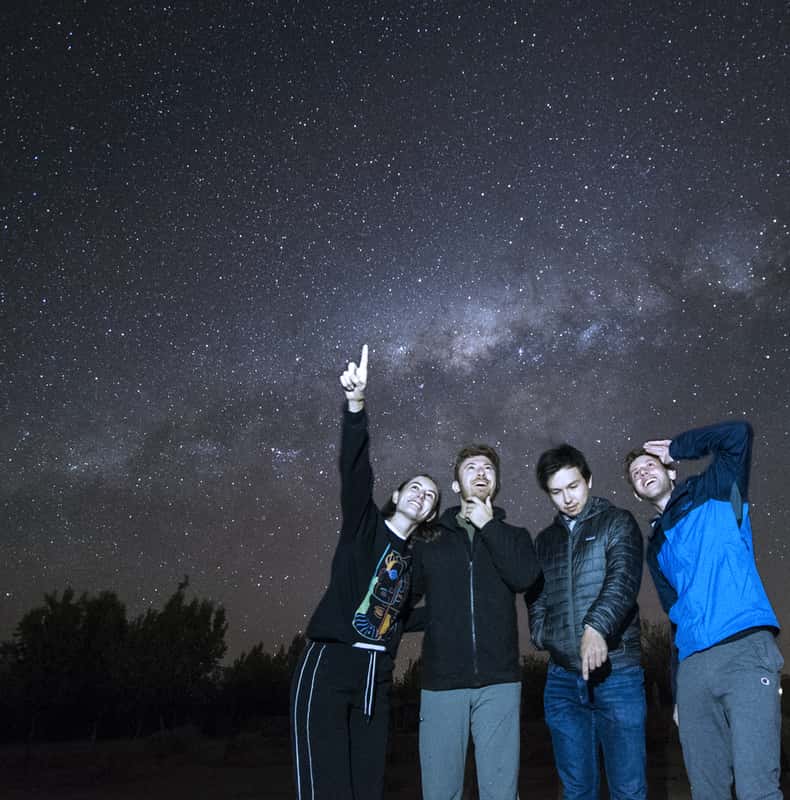
Two guided stargazing nights in San Pedro de Atacama
Tours are selected for quality, not commission. I earn a small fee if you book — at no extra cost to you.
Gear and prep
Your eyes are the only instrument every trip already includes, and they need 20 to 30 minutes of uninterrupted darkness to fully adjust; checking a bright phone screen at minute fifteen resets that clock. Pack a red flashlight, or a white one wrapped in red cellophane, so you can read a map or find your bag without undoing that adjustment. For a first Milky Way trip specifically, a pair of 10x50 binoculars does more than most beginner telescopes: no setup, no collimation, real detail on the Moon's terminator and Jupiter's brightest moons within seconds of stepping outside. Stargazing for beginners walks through the rest of the naked-eye and binocular basics worth knowing before you go.
If you already know you'll keep using a telescope beyond one trip, my guide to the best beginner telescopes is a better starting point than whatever's cheapest at a big-box store. If photography is the real goal, the timing above, season, moon, and Bortle darkness, is exactly what matters before you touch a single camera setting. Dress for the destination's actual conditions rather than a generic packing list too: a desert plateau at altitude and a coastal dark-sky reserve call for very different layers, even on the same new-moon night.
Frequently asked questions
When is Milky Way season, and does it depend on where I live?
Yes, entirely. From the Northern Hemisphere, the galactic core clears the horizon roughly February through October, peaking May through August. South of the equator the calendar flips: destinations around 20 to 30 degrees south, like the Atacama or Namibia's NamibRand, see the core climb far higher overhead during that hemisphere's own autumn and winter, roughly April through September. Near the equator the two windows overlap for most of the year. Check your destination's hemisphere before you check flight prices.
How much does the new moon actually matter compared to the season?
About as much, just for a different reason. Season decides whether the core is even above the horizon; moon phase decides whether the sky stays dark enough to see it once it's up. A full moon raises the sky's background brightness enough to wash out the core's dust lanes even from an excellent Bortle 1-2 site. Plan to travel within roughly five to seven nights of a new moon, and check a live lunar calendar for your destination before locking in flights.
How many nights should a Milky Way trip actually be?
Four to five nights is the range most specialist operators recommend: long enough to arrive before the darkest window, stack two or three nights close to new moon, and still absorb one cloudy evening without losing the trip. Three nights is a workable minimum if your schedule is tight. A single overnight stop gives you no buffer at all, so one cloud bank and the whole trip is a miss.
Do I need a Bortle 1 sky, or is Bortle 4 good enough?
Bortle 4 is the practical minimum worth planning a dedicated trip around: dark enough for the galactic core to show real contrast without requiring an expedition. Bortle 1-2 sites push it much further. Naked-eye limiting magnitude roughly doubles compared to a good Bortle 4 sky, and at the darkest sites the core is bright enough to cast a faint shadow on pale ground.
What happens if my dark-window night gets clouded out?
This is exactly why a single night is the wrong length for a trip like this. Book four to five nights, stack the two or three closest to new moon in the middle of the stay rather than at the edges, and check the forecast for your specific site the same day rather than two weeks out. One cloudy night inside a longer, well-timed stay is a shrug. One cloudy night on a single-night trip is the whole trip.
Do I need a telescope to see the Milky Way, or will my eyes be enough?
Your eyes are enough for the naked-eye arch on any night that meets the season, moon, and Bortle criteria above, no equipment required. A pair of 10x50 binoculars adds real detail with no setup at all, and is the better first purchase over a telescope for most people's first trip. Only add a telescope once you know you'll use it beyond one trip.
Further reading
Sources
5 references Show Hide
- capturetheatlas.com