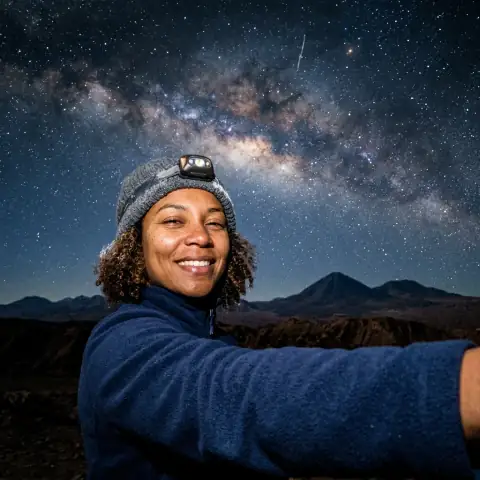
Dark-sky travel writer
Maya Okonkwo
I'm Nigerian-born and have spent years writing about dark-sky travel. In person, I've stood under three skies: the Atacama altiplano in Chile, NamibRand Nature Reserve in Namibia, and the dunes at Merzouga on the edge of the Sahara. Everything else I cover, from Arctic aurora coasts and Pacific dark-sky reserves to desert observatories at Wadi Rum and AlUla, I document rather than claim to have seen. That means measured Bortle class and SQM readings, cloud-cover climatology, moon-phase calendars, Kp index and space-weather data, operator-confirmed prices, and access rules and drive times pulled from park services, dark-sky reserve authorities, the International Dark-Sky Association, and the lodges and observatories themselves, not aggregator sites. I still lead with the question most guides skip: when, exactly, should you go. I vet lodges and tours for first-timers and say plainly when a trip is likely to get clouded out, whether I've stood there myself or not.
Credentials
I've seen dark skies firsthand in the Atacama altiplano, Namibia's NamibRand Nature Reserve, and Morocco's Merzouga dunes; every other destination I write about is built from measured Bortle and SQM data, cloud climatology, and primary sources like park services and the International Dark-Sky Association.
dark-sky destinations aurora forecasting astrophotography for beginners trip planning stargazing gear light-pollution data
602 articles published across 8 topics
Published Work
602 pieces in total. The latest from each topic, newest first.
-
Article
Organ Pipe Cactus Is Now a Dark Sky Park. Check the Alerts First
Organ Pipe Cactus became an International Dark Sky Park in 2026. Where to set up a telescope, when rangers run programs, and what to check before you drive.
-
Article
Who Was Bryce Canyon Named After? Ebenezer Bryce's Story
Bryce Canyon is named for Ebenezer Bryce, a Scottish-born Mormon pioneer who built a timber road into the cliffs, then left. Here is how his name stayed.
-
Article
Seeing vs Transparency: Why Dark Isn't Always Best
Dark skies don't guarantee a sharp view. Astronomical seeing vs transparency, why they trade off, and how to match the night to Saturn or faint galaxies.
-
Guide
Best Lodges for Death Valley Stargazing
Four Death Valley lodges ranked for stargazers: proximity to dark viewing areas, bookability, and heat-ready amenities, matched to your trip priorities.
-
Guide
Best Places to See the Milky Way: 14 Destinations Ranked
Ranked by Bortle darkness, clear-night odds, and galactic-core season: 14 places worldwide where the Milky Way is genuinely visible, from Atacama to Uluru.
-
Destination
Northern Lights in Tromsø
At 69.6°N inside the auroral oval, Tromsø sees aurora at Kp 2. Peak season November–February. Best viewing spots, tour advice, and aurora forecast strategy.
-
Lodge
Stovepipe Wells Village
Stovepipe Wells Village Hotel review: a 1926 motor court inside Death Valley National Park, two miles from Mesquite Flat Dunes, with no astronomy programs.
-
Article
Do the Northern Lights Make a Sound? The Science
Aalto University recordings put the crackle of the aurora about 70 m above the ground. Here is how the inversion-layer theory works and where it is disputed.
-
Article
Guided Aurora Tour or Self-Drive Chase in Finnish Lapland?
Guided aurora tour or rental car in Finnish Lapland? Compare winter-driving rules, reindeer risk, flexibility and cost, then pick the option that suits you.
-
Lodge
StarStruck Glamping
StarStruck Glamping review: four solar-powered geodesic domes 30 minutes from Big Bend, a telescope in every stay, photos, and why nightly rates aren't posted.
-
Event
International Dark Sky Week
International Dark Sky Week is DarkSky International's annual worldwide spring event against light pollution: when it runs, how to join, and what it changes.
-
Event
World Space Week
World Space Week is the UN-proclaimed space observance held 4 to 10 October each year. What it marks, who runs it, and how to join with a stargazing night.
-
Guide
Best Binoculars for Stargazing: What Actually Matters
Best binoculars for stargazing start at 10x50, not 20x80. I ranked 8 models on aperture, exit pupil, and price, from $35 budget picks to premium ED glass.
-
Event
Saturn at Opposition 2026
Saturn is closest to Earth on October 4, 2026, at 12:21 UTC. Find it rising east at sunset, in Cetus, and what you'll see by eye, binoculars or telescope.
-
Destination
AlUla Stargazing
Stargaze above Hegra's 2,000-year-old Nabataean tombs in AlUla, the Gulf's first DarkSky-accredited Dark Sky Park. When to go, where to stay, and how to plan.
-
Lodge
STF Abisko Turiststation
STF Abisko Turiststation review: a budget-friendly mountain station in Abisko National Park, the base for the Aurora Sky Station chairlift up Mount Nuolja.
-
Tour
Atacama Stargazing & Astronomy Tour
Evening telescope session under the world's clearest skies. Book near new moon, avoid full moon. SPACE Observatory, San Pedro de Atacama — CLP 45,000.
-
Lodge
Best Western Plus Bryce Canyon Grand Hotel
Best Western Plus outside Bryce Canyon, 164 rooms, pool, breakfast. Gateway to Bryce Canyon's Gold Tier Dark Sky Park and 100+ annual ranger astronomy programs.
-
Tour
Bryce Canyon Astronomy Festival
Annual three-day astronomy festival at Bryce Canyon National Park featuring free telescope viewing, expert talks, and NASA science exhibits. June 11–13, 2026.
-
Tour
Fairbanks Aurora Viewing Tours
Fairbanks aurora tours from $235. At 64.8°N under the auroral oval, the northern lights appear 240+ nights a year. Compare operators and guarantee policies.
-
Tour
Hawaii Forest & Trail Mauna Kea Summit & Stars Adventure
Hawaii Forest & Trail's UH-permitted Mauna Kea tour pairs a 13,796-foot summit sunset with telescope stargazing: ~$330 per person, 7-9 hours, age 13+.
-
Tour
Lake Tekapo Lakeside Stargazing
Free, self-guided stargazing on Lake Tekapo shoreline near the Church of the Good Shepherd — no telescope, no guide, no booking, just Bortle Class 2 skies.
-
Lodge
Nova Inn Yellowknife
Nova Inn Yellowknife, the cheapest downtown aurora base at ~C$160/night: 3-star, walkable to Old Town, with an on-site restaurant. Honest trade-offs inside.
-
Destination
Northern Lights in Iceland
Iceland's whole-country aurora guide: best regions to base in, aurora season Sep–Mar, ice caves, winter driving reality, and where cloud cover ends every plan.
-
Destination
Fairbanks Northern Lights
Fairbanks sits directly under the auroral oval at 64.8°N. Aurora season runs Aug 21–Apr 21, peaking Feb–Mar, with roughly 90% odds if you stay 3+ nights.
-
Guide
Best Lodges in Fairbanks for Aurora
Six Fairbanks lodges ranked for aurora viewing: dark-sky access, in-room windows, and honest booking info, from glass-dome domes to a budget airport stay.
-
Guide
Aurora Viewing Spots Near Fairbanks, Alaska
Six ranked aurora-viewing spots near Fairbanks, from Cleary Summit to the remote Chatanika corridor, with drive times and road conditions for DIY chasers.
-
Destination
Tenerife Stargazing
Tenerife stargazing guide: Teide National Park's UNESCO Bortle-2 skies, 83 constellations visible. Observatory visits from €21, Parador hotel, and best tours.
-
Event
Perseid Meteor Shower
The 2027 Perseid meteor shower peaks the night of August 12–13, but a bright waxing gibbous moon will wash out the fainter meteors. Here's when to look up.
-
Event
Annular Solar Eclipse 2027
An annular solar eclipse (ring of fire) crosses southern Chile, Argentina, and West Africa on February 6, 2027. Where to watch, and is it worth the trip.
-
Editorial Pages
About Dark Skies Atlas
-
Trip Plans
Aurora Hunting Trip: Plan Your Northern Lights Chase
-
Editorial Pages
Editorial Standards
-
Trip Plans
Milky Way Trip: Plan a Galactic-Core Getaway
-
Trip Plans
Your First Dark-Sky Weekend: A 3-Night Star Plan