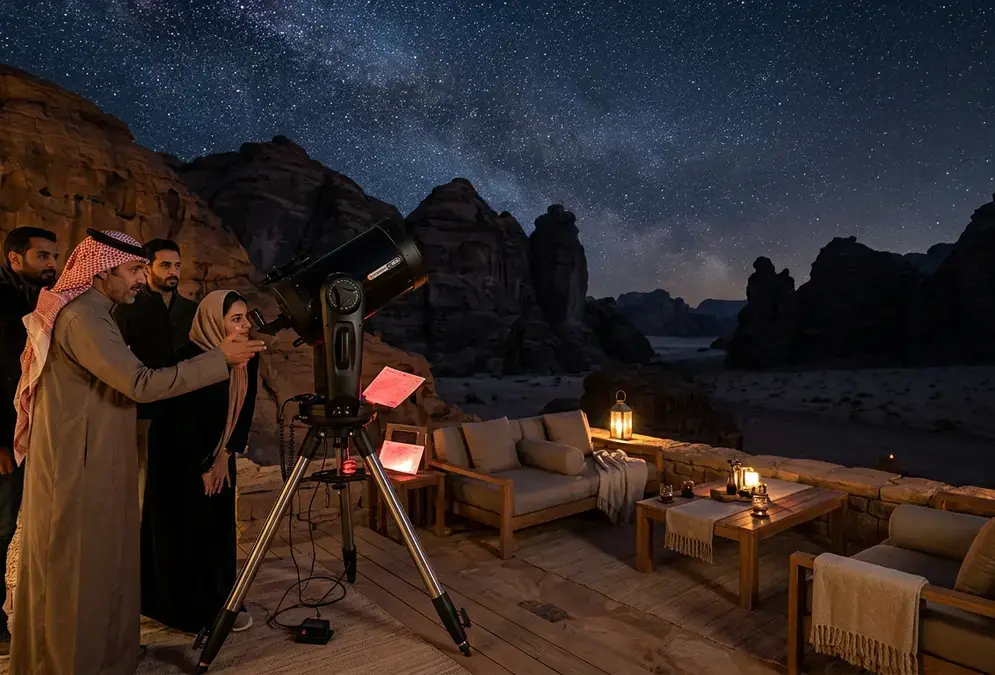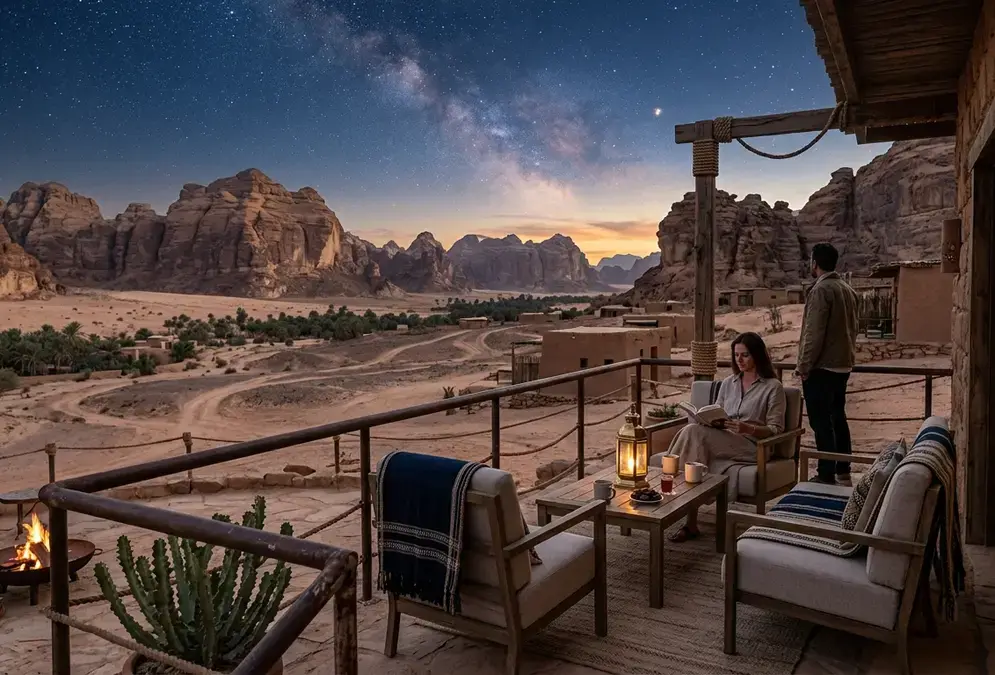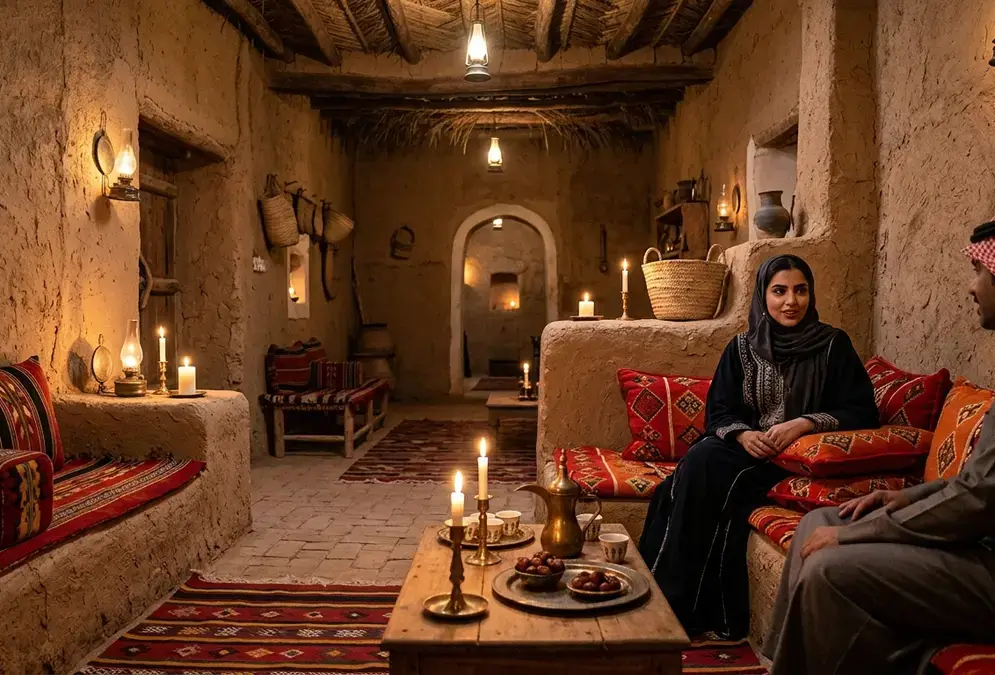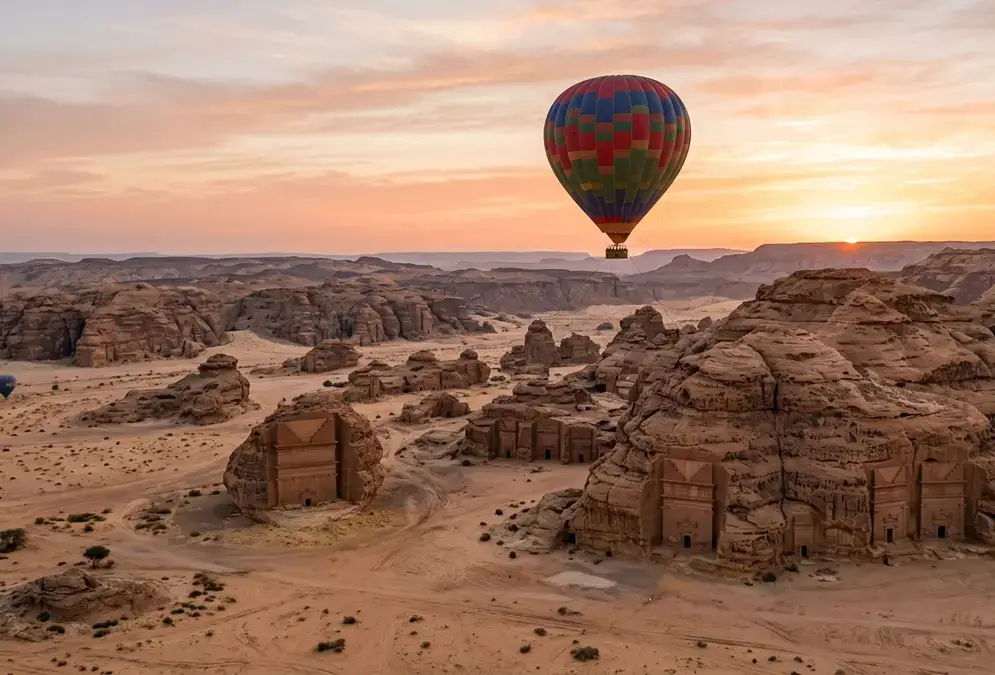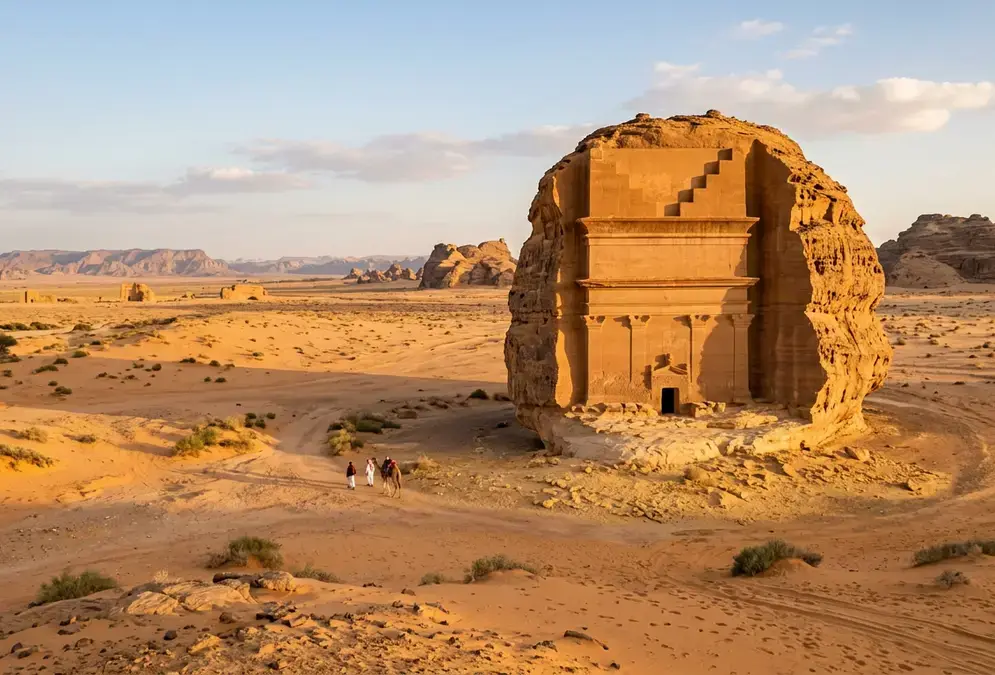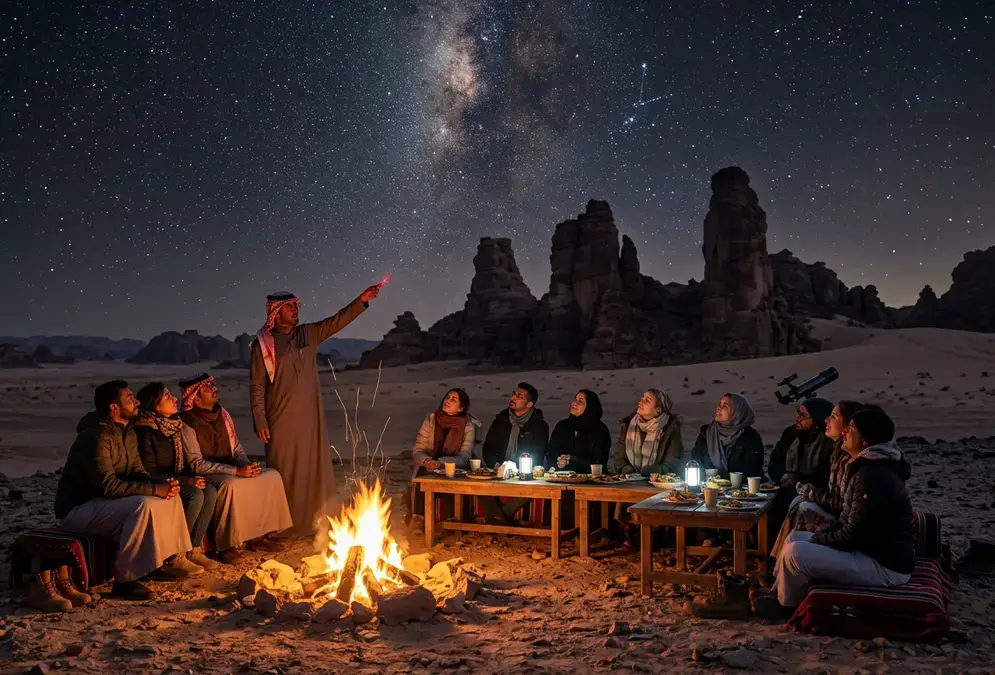
Most stargazing tours hand you a folding chair and a shared telescope. AlUla's official program skips the equipment entirely. Stargazing at Gharameel, run by the Royal Commission for AlUla (RCU) through Experience AlUla, is a naked-eye night out: a 4x4 ride into the desert, a guide who works the sky by hand and laser pointer rather than an eyepiece, and a traditional Saudi dinner cooked over a campfire while you wait for full dark. It runs inside the AlGharameel Nature Reserve, part of the Gulf's first DarkSky-accredited Dark Sky Park, a short drive from the Nabataean tombs at Hegra.
The official experience: what RCU built at Gharameel
Gharameel sits inside one of two zones that earned Saudi Arabia's, and the Gulf's, first Dark Sky Park accreditation from DarkSky International in 2024. RCU built Stargazing at Gharameel as the anchor public experience for that designation: a single, ticketed program bookable through Experience AlUla's own platform rather than a patchwork of independent desert-tour operators. A government tourism commission staffs and maintains this one, rather than leaving stargazing quality to whichever private operator shows up that season.
The program is deliberately unplugged. No telescopes are provided. A bilingual guide, working in English and Arabic, walks you through the visible sky by eye, naming constellations and explaining what you are actually looking at rather than handing you an eyepiece and moving on. If you came expecting to peer at Saturn's rings through glass, this isn't that tour. It's built for people who want to learn the sky itself.
What three to four hours actually includes
A single booking runs 3 to 4 hours and covers:
- A professional bilingual guide (English/Arabic)
- Round-trip transport from the Husaak AlUla Adventure Centre
- Access to the remote Gharameel stargazing area
- A stargazing or moonlit-landscape session, depending on the night's moon phase
- A traditional Saudi dinner, cooked around a campfire
- Free parking at the access point
The experience genuinely changes shape depending on the calendar. On a full-moon night, the guide shifts toward a moonlit landscape walk, since a bright moon washes out most of what a dark-sky program exists to show. On darker nights, closer to new moon, the whole session stays focused on stars and constellations. Neither is a lesser version of the other, but if the deep, star-dense sky AlUla is known for is the whole reason you're booking, aim for a night close to new moon.
Getting there: the 4x4 ride from Husaak
Gharameel isn't reachable by regular car. The only access point is the Husaak AlUla Adventure Centre, and the transfer out to the reserve runs over 4x4 off-road terrain, included in the ticket price. Once you're out there, expect zero mobile reception: it's remote enough that the reserve's darkness is the whole point, and that same remoteness means no signal to check messages or arrange a change of plan on the fly. Bring warm layers and closed-toe footwear; desert nights cool fast once the sun drops, whatever the daytime heat was.
Price, group size, and how to book
Stargazing at Gharameel starts at SAR 397 per adult and SAR 340 per child (ages 8 and up). Group bookings need a minimum of four people to run, so solo travelers and couples should check current group-fill options before locking in a specific date; a two-person booking may need to wait on other guests to join.
Book directly through Experience AlUla, the RCU's own ticketing platform, or the RCU's central tickets portal. This is a government-run tourism experience, not a listing you'll find on GetYourGuide, Viator, or a third-party tour marketplace, and no independent operator sells the same access. Treat any site outside Experience AlUla claiming to resell this exact tour with suspicion.
Who this suits, and who should look elsewhere
This is a general-audience, naked-eye stargazing experience, not a technical astronomy tour. It suits first-time stargazers who want a guided introduction to the desert night sky, families with children eight and older, couples and small groups comfortable with the four-person minimum, and travelers already building an AlUla heritage trip who want one clear night reserved for the sky.
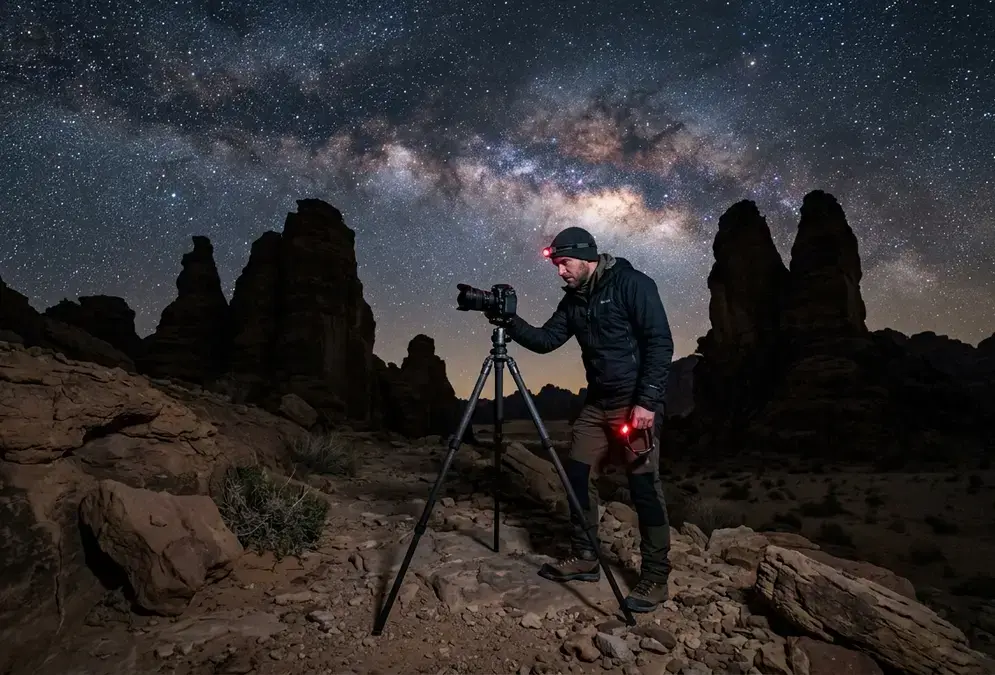
It's a weaker fit if you're arriving with a camera and tripod hoping for coached long-exposure technique. The booking itself works the same way for photographers, since nothing stops you bringing your own gear, but the guide's focus stays on naked-eye orientation and storytelling rather than camera settings.
Hegra and the wider AlUla heritage context
Stargazing at Gharameel isn't sold as a combined ticket with Hegra, Saudi Arabia's first UNESCO World Heritage Site, or Jabal Ikmah, but the two experiences share a region worth planning around together. Hegra's Nabataean tombs sit under the same protected darkness the Dark Sky Park was built to preserve, and most travelers booking Gharameel are already in AlUla for the archaeology. Pair a daytime Hegra visit with an evening at Gharameel as separate bookings rather than expecting one ticket to cover both. For the fuller heritage-and-sky picture, including where to stay and how many nights to budget, see the AlUla stargazing guide.
When to go, and what to check before you book
Treat this as a seasonal product, not a year-round listing. As of this writing, Stargazing at Gharameel is confirmed live through mid-November 2026, aligning with AlUla's broader October-to-April cool season, when daytime highs run a comfortable 20-30°C rather than summer's 40°C-plus. RCU has adjusted desert-experience schedules before as the wider AlUla Manara astronomy project develops, so don't assume a booking window that was open last year is still open now. See the best time to go stargazing in AlUla for the full seasonal breakdown, or AlUla's stargazing FAQ for other common booking questions.
Check the Experience AlUla listing directly for current dates before building a trip around this specific experience, and keep a backup night in mind if the site shows the program as paused. If you're staying nearby, this Ashar Valley resort, inside the same Dark Sky Park, runs its own guided telescope sessions as a fallback, or a complement, on nights Gharameel isn't running.