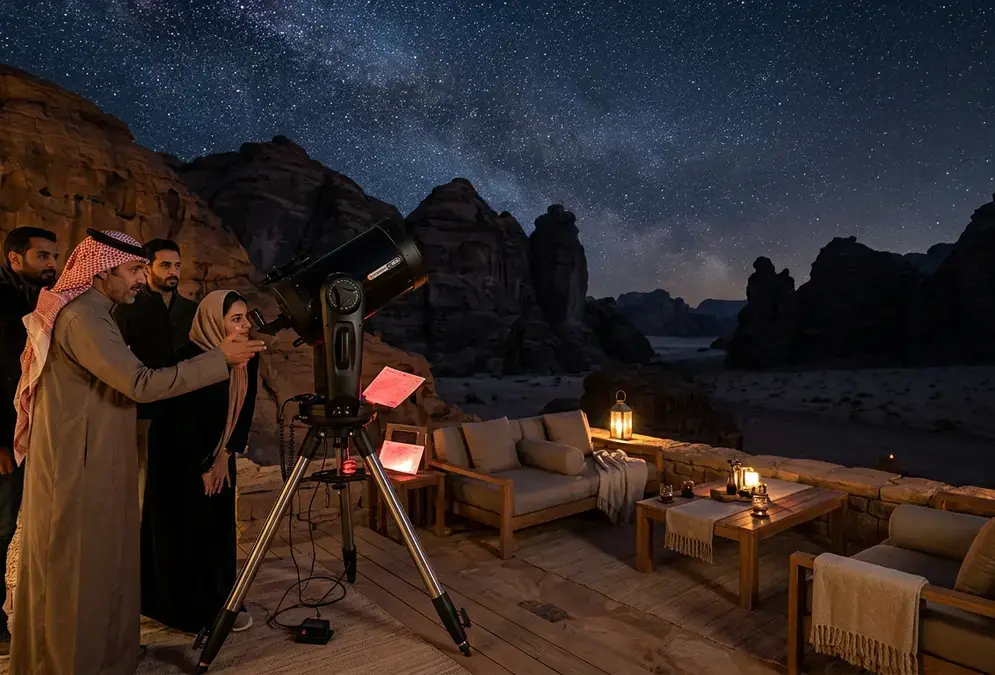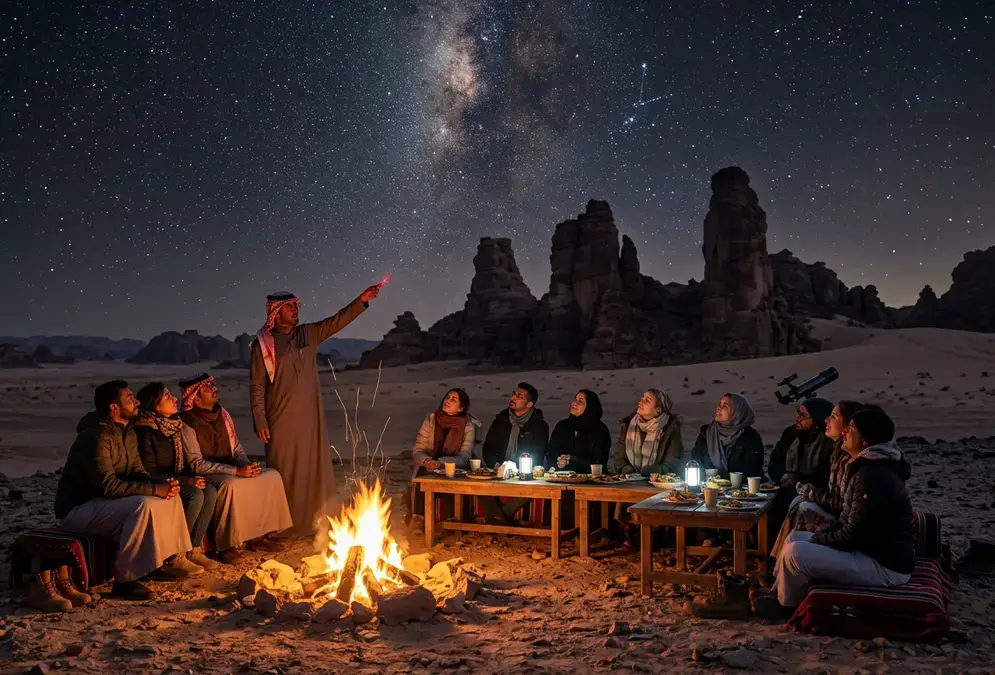
Search for a dedicated AlUla astrophotography tour, one with a photographer-guide, structured camera coaching, and dust-handling instruction built in, and you won't find one. What exists instead is Stargazing at Gharameel, the official Experience AlUla evening in the country's first International Dark Sky Park, run by an astronomer or Bedouin guide who is genuinely excellent at orienting you under the sky, but not there to teach manual exposure. This page is for photographers booking that same session anyway, because the sky above Gharameel is good enough to be worth the trip even without a coach standing behind your tripod.
What you're actually booking
Stargazing at Gharameel runs 3 to 4 hours, departs Husaak Adventure Centre by round-trip 4×4 (the site is off-road and unreachable otherwise), and costs SAR 397 per adult and SAR 340 per child, with a minimum group size of 4. It includes:
- A professional English- or Arabic-speaking guide
- Naked-eye and telescope observation
- Constellation storytelling drawn from Bedouin navigation tradition
- A traditional Saudi dinner
- Shared telescope access for the group
A longer version, Magical Journey Among the Stars, stretches the same format to 5.5 hours with more storytelling and a later return, around 11:00pm.
Neither variant includes camera-specific instruction. Experience AlUla's own listing is honest about that: the tour is described as suitable for photographers because of the dark-sky conditions, not because a guide will help you nail your settings. If you want live, hands-on camera coaching the way a dedicated astrophotography workshop offers elsewhere, book knowing that isn't what this is.
The sky itself is the real draw
AlUla Manara and AlGharameel Nature Reserve were named the Gulf's first International Dark Sky Park by DarkSky International in late 2024, and the reserve delivers on that in a way few sites do: millions of stars visible to the naked eye, a Milky Way clear enough to photograph in detail, and genuinely zero light pollution once you're off the highway. That baseline is what makes the trip worth planning around a camera in the first place, coaching or not.
Camera gear built for a desert, not just a dark sky
Pack for the sand as much as the stars. Bring:
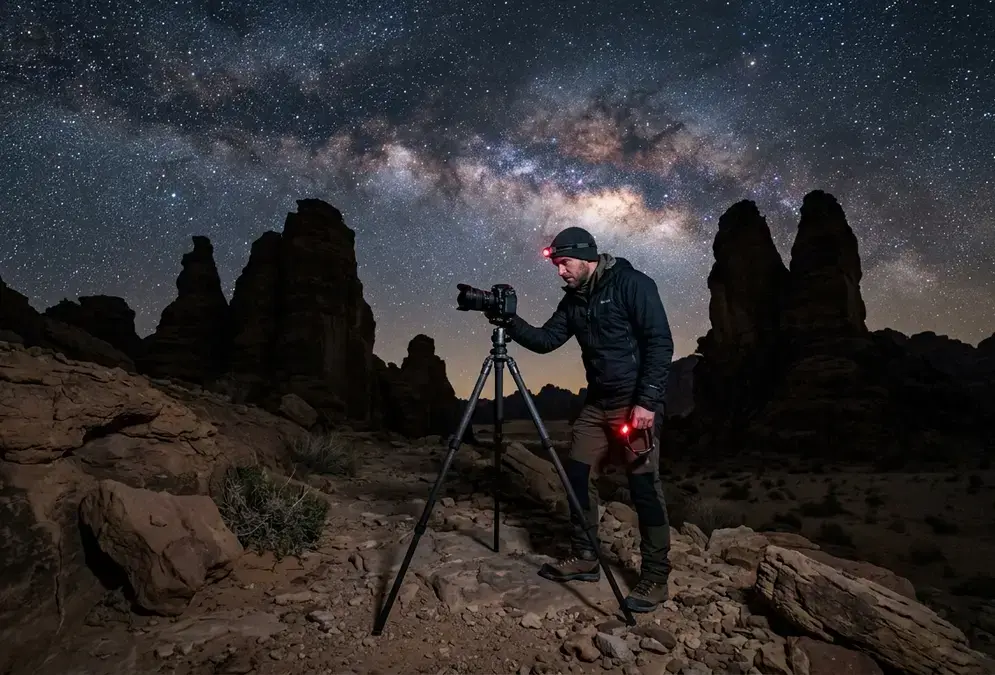
- A DSLR or mirrorless camera with full manual control over aperture, shutter speed, and ISO
- A wide-angle lens (14–24mm, f/2.8 or wider) to fit a useful slice of the Milky Way in frame
- A sturdy tripod rated for uneven, sandy ground, since Gharameel's terrain isn't a level car park
- Binoculars, useful for picking out constellation detail between shots
- Two charged batteries; cold desert nights drain them faster than daytime shooting ever suggests
Dust and sand handling isn't part of the standard briefing, so plan for it yourself. Keep a lens cap or cover on between shots rather than leaving glass exposed to blowing sand, avoid swapping lenses in the open air if the wind picks up, and pack a rocket blower rather than relying on a cloth to clear grit off a lens or sensor, since dragging sand across glass scratches it. A dry bag or a simple zip-lock case for spare batteries and memory cards keeps fine desert dust out of anything with a port or a hinge. None of this is complicated, but none of it is mentioned on the tour listing either, so it's on you to show up prepared. For the full kit list, from lens choice to sensor care, see AlUla astrophotography gear; for everything else worth packing for the desert's heat-to-cold swing, see AlUla's packing list.
Composing at Gharameel, and why Hegra is a separate shot
Gharameel's own terrain, open desert floor and low rock formations well clear of any settlement, gives you a genuine 360-degree horizon to work with. A low camera angle that puts sandstone silhouettes along the bottom third of the frame, with the galactic core rising behind them, is the composition most worth setting up for here. Ask your guide where the group is stopping that night; site selection within the reserve varies with the moon cycle and isn't fixed to one fenced viewpoint.
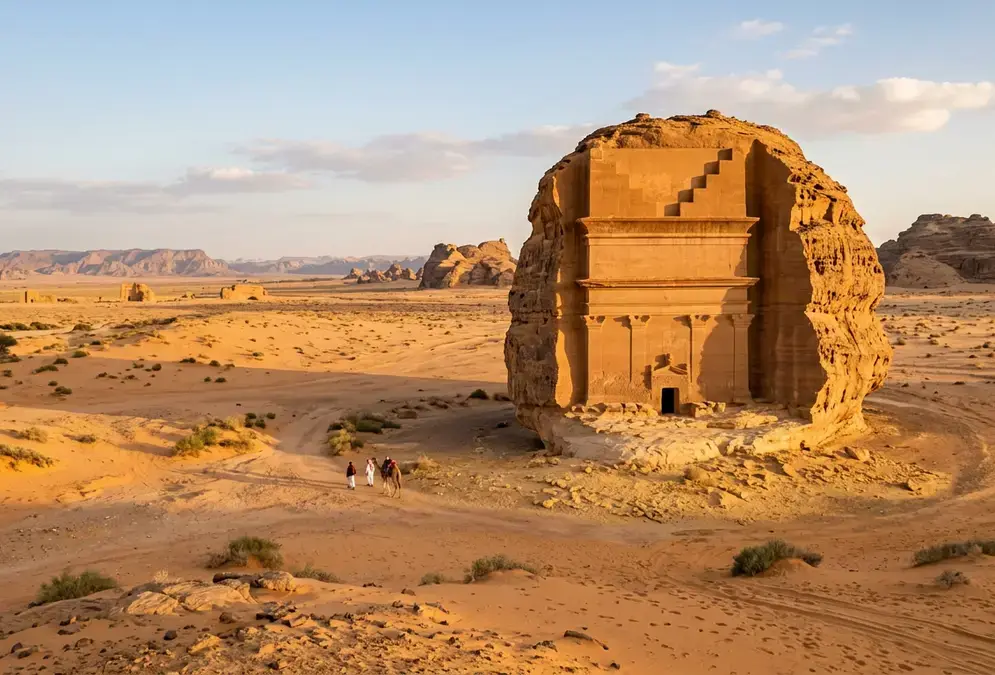
What this tour does not include is Hegra itself. The Nabataean tombs sit at a separate, access-controlled site inside AlUla's historic core, reachable only through scheduled guided visits, not through the Gharameel evening. If shooting the tombs against a night sky is the shot you actually want, that's a different booking entirely, and the AlUla stargazing guide covers how to work a later guided slot or a nearby desert camping stay around it.
Filling the coaching gap yourself
Because no guide on this tour will walk you through manual settings, do the homework before you land. Experience AlUla publishes a Guide to Astrophotography in AlUla, written with input from astrophotographer Ollie Taylor, covering star-trail and Milky Way technique, equipment choices, and apps like Stellarium and Star Walk for planning where the core will sit on your date. Read it before the trip, not during it; there's no signal at Gharameel to pull it up once you're there.
If a live lesson matters enough to you to be worth arranging separately, the Royal Commission for AlUla (RCU) can be approached directly for custom astrophotography workshops. These aren't listed on any public booking platform, pricing and availability aren't published, and they require an inquiry well ahead of your trip rather than a same-week booking. Treat this as a real option for serious photographers, not as something you can assume will be arranged on arrival.
What the desert does to your evening, beyond the photos
Gharameel drops mobile reception to essentially nothing, so download star charts, plan your shot list, and check your camera's settings before you leave the vehicle rather than mid-session. Nights get surprisingly cold even after a hot desert day; pack real layers and closed-toe boots for the uneven ground, not just a jacket for standing around. A charged power bank is worth carrying since there's no way to top up equipment once you're out there for the evening.
When to go
October through April delivers the mild desert nights that make standing at a tripod for three or four hours tolerable; outside that window the tour still runs, but comfort drops fast. Moon phase decides more than the season does: ask whether your date falls under the operator's 'Stargazing' or 'Moonlit' scheduling, since a bright moon washes out the same Milky Way detail here as anywhere else on Earth, regardless of how dark the surrounding reserve is.
Booking
Book directly through Experience AlUla, by phone at +966 920 025 003 (Sunday–Thursday, 08:00–17:00 KSA), or via KKday, TripAdvisor, or Sightseeingo. Groups need a minimum of four people, and the operator asks for 15 minutes' early arrival at Husaak Adventure Centre. If your trip is built specifically around photography and you want more time under the sky than the standard 3 to 4 hours, ask about the longer Magical Journey Among the Stars variant when you book.