
Why AlUla's packing list starts with the thermometer, not the wardrobe
Fly into AlUla in October and the airport thermometer reads close to 32°C (89°F), easy shorts-and-t-shirt weather. Drive out to the desert that same evening to wait for full dark, and the day has cooled to roughly 16°C (60°F) by the time the sky turns properly black[1]. That's a swing of almost 16°C (29°F) in a single day, and it's the fact that should shape your AlUla packing list more than any dress code or gear checklist.
AlUla isn't a place that demands arctic gear. Even in the coldest month of the October-to-April stargazing season, nighttime lows stay well above freezing: cold enough to need a real jacket, nowhere close to the kind of cold that shuts down a trip. What actually catches first-time visitors off guard is less the absolute temperature and more the speed of the drop. You go from desert-day heat to a genuinely chilly evening within an hour of sunset, with nothing gradual about it.
29°F swing
If you haven't settled on when to go yet, AlUla Stargazing covers the full case for timing a trip around comfort rather than clear skies, since AlUla's nights stay largely clear most of the year regardless of season.
The layering system: what actually goes over the linen shirt
Start with what you'd wear on any hot desert afternoon: a loose, breathable base layer, linen or lightweight cotton, long sleeves rather than short. That's not modesty dressing yet, just sun sense. Hegra's sandstone tombs sit fully exposed, and long sleeves beat reapplying sunscreen every hour most afternoons.
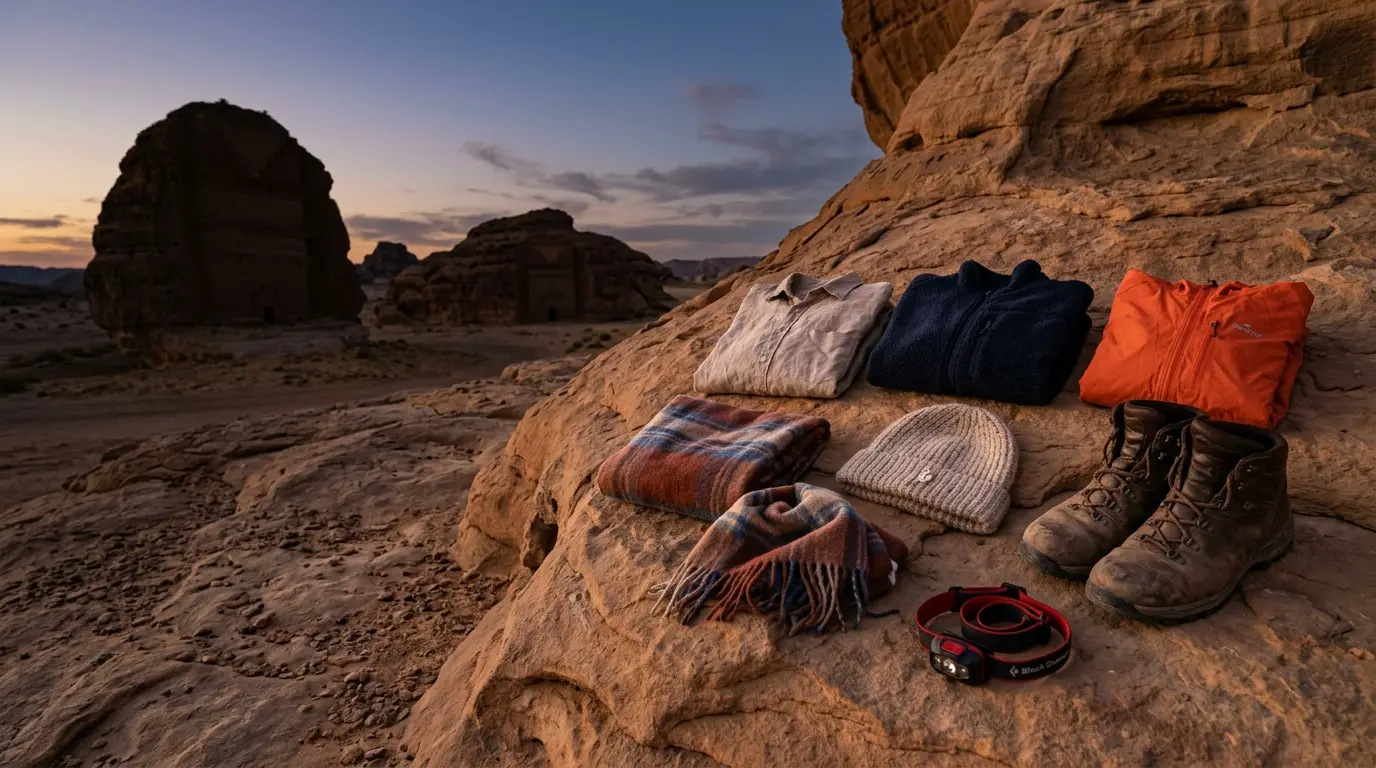
Once the sun drops, that same outfit stops working almost immediately. Experience AlUla's own guidance for its official Gharameel stargazing excursion is specific about what changes: comfortable clothing for the day, then a warm jacket, hat, and scarf once the group heads out into the dark[2]. That's the entire cold-weather kit the operator asks for, and it holds for independent desert nights too. Not a heavy expedition parka, just a real mid-layer and a windproof shell you put on once you're standing still watching the sky instead of walking.
For a trip anywhere in the October-through-April window, pack:
Once the sun drops, that same outfit stops working almost immediately.
- A packable fleece or wool mid-layer that compresses down small in a daypack
- A windproof outer shell (a rain shell doubles as a windbreak here)
- A warm hat and scarf, or a buff you can pull up over ears and neck
- One long-sleeve linen or cotton layer for daytime sun, doing double duty at heritage sites later
Footwear for sandstone and a 4x4 ride into the dark
Getting to most of AlUla's dark-sky viewing spots isn't a paved walk. The official Gharameel stargazing excursion is reached by 4x4 vehicle over off-road desert terrain, and the operator is direct about why closed-toe shoes matter: the ground you cross to reach the viewing area is uneven enough that sandals or flip-flops genuinely aren't safe there[3].
The same logic holds anywhere else you're walking after dark in AlUla, dedicated tour or not. Sturdy, closed-toe walking shoes or boots with real tread handle sandstone scree and loose gravel, the kind of terrain that looks flat under headlamp light and isn't. You don't need technical mountaineering boots. A supportive trail shoe or a light hiking boot covers both the daytime heritage sites and a night walk out to a stargazing spot.
Booking the Gharameel tour directly answers the footwear question for you, since the operator lists it as a requirement rather than a suggestion, useful shorthand for how seriously to take the rest of this list.
Stargazing gear: the red-light rule, and keeping sand out of everything
A headlamp with a red-light mode is standard kit for any stargazing trip, AlUla included, and it's worth packing even if nobody at your excursion mentions it. Human eyes take roughly 20 to 30 minutes to fully adjust to darkness, and a single burst of white light resets that adaptation instantly. Red light doesn't trigger the same reset, which is why stargazers default to it as a matter of habit rather than because any specific tour requires it.
Beyond the headlamp, the rest of the kit is ordinary desert-travel sense rather than anything specific to AlUla's dark-sky programme:
Recommended tours
Tours are selected for quality, not commission. I earn a small fee if you book — at no extra cost to you.
- A buff or light scarf for wind-blown sand, useful on both night stargazing walks and daytime canyon visits
- Lip balm and a heavier moisturizer than you'd normally pack; the desert air here is dry enough to chap skin fast, day or night
- A dry bag or sealed pouch for your phone and camera if you're heading into open desert, since fine sand works its way into anything with a seam or a port
- Sunglasses for daytime use, though you won't need them once the sun's down
None of this is specialised gear. It's the same short list any desert trip calls for, stargazing or not.
Modest dress for Hegra, Jabal Ikmah, and AlUla's heritage sites
AlUla's status as a UNESCO World Heritage Site means most of what you're visiting during the day is a religious and archaeological site first, and dress expectations follow from that rather than from a single rule posted at the gate.
Saudi Arabia lifted its requirement that foreign women wear an abaya or headscarf in 2019, and general visitor guidance since then has settled around a modest-dress standard common across much of the Gulf: clothing that covers shoulders and knees, loose rather than fitted, and not sheer. That's a general travel-advice consensus rather than a posted legal code, and specifics can shift, so check Visit Saudi's current visitor guidance before you pack rather than relying on last year's blog post, this one included.
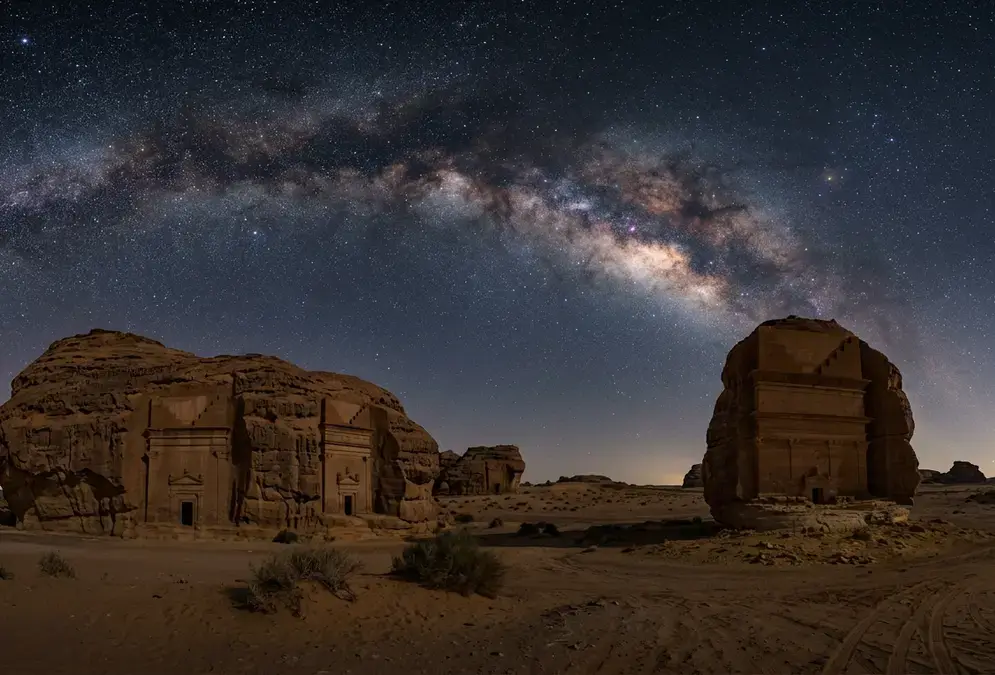
Featured · Destination
AlUla Stargazing
Stargaze above Hegra's 2,000-year-old Nabataean tombs in AlUla, the Gulf's first DarkSky-accredited Dark Sky Park. When to go, where to stay, and how to plan.
The good news is this rarely means packing separate 'modest' clothing. The same long-sleeve linen layer already on this list for daytime sun protection at Hegra does double duty here, and the warm layers you're packing for the cold desert night tend to be modest by default anyway. A fleece and a scarf don't show much skin regardless of the destination.
The AlUla packing checklist, month by month
Pull all of the above together and an AlUla desert-night packing list for the October-through-April season looks like this:
- Long-sleeve linen or cotton layer (sun protection and modesty, daytime)
- Fleece or wool mid-layer for after dark
- Windproof outer shell or light jacket
- Warm hat and scarf, or a buff
- Closed-toe walking shoes or a light hiking boot
- Headlamp with a red-light mode
- Buff or scarf for sand, plus lip balm and moisturizer
- Sunglasses, sunscreen, and a refillable water bottle
Exactly how much cold-weather gear you need shifts across the season. October and April fall at the warm edges of the window; January is when you'll actually be glad of the scarf — and the same pre-dawn chill applies if a sunrise hot-air balloon flight over the desert is on the itinerary, not just night stargazing. For the fuller seasonal picture, Best Time for Stargazing in AlUla breaks down exactly why October through April is the recommended window.
| Month | Average day high | Average night low |
|---|---|---|
| October | 89°F (32°C) | 60°F (16°C) |
| January | 70°F (21°C) | 39°F (4°C) |
| April | 87°F (31°C) | 55°F (13°C) |
None of this is complicated kit. The one mistake worth avoiding is packing for the daytime desert and assuming the night will feel roughly the same. It won't, and that gap between AlUla's afternoon heat and its after-dark chill is the whole reason this list looks different from one built for a Gulf city break in the same season.