Why La Palma's AEMET data changes your packing list
La Palma's official tourism image is a subtropical island: banana plantations on the coast, black-sand beaches, an average annual temperature that barely dips below the twenties. None of that describes the Roque de los Muchachos ridge after dark, and the gap between the two is exactly what a La Palma stargazing gear kit has to solve.
The AEMET weather station on the ridge itself (station C101A, 2,223 metres, in the municipality of Garafía)[1] has logged real numbers, not seasonal estimates. The coldest monthly average on record is 2.6°C in February 2023. The coldest single reading is -4.1°C on 11 January 2021. The warmest monthly average is 21.3°C in August 2024, and that same month produced the absolute high of 29.7°C, on 3 August 2024.[1] That's a swing of nearly 34 degrees between the coldest recorded night and the hottest recorded day, on the same ridge, sometimes within the same year.
Here's the detail that actually decides what goes in your bag. Roque de los Muchachos Observatory (ORM) is a day-visit-only site: the telescopes are working research instruments, and the gates close after dark so vehicle lights and stray illumination don't disrupt live observation runs.[2] You are not gearing up to walk in and stand under the Gran Telescopio Canarias at 1am. You're gearing up for an independent session at a Garafía viewpoint, or a guided outing lower on the ridge, once the day-trippers and the observatory staff have gone home.
-4.1°C/29.7°C
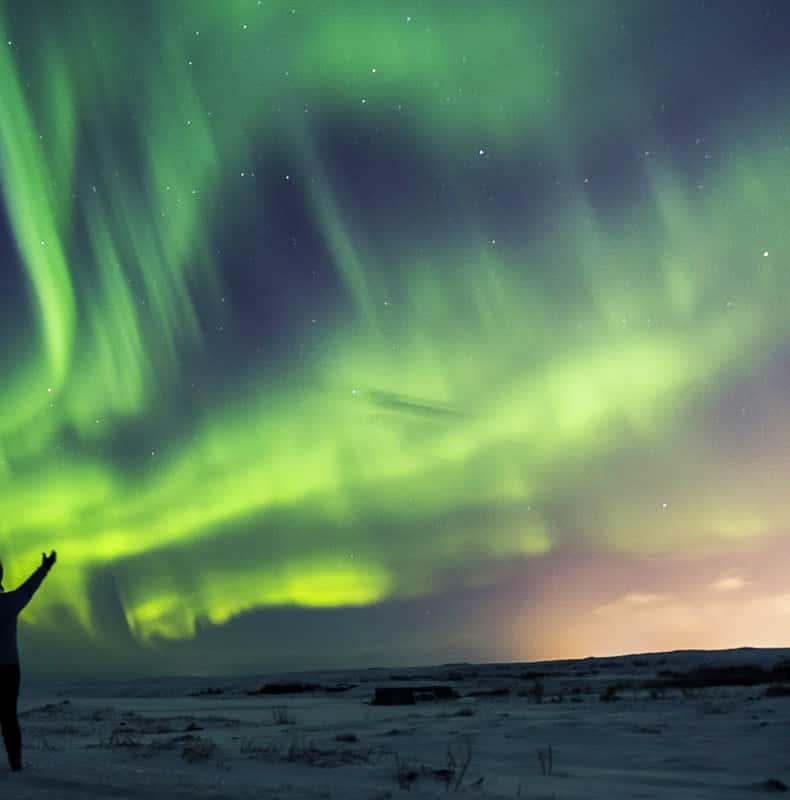
Cotton, a light rain jacket, and the sandals from your beach afternoon do not survive that swing. Neither does an Arctic-weight kit built for a polar aurora trip, since this ridge never approaches that kind of cold even at its lowest recorded reading. What actually works falls between those two extremes, built around the AEMET numbers above rather than the island's beach-holiday reputation.
For the full destination picture beyond gear, La Palma stargazing covers the trade-wind inversion, the Starlight Reserve status, and why the summit sits above the cloud line for most of the year.
The three-layer system built for AEMET's real range, not a beach-holiday guess
The AEMET numbers above span nearly 34 degrees between the coldest recorded night and the hottest recorded day. A three-layer clothing system covers essentially all of it, provided you swap pieces by season instead of packing one fixed outfit for the whole trip.
Base layer. A merino or synthetic thermal top, not cotton. At 21.3°C, August's average high, a light merino t-shirt is enough on its own for the walk to your viewpoint; once the sun is down and you're standing still, add the mid layer regardless of month.
Read next · Article
Stargazing Gear for Beginners: Binoculars to Telescopes
New to stargazing gear? This guide breaks down binoculars, telescopes, and smart telescopes, so you know what to buy first and what to skip for right now.
Mid layer. A 200-weight fleece covers most of the year. In February, when the ridge averages 2.6°C and can drop toward its recorded low of -4.1°C, swap the fleece for a light insulated or down jacket instead. This is the layer that genuinely needs to flex with the season here: the ridge reaches freezing in winter in a way that generic Canary Islands packing advice tends to skip over.
Outer shell. A windproof, breathable shell. Wind across an exposed ridge above 2,000 metres[1] cuts through a fleece alone within minutes, and it does more to how cold you actually feel than the thermometer reading by itself.
Hat, gloves, socks. A beanie and thin gloves cover summer nights; swap to a fleece beanie and insulated gloves from November through March. Wool socks over cotton, always, since volcanic rock sheds heat fast once the sky has been clear for a few hours.
The whole system, base layer, fleece or light down, shell, beanie, gloves, spare socks, packs into one compression cube. You don't need a parka rated to -30°C: the ridge's own coldest recorded night, -4.1°C, is a fraction of that, and it happens rarely, not every February.
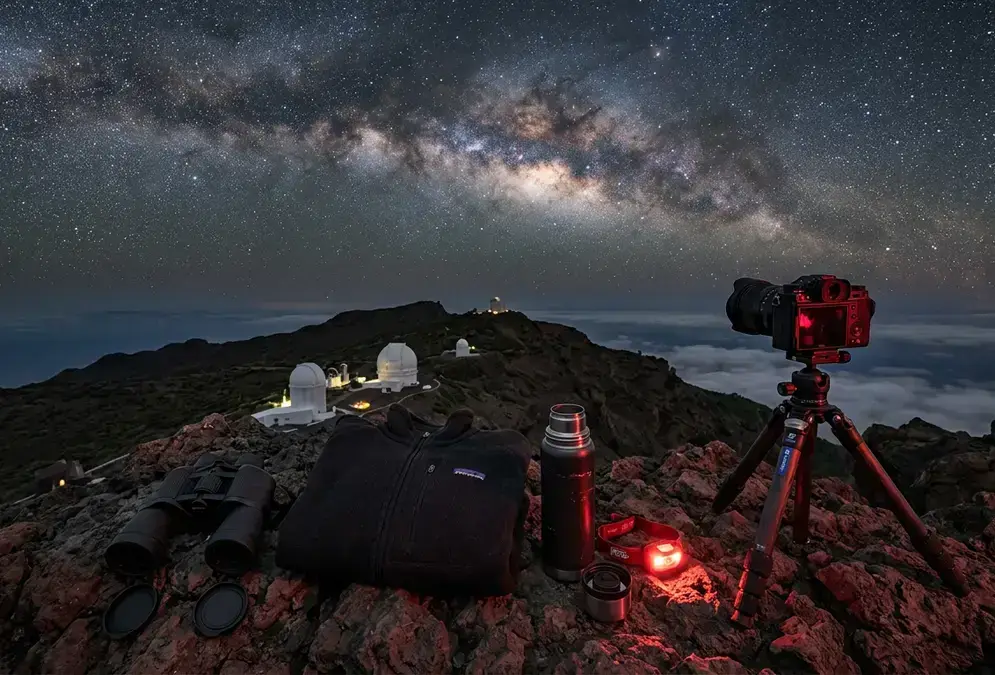
Essential gear: red headlamp, tripod, binoculars, thermos
Beyond clothing, four items decide whether a night on the ridge is comfortable or cut short. All four fit in a daypack.
Red headlamp. Not optional, and not a place to save money. Roque de los Muchachos measures among the darkest skies on the planet, Bortle Class 1-2, with artificial light pollution at the observatory estimated at roughly 2% of natural sky brightness.[3] A single white-light flash on a sky that dark costs everyone nearby their dark adaptation, the 20 to 30 minutes your eyes spend rebuilding the light-sensitive pigment rhodopsin.[4] A headlamp with a dedicated red mode on its own switch, not a dimmed white setting, is the standard gear on this ridge for exactly that reason. Bring spare batteries, since cold drains them faster. A dead headlamp means walking back to the car by phone light, undoing the night vision of anyone else still observing.
Tripod. A lightweight travel tripod that collapses to carry-on size. The volcanic ground at Garafía's viewpoints is uneven and exposed to Atlantic wind; spiked feet or a hook under the centre column for extra ballast keep a long exposure sharp instead of blurred.
10x50 binoculars. The single best weight-to-experience upgrade for independent stargazing here, since you're not walking into ORM with a telescope: the observatory doesn't sell that kind of access at all. At 10x magnification through a 50mm objective, Jupiter's four Galilean moons resolve as distinct points and the Pleiades split into individual stars instead of one smudge. The 5mm exit pupil, aperture divided by magnification, roughly matches what a dark-adapted eye can use, which is why 10x50 became the standard recommendation. If you're building toward night photography rather than naked-eye and binocular observing, La Palma astrophotography gear covers camera bodies, lenses, and exposure settings; this guide sticks to what you need before you ever mount a camera.
Thermos. At 2.6°C, February's coldest average, or anywhere near it, a hot drink adds real time to a session. Fill it before you leave the coast: there is no shop, no café, and no petrol station once you're on the Garafía road network after dark, and the nearest late-opening store is a genuine drive back down the mountain, not a five-minute detour.
Independent stargazing at Garafía, and why ORM being day-visit-only changes your kit
Because the observatory itself closes to the public after dark, most La Palma stargazing gear gets used somewhere else entirely: a pull-off in Garafía, a viewpoint near Las Tricias, or the terrace of a lodge that happens to sit above the cloud layer. That's a genuinely different gearing-up problem than driving into a site where staff, restrooms, and a visitor centre stay open at night.
No permit is required for roadside stops in Garafía or along the roads toward the observatory access corridor, but there's also no infrastructure to fall back on. Once you've parked and set up, you're your own support crew for the next few hours: your own light, your own warmth, your own hot drink, your own spare batteries. This is the biggest way this kit differs from one built for a more developed observing site: nothing here assumes a nearby building you can duck into if you're cold or something breaks.
Featured · Destination
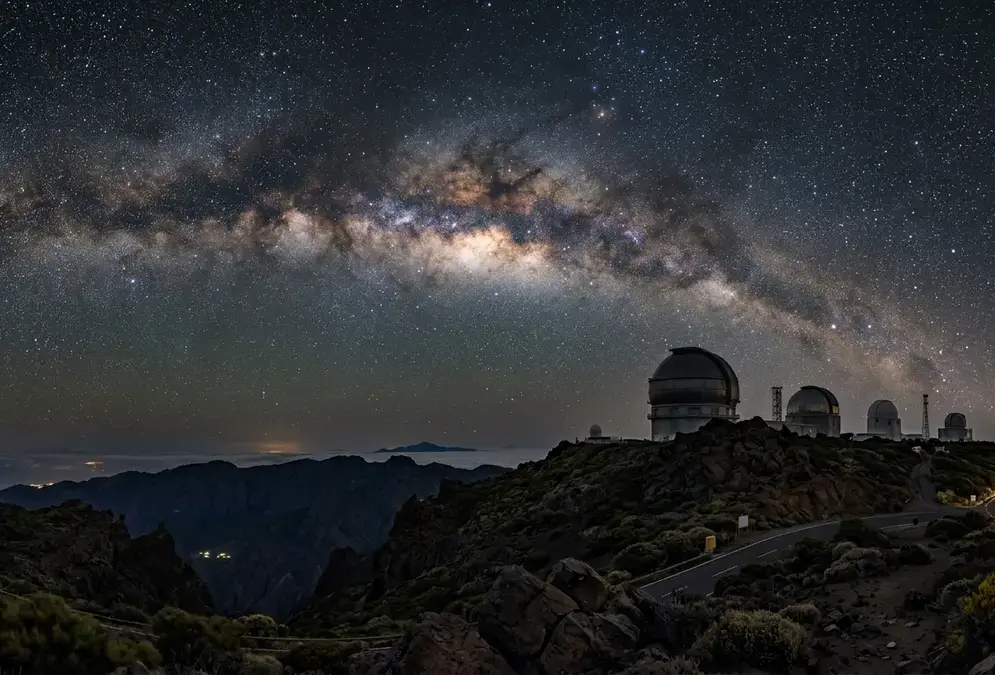
La Palma Stargazing
La Palma stargazing guide: the world's first Starlight Reserve since 2012, Bortle 1-2 skies above Roque de los Muchachos, plus where to stay and go year-round.
If you'd rather hand off the planning to someone else, a guided outing from the coastal towns still needs the same base kit, warm layers and a red headlamp at minimum, since even a guide's telescope doesn't keep you warm. Independent or guided, the AEMET numbers from the first section apply either way.
What to leave home, and why there's no shop nearby if you forget something
Some items belong on a general Canary Islands packing list and have no place in a bag headed for Garafía specifically.
Heavy Arctic gear. A parka rated to -30°C, insulated snow pants, battery-heated gloves: all of it solves a cold far beyond anything AEMET has recorded on this ridge. The coldest single reading in the station's record is -4.1°C, not -20°C, and that reading is the outlier, not a typical February night.
Your own telescope. ORM doesn't sell night access at all, guided or otherwise, so there's no scenario where hauling a telescope through airport security gets you time behind its instruments. If you want your own optics beyond the naked eye, bring 10x50 binoculars instead; a telescope you're still collimating at 1am costs you more observing time than it buys.
Recommended tours
Tours are selected for quality, not commission. I earn a small fee if you book — at no extra cost to you.
An empty thermos and an empty phone battery. This is what first-timers underestimate most on this specific island. Garafía is remote even by La Palma's standards: no meaningful public transport reaches it, fuel stations thin out well before the observatory road begins, and once you're parked at a viewpoint after dark there is nowhere within a reasonable drive to buy a forgotten charger, a spare set of gloves, or a thermos refill. Fill up, charge up, and pack spares before you leave Santa Cruz de la Palma or Los Llanos de Aridane, not after.
Read next · Lodge
Casa El Colmenero
Casa El Colmenero: a restored rural house at 1,042 m in Garafía, La Palma, above the clouds that shield Roque de los Muchachos Observatory's dark skies.
If a lodge with a private terrace above the cloud layer sounds better than a roadside pull-off, this self-catering property, a self-catering rural house at 1,042 metres in Garafía, sits inside the altitude band where the Atlantic cloud deck typically breaks.[5] Self-catering means the same no-shop-nearby rule applies at the lodge itself: bring what you need for the whole stay, since there's no on-site restaurant to fall back on after dark.
The bottom line: pack for the ridge's real range
A complete La Palma stargazing gear kit, three layers of clothing, a red headlamp, a travel tripod, 10x50 binoculars, and a thermos, fits in a carry-on and a daypack. None of it is exotic, and none of it needs to be Arctic-rated: the AEMET station on this ridge has never recorded a night colder than -4.1°C, and most winter nights sit closer to its 2.6°C monthly average.
What makes this kit different from a generic stargazing packing list is where it gets used. You're not walking into a building with heating and a gift shop; ORM closes its gates after dark, and the nearest fallback if you forget something is a genuine drive back down the mountain, not a five-minute walk. Pack once, pack for the real range, and you won't be improvising at 1am on a ridge with no shop for miles.
A dead headlamp means walking back to the car by phone light, undoing the night vision of anyone else still observing.
For the seasonal side of this same planning problem, moon phase, calima risk, and which months actually deliver the clearest skies, the best time for stargazing in La Palma guide covers the month-by-month picture this gear list is built to survive.