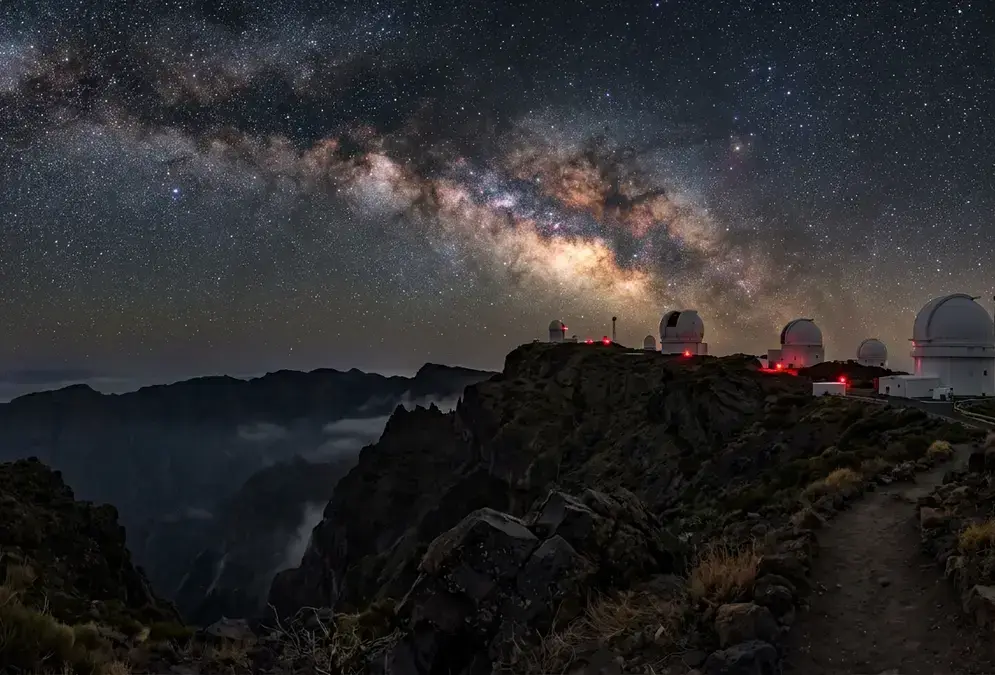

Why La Palma stargazing has no real off-season
Most of the destinations in this guide run on a season. Iceland, Lapland, Tromsø, and Fairbanks all chase the aurora's solar-driven rhythm: dark polar nights from roughly September through March, then a summer stretch when the sky barely gets dark enough to see anything at all. La Palma runs on a different engine entirely. Its skies are shaped by latitude and a trade-wind inversion, not the aurora oval, and that mechanism doesn't switch off for half the year.
The Isaac Newton Group, which co-runs the Roque de los Muchachos Observatory (ORM) at 2,396 metres[10], publishes the operating numbers behind that claim. The site logs high fractions of clear nights, roughly 70%, and photometric nights, roughly 60%, across a full year, and the IAC attributes this to an inversion layer sitting between 1,300 and 1,700 metres that "guarantees (though with many exceptions in winter) stable observing conditions during three-quarters of the year."[1] That's a rare thing: an official source naming its own weak season in its own literature.
That IAC caveat is the honest starting point for this whole guide. La Palma genuinely is a year-round dark-sky destination in the sense that no single month locks you out entirely. But "year-round" and "every night is equal" are not the same claim; the real difference between a good week and a mediocre one comes down to three variables: which part of the Milky Way core is above the horizon, how much Saharan calima dust is in the air, and how cold you'll be standing at altitude waiting for your eyes to adjust. For the full picture of why this island earns its Starlight Reserve status, see La Palma Stargazing.
70%
When the Milky Way core is visible, and why March is underrated
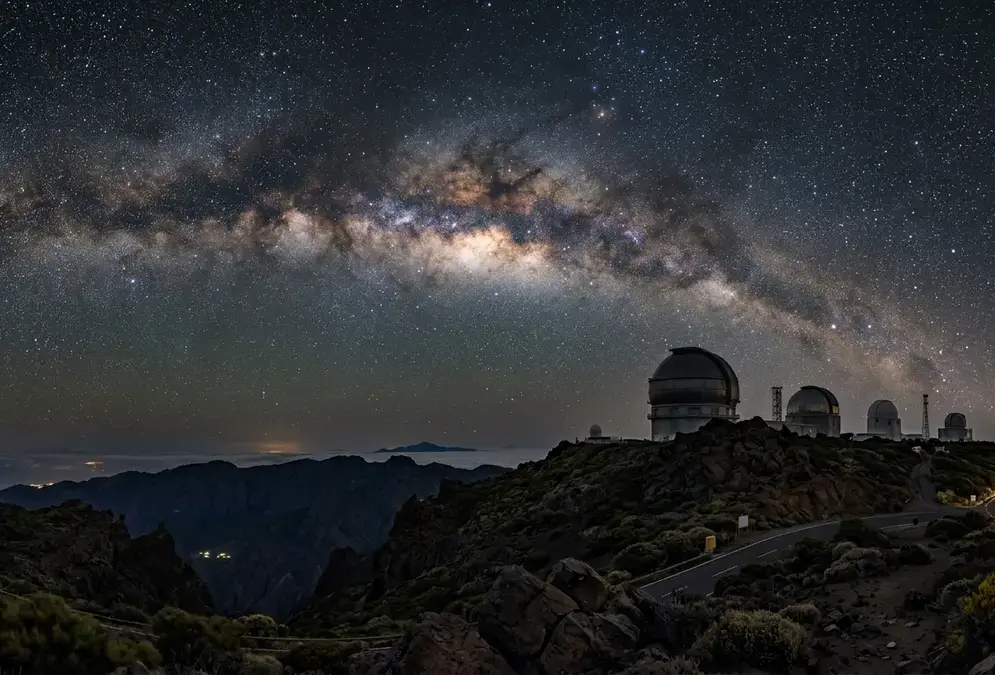
La Palma sits at roughly 28° North[2], the same latitude band that puts the galactic core, the dense, bright centre of the Milky Way in Sagittarius, within photographic reach for much of the year rather than only a few weeks. A La Palma-specific tourism source frames it directly: the island is "positioned at 28˚ North, which is a good latitude to photograph the central core of the Milky Way," with the core season running roughly March through October and its most favourable, most acute rising angle occurring in March.[2] That tracks the wider Northern Hemisphere pattern, where independent astronomy sources put the best general window for Milky Way viewing at March to September.[4]
Here's the detail most guides to this island skip. That same source pins the most favourable rising angle of the core to March, not June or July, which is where most Northern Hemisphere guides, including my own Best Time for Stargazing in Tenerife, point readers for maximum core altitude. The two claims aren't contradictory; they measure different things. By June and July, the core climbs higher and stays up longer after dark, which is what most photographers actually want. In March, though, the core rises at a steeper angle relative to the horizon, a compositional difference that rewards a different kind of shot rather than the highest possible arc. If your trip window is fixed to shoulder season, March isn't a consolation prize; it's a genuinely distinct look at the same object.
None of this changes the physics under the visible core. Seeing conditions at ORM are exceptional independent of season. The mean seeing value measured at the observatory is 0.76 arcseconds, median 0.64 arcseconds, a figure from the image-quality study still cited by the Isaac Newton Group[5] that places Roque de los Muchachos as the second-best site for optical and infrared astronomy in the Northern Hemisphere, after Mauna Kea. That's a professional-astronomy statistic, not a tourism claim, and it holds regardless of which month you visit.
Month-by-month: temperature, calima risk, and the Milky Way window
The table below distils the year into the three things that actually change: how cold you'll be, how likely Saharan dust is to haze the sky, and whether the Milky Way core is up at all. Two things are deliberately missing from it: a month-by-month clear-night count and month-by-month crowd levels, because no one, including the observatory's own operators, publishes either at that resolution for La Palma. AstroLaPalma, the island's own astro-tourism operator, doesn't rank months at all. It markets the island as good for astronomical observation "year-round," citing "its subtropical climate and geographical location."[6] Where this table gives you a number, a specific dated source backs it; where it gives you a qualitative band instead, that's because the precise figure genuinely isn't published anywhere.
The temperature figures come from AEMET's own weather station at Roque de los Muchachos itself (station C101A, 2,223 metres, in the municipality of Garafía)[7], not a generic Canary Islands estimate. Across the recorded data series, the coldest monthly average on record is 2.6°C in February 2023 and the coldest single reading is -4.1°C on 11 January 2021, while the warmest monthly average on record is 21.3°C in August 2024, with an absolute high of 29.7°C on 3 August 2024.[7] Treat those as the real ends of the range; the shoulder months sit somewhere between them, not at either extreme.
| Month | Night at ORM altitude | Calima risk | Milky Way core |
|---|---|---|---|
| Jan | Cold; record low -4.1°C | Elevated | Below horizon |
| Feb | Coldest month, avg 2.6°C | Highest risk | Below horizon |
| Mar | Cold, milder than Feb | Safest month | Rising, steepest angle |
| Apr | Cool | Low | Rising, improving |
| May | Mild | Safest (with March) | Good, most of night |
| Jun | Mild to warm | Low | High altitude |
| Jul | Warm | Low | High altitude |
| Aug | Warmest month, avg 21.3°C | Low-moderate | Excellent |
| Sep | Warm, cooling | Low-moderate | Very good |
| Oct | Cooling, transitional | Moderate | Fading, season ends |
| Nov | Cold | Elevated | Below horizon |
| Dec | Cold | Highest risk, ~17 days | Below horizon |
Calima: the dust risk that peaks in different months than you'd guess
Calima is the Canary Islands' term for Saharan dust blown out over the Atlantic, and it's the one weather risk on this island that has nothing to do with the trade-wind cloud layer. It sits below the same 1,300-to-1,700-metre inversion[1] that keeps ORM's summit clear of cloud, but a strong enough intrusion can still haze the sky above that line, and it will dull the view at any lodge or viewpoint below it.
Here's where La Palma's own pattern breaks from the generic "Canary Islands calima" story most guides repeat, which usually just says January and February. A La Palma-specific risk model instead puts the highest-risk months at December and February, with December rated "very likely" and averaging roughly 17 days of calima conditions in that month alone; November also carries elevated risk. The safest months, by the same model, are May and March[3], which happens to line up with exactly when the coldest weeks of winter have passed and the Milky Way core starts becoming usable again.
Across a full year, La Palma sees roughly 10 to 15 calima episodes, each typically lasting one to three days.[8] Because the island sits at the western edge of the archipelago, dust arrives more diluted here than on Lanzarote or Fuerteventura, further east and closer to the African coast, except during the most severe intrusions. If you're locking in winter dates regardless, check a live calima forecast a few days out rather than trusting a seasonal average. A bad intrusion can arrive and clear inside 72 hours, and the observatory's altitude usually, though not always, keeps it above the worst of it.
Planning around the moon, whatever month you land in
Season decides which part of the sky is available. Moon phase decides whether you can actually see it. A lunar synodic cycle, new moon to new moon, lasts about 29.5 days, and the practical dark window inside it runs roughly five nights either side of new moon, when the moon's brightness is a non-issue. Outside that window, a general astro-tourism benchmark holds: once moon illumination climbs above roughly 30%, it's usually too much light to see the Milky Way well.[9]
That means the moon calendar can undo a well-chosen month. Land in peak Milky Way season, in July, three days after full moon, and you'll get a bright, washed-out sky despite doing everything else right. Land in October, near the tail of the core season, on a new-moon night, and you'll see more structure in the galactic dust lanes than a badly-timed July trip ever showed you. Local operators echo the same point in plainer language: guides at both AstroLaPalma and Ad Astra La Palma note that full-moon nights still draw visitors, since the moon itself becomes the spectacle, but star visibility drops noticeably compared with a genuinely dark night.
The practical move: pick your travel month using the season and calima guidance above, then check that specific year's new-moon date for that month before booking flights. For the general mechanics of cross-referencing moon phase against season and weather anywhere in the world, When to Stargaze covers the method in more depth.
Read next · Article
When to Stargaze: Moon Phase, Season & Weather
When to stargaze depends on moon phase, hemisphere, and cloud cover, not luck. Learn the new-moon window, galactic-core season, and how to read a sky forecast.
Packing, logistics, and where this trip fits together
Pack for the AEMET numbers above, not for a general assumption that the Canary Islands are always warm. A record low of -4.1°C and a coldest monthly average of 2.6°C mean winter nights at the summit genuinely reach freezing, while a warmest monthly average of 21.3°C means even August nights are mild rather than hot, nothing like the sweatshirt-optional evening you'd get at sea level.[7] Bring:
- A down or insulated jacket, packed regardless of season
- A windproof outer shell; wind at 2,000-plus metres cuts through single layers fast
- Insulated boots or thick-soled shoes, since volcanic rock loses heat quickly underfoot after dark
- Gloves and a hat, October through April at minimum
- A red-light headlamp to preserve night vision while you find your footing
Recommended tours
Tours are selected for quality, not commission. I earn a small fee if you book — at no extra cost to you.
A rental car is not optional on this island. There's no public transport to Garafía, the observatory road, or most of the dark-sky lodging, and the drive up from either coast takes longer than the map distance implies. Casa El Colmenero, a restored rural house at 1,042 metres[11] in Garafía, sits inside the altitude band where the cloud layer typically breaks, and it's the strongest current lodging option on the physics alone; the full ranked comparison across five properties is in Best Places to Stay on La Palma for Stargazing.
One honest caveat before you book: La Palma's tour market is smaller and newer than Tenerife's, and this guide can't point you to a published ranked "best months" list from any local operator, because none exists. AstroLaPalma and Ad Astra La Palma both sell the island as good year-round rather than steering visitors toward specific windows. The month-by-month reasoning here is built from the sourced weather and dust data above, not lifted from a tour operator's marketing calendar, which is exactly the gap this guide exists to fill.
Featured · Destination
La Palma Stargazing
La Palma stargazing guide: the world's first Starlight Reserve since 2012, Bortle 1-2 skies above Roque de los Muchachos, plus where to stay and go year-round.