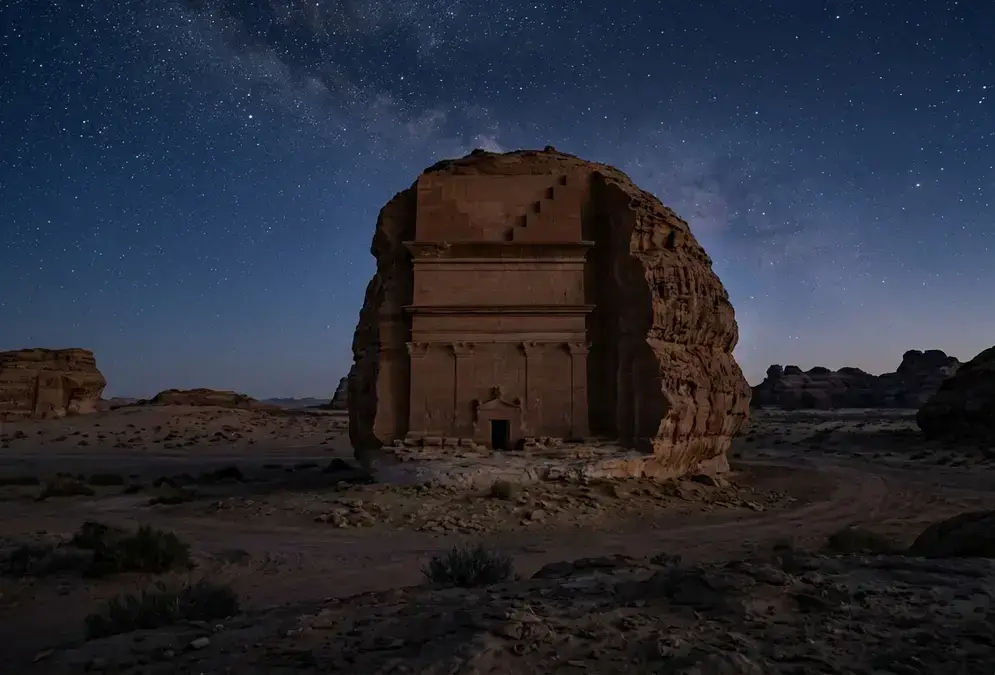

AlUla's calendar is a heat problem, not a cloud problem
Most dark-sky travel guides on this site revolve around a single question: which months give you the clearest sky. AlUla breaks that pattern. This desert basin in northwest Saudi Arabia sits under skies that stay largely clear across most of the year, so picking a month here is less about dodging clouds and more about deciding how much heat you can stand while doing it.
That's a genuinely different planning problem than an aurora trip to Tromsø or Fairbanks, where the whole calendar bends around cloud cover and darkness hours. In AlUla, the sky itself is fairly forgiving. What isn't forgiving is the desert sun: daytime highs run around 20 to 27°C (68 to 80°F) in the coolest stretch of winter, comfortable enough to spend a full afternoon among Hegra's rock-cut tombs and still have something left for a night under the stars, versus 36 to 38°C (97 to 100°F) once June through August arrives, hot enough that a midday walk through an exposed sandstone canyon stops being a casual stroll[1].
The October through April window that most guides recommend exists for exactly this reason: it's the stretch where the desert lets you function outside during daylight, not the stretch where the sky happens to be darkest. For the full destination rundown, from getting to AlUla to where to stay, see AlUla Stargazing.
October through April: the cool window, and where the exact dates diverge
Independent climate data and AlUla's own tourism marketing land on the same broad stretch, though they don't draw the line in quite the same place. General climate guides for the region point to October through March or April as the comfortable window. A CNN travel feature produced with Saudi Tourism narrows things slightly for stargazing specifically, pointing to the cooler months as the best time to go[2]. Treat September and April as edge months worth a caveat, not a boundary everyone agrees on to the week.
What nobody disputes is the trade. Cooler days let you actually enjoy Hegra's sun-exposed tombs and Jabal Ikmah's inscribed canyon walls without cutting the visit short, and cooler nights mean you're not still sweating from the afternoon when you set up for stargazing. Pack for both extremes regardless of which month you land in:
| Season | Day / night temp | Heritage touring | Best for |
|---|---|---|---|
| Oct-Apr (cool season) | 20-27°C day / cool nights, layers needed | Comfortable at midday | Hegra + stargazing same day |
| Jun-Aug (summer) | 36-38°C day / 19-22°C night | Sun exposure a real risk at midday | Clearest skies, toughest days |
| May & Sept (shoulder) | ~30-35°C day / milder, not cool yet | Doable at dawn or dusk only | Lower crowds, moderate compromise |
- Warm clothing for after dark. Desert nights drop fast once the sun goes down, cold enough that all-night stargazing excursions call for proper layers and sturdy footwear even outside the depths of winter[3].
- Sun protection for the day. A hat, sunscreen, and a water bottle you actually refill matter more here than at almost any other destination on this site.
- A separate check on the moon phase. Whatever month you travel, a bright moon washes out the fainter reaches of the Milky Way over the desert the same way it does anywhere else on Earth. A moonless week near new moon is what actually reveals the full band overhead, not the season by itself. The same moon-phase-plus-season method applies everywhere, not only AlUla; see When to Stargaze for the full mechanics.
The table below lines up the two main seasons, plus the shoulder months, side by side.
Hegra by day, the desert by night: the sun-exposure trade-off
Hegra and Jabal Ikmah are the reason most travelers build a trip to AlUla in the first place, and both are outdoor sites with almost no shade. Walking among Hegra's rock-cut Nabataean tombs, or reading the inscribed canyon walls at Jabal Ikmah, means standing in open desert sun for hours. Multiple travel guides recommend booking these visits for early morning or the hour or two before sunset, when the heat is manageable and the light for photography is better anyway.
That timing does double duty. A tour that wraps up close to sunset lets you go straight from a cool-of-day heritage visit into an evening stargazing session without a long gap to fill, since AlUla's dark-sky zones sit clear of any real light pollution once the sun is down[4]. Book Hegra access through Experience AlUla, the official tour operator; tour hours and pricing shift with the season, so check current details before you plan the rest of your evening around a specific slot rather than assuming last year's schedule still holds.
Featured · Destination
AlUla Stargazing
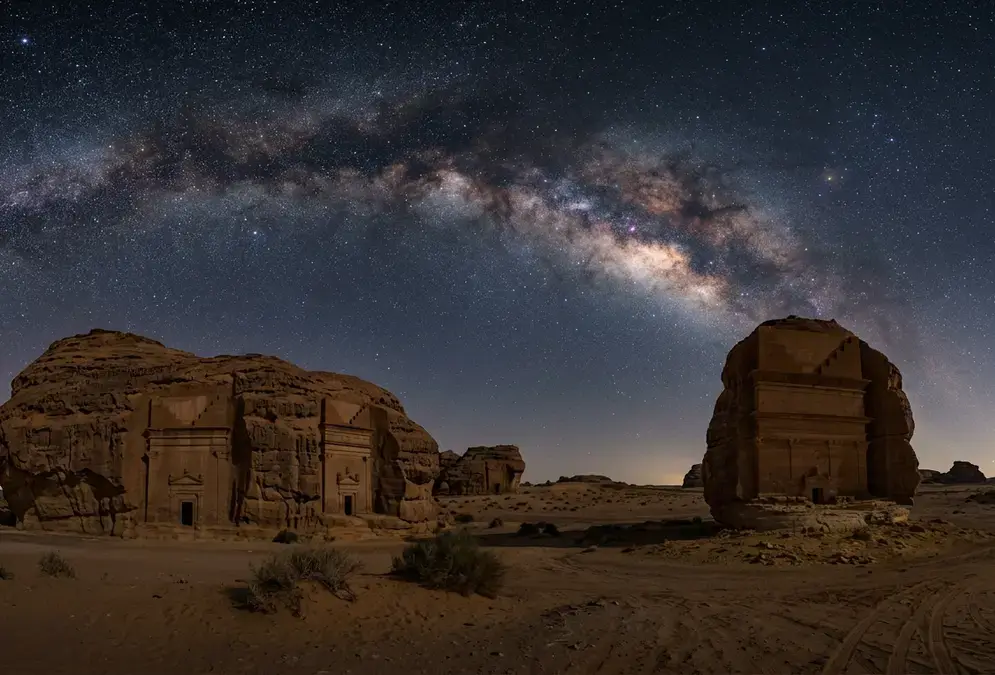
Stargaze above Hegra's 2,000-year-old Nabataean tombs in AlUla, the Gulf's first DarkSky-accredited Dark Sky Park. When to go, where to stay, and how to plan.
This is the actual trade-off that decides your travel dates more than anything else about AlUla: come in the cool season and you can do both, a full day of tombs and inscriptions followed by a full night of sky, without either one wearing you down. Come in peak summer and you're choosing between the two, since the same heat that makes a 10am canyon walk miserable barely lets up after dark.
Summer (June-August): why the heat, not the clouds, rules it out
June actually has AlUla's clearest skies of the year, clear, mostly clear, or partly cloudy 95% of the time, more than any other month, while December is the cloudiest month on the calendar, overcast or mostly cloudy about 27% of the time, and still sitting inside the recommended cool-season window. That's the detail that trips up anyone assuming "best time to visit" and "best sky" mean the same thing here. They don't.
Heat, not cloud cover, is what summer actually delivers. Average daytime highs reach 36 to 38°C (97 to 100°F), and overnight lows barely drop below 19 to 22°C[1], warm enough that even a late-night stargazing session doesn't offer the same relief a cool-season night does. Add in daytime heritage touring at Hegra or Jabal Ikmah, both essentially shadeless, and summer becomes a season of avoiding the sun rather than a season built around anything the sky is doing.
95% vs 27%
None of this means summer skies are bad. It means the sky was never the problem to begin with, in any month, and the real decision is how much heat you're willing to absorb to get under it.
Shoulder months, stargazing festivals, and picking your exact dates
September and May fall at the edges of the window, and neither is a clean win. Daytime heat in both months is still significant, likely pushing well past 30°C, while nights are cooling toward the comfortable range that defines the cool season proper. Treat them as a lower-crowd, moderate-comfort compromise rather than the ideal pick, useful if your travel dates are fixed and the cool season proper doesn't line up with them.
AlUla's official tourism body also periodically hosts astronomy-themed festivals and events built around the region's dark-sky identity, though scheduling shifts year to year; check current listings before you plan a trip around a specific one. If a festival atmosphere and organized programming matter to your trip as much as the sky itself, it's worth timing a visit around whatever's currently on the calendar. Outside of any specific event, there's no operational reason to prefer one cool-season month over another beyond your own tolerance for slightly warmer or slightly cooler nights.
Whichever month you land in, the moon still decides the night. Plan around the new-moon window, roughly the week before and after, for the darkest possible sky above the desert; that principle holds everywhere dark-sky travel happens, AlUla included, regardless of season.
Dark Sky Park status, planning your visit, and what a clear AlUla night looks like
AlUla's dark-sky push fits a wider pattern: Saudi Arabia is one of just 22 countries actively working to protect natural night skies, and in late 2024 AlUla itself became the first location in the Gulf region to earn International Dark Sky Park status from DarkSky International[2]. That status covers the AlUla Manara and Gharameel Nature Reserve zones specifically, the parts of the destination built and protected for exactly this kind of trip, separate from the archaeological sites themselves.
None of that changes the calendar math above. It just means the sky you're planning your trip around is a verified one, not a marketing claim. AlUla Manara, the astro-tourism centre well outside the historic core, is where much of the organized stargazing infrastructure is concentrated; if you're staying closer to Hegra and Old Town, desert camping areas near the archaeological zone offer a lower-effort alternative on nights you don't want to drive out.
A few things worth locking in before you book:
Recommended tours
Tours are selected for quality, not commission. I earn a small fee if you book — at no extra cost to you.
- Confirm current visa and entry requirements directly. Saudi Arabia's policies for international travelers do change, and a specific official source beats last year's blog post.
- Book Hegra and Jabal Ikmah through Experience AlUla, the official operator, and build your evening stargazing plans around whatever tour slot you actually secure.
- Give yourself three to four nights, not one. That covers the daytime heritage sites plus at least one clear night reserved for a proper stargazing session, with a backup if the first evening doesn't cooperate.
Where you stay factors in too. This resort, inside the Ashar Valley and a short walk from Hegra, runs its own guided telescope sessions as part of the stay, one way to fold the night-sky side of the trip into your accommodation rather than treating it as a separate booking. For other common questions about planning around the season, see AlUla's stargazing FAQ.