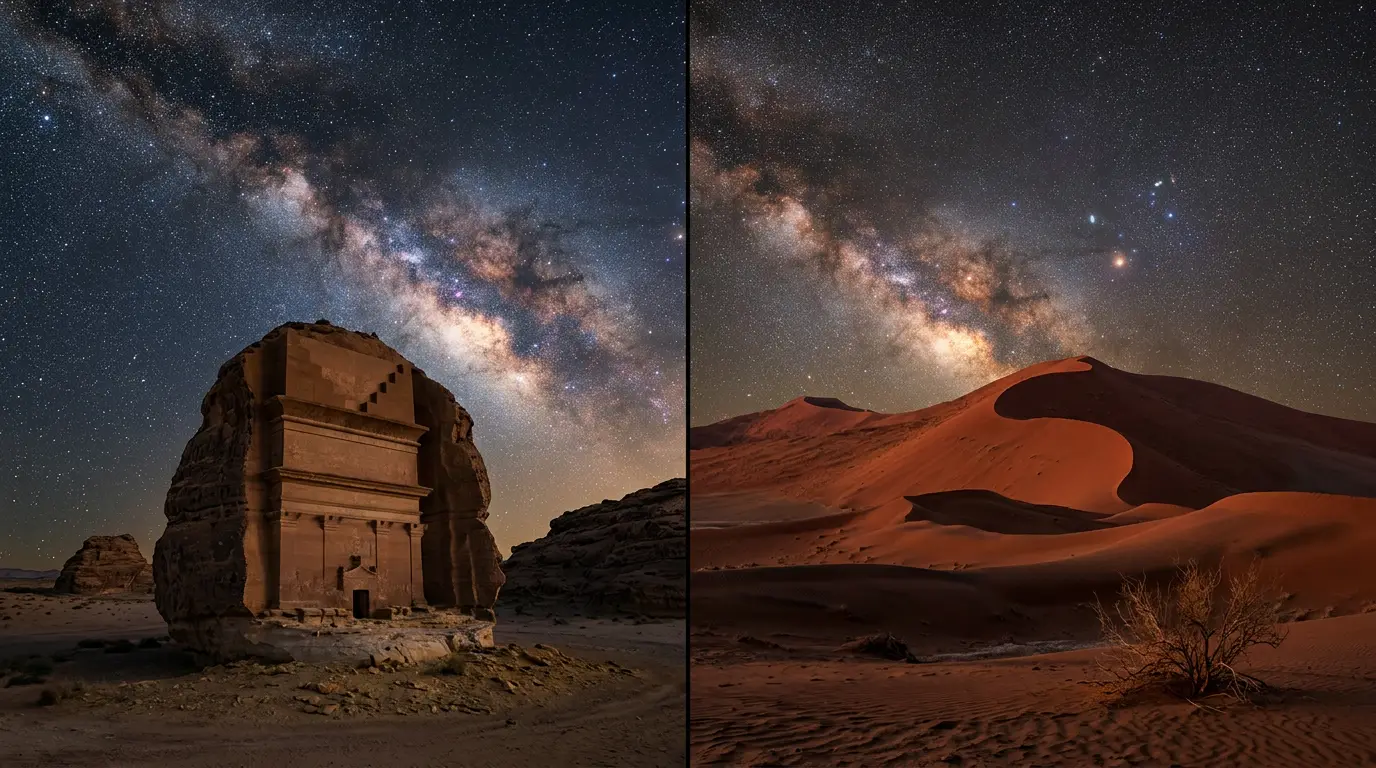

Two different DarkSky designations: Park versus Reserve
Comparing AlUla and NamibRand on sky quality alone is the easy part: both occupy genuinely dark, remote desert, and both will show a first-time stargazer more of the Milky Way than they've likely seen before. Comparing their credentials is where most write-ups get sloppy, because AlUla and NamibRand hold two different DarkSky International designation categories, not two tiers of the same one.
NamibRand became Africa's first International Dark Sky Reserve in 2012, certified at Gold Tier, the strictest classification DarkSky International awards a Reserve[1]. AlUla's designation, awarded in October 2024, is a Dark Sky Park covering the Manara and AlGharameel Nature Reserves: Saudi Arabia's and the GCC's first ever[2]. Reserves and Parks are assessed on different criteria inside DarkSky International's own system, and Parks don't carry a Gold, Silver, or Bronze tier the way Reserves do. Neither designation publishes a specific Bortle-scale reading, either; both simply confirm the same measured-darkness and lighting standards a low Bortle-scale rating reflects elsewhere. There's no honest sentence that says AlUla "matches" or "falls short of" NamibRand's Gold Tier rating, because they were never measured against the same scale.
AlUla has continued expanding its dark-sky-certified areas to additional reserves beyond the original Manara and AlGharameel designation. NamibRand's Reserve covers roughly 2,000 km² today[3], a footprint that earns its status through Reserve-specific criteria instead: sustained darkness verified across a populated periphery supporting a protected dark core, exactly what the Reserve category exists to measure, and not something the Park category evaluates the same way.
For the full designation history, protected-area numbers, and current visitor logistics, see AlUla Stargazing and NamibRand Nature Reserve.
2,000 km²
Heritage under one sky, wildlife under the other
Once you get past the paperwork, the two trips diverge completely, because AlUla and NamibRand each pair their dark sky with a totally different daytime draw.
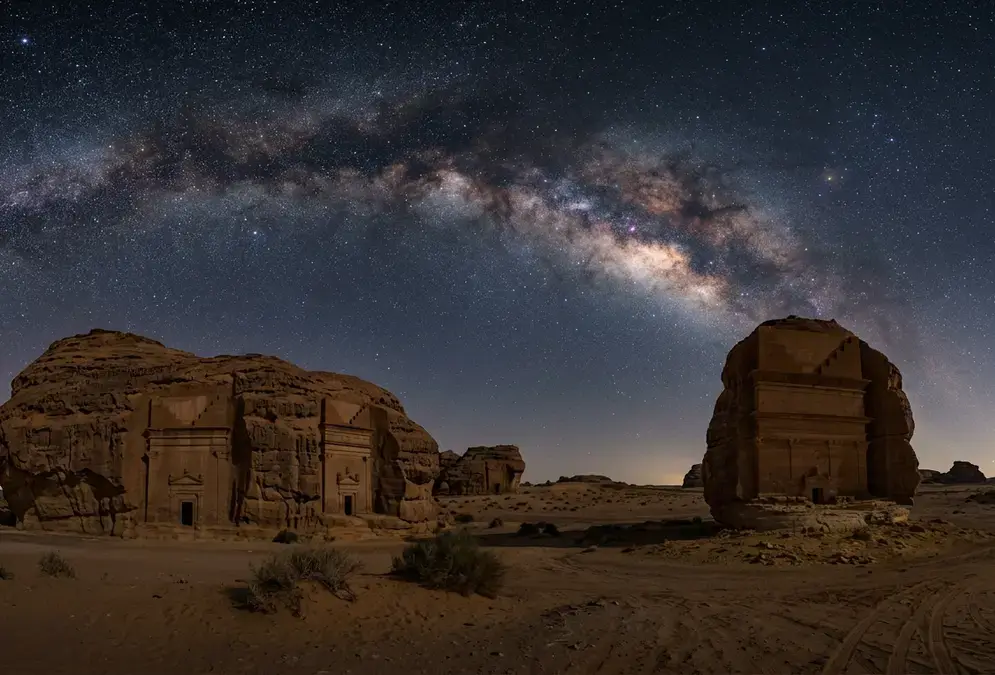
AlUla's pitch is heritage first. The desert valley holds Hegra, Saudi Arabia's first UNESCO World Heritage Site, where Nabataean tombs were carved into rose-red sandstone roughly two thousand years ago. Under moonlight, those tombs take on a glowing, monument-like quality, transformed rather than merely lit. The sky here is framed as a continuation of AlUla's Nabataean heritage, not a separate attraction bolted onto it: ancient desert travelers navigated by the same stars a modern visitor sees above the same rock-cut tombs.
Featured · Destination
AlUla Stargazing
Stargaze above Hegra's 2,000-year-old Nabataean tombs in AlUla, the Gulf's first DarkSky-accredited Dark Sky Park. When to go, where to stay, and how to plan.
NamibRand's pitch is safari first. Daytime here means oryx, springbok, brown hyena, and black-backed jackal moving across gravel plains between the dunes, with the neighboring Sossusvlei and Deadvlei landscapes a short drive away. The astronomy caps off a wildlife day: the guide who points out a jackal track at noon is often the same one who walks you back out after dinner to point out Scorpius.
Neither destination treats the sky as the whole trip, but the supporting cast is entirely different. AlUla asks you to care about Nabataean archaeology and rock-cut history; NamibRand asks you to care about desert-adapted wildlife and dune landscapes. Picking between them is really picking which daytime story you'd rather have running underneath the night sky.
Both destinations also extend past their headline attraction if you build in the extra days. AlUla's Old Town, Jabal Ikmah's canyon of ancient inscriptions, and the still-developing Wadi AlFann land-art valley round out a heritage-focused itinerary beyond Hegra alone. NamibRand's border with Namib-Naukluft National Park does the same for a wildlife-focused trip, with Sossusvlei's dunes and Deadvlei's clay pan an easy sunrise excursion, and travelers with more time often extend north to Etosha for a full Namibia safari circuit. Neither destination is really a single-attraction stop once you look past the stargazing headline.
Where you sleep: government resort push versus private-lodge consortium
The accommodation model behind each destination says a lot about who built it and why.
AlUla's lodging mixes international luxury brands with a state-backed development push. Banyan Tree AlUla and Our Habitas AlUla occupy the Ashar Valley among the same sandstone formations as the heritage sites; Shaden Resort and Dar Tantora The House Hotel round out the boutique-resort tier. Behind all of it is the Royal Commission for AlUla (RCU), building infrastructure aimed at a wider visitor base than a handful of lodges: public-access programming at AlUla Manara[2] and periodic astronomy-themed festivals and events add a calendar draw on top of the standing lodge and tour offerings. This is a destination being built out on purpose, by a government agency, rather than one that grew organically around a handful of private landowners.
Read next · Lodge
Banyan Tree AlUla
Banyan Tree AlUla pairs canyon-set villas near Hegra with free astronomer-led stargazing twice weekly, inside Saudi Arabia's first International Dark Sky Park.
NamibRand runs the opposite model. Every property inside the reserve is a private landowner partner rather than a franchise: Wolwedans, &Beyond Sossusvlei Desert Lodge, and Kwessi Dunes among them, with no OTA booking button anywhere in the reserve. No government body runs it; a consortium of lodges funds the reserve's private nature reserve conservation model directly through tourism revenue, and that arrangement is exactly why NamibRand can enforce lighting discipline that a publicly run park usually can't.
What that means for a traveler: AlUla gives you more entry points, luxury resort stays alongside standalone ticketed experiences like Stargazing at Gharameel, while NamibRand gives you exactly one entry point: an overnight stay at one of a handful of partner lodges, with no day-visitor or budget option at all. Neither is inherently better run; they're simply two different answers to the same question of who pays to keep a desert dark.
Getting there, and what the trip actually costs
Distance shapes both trips before you even reach the sky.
Recommended tours
Tours are selected for quality, not commission. I earn a small fee if you book — at no extra cost to you.

AlUla has its own international airport, with domestic flights from Riyadh and Jeddah, both under two hours; international routes are expanding but remain thin next to Saudi Arabia's major hubs, and travelers already in Medina can fly there instead and continue to AlUla by road. Whichever way you arrive, it's a materially shorter, less remote journey than reaching NamibRand.
NamibRand runs through Windhoek's Hosea Kutako International Airport, and from there it's a genuine half-day of onward travel no matter which option you pick: roughly 7 to 8 hours self-drive on a mix of tarred highway and graded gravel, about an hour by charter flight to a private airstrip, or a scheduled FlyNamibia flight to Keerweder Airstrip followed by a 45-minute road transfer. There's no version of a NamibRand trip that skips this leg. I've made that drive myself, and it's worth budgeting as a real cost of the trip, not a delay before the trip starts.
| Factor | AlUla | NamibRand |
|---|---|---|
| DarkSky designation | International Dark Sky Park (Oct 2024) | International Dark Sky Reserve, Gold Tier (2012) |
| Daytime draw | Nabataean heritage at Hegra | Desert-adapted wildlife safari |
| Lodging model | Luxury resort brands plus standalone tickets | Private lodge consortium only, no budget tier |
| Getting there | Own international airport, domestic flights ~1-2 hrs | Windhoek airport plus a half-day onward transfer |
| Best season | Oct-Apr, driven by heat, not cloud cover | May-Oct dry season; wet season is a soft trade-off |
Cost follows the same pattern as access. NamibRand has no budget tier at all: every property is a private lodge, and the astronomy program is folded into the nightly rate rather than sold separately, so the true cost of a night under NamibRand's sky is whatever the lodge charges to sleep there. AlUla's pricing picture is more varied, mixing luxury-resort rates with standalone guided experiences, though specific tour pricing wasn't confirmed clearly enough in the available reporting to quote a number here. The honest summary either way: AlUla's guided-access astrotourism model gives you more ways in at different price points, while NamibRand's lodge-exclusivity gives you exactly one, set by whichever property you book. Factor the flight and the transfer into the comparison, not just the nightly rate, since both add real days to either trip before a single star gets counted.
Best season: escaping heat versus escaping storms
Both destinations run a best-season window, but the reason behind each one is different, and that matters for how strict you need to be about it.
AlUla's window runs October through April, and heat, not cloud cover, is the entire reason. The desert's skies stay clear most nights of the year regardless of season; the constraint is comfort, since summer daytime highs regularly clear 40°C. October and February specifically offer the best balance of mild weather, lower crowds, and better rates[4]. Miss that window and you're not risking a cloudy night, you're risking a genuinely unpleasant one. For the month-by-month breakdown, see AlUla stargazing forecast.
NamibRand's dry season runs May through October, with March through September specifically favoring the galactic core riding high overhead rather than skimming the horizon. Namibia's wet season, November through April, brings brief afternoon thunderstorms, but the region's overall aridity means it rarely delivers the sustained overcast that would actually ruin a trip; it's a softer trade-off of lower prices and thinner crowds against a slightly less certain sky, not a hard no.
That's the real difference in season logic, not just a mirrored hemisphere. AlUla's off-season is a closed door: extreme heat makes the wrong months a bad idea outright. NamibRand's off-season is an open compromise: a slightly riskier bet on clear skies, still workable for a traveler chasing a lower price.
How to choose: a decision framework
There's no honest version of this comparison that ends with a single winner. AlUla and NamibRand both deliver a genuinely dark sky, certified through two different DarkSky categories that don't rank against each other, wrapped around two completely different daytime experiences and two completely different ways of paying to get there. The right pick depends on what kind of trip you actually want underneath that sky, not which destination's paperwork sounds more impressive. If you're still weighing whether a private-reserve stay is worth NamibRand's cost and distance at all, Is NamibRand Worth It for Stargazing? works through that question directly.
Pick AlUla if
- You want ancient history and rock-cut archaeology alongside the night sky, not wildlife
- You'd rather have multiple ways in, luxury resort stays or standalone ticketed experiences, than one lodge-only option
- A shorter flight and a more conventional hotel-booking process matter to your planning
- You're comfortable with a destination still building out its astrotourism infrastructure, rather than one with decades of established lodges
Pick NamibRand if
- You want desert-adapted wildlife and a private-reserve safari-astronomy combination bundled with the stargazing
- A certified Gold Tier Reserve, and the reserve-wide lighting discipline it enforces, matters to you specifically
- Budget isn't the deciding factor and you're comfortable treating remoteness as part of the appeal
- You'd rather commit to one lodge for several nights than move between different tours and price points