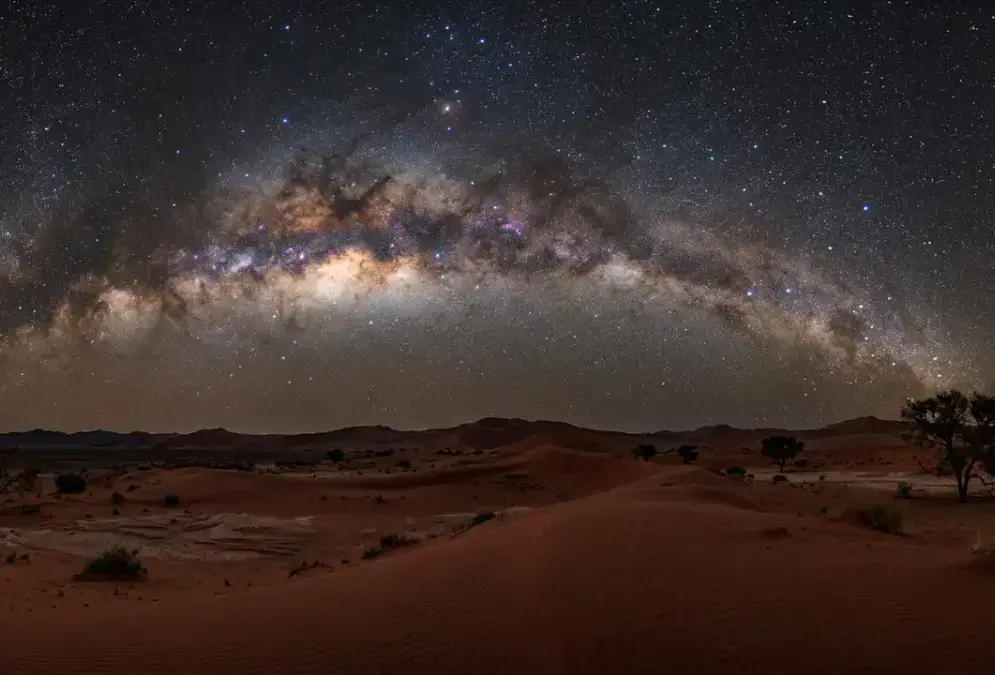

What you're actually signing up for
NamibRand isn't a place you drop into for a single night session and a public shuttle bus. It's a 200,000-hectare private reserve[2] in the southern Namib Desert, consolidated in the early 1990s from a patchwork of sheep and cattle farms into a single conservation unit, and every property inside it is a landowner partner rather than a franchise. There's no gate to walk up to on your own. Access runs entirely through the lodge you've booked, and the guide who takes you out after dinner works for that lodge, not for a separate observatory or park authority.
That private-consortium model is also why NamibRand earned Gold Tier status, the strictest classification DarkSky International awards, becoming only the second reserve on the planet to reach it[1]. The reserve spans over 2,000 km² of red dunes, gravel plains and granite mountains, and it was Africa's first certified International Dark Sky Reserve[2]. None of that reads like tourism-board copy. It tracks measured sky darkness, held consistently enough across enough nights to clear DarkSky's own review.
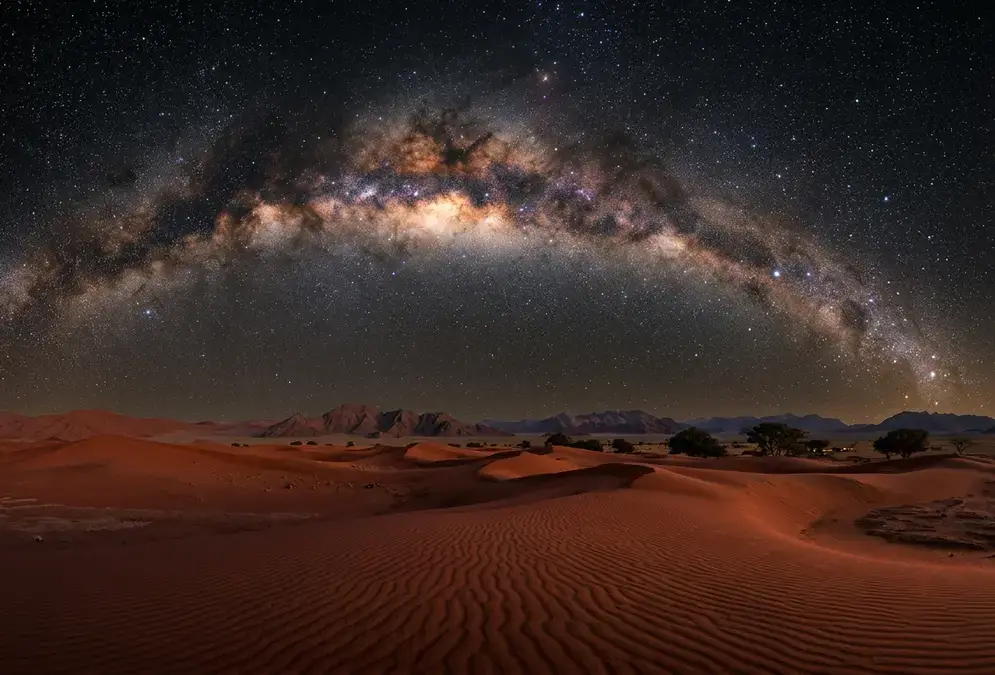
Featured · Destination
NamibRand Nature Reserve
NamibRand is Africa's only Gold Tier Dark Sky Reserve: extreme Namib Desert isolation, the Southern Cross, Magellanic Clouds, and luxury safari lodges.
What you don't get here is a research telescope or a public dome to walk into. NamibRand's astronomy is guide-led from lodge grounds or a dune camp, built around naked-eye orientation and a trained storyteller rather than an instrument. For the reserve's full numbers, lodges and access routes, see NamibRand stargazing.
The skies: what actually separates NamibRand
NamibRand records more than 300 clear nights a year, with air dry enough that astrophotographers describe it as a genuine paradise for long exposures[2]. That number alone doesn't separate it from Atacama or Aoraki Mackenzie, both of which post similarly high clear-night counts of their own. What does separate it is what's actually up there once the sky clears.
Time a NamibRand trip for the austral autumn and winter, roughly March through September, and the galactic core climbs high and stays up for hours rather than skimming the horizon the way it does from temperate-latitude sites. The Large and Small Magellanic Clouds, both naked-eye galaxies invisible from anywhere north of the tropics, sit low in the southern sky on any clear night. The Southern Cross anchors the same view, a constellation Namibia values enough to put on its own flag.
300+
None of that needs a telescope, and that's the point. NamibRand's pitch was never built around a dome and an eyepiece the way an observatory town's is. It hands over the whole naked-eye sky intact and lets the desert's dry air do the rest.
The darkest sky I've personally seen was here, and it wasn't a rating that made the difference. It was standing somewhere with no glow on the horizon in any direction at all, which turns out to matter more than whatever number a certification puts on it.
The landscape: a safari, not just a sky
Nobody books a multi-night NamibRand stay for the astronomy alone. Daytime here is a private-reserve safari: oryx, springbok, brown hyena and black-backed jackal move across the gravel plains between the dunes, and the same guide who points out a jackal track at noon walks you back out after dinner to point out Scorpius.
Some lodges lean into that combination harder than others. At Kwessie Dunes, each bedroom has its own open-air 'star gazer' room, built completely open to the sky, and guides from the Wolwedans Collection and Tok-Tokkie Trails are trained in astronomy narration rather than just wildlife spotting[3]. That's a genuinely different model from a public observatory tour: instead of a stranger with a laser pointer and a script, it's the same guide who's been driving you around the reserve all day.
The reserve also borders Namib-Naukluft National Park, which puts Sossusvlei's towering red dunes and the bone-white clay pan at Deadvlei within a short morning drive of most lodges. Most multi-day itineraries build around exactly that pairing:
- Two or three nights inside NamibRand for the stargazing and the daytime wildlife
- A sunrise excursion at Sossusvlei and Deadvlei before moving on
- An optional extension north toward Etosha for a fuller Namibia safari circuit
The real costs and friction points
Price is the honest objection, and it's a real one. NamibRand has no budget tier: every property inside the reserve is a private lodge or tented camp, priced and booked directly or through a specialist Namibia operator rather than a general travel site. Round-up estimates for a combined multi-night itinerary, pairing a NamibRand lodge stay with Sossusvlei and a Karoo observatory leg, put the total in the low-to-mid five figures per person, though that figure traces to travel-aggregator round-ups rather than any single lodge's own rate card, so treat it as a rough order of magnitude and confirm current pricing directly with the operator before booking anything[4].
Recommended tours
Tours are selected for quality, not commission. I earn a small fee if you book — at no extra cost to you.
Getting there adds its own friction. Windhoek's Hosea Kutako International Airport is the main gateway, and from there it's a genuine half-day of onward travel either way: a long self-drive on a mix of tarred highway and graded gravel, or a shorter charter flight straight to a private airstrip near the lodge. Either route is more remote, and takes noticeably longer door-to-lodge, than the short shuttle from a town center that both Atacama and Aoraki Mackenzie offer.
| Destination | Model | Cost tier | Public observatory access |
|---|---|---|---|
| NamibRand | Private reserve, guide-led from lodge grounds | High: lodge-only, no budget tier | None |
| Atacama | Desert town with a commercial tour market | Wide range: budget tours to private lodges | Yes: ALMA and Paranal run free public visits |
| Aoraki Mackenzie | Alpine reserve built around one observatory | Low: a guided tour fee, not a lodge minimum | Yes: Mt John Observatory |
None of that makes NamibRand a bad trip. It makes it one that needs planning on purpose, the same way a long-haul safari does, rather than something you slot into a weekend.
NamibRand versus Atacama versus Aoraki Mackenzie
Atacama makes its case on infrastructure, not exclusivity. The Chilean desert around San Pedro sits at roughly 2,400 meters, rated Bortle-1 dark and posting 300-plus clear nights of its own[5], but unlike NamibRand it has a dense commercial tour market underneath that darkness. A basic 2-3 hour telescope tour runs roughly USD 50 to 90[6], a fraction of a single night at a NamibRand lodge, and travelers who want to go further can register months ahead for a free weekend visit to ALMA or Paranal, working research observatories that NamibRand simply has no equivalent of.
Aoraki Mackenzie undercuts both on price. It's one of only two Gold Tier Dark Sky Reserves in the world (alongside NamibRand) and the largest in the Southern Hemisphere[7], and its centerpiece, Mt John Observatory, is a short guided shuttle from Lake Tekapo township rather than a multi-night lodge commitment. A guided visit there costs a tour ticket, not a private-lodge minimum. For a full breakdown of whether that trade-off holds up on its own terms, Is Aoraki Mackenzie Worth It for Stargazing? works through the same question from the other side of the world.
What NamibRand sells that neither of the other two does is the combination itself: a private-reserve safari bundled with guide-led astronomy, in a Gold Tier sky, with no public infrastructure diluting the exclusivity. If what you actually want is observatory access and a lower price floor, Atacama or Aoraki Mackenzie both beat it on those terms specifically. If what you want is a private desert reserve where the same guide handles the wildlife drive and the night sky, NamibRand doesn't have a real competitor.
The verdict on NamibRand
NamibRand is worth it for a specific traveler: someone who wants the safari-astronomy combination more than a public observatory ticket, who's already budgeting for a proper Namibia trip, and who treats the remoteness as part of the appeal rather than an obstacle to plan around. For that person, the Gold Tier sky is a bonus layered onto a trip that was already going to be expensive and hard to reach.
It's a harder sell for anyone chasing the cheapest possible dark sky, or anyone who specifically wants to stand inside a working research dome the way Atacama's ALMA visits or Aoraki Mackenzie's Mt John sessions allow. Neither of those experiences exists inside NamibRand's reserve boundary, by design. Budget stargazers priced out of the lodge tier can still base in Sesriem or Solitaire just outside the reserve and reach much of the same dark desert for far less.
Build at least two or three nights into the plan either way, align the trip with the new-moon window, and NamibRand delivers a sky and a daytime landscape that neither Atacama nor Aoraki Mackenzie fully matches, at a cost and a distance that neither of them asks you to pay.