
The short answer: two nights, three nights, or four
Two nights is the realistic floor for a NamibRand stargazing stay, and it's the number the reserve's own lodges build their minimum-stay policies around. At NamibRand Family Hideout, one of the properties inside the reserve, guests are advised to book at least two nights because the lodge sits more than 16 km off the main C27 road[2], a remoteness factor that applies just as much to the reserve's other camps, most of which sit at the end of their own long private tracks.
Push to three nights and the trip stops feeling like a single roll of the dice against the weather. Some operators recommend three nights specifically so a stay covers not just a clear-night stargazing session but also a nature drive, the Tok-Tokkie walking trail, or a visit to NaDEET, the reserve's desert education center, without cramming everything into one overloaded evening.
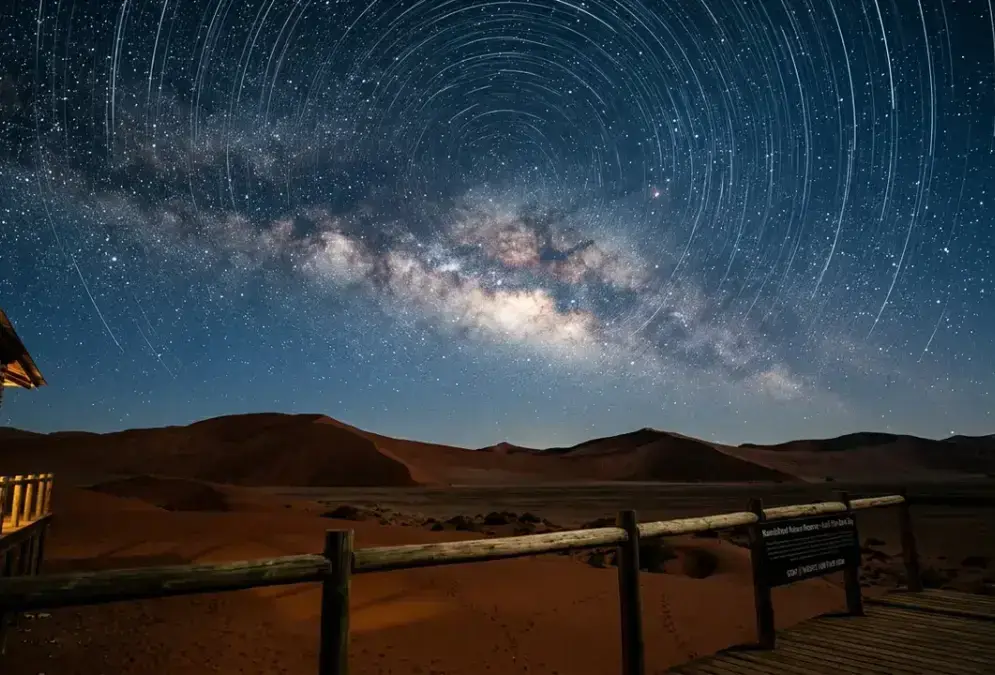
Four nights buys real insurance. NamibRand was inscribed as an International Dark Sky Reserve at Gold Tier in May 2012, the darkest and strictest category DarkSky International awards[1], but Gold Tier certification says nothing about whether any specific night on your trip will be cloudless or moonless. A fourth night is the difference between hoping for one good sky and actually planning for one.
A fourth night is the difference between hoping for one good sky and actually planning for one.
Why the trip from Windhoek eats a full day before you even arrive
Every NamibRand itinerary starts at Hosea Kutako International Airport near Windhoek, and the honest math there changes how much stargazing time your trip actually buys.
Self-drive covers roughly 375 km between the airport and the Sesriem/Sossusvlei area, and the recommended budget is about 6 hours behind the wheel, ideally routed over the scenic Spreetshoogte Pass[3]. That's before NamibRand's own lodges, most of which sit further off the main road again. Add the practical arrival overhead: budget roughly 2 hours for airport procedures plus at least 1 hour for rental-car pickup, longer if you're renting a 4x4[4]. Land at midday and a self-drive traveler is realistically arriving at a NamibRand lodge after dark, having burned an entire day on logistics before the first stargazing session even starts.
A charter flight cuts most of that away. A scheduled charter from Windhoek's Eros Airport to the Sossusvlei airstrip runs about 1 hour 15 minutes[5], landing travelers close enough to a lodge transfer that a first-night stargazing session is genuinely on the table. It costs more, but for a trip built specifically around a handful of clear nights, buying back most of a travel day is often the better trade than saving on car rental. See getting to NamibRand for the full self-drive-versus-charter breakdown, including the regional-carrier option between the two extremes.
6 hours
Pairing NamibRand with Sossusvlei and Deadvlei: the realistic circuit
NamibRand borders Namib-Naukluft National Park, and almost nobody flies this far only to stay inside NamibRand's fence line. Sossusvlei's towering red dunes and Deadvlei's bone-white clay pan, ringed by centuries-dead camel-thorn trees, sit close enough that skipping them once you've already made the trip out is the kind of decision travelers tend to regret at home.
Budget Sossusvlei/Sesriem its own two-night minimum. A sunrise excursion to beat both the heat and the tour buses takes one full morning, and many travelers find they'd rather give Dune 45 and Deadvlei separate mornings than rush both into a single dawn. Add a rest day for the drive itself, since the Windhoek-to-Sesriem leg alone typically eats the whole of arrival day, and a realistic combined circuit lands at four to five nights minimum: two in Sossusvlei/Sesriem, two to three more at a NamibRand lodge. For the fuller picture on NamibRand's own Gold Tier rating, lodges, and dark-sky specifics, see NamibRand stargazing.
Featured · Destination
NamibRand Nature Reserve
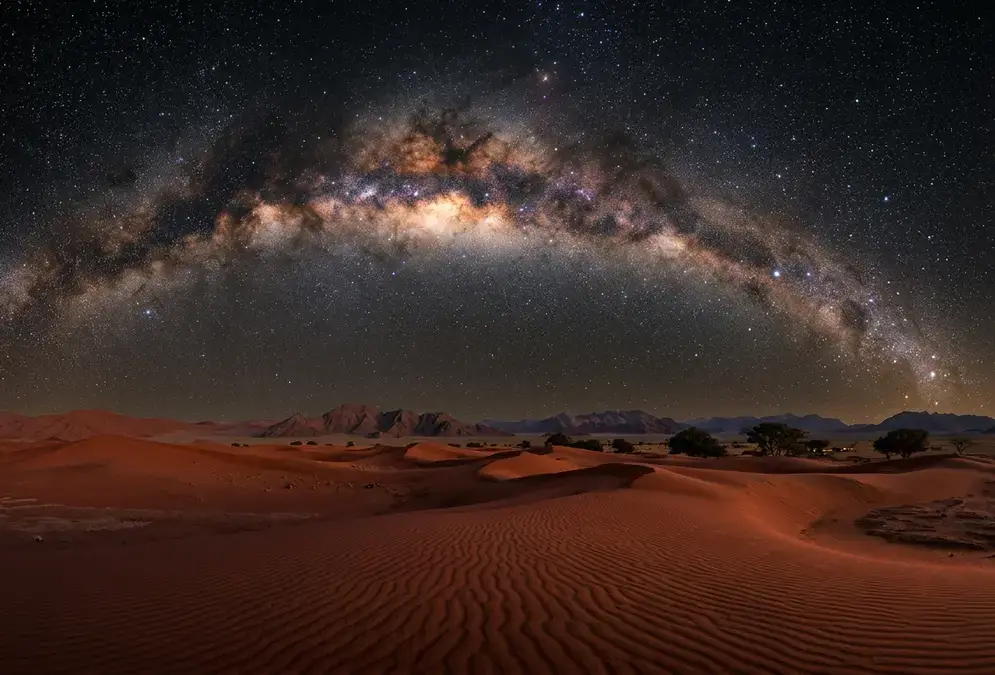
NamibRand is Africa's only Gold Tier Dark Sky Reserve: extreme Namib Desert isolation, the Southern Cross, Magellanic Clouds, and luxury safari lodges.
Stretch the trip to six or seven nights and the pace stops feeling rushed at either end. That's the range most fully-planned Namibia stargazing-and-dunes circuits land in once you've priced in the drive time from the last section, and it's still well short of the commitment the next section describes.
The Etosha question: an 11-12 day trip, not a quick add-on
Extend a NamibRand-and-Sossusvlei circuit north to Etosha National Park for big-game viewing, and the trip's category changes entirely. This isn't a two- or three-day extension bolted onto the itinerary you've already priced. Etosha adds a genuine multi-region Namibia safari on top of the dark-sky leg.
A published andBeyond tailor-made Namibia itinerary that folds Etosha into a Sossusvlei-based circuit runs 12 days and 11 nights total, covering Sossusvlei Desert, Swakopmund, Damaraland, Etosha, Okonjima, and Windhoek[6]. That's not an outlier. Operators building Etosha-inclusive Namibia circuits routinely land in similar territory, because the driving distances between the Namib's dune country and Etosha's game-viewing loops in the far north are themselves substantial, on top of whatever nights you've already committed to NamibRand and Sossusvlei.
The honest framing: NamibRand plus Sossusvlei is a five-to-seven-night trip. Add Etosha and you're planning something closer to ten to twelve nights, once Windhoek arrival and departure buffers and the inter-region transfer days are counted. Treat Etosha as a decision about whether this is a two-week Namibia safari with a dark-sky chapter in it, not a quick stargazing add-on with a game park tacked to the end.
| Circuit | Nights | What it covers |
|---|---|---|
| NamibRand only | 2-4 nights | Stargazing, nature drives, Tok-Tokkie trail |
| NamibRand + Sossusvlei | 5-7 nights | Stargazing plus the Sossusvlei/Deadvlei dune circuit |
| NamibRand + Sossusvlei + Etosha | 10-12+ nights | Full Namibia safari with dark-sky and big-game legs |
Buffer nights: insurance against cloud cover and a bright moon
None of the numbers above account for the one variable that can ruin any of them: a cloudy night, or a full moon. Standard dark-sky-travel guidance applies here just as much as anywhere else: time the trip away from the full-moon window, and build in at least one spare night if the itinerary allows, since a single overcast or moon-bright evening can otherwise cost you the only clear stargazing opportunity your whole trip was built around.
There's no single quotable rule for exactly how many buffer nights NamibRand itself demands beyond that general principle, and treating any specific figure as a hard guarantee would be dishonest. What's defensible is the logic: a two-night stay has one shot at a clear, moonless sky; a four-night stay has three or four chances. For a trip this expensive to reach, that math alone is often reason enough to add the extra night.
Check a new-moon calendar before locking in dates, not after. When to stargaze covers how moon phase, season, and cloud forecasts interact everywhere, not just in Namibia, and it's worth reading before you book flights rather than after.
Building the itinerary: booking order and the long-haul math
NamibRand is not a budget stargazing detour. Every property inside the reserve is a private lodge, flights to Windhoek from most departure points involve at least one long-haul leg, and the on-the-ground logistics above assume you've already committed serious time and money before the first clear night. Treat the planning in that order.
Book lodges first. NamibRand's camps price by the night, run limited capacity, and don't compete on an open booking platform the way a city hotel does. If Etosha is joining the circuit, book that leg early too, since its own lodges, especially near the park's better waterholes, fill out well ahead of peak dry-season dates.
Recommended tours
Tours are selected for quality, not commission. I earn a small fee if you book — at no extra cost to you.
Decide self-drive versus charter before anything else locks in, because that decision changes your arrival-day math from earlier in this guide and, with it, how many of your booked nights actually deliver a real stargazing session. A charter-flight arrival on day one gives you a shot at that first night's sky; a self-drive arrival on the same schedule usually doesn't.
Pack for extremes, not for a season. Desert days run hot regardless of month, and desert nights drop close to freezing in the dry season. Stargazing gear for beginners covers what's actually worth packing, starting with a red-light headlamp for protecting night vision on unlit lodge tracks after dark.
What a realistic first-timer itinerary looks like
A first NamibRand stargazing trip that also wants Sossusvlei, without Etosha, commonly looks like this:
- Day 1: Fly into Windhoek, then charter or self-drive transfer toward Sesriem
- Day 2: Sossusvlei/Deadvlei sunrise excursion, rest of the day at leisure
- Day 3: Transfer to a NamibRand lodge
- Days 4-5: Stargazing sessions, a nature drive, and the Tok-Tokkie Trail if time allows
- Day 6: Departure transfer back to Windhoek
That's six nights total, with one full buffer night built in against a cloudy or bright-moon evening.