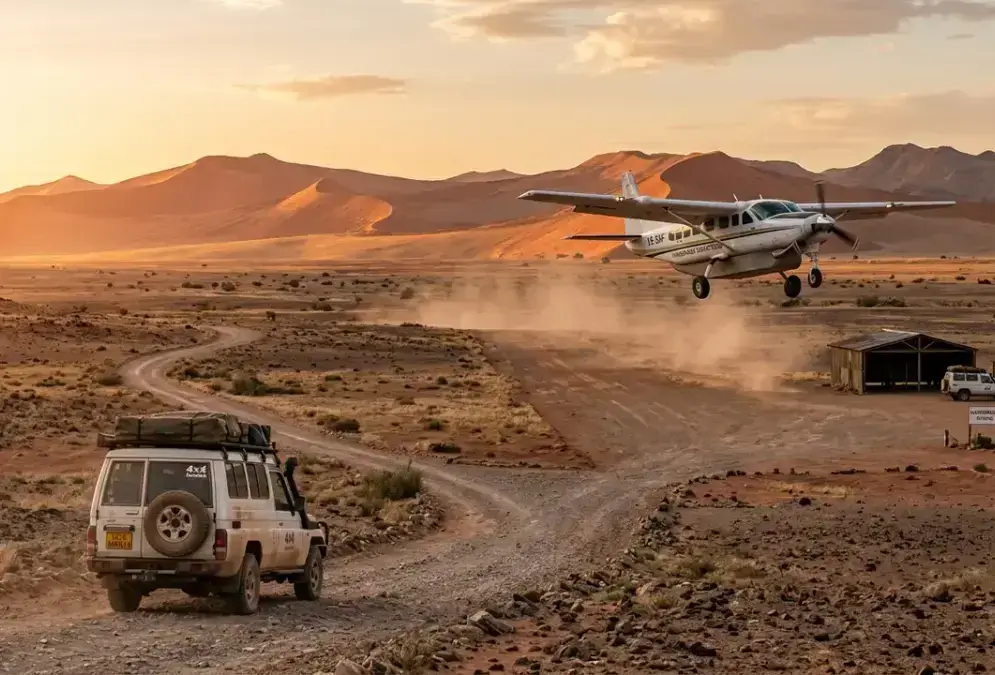

Windhoek's Hosea Kutako Airport: the only way in
Every trip to NamibRand starts at the same building, whether you're booked on a private charter or renting a 4x4 for the drive. Hosea Kutako International Airport (WDH), about 45 km east of Windhoek, is Namibia's main international gateway, and for a trip to NamibRand there's no way around it: nothing lands closer to the reserve itself.
Clearing immigration here takes more planning than it used to. As of April 2025, US citizens and most other Western passport holders need a visa to enter Namibia: either an eVisa arranged in advance, or a tourist visa on arrival at major entry points including Hosea Kutako. The stay granted on arrival defaults to 30 days; longer stays, up to 90 days, are possible but sit at the immigration officer's discretion rather than being automatic[1]. The passport itself is the part worth double-checking before you fly. Immigration expects at least six months of validity remaining past your entry date, a minimum of three blank pages for entry and exit stamps, and a valid return ticket[2]. None of that is unusual for international travel, but NamibRand's remoteness means there's no consulate nearby to fix a shortfall once you're this deep into the Namib.
From the arrivals hall, the real decision starts for anyone heading into NamibRand Nature Reserve. Guests on a lodge charter head for a small private-aviation terminal a short walk from the main building. Everyone doing this by road heads for a rental-car counter instead, and from here the two routes barely resemble the same trip.
30 days
The charter flight: straight to a bush airstrip
Most guests staying at NamibRand's high-end lodges never see the self-drive route at all. Their transfer is arranged before they land: a lodge-arranged charter flight meets them at Hosea Kutako, or at Eros Airport closer to central Windhoek, and flies them directly to a private bush airstrip inside or beside the reserve.
Charter transfers like this are standard across NamibRand's fly-in lodges, including this concession-side lodge: your lodge arranges a short flight from Windhoek to a private bush airstrip near the property. Wilderness Air, the aviation operator behind several of Namibia's upscale lodge groups, runs this kind of routing with a fleet built for exactly this purpose: a 12-passenger Cessna 208B Grand Caravan suited to short bush strips, and a faster 5-passenger Cessna 210 kept for Namibia's longer sectors[3]. Which aircraft you board on any given charter depends on the airstrip and the size of your group, not anything you choose yourself.
What no operator publishes is a standalone fare for this specific leg. Charter pricing here runs bundled into the lodge's per-night rate rather than sold as a separate ticket. Ask your lodge directly what the transfer costs and how long the flight takes, and treat any figure quoted months ahead of your trip as an estimate rather than a locked-in fare, since it shifts by lodge, by airstrip, and by season.
Self-drive: the 4-6 hour gravel run from Windhoek
Skip the charter and you're committing to a genuine day of driving, most of it on gravel. The route south from Windhoek runs the B1, Namibia's main tarred highway, to Rehoboth, about 87 km, then turns southwest onto the C24 and climbs over Remhoogte Pass toward the C14 turn-off, another roughly 174 km, before a final 14 km stretch on the C14 into Solitaire[4]. That's about 275 km to Solitaire, and the tar ends at Rehoboth: everything past the B1 on this route is gravel[4].
Push on toward Sesriem, the gateway to Sossusvlei, and the total run from Windhoek stretches to roughly 345 km and about 5 hours[5]. Add whichever lodge access road leads into NamibRand itself from there, and the honest range most travelers land on is 4 to 6 hours door to door, depending on the exact property and how long you linger at Solitaire's bakery along the way.
Gravel driving here rewards restraint over confidence. Many drivers find these roads comfortable around 80 km/h on the better-maintained stretches, easing off toward 70 km/h on rougher ground, and the washboard corrugation that builds up on some sections can force speeds down to 50 km/h or slower[6]. A high-clearance 4x4 is the standard recommendation for this route, though a robust 2WD can manage it outside the wet season if you drive to the road's condition rather than the speed limit. Whatever you're driving, fill the tank in Rehoboth or Solitaire; nothing reliable sits between them. I've made this drive myself, and it's worth planning for as its own day, not a delay before the trip starts: the real cost of a NamibRand stay is the distance, more than anything on the lodge bill.
Why you can't drive yourself into NamibRand
Here's the detail that catches self-drivers off guard: reaching Solitaire or Sesriem under your own power doesn't get you into the reserve itself. Access to NamibRand Nature Reserve is restricted, and private vehicles are allowed only on specific lodge access roads or to designated pickup points[7]. Only 4WD vehicles belonging to NamibRand and its accommodation partners are permitted to drive within the reserve's boundaries, and no independent self-drive activity happens inside it at all[7].
Recommended tours
Tours are selected for quality, not commission. I earn a small fee if you book — at no extra cost to you.
In practice, your rental car's job ends at a pickup point arranged in advance with your lodge, not at some single named entrance the way Namib-Naukluft's Sesriem gate works for the dunes next door. There's no equivalent public checkpoint for NamibRand itself; access runs through individual lodge roads, not one shared gate. From that handoff point, a lodge vehicle takes over, and every activity inside the reserve, from game drives to the stargazing sessions themselves, runs through your accommodation rather than anything you booked or drove independently.
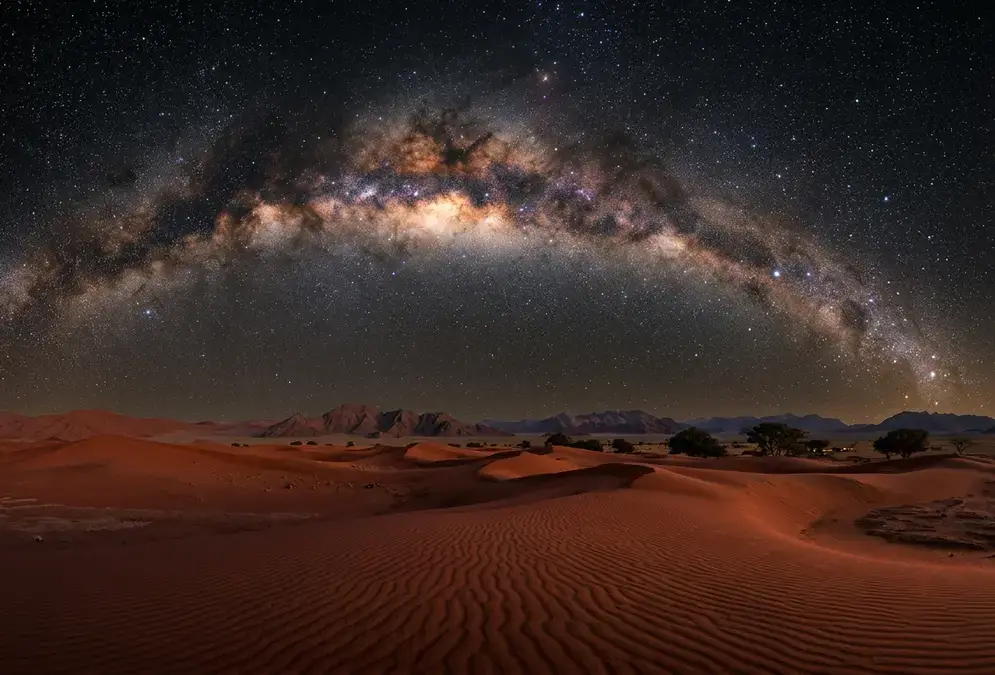
Featured · Destination
NamibRand Nature Reserve
NamibRand is Africa's only Gold Tier Dark Sky Reserve: extreme Namib Desert isolation, the Southern Cross, Magellanic Clouds, and luxury safari lodges.
Confirm your lodge's specific handoff arrangement before you leave Windhoek, not after you're already on the C14 wondering which turning is yours.
Charter or self-drive: which one actually fits your trip
Neither option is objectively better; they solve different problems. A charter removes the gravel-driving risk entirely and buys back most of a travel day, at the cost of running on your lodge's schedule and, typically, a higher price folded into the room rate. Self-driving costs more time and demands real attention through the C24 and C14, but it hands you a flexible itinerary: stop at Solitaire's bakery, detour to Duwisib Castle, or pull over at a viewpoint whenever you want, not whenever a flight schedule allows.
Budget and trip length usually settle the question. A short two-night stay barely survives a 4-6 hour drive each way, so a charter reclaims that time for the reserve itself. A longer Namibia circuit that already has a rental car booked for Etosha or Swakopmund makes the self-drive leg feel like part of the trip rather than a tax on it.
| Method | Typical time | Best for |
|---|---|---|
| Charter flight | Roughly an hour or so, plus a short lodge transfer | Short stays, avoiding gravel driving, time-poor itineraries |
| Self-drive | 4-6 hours from Windhoek to a lodge access road | Longer Namibia circuits, flexible stops, lower cost |
Before you fly: visa rules, timing, and pairing with Sossusvlei
Sort the paperwork before you sort the transfer. Confirm your passport clears the six-month validity and three-blank-page requirements well ahead of departure; there's no consulate to fix a shortfall once you're this deep in the Namib. Since April 2025, US passport holders and most other Western nationalities need a visa to enter Namibia, either an eVisa arranged ahead of the trip or a tourist visa issued on arrival at Hosea Kutako, with a default stay of 30 days rather than an automatic 90.
Build at least two to three nights into the NamibRand portion of the trip, whichever way you arrive. A single overnight barely covers the transfer time before you're heading back to the airstrip or the highway. Most itineraries pair the reserve with a sunrise run to Sossusvlei and Deadvlei next door in Namib-Naukluft National Park, easily reached from lodges such as this bordering property or Wolwedans Dunes Lodge. Check the moon phase before locking in dates too: When to Stargaze covers how a bright moon washes out the same faint detail here as anywhere else on this list.