
What a major lunar standstill actually is
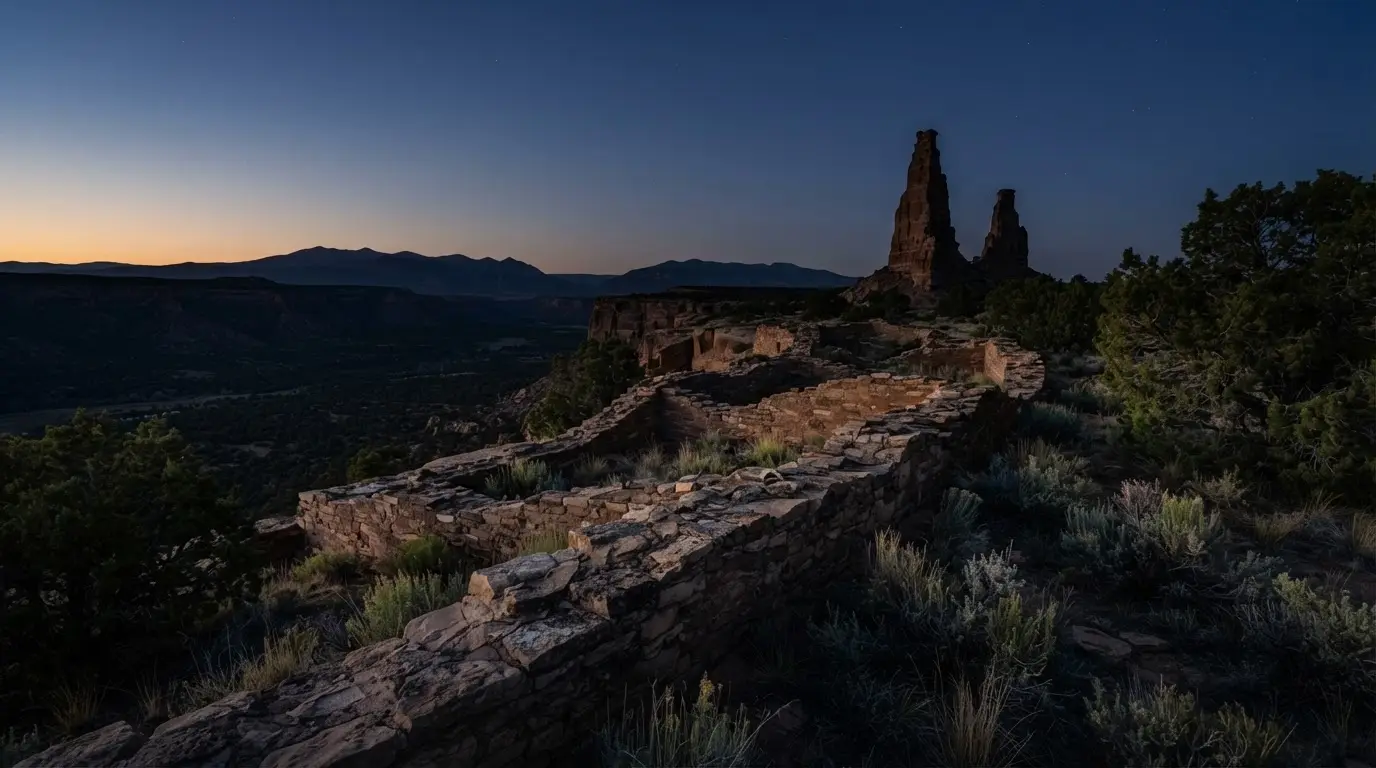
Chimney Rock's alignment is the northern major standstill. At the northernmost point of its multi-year journey the full moon rises between the two rock pillars,[5] and only someone standing near the Great House sees it framed that way, which some believe explains why the building sits where it does.[6] The same cycle also carries the moonrise to a far-southern limit,[7] but the spires belong to the northern one.
A standstill is about where the moon rises. The sun's rise point travels the horizon over a year, between its solstice limits, and the moon's does the same every month;[8] at a standstill the monthly extreme reaches its farthest point north or south. How long the window lasts depends on the account: the Forest Service says the rising is visible for a few days throughout the year over three years,[9] while the Cortez Journal describes monthly moonrises over about two years.[10]
The cycle takes 18.6 years,[11] because the moon's orbit is tilted against Earth's and the Sun's gravity swivels it.[12] The lunar nodes, the points where that orbit crosses the ecliptic, complete one turn in that time.[13] At a major standstill the two tilts add up to about 28.5°, the moon's most extreme inclination;[14] a minor standstill is the opposite limit, a monthly minimum of about 18.13° north or south.[15]
The payoff comes at sunset near the winter solstice, when the full moon rises between the stone pillars and is caught in a thin window of sky.[16] The event needs a full moon close to the December solstice as well as a standstill under way, a double coincidence that thins out the good nights.
The most recent standstill spanned 2022 to 2025, with its peak around the turn of 2024 into 2025.[4] One account puts the next peak near 2043[4] and another puts the moonrise's return at 2044[17], so plan for the early-to-mid 2040s and treat anything more exact as provisional. In between, the full moon calendar still decides which nights are dark.
Why a Chacoan Great House sits on this mesa
Chimney Rock was an outpost of the Chaco phenomenon, a network of far-flung communities linked by trade, politics and religion, with Chaco Canyon in New Mexico at its hub.[18] It is the highest of the Chacoan sites, at about 7,000 feet above sea level[19], and an architectural study concluded that its pueblo is clearly Chacoan, built by Chacoans or under their direction rather than imitated locally.[20]
More than 150 documented archaeological resources in eight clusters around the spires date to the Pueblo II period, from pit houses to great kivas and great houses.[21] The settlement housed about 2,000 people between AD 925 and 1125, and its Great House Pueblo had 36 ground-floor rooms plus round kivas[22], so this was a lived-in community, not a lookout post. The kivas were ceremonial rooms, which means religion was built into the village rather than bolted on.
Featured · Destination
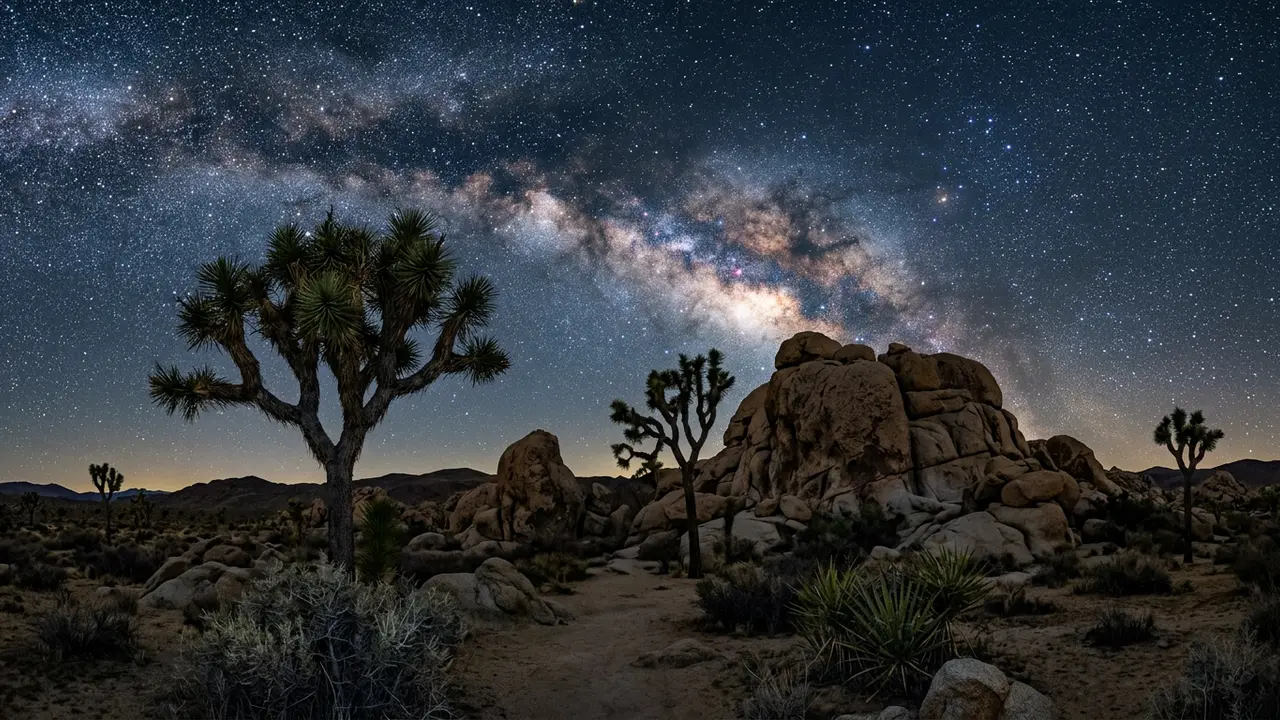
Joshua Tree National Park
Joshua Tree earned International Dark Sky Park status in 2017, just two hours from LA. Here's where to see the Milky Way, dodge crowds, and stay the night.
J. McKim Malville, an astrophysicist at the University of Colorado, worked out in 1987 where the moon would come up at a northern standstill, then showed it: between Chimney Rock and Companion Rock.[23] The order matters, because a prediction made before the observation is harder to dismiss than an alignment spotted afterward. The test came nearly nine centuries after the 1093 cutting date, which makes the result more striking, not less.
What the tree rings say, and where the argument starts
Dendrochronology supplies the hard dates. The Great House has been read mainly from one tree-cutting date, 1076, from the East Kiva ventilator and thirteen from 1093 in Room 8,[24] and both years correspond with major standstills.[2]
Researchers have read that evidence in three overlapping ways:
- Frank Eddy: a single planned build in 1076 by Chacoan priest-colonists, then a new roof in 1093.[3]
- Other researchers: construction in 1093.[3]
- J. McKim Malville: an observatory placed and built to match major standstills, backing the priests of Chaco Canyon's claim to hidden knowledge and power.[25]
Those two dates sit 17 years apart, a shade under one 18.6-year cycle, and one sample against thirteen is a lopsided base for a 1076 founding story. The near-match is tidy. Tidy is not proof.
Other wood dated to about 1018, another major-standstill year, and to 1011, a minor one, the low end of the same cycle.[26] Dates that keep landing on standstill years are suggestive, but a tree-ring date records when a tree was cut, never why.
What the alignment proves, and what it does not
Nobody disputes that the moon, the pillars and the Great House line up; the alignment has been calculated, surveyed and photographed.[27] Intent is the part that is unproven. Malville's case is that the Chacoans sited and built for it, and cutting dates alone cannot show that.
The setting offers one backdrop: a generation at the pueblo lived through wetter-than-normal conditions from 1060 to 1090[28], a spell that spans the 1076 date and ends just before 1093.
The Zuni are one of about 25 tribes with a cultural or traditional affiliation to Chimney Rock[29], a reminder that the archaeologists' dispute is not the only account of what the place means. Archaeoastronomy elsewhere hits the same wall: dated tomb inscriptions at Hegra cluster in certain months, and a pattern in the calendar still is not a motive.
Here is where I land. The alignment is a fact, the Chacoan authorship is a fact, and the intent is a hypothesis with a serious champion. A visitor can hold all three at once without picking a side, and the place is better for it.
Visiting Chimney Rock as a dark sky park
The park covers about 4,726 acres of federal land in the San Juan National Forest.[30] Chimney Rock sits in a sparsely developed valley close to the Colorado-New Mexico line, between Pagosa Springs and Durango, and its isolation gives it some of the darkest night skies in that national forest.[31] Remote is the selling point, and it is the one thing a single badly aimed floodlight can ruin.
Staff can run stargazing evenings, sunrise gatherings at the solstices and equinoxes, and meteor-shower nights timed to the Perseids.[32] Check the monument's current schedule before you build a trip around any of them.
Recommended tours
Tours are selected for quality, not commission. I earn a small fee if you book — at no extra cost to you.


An activity pass is required for every vehicle, at $20 per car or $10 per motorcycle, and it covers five days of access.[33] Do not expect the old fire lookout tower to serve as a viewing platform: it came down in 2010, partly because it blocked astronomical alignments from the Puebloan structures.[34]
Featured · Article
What Is Light Pollution? Definition, Types, and Solutions
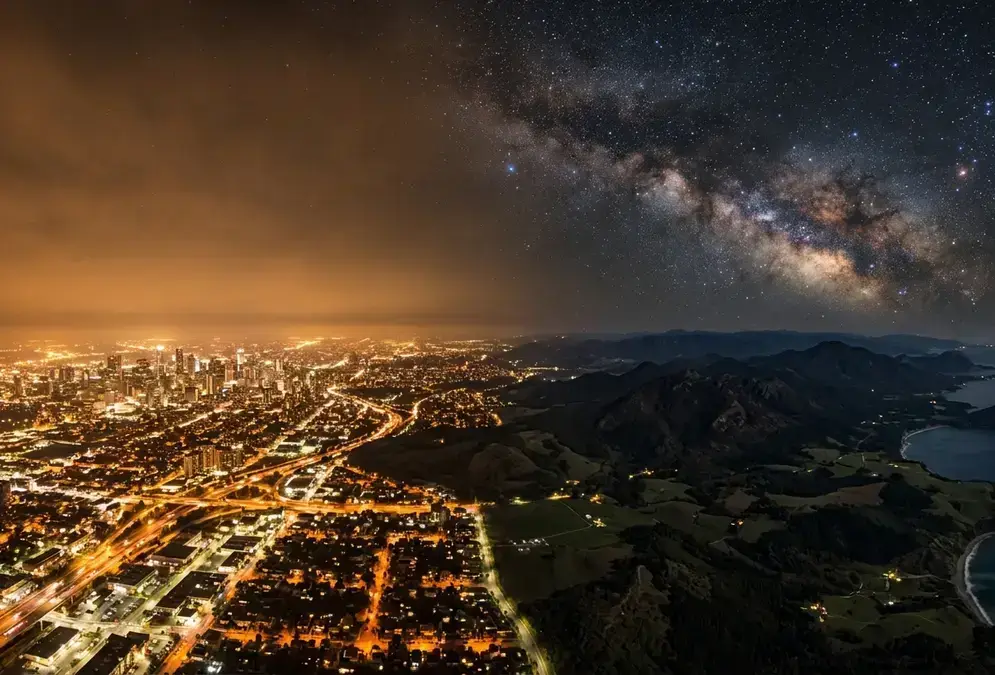
Light pollution is artificial light brightening the night sky, affecting 80% of the world. Learn the 4 types, wildlife and health effects, and how to fix it.
For comparison, the best dark sky parks in the world guide sets Chimney Rock's peers side by side, and Organ Pipe Cactus Dark Sky Park is another recent certification where it pays to check alerts before the drive.
Plan two different trips around two different moons: the new moon for the stars and, once the next standstill arrives, the full moon nearest the winter solstice for the pillars. Moon phase, season and weather trade off against each other in any best time to stargaze decision, and Chimney Rock is no exception. I would not wait for the 2040s to go.