
A month that keeps showing up in stone
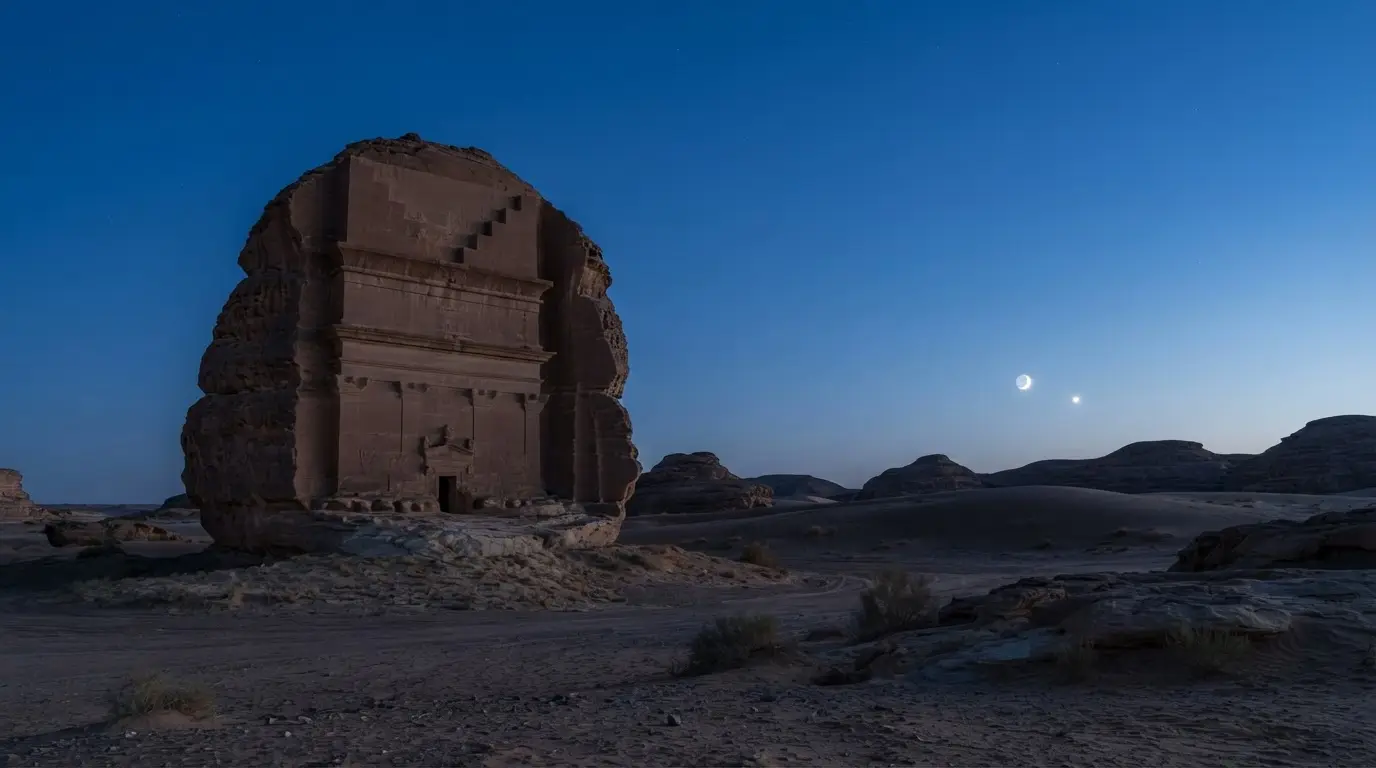
Hegra, the southern twin of Petra and now a UNESCO World Heritage site in Saudi Arabia's AlUla region, holds 111 monumental tombs, 94 of them carved with facades[3]. Of the more than 80 largest tombs, only 22 carry foundation-date inscriptions recording when the dedication took place[1]. Seven of the twelve months on the Nabataean calendar appear across those 22 texts, but four repeat, and Nisan dominates: it names eight of the 22[1].
Run the numbers and the odds of that happening by chance drop under 2 percent; Iyyar and Thebet, the next most frequent, sit closer to 17 percent each[1]. Archaeoastronomers Juan Antonio Belmonte and César González-García, who first ran that calculation, flagged one honest complication: no dated Hegra tomb names the month Tishri at all, and they can't explain why[4].
What the calendar was actually tracking
The favored months line up with the Nabataean sky in a way that looks too neat to be coincidence. Nisan was, on the researchers' reading, likely the first month of the year and the one containing the vernal equinox. Iyyar sometimes marked the year's first visible lunar crescent. Thebet was most likely the lunar month holding the winter solstice[5].
Belmonte and González-García are careful with their language, and it's worth keeping that same care: the epigraphic evidence "strongly suggests" these months mattered within the Nabataean cultic calendar, not that it proves an alignment[5]. The calendar itself was lunisolar, tracking the moon month to month while pinning the whole cycle to the solar year, the same basic problem every ancient calendar-keeper from Babylon to Rome had to solve.
The habit of dating dedications this precisely wasn't new by the time Hegra's tombs went up. The oldest known dated Nabataean inscription anywhere, a betyl dedication to Dushara at Petra, goes back to 96/95 BCE[6]. Modern visitors planning when to go stargazing in AlUla still work around the same equinox and solstice math, just for very different reasons.
The gods the calendar answered to
Behind the calendar sits a pantheon that mixed the certain with the disputed. Al-Uzza, whose name means "The Most Powerful," was identified with the planet Venus, usually as the Evening Star, a reading corroborated independently by the fourth-century writer Jerome, who reported that Nabataean worshippers honored her as the Morning Star[7]. Archaeologists have found a betyl, an unshaped stone block standing in for a divine image, dedicated to Al-Uzza at Hegra itself, set alongside a second betyl for "the lord of the Temple" into a mountain sanctuary[8].
Dushara is a harder case. His name means "the One of Mount Shara," a geographic epithet with nothing obviously celestial about it, and only a single inscription, describing him as "the one who separates night from day," hints at an astral role at all. From that one line, scholars have proposed Venus, Mercury, or the sun as his sky identity, without settling on one[9]. The strongest evidence for a solar Dushara comes from Epiphanius of Salamis, a fourth-century Christian writer who described a winter-adjacent birth festival for Dushara at Petra and at Elusa, in the Negev, on the 6th of January[10]. That festival is documented at Petra and Elusa, not at Hegra[10].
Featured · Destination
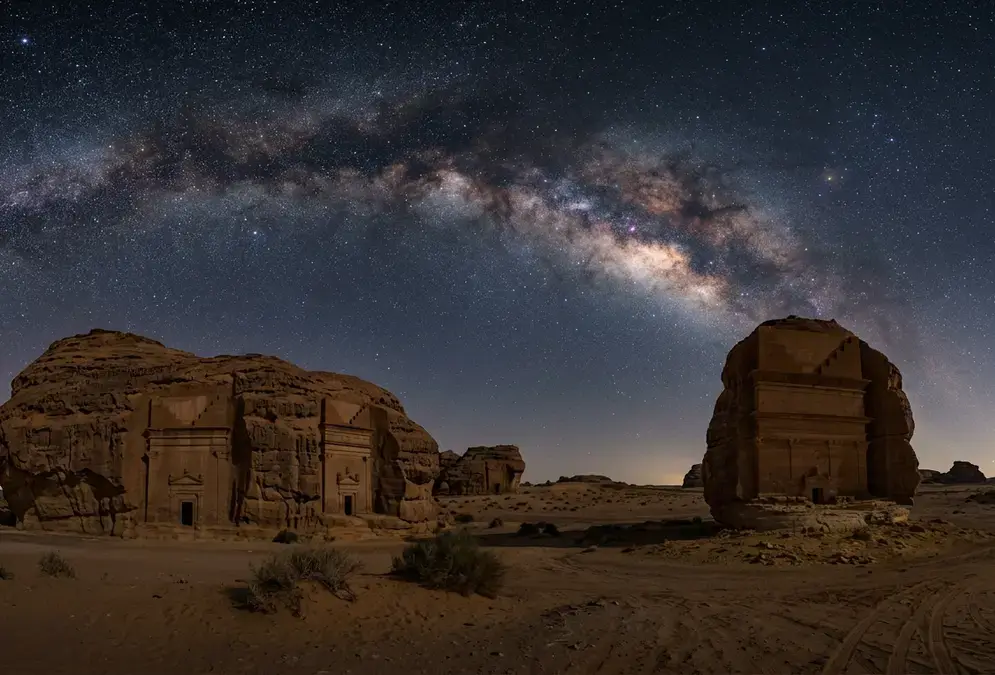
AlUla Stargazing
Stargaze above Hegra's 2,000-year-old Nabataean tombs in AlUla, the Gulf's first DarkSky-accredited Dark Sky Park. When to go, where to stay, and how to plan.
A third figure, Al-Qaum, ruled the night itself. Accounts of his cult describe him as a war and caravan god who "protected the souls of the sleepers in the form of stars, accompanying them on their nightly journey through the heavenly realms, as well as guiding caravans in the desert by means of the stars"[15].
What Hegra's own stones preserve is a curse, not a festival. Tomb inscriptions there regularly invoke Dushara alongside a goddess named Manatu, warning would-be violators, and Manatu may have carried a lunar association of her own[11]. The same pantheon reappears elsewhere in the Nabataean world, including at Wadi Rum's own Nabataean religious sites, further north.
The survey that finally checked
For years, the calendar clustering was the only evidence anyone had. Belmonte and González-García admitted as much in 2017, writing plainly that serious archaeoastronomical fieldwork at Hegra hadn't been done and calling it "one of our group's dreams"[12]. Petra had already been mapped for solstice and equinox light effects at monuments like the Monastery and the Lions' Triclinium. Hegra had nothing comparable.
That changed in February 2023, when a Royal Commission for AlUla-backed team measured the orientation of 113 tombs and sanctuaries at Hegra, including every monumental one, the largest set of Nabataean tombs ever analyzed this way[2]. Published in 2024, the results state that the tombs "were not randomly orientated but followed a series of patterns" aimed, the paper argues, mainly at what the sky showed from each tomb, and only sometimes at the surrounding land[13].
One example from the survey's notes: Qasr Al Sani', a tomb dated to 8 AD and dedicated, fittingly, in the month of Nisan, was found cardinally oriented due north. It was built for a man named Malkayun AlArraf, described in his own inscription as a fortune teller, presumably, the survey authors note, an astrologer[14].
What the stones still don't say
The 2023 survey answers the question Belmonte and González-García couldn't in 2017, but it doesn't answer everything. The full results table, showing every tomb's measured orientation and which point on the horizon it targets, stays behind a paywall; only the pattern and the one named example have surfaced so far. Nothing published so far claims Hegra's tombs align to a solstice sunrise or a named star the way some structures at Petra do.
Dushara's own nature is still argued over: mountain god, sun god, or something the Nabataeans never separated so cleanly. What's firmer is the shape of the habit. People who cut Nabataean tombs into sandstone kept choosing the same handful of months to do it, and a calendar built around the sun and moon is the most straightforward reason why. Readers who go looking for Hegra's own dark skies today are, without realizing it, watching the same equinox and solstice the tomb-builders once timed their work around, and AlUla's modern astrotourism push exists to make that easier, not to explain what it once meant.
Featured · Article
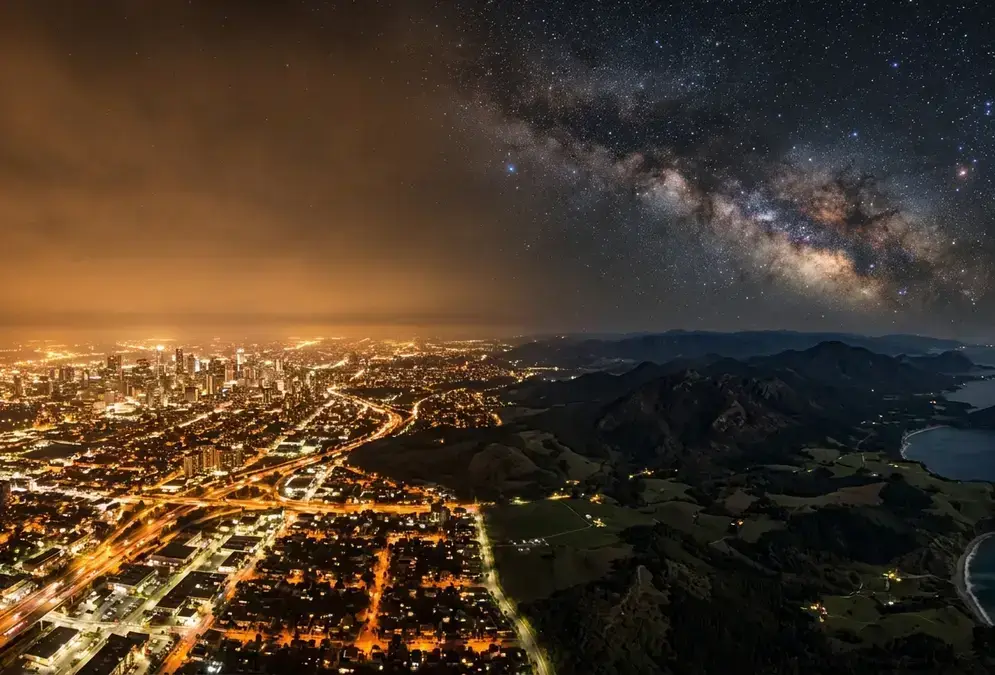
What Is Light Pollution? Definition, Types, and Solutions
Light pollution is artificial light brightening the night sky, affecting 80% of the world. Learn the 4 types, wildlife and health effects, and how to fix it.