
What Is Light Pollution?
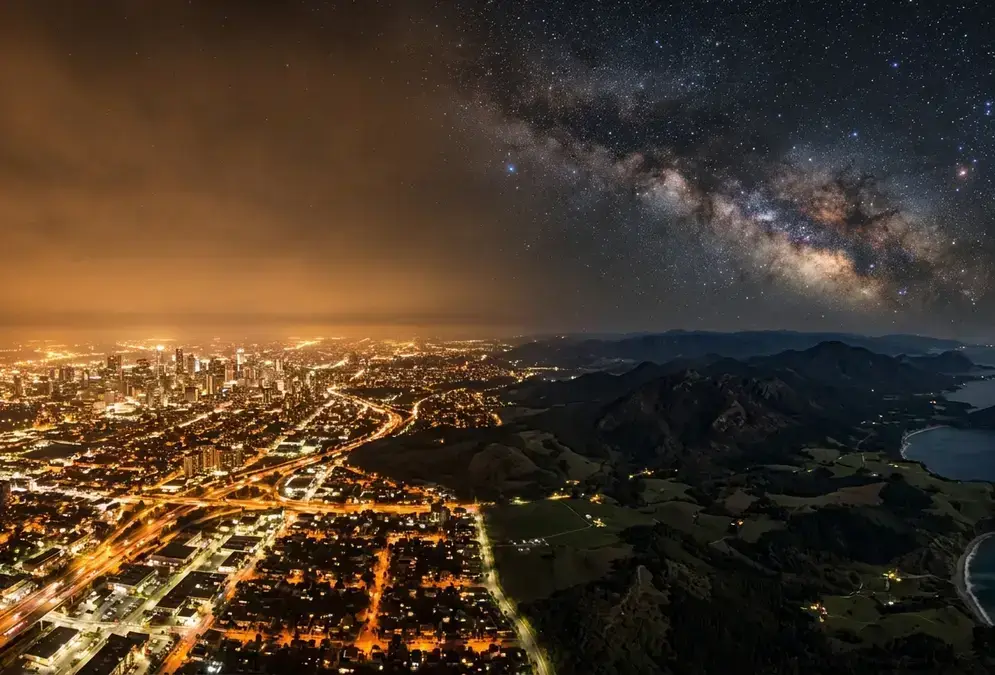
Light pollution is the human-made alteration of outdoor light levels from those occurring naturally[1]. In plain terms, it is artificial light where it does not belong and when it is not needed. The concept of light as a pollutant took decades to gain traction because light, unlike smog or raw sewage, doesn't look dirty. But the 2016 World Atlas of Artificial Night Sky Brightness changed that, quantifying the problem across every continent for the first time.
Scientists classify light pollution into four distinct components, each with its own physical cause and a different fix. You can see all four on a single drive from a rural observatory through suburbia into a downtown core. For anyone new to why dark skies matter, stargazing for beginners explains what you gain when you get away from them.
- Glare is excessive brightness that causes visual discomfort. An unshielded streetlight shining directly into your eyes reduces visibility rather than improving it, the opposite of what lighting is meant to do
- Sky glow is the brightening of the night sky over populated areas, the orange or gray dome you see from miles outside a city. It is caused by light that escapes upward from streetlights, parking lots, and buildings, scattering off particles in the atmosphere
- Light trespass occurs when light spills where it is not intended, a neighbor's security floodlight through your bedroom window, a billboard illuminating a quiet side street
- Clutter refers to bright, confusing groupings of light sources, the visual noise of signs, commercial strip lighting, and competing storefronts that make it hard to focus on anything
Why Glare Is a Safety Problem, Not a Feature
Many cities install bright unshielded lights believing they improve road safety and deter crime. The evidence says otherwise. Glare reduces contrast perception, making pedestrians and obstacles harder to see, not easier. A fully shielded fixture that directs light downward onto the road surface gives drivers better visibility with less total power than a bare bulb that blinds them.
Sky Glow: the Most Widespread Component
Sky glow is what most people mean when they talk about light pollution. It is the reason the Milky Way has become invisible to roughly one-third of the U.S. population and most Europeans. Why the Milky Way is disappearing worldwide traces that same loss on a global scale, from a permanently lit Singapore sky to the 1994 Los Angeles blackout that briefly gave the city its stars back. Even on a clear night in a major city, you might count a few dozen stars. At a true dark-sky site, the same sky holds thousands. The difference is entirely sky glow, caused by upward-directed light from hundreds of square miles of urban and suburban development.
What Causes Light Pollution?
Light pollution sources are everywhere artificial light is aimed upward or left on without purpose. The largest contributor is street lighting, but it is far from the only one. Building facade lighting, advertising billboards, parking lot floods, stadium and sports-field lights, commercial greenhouses, and increasingly, satellite constellations like Starlink all add to the collective glow[3].
The scale of the problem only became clear with the 2016 World Atlas, which found that 80 percent of the world's population lives under light-polluted skies[4]. In the United States and Europe, the number rises to 99 percent[4], meaning virtually no one in those regions experiences a natural night. The same study warned that unless blue-light emissions are restricted, the ongoing transition to LED technology could produce a 2- to 3-fold increase in sky glow on clear nights[5]. LEDs are more energy-efficient, but the cooler color temperatures widely installed (4000K and above) emit far more blue light, which scatters more in the atmosphere. Among G20 countries, Italy and South Korea rank as the most light-polluted by area, while Canada and Australia have the least[5].
80%
Streetlights: the Biggest Contributor
Poorly designed or unshielded streetlights are the single largest source of light pollution in most communities. Older cobra-head fixtures emit light in all directions, including straight upward, wasting energy and creating glare. The municipal shift to LED streetlights has brought a new problem: many cities installed 4000K and 5000K fixtures, which produce a harsh blue-white light that scatters in the atmosphere and disrupts melatonin production in humans and wildlife.
Commercial Lighting, Advertising, and Greenhouses
Parking lot lights, illuminated billboards, and building facade lighting are often vastly overlit, left on all night with no timers or occupancy sensors. Sports stadium floodlights can be visible from miles away. In rural areas, the expanding use of artificial light in greenhouse agriculture for year-round crop production is an emerging source that few light-pollution maps capture well. Greenhouse glow is intense enough in parts of the Netherlands and southern Spain to be visible from space.
Satellite Constellations: the New Frontier
Large satellite constellations reflect sunlight and, in some cases, emit their own radio and optical light. The streaks they leave across long-exposure astrophotography frames can ruin data for professional observatories and amateur photographers alike. While not yet the dominant source of sky brightness, satellite megaconstellations represent a growing fraction of the artificial light and radio noise in the night sky, one that existing outdoor-lighting ordinances were never written to address.
How Light Pollution Affects Wildlife and Ecosystems
Artificial light at night disrupts nearly every level of the biological chain, and the evidence grows with each new study. The species most visibly affected are those whose behavior evolved around natural darkness, a category that turns out to include far more animals than most people realize[6].
Migratory birds navigate partly by starlight. When they encounter brightly lit buildings, especially during spring and fall migration, they become disoriented. Some circle exhausted until they drop; others collide with glass. A single illuminated skyscraper can kill hundreds of birds in one night during peak migration. In cities that have adopted Lights Out programs, turning off or dimming building lights during migration season, recorded bird fatalities have dropped measurably. At NamibRand Nature Reserve, where every partner lodge commits to strict lighting rules as a condition of operating inside the reserve, the darkness does double duty: it protects both the stargazing experience and the desert-adapted nocturnal wildlife that depends on it.
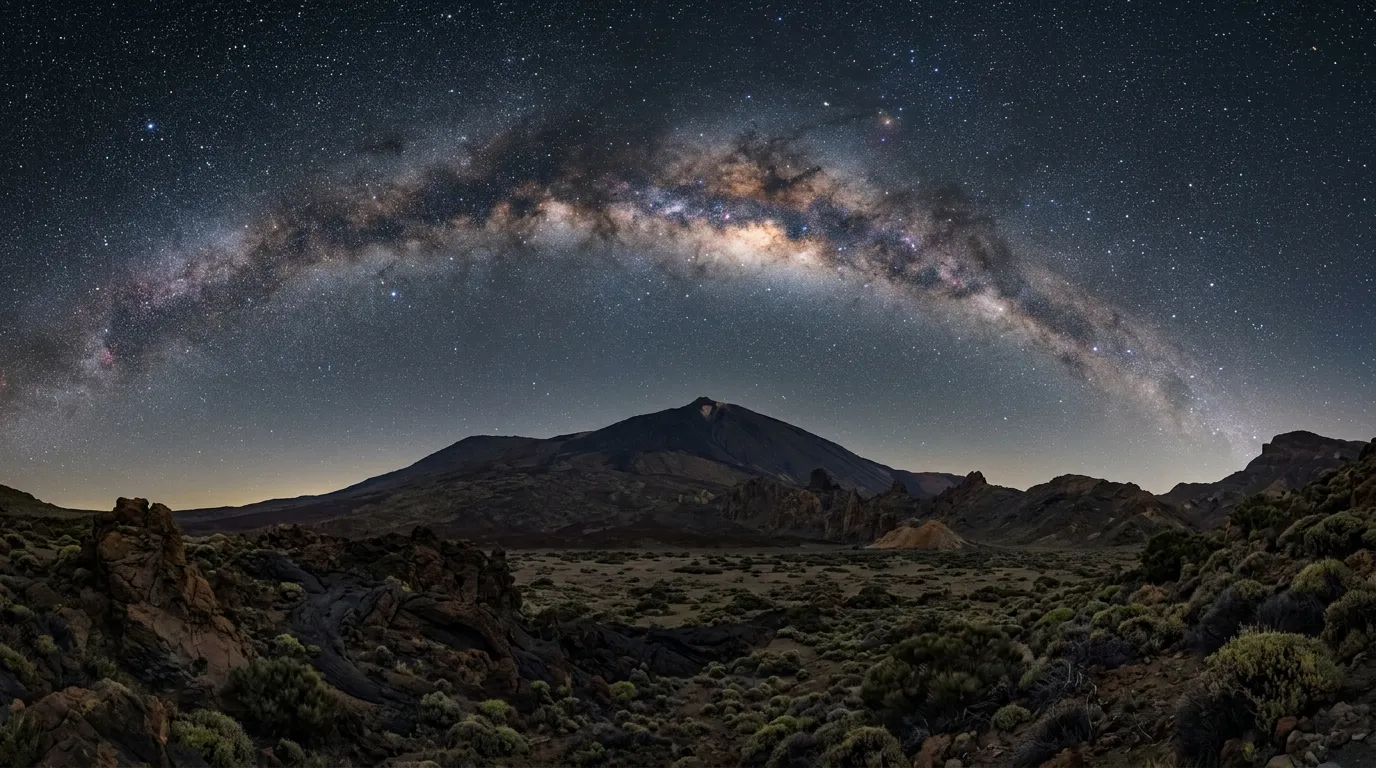
Featured · Destination
Tenerife Stargazing
Tenerife stargazing guide: Teide National Park's UNESCO Bortle-2 skies, 83 constellations visible. Observatory visits from €21, Parador hotel, and best tours.
Sea turtle hatchlings face an equally stark problem. They instinctively head toward the brightest horizon, which for millions of years meant the ocean reflecting starlight. Today, beachfront hotels and streetlights pull them inland instead, where they die of dehydration or predation. Coastal communities in Florida and the Caribbean have begun replacing beachfront lighting with amber or red narrow-spectrum LEDs, which are far less disruptive to turtles while still providing safety lighting for humans.
The damage extends to creatures most people never think about. Nocturnal pollinators like moths fail to feed or reproduce under artificial light, which cascades into reduced plant pollination. A 2024 study suggests lamps disorient flying insects rather than attract them, which why moths circle lights walks through. Nocturnal mammals from bats to desert rodents alter their foraging patterns. Even biological soil crusts in arid environments, communities of lichens, mosses, and cyanobacteria that stabilize desert soil and take decades to form, are disrupted by nearby artificial light at night[8].
The Poster Species: Birds and Turtles
Migratory birds and sea turtle hatchlings are the two most-studied cases of light pollution's wildlife impact, and the patterns are now well-documented. Lights Out programs, active in dozens of U.S. and Canadian cities, ask building owners to dim or switch off nonessential exterior and interior lights from midnight to dawn during migration months. For sea turtles, the solution is even more straightforward: replace bright white beachfront lighting with long-wavelength amber or red light, install full-cutoff shields, and turn lights off during hatching season. These interventions work immediately.
The Hidden Chain: Pollinators, Mammals, and Soil
What happens at the insect level may turn out to be the most consequential effect of light pollution. Moths, the primary nocturnal pollinators in many ecosystems, are drawn to artificial light and away from flowers, reducing pollination rates. Bats, which feed on moths, alter their flight paths to follow light corridors, changing the distribution of insect populations. In desert environments, even biological soil crusts, the dark, knobby crust that holds sand together, are disrupted by artificial light, with consequences for soil stability and nitrogen fixation that researchers are only beginning to measure.
The Human Toll: Health and Heritage
Light at night does not only affect animals. The human circadian rhythm, the internal biological clock that regulates sleep, hormone production, and metabolism, runs on a roughly 24-hour cycle calibrated by natural light exposure. Exposure to artificial light at night, particularly blue-wavelength light, suppresses the production of melatonin, the hormone that signals your body it is time to sleep[7].
This disruption has been linked to sleep disorders, reduced cognitive performance, and, in long-term shift-work populations, elevated risk for certain chronic conditions. The scale of the problem is staggering: 99 percent of people in the United States and Europe cannot experience a natural night[4], which means the biological signal of true darkness has been functionally erased from daily life across the developed world. The American Medical Association issued formal guidance in 2016 warning that high-color-temperature LED street lighting (4000K and above) poses health and environmental risks and recommending that communities install lighting no higher than 3000K correlated color temperature (CCT) for outdoor applications.
“More than 80 percent of the world's population lives under light polluted skies. In the United States and Europe, 99 percent of the public can't experience a natural night.”
Beyond health, light pollution represents a cultural loss with no precedent in human history. For most of the hundreds of thousands of years Homo sapiens has existed, the night sky was visible to everyone, a universal source of navigation, storytelling, and agricultural calendars. Aboriginal Australian songlines, Polynesian wayfinding, and the star-based agricultural timing of ancient civilizations from Egypt to Mesoamerica were all built on a sky that no longer exists for the majority of people alive today. The 2016 World Atlas authors described this as humanity enveloping our planet in a luminous fog that prevents most of Earth's population from having the opportunity to observe our galaxy[5]. A child born in a major city today may reach adulthood without ever seeing the Milky Way.
How Blue Light Disrupts Sleep
The biological mechanism is well-established. Melanopsin, a photopigment in retinal ganglion cells, is most sensitive to blue light wavelengths around 480 nanometers, precisely the spectrum that cool-white LEDs emit in abundance. When melanopsin detects blue light, it signals the suprachiasmatic nucleus in the brain to suppress melatonin and shift the body toward a daytime alertness state. This is why sleep specialists recommend avoiding phone and tablet screens before bed. The same blue wavelengths that degrade your sleep indoors are scattered through the atmosphere by unshielded streetlights and billboards outdoors, affecting entire neighborhoods rather than just a single bedroom.
What We Lose When the Stars Disappear
The cultural argument for dark skies is harder to quantify than a melatonin measurement, but it is equally real. Every human society before the electric era built stories, rituals, and practical knowledge around the stars. The loss is not sentimental. It is a break in a chain of human experience that stretches back to our earliest ancestors. Dark-sky advocacy groups increasingly frame their work in terms of cultural heritage preservation rather than just astronomy, a shift that has helped night-sky protection gain political traction in places where telescope tourism alone was never going to be enough.
Measuring the Night Sky: the Bortle Scale and More
You cannot fix what you do not measure, and light pollution has several measurement systems that range from a simple naked-eye scale you can use tonight to satellite instruments orbiting overhead.
The Bortle Dark-Sky Scale, developed by amateur astronomer John E. Bortle and published in Sky & Telescope in 2001, ranks sky darkness on nine levels from Class 1 (excellent dark sky, the Milky Way visible in sharp detail, zodiacal light and airglow clearly present) to Class 9 (inner-city sky where only the Moon, planets, and the very brightest stars are visible)[8]. It remains the most practical system for stargazers because it requires no equipment: you compare what you see to Bortle's descriptions and assign a class.
| Bortle Class | Sky Description | SQM Reading | What You Can See |
|---|---|---|---|
| 1 | Excellent dark sky | 21.7–22.0 | Milky Way casts shadows; zodiacal light, gegenschein, and airglow all visible in detail |
| 4 | Rural/suburban transition | 20.4–21.3 | Zodiacal light visible but not striking; Milky Way complex but less detailed; clouds appear brighter than sky |
| 7 | Suburban/urban transition | 18.0–18.9 | Milky Way invisible; sky grayish-white; only the brightest stars and planets clearly visible; clouds brightly lit |
| 9 | Inner-city sky | Below 17.5 | Only the Moon, planets, and brightest stars visible; entire sky brightly lit; Pleiades invisible to naked eye |
For quantitative measurement, the Sky Quality Meter (SQM) is a handheld device that reads night sky brightness in magnitudes per square arcsecond. A reading of 22.0 represents pristine dark sky; 16.5 is a bright city center. The 2016 World Atlas was calibrated using data from SQM devices at 20,865 individual locations around the world[5], with citizen scientists contributing about 20 percent of that calibration data through programs like Globe at Night. For a practical example, the core of the Atacama Desert in Chile regularly posts SQM readings above 21.9, putting it at Bortle Class 1 and making it one of only a handful of places on Earth where professional observatories can operate at their designed limits. Before you head out with your own meter expecting to match that exact 21.9, how sky darkness actually gets measured is worth reading first, since moonlight, the Milky Way's own glow near the zenith, and even the specific SQM model in your hand can each move the number.
From space, the VIIRS (Visible Infrared Imaging Radiometer Suite) instrument aboard the Suomi NPP satellite was the first sensor designed specifically to measure artificial night lights globally, and its data formed the backbone of the 2016 World Atlas[5]. VIIRS measures upward-directed light only, so it undercounts the light that scatters horizontally, but it remains the best global dataset available.
For amateurs, Globe at Night is a citizen science project that asks participants to compare their view to star charts and report which stars they can see from their location[1]. The project has collected hundreds of thousands of observations and directly feeds the global light-pollution maps that researchers and policymakers use. You can participate in fifteen minutes from your own backyard.
The Bortle Scale in Practice
Bortle's nine classes attach specific, observable criteria to each level. At Class 1, the zodiacal light is visible as a distinct pyramid of light along the ecliptic, and the Milky Way region near the galactic center casts faint shadows. At Class 4, the sky near the horizon shows a grayish glow, the Milky Way is still visible overhead but less structured, and clouds appear brighter than the surrounding sky. By Class 7, the Milky Way is invisible, the sky is grayish-white, and even moderately bright stars are hard to pick out through the glow. At Class 9, the inner-city limit, only the Moon, the brightest planets, and a few dozen stars break through the brightly lit dome. Most suburban stargazers live somewhere between Class 5 and Class 7, close enough to a city that a 30-minute drive toward the rural edge can drop them a full Bortle class.
Technology Meets Citizen Science
The SQM and VIIRS satellite give you numbers; Globe at Night gives you a picture built by thousands of ordinary people looking up. Combined, they form a measurement stack: satellite data covers the whole planet at coarse resolution, SQM readings provide ground-truth calibration at specific sites, and citizen science fills the gaps. If you want to contribute, Globe at Night runs monthly campaigns where you match your sky to one of seven magnitude charts and submit your observation online. A single SQM-L device costs over a hundred euros and is the standard tool for serious dark-sky site assessment.
Solutions: Light Pollution Is Reversible
Light pollution is unlike air or water pollution in one critical way, it stops the moment you shut off the source. The sky above a properly lit neighborhood looks the same tonight as it would have fifty years ago. No cleanup crew, no decades-long remediation, just smarter choices about how, when, and what color of light to use.
DarkSky International and the Illuminating Engineering Society jointly published the Five Principles for Responsible Outdoor Lighting[11], which together form the closest thing to a universal standard for dark-sky-friendly lighting:
- Useful: Every light should have a clear purpose. If you cannot name what a fixture is illuminating, it should not be on
- Targeted: Light should be directed only where it is needed, using full-cutoff shielding that prevents any light from escaping above the horizontal plane
- Low Level: Light should be no brighter than the task requires. Most outdoor areas are overlit by a factor of two or more
- Controlled: Use timers, dimmers, and motion sensors so lights operate only when needed. A motion-activated light is more effective for security than one burning all night
- Warm-Colored: Limit blue-violet light. DarkSky recommends 3000K CCT or lower for outdoor lighting, with 2700K or 2200K preferred wherever possible
At the community level, the International Dark Sky Places (IDSP) program certifies parks, reserves, communities, and sanctuaries that demonstrate a real commitment to night-sky protection through responsible lighting and public education[12]. More than 200 sites worldwide now carry the designation. A certified dark sky park commits to a lighting management plan, regular monitoring, and interpreted night-sky programming, a standard substantially higher than a patch of dark open land with no lights nearby. Communities can also adopt local lighting ordinances that mandate shielding, set maximum brightness and color temperature limits, and restrict commercial lighting hours.
Recommended tours
Tours are selected for quality, not commission. I earn a small fee if you book — at no extra cost to you.


At the individual level, the steps are straightforward and cheap. Every one of them works the night you implement it. Dark sky etiquette covers the behavioral side, how to share a dark site without ruining it for others, but the hardware side is even simpler.
- Assess your home's outdoor lighting. Walk outside at night and look at each fixture. If you can see the bulb directly, it is unshielded
- Replace unshielded fixtures with full-cutoff units that direct light downward
- Swap cool-white bulbs (4000K and above) for warm-white bulbs (2700K or 3000K)
- Add a motion sensor or timer to any light currently left on from dusk to dawn
- Close curtains and blinds at night, indoor light escaping through windows contributes measurably to sky glow
- Join a citizen science monitoring effort like Globe at Night or your local astronomy club's light-pollution survey
None of this requires giving up outdoor lighting for safety or aesthetics. A shielded, warm-toned, motion-activated fixture provides better visibility with less glare than a bare floodlight, and it does not spill upward into a sky someone else is trying to use.
The Five Principles, Explained
The Five Principles work because they target the physical mechanism of light pollution, upward-directed light, rather than asking for universal darkness. A fully shielded fixture that points every lumen at the ground is brighter and more useful at 50 watts than an unshielded fixture at 150 watts that scatters half its output sideways and up. The color temperature recommendation is equally grounded in physics: blue light scatters roughly four times more in the atmosphere than amber or red light of the same intensity. Choosing 2700K over 5000K for a streetlight cuts its contribution to sky glow by a factor that is immediately measurable with an SQM.
Where International Dark Sky Places Fit In
The IDSP program is more than a plaque. Certification requires a lighting management plan, an inventory of every fixture on the property with a timeline for retrofitting, regular sky-quality monitoring, and a public education component. The program has five tiers: International Dark Sky Parks (publicly accessible protected land), Reserves (core dark zone surrounded by a populated periphery that agrees to lighting rules), Sanctuaries (the most remote, often privately owned sites), Communities (towns and cities that adopt dark-sky-compliant ordinances), and Urban Night Sky Places (municipal sites that create accessible stargazing within an otherwise light-polluted setting). A certified site can lose its designation if it fails a review, so the badge is inspected, not just claimed.
Three Things You Can Do Tonight
Walk outside and look at your home's exterior lights. If any fixture lets you see the bulb directly, it is contributing to sky glow. Swap the bulb for a warm-toned LED (2700K) and install a simple screw-on shield if the housing allows it. On a motion sensor, a light that activates only when someone approaches is more alarming to an intruder than one that glows all night, and it uses less electricity. Finally, step onto a dark street and look up. Count the stars you can see. Then do the same experiment from a rural site thirty minutes away. The difference between the two numbers is the light pollution you can personally reduce.