What a Light-Pollution Reading Actually Measures
Every number in this article is the same unit under a different name: magnitudes per square arcsecond, usually written mag/arcsec² or mpsas. A reading of 20.00 means the sky itself is putting out light equivalent to a 20th-magnitude star spread evenly across one square arcsecond of that patch of sky. It measures how bright the sky is glowing, not how many stars you can pick out in it.
The scale is also inverted and logarithmic, which is the part that trips up almost everyone the first time they see a number. A lower reading means a brighter sky, not a darker one: each whole magnitude drop represents roughly 2.5 times more light coming from that patch of sky, and a difference of 5 mag/arcsec² is a 100-fold difference in actual brightness[1]. A city sky reading 18 and a park reading 21 aren't "3 points apart" in any everyday sense: they're closer to 15 times apart.
In practice, readings cluster in a narrow, predictable band: around 16 mag/arcsec² for bright urban skies, and around 22 for the darkest skies on Earth[2]. Very few places anywhere measure above 22. If an operator quotes you a number outside that range, it's worth checking that figure against what light pollution actually is before you take it at face value.
That matters most when you're comparing marketing copy. A lodge advertising "incredibly dark skies, SQM 21" sounds similar to a reserve advertising "SQM 21.5," but the half-point gap is a real, visible difference in how sharply the Milky Way's dust lanes stand out overhead, not a rounding error.
None of that tells you anything about what the sky actually looked like on the one night you were there, which is where the rest of this gets interesting: the same patch of sky can read differently depending on what instrument you point at it, and where.
The SQM Family: Why the Lens Model Reads a Different Number
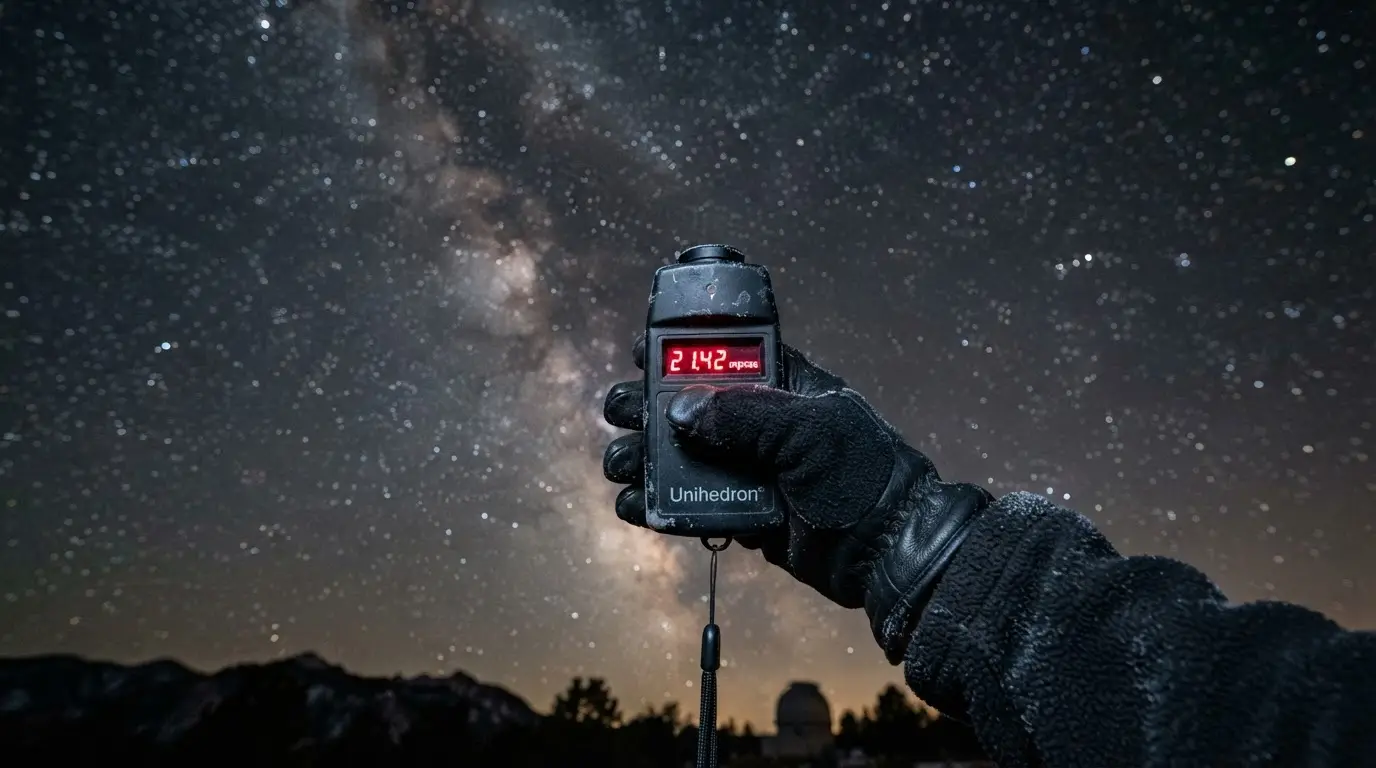
Point two different Unihedron meters at the same patch of sky and you can get two different honest answers, because they aren't measuring the same cone of sky. The standard SQM accepts light from a wide cone roughly 84° across; the SQM-L, which adds a lens, narrows that down to about 20°[3]. The lens version behaves closer to a spot meter: its Half Width Half Maximum runs roughly 10°, against roughly 42° for the standard model[4]. That narrower cone is what makes the SQM-L far less thrown off by trees, buildings, or a glow sitting low on the horizon.
The lens exists because the original SQM's wide cone was picking up far more of the sky than most users actually wanted measured. Aim the wide-angle original anywhere near a horizon glow or a stray porch light and the reading blends that glow into the same number as the zenith overhead; the SQM-L's tighter cone was built specifically to stop that from happening.
Neither version is a precision lab instrument, and Unihedron doesn't pretend otherwise: both models are calibrated to be pointed straight up, at the zenith[5], and nowhere else. Point one at the horizon, or at a light dome sitting low in the sky, and the reading means something different from what the spec sheet promises.
Most visitors never see a raw SQM number at all; they see it converted into a Bortle class, and the Bortle scale is worth understanding on its own before you trust that conversion. The two scales measure related things through different instruments, which is exactly why the conversion between them is an approximation and not a lookup table.
What Satellites Actually Measure From Orbit
The maps that show light pollution spreading across whole continents don't come from a handheld meter at all. They come from a satellite instrument called the VIIRS Day/Night Band (DNB), which records upward radiance at 15 arc-second resolution, roughly 500 meters at the equator[6]. It's also panchromatic, a single band built to be ultra-sensitive in low light rather than to tell one light source's color from another's[7]. That trade-off, sensitivity over color, is exactly why these maps are so good at showing where light is spreading and comparatively poor at showing what color it is, sodium orange versus LED white, once it gets there.
Feed that raw satellite data through a light-pollution propagation model, calibrate it against real ground-based sky-brightness measurements, and you get something like the World Atlas of Artificial Night Sky Brightness[8], the source behind the startling headline figures that circulate about light pollution worldwide. That's an important distinction to hold onto: it's a model, not a direct reading of any one place.
That's not a small dataset to work with, either. A model built from a wall-to-wall satellite scan of the planet is the only way anyone has ever mapped light pollution at a global scale at all; no network of ground meters could ever cover that much ground.
But a model built from orbit can't see a hill, a treeline, or one nearby town's shielded versus unshielded streetlights. It gets a destination's light pollution into the right neighborhood; it doesn't replace the SQM-L readings and star counts a reserve actually goes out and takes on the ground to earn its certification.
Featured · Destination
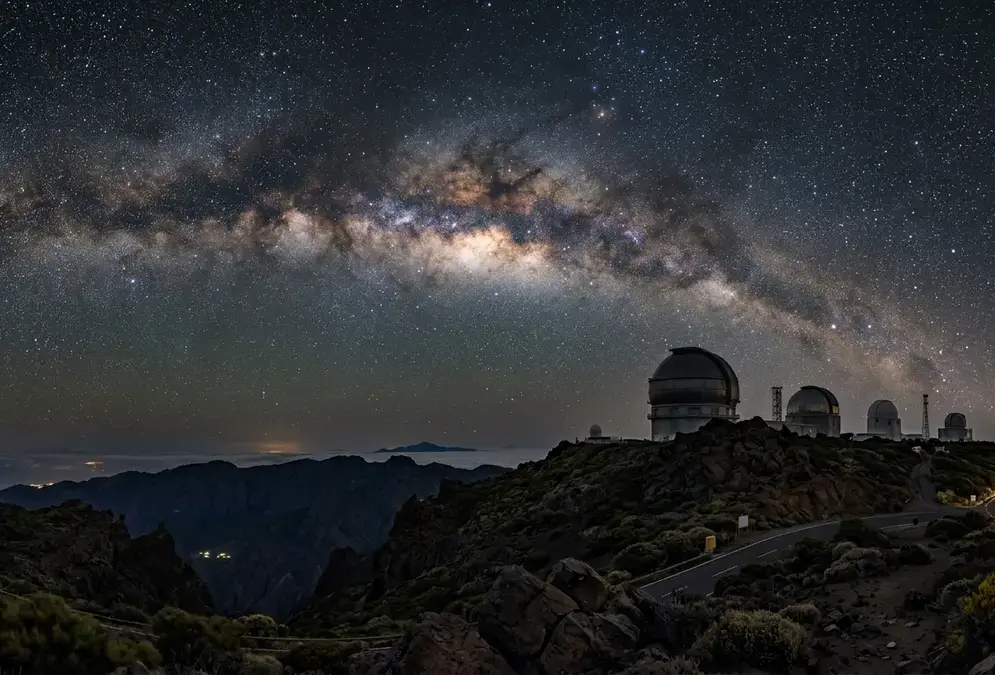
La Palma Stargazing
La Palma stargazing guide: the world's first Starlight Reserve since 2012, Bortle 1-2 skies above Roque de los Muchachos, plus where to stay and go year-round.
Counting Stars Instead: Globe at Night and the Naked-Eye Method
The simplest measurement of all needs no equipment: count the stars you can see in a known patch of sky and compare the count against a chart. That's the method behind Globe at Night, the long-running citizen-science project that turns naked-eye star counts into a Naked Eye Limiting Magnitude (NELM), the faintest star an observer can detect without help. No specialized equipment is required at all, though a handheld SQM reading can be submitted alongside a naked-eye count[11].
Globe at Night runs the same way season after season precisely because a lot of small, imprecise observations, gathered from thousands of participants across many nights, average out into something genuinely useful for tracking how a region's sky is changing over years, even though no single submission is very precise on its own. It's also one of the only ways anyone has systematically tracked how the switch from orange sodium streetlights to white LEDs has changed skies worldwide, one naked-eye count at a time. That same NELM archive is also behind one of the starker recent findings on why the Milky Way keeps disappearing faster than satellites alone ever showed: a 2023 analysis of it found skies brightening by roughly 9.6% a year worldwide, well above the older satellite-only estimate of about 2% a year.
Recommended tours
Tours are selected for quality, not commission. I earn a small fee if you book — at no extra cost to you.


One person's honest count on one night can swing noticeably from another's, which is the trade-off for needing nothing but your own eyes. But averaged across enough observations, the naked-eye method does line up with instrument readings: Globe at Night's own conversion table equates a NELM of 6, roughly 2,500 visible stars, with about 20.4 mag/arcsec²[10], a direct bridge between what you can count and what a meter would show.
Featured · Article
Stargazing Gear for Beginners: Binoculars to Telescopes
New to stargazing gear? This guide breaks down binoculars, telescopes, and smart telescopes, so you know what to buy first and what to skip for right now.
It's also the easiest entry point for stargazing for beginners: no meter to buy, no app to calibrate, just a clear night, a known constellation, and a star chart to compare against.
Why Your Reading Never Matches the Published Number
A published SQM-L figure for a certified reserve isn't a single lucky reading taken once, and it isn't published the day someone visits, either. DarkSky's own survey protocol calls for at least six readings per visit, with the first one thrown out, reporting every measurement that follows rather than cherry-picking the best one[13], often repeated across multiple visits before a designation is even granted. That's already a more careful process than almost any visitor can replicate with one reading on one night, taken whenever the sky happens to look good.
The rest of the gap comes from things a protocol can only average around, never eliminate, and they're worth knowing before you point a meter at the sky yourself.
What still varies from night to night
A bright moon above the horizon can wash out enough of a sky's true darkness that serious sky-brightness surveys always wait for the moon to be down before taking a reading, which is also why the best time to stargaze starts with the moon's phase before anything else. Point a zenith-only meter at the sky on a moonless night and you'll still barely register the zodiacal light: that faint natural glow is brightest and widest near the horizon, exactly where a zenith-looking instrument has almost no sensitivity[14]. The Milky Way itself adds to the reading depending on where it sits: the southern Milky Way alone can add as much as 0.85 mag/arcsec² near the zenith when it passes close to overhead[12], enough to make an otherwise-identical sky read measurably brighter on the nights it's up there. Add the atmosphere's own faint chemical glow, called airglow, which brightens and fades on its own schedule for reasons that have nothing to do with anything a park controls, and the case for treating any single number as fixed starts to look thin.
Weather adds its own variable on top of all that. Snow cover can make snowglow near artificial light twice as bright as a full moon[15], and a handheld meter has no way to separately weigh in humidity or haze on the night you're standing there. None of this means the published figure is wrong; it means the published figure is a best-case, protocol-controlled number, and your one reading is a sample of one, taken under whatever the atmosphere happened to be doing that night.
What that means for your own reading
None of this is a flaw in either instrument. A meter built to survive a field bag will never carry the precision of a research-grade photometer, and a research-grade photometer will never tell you what the sky felt like standing under it, or whether the dust lanes of the Milky Way were visible to your own dark-adapted eyes that particular night. The honest way to use your own reading is as a data point next to the published one, not a contradiction of it: note the moon phase, note whether the Milky Way was up, note whether snow was on the ground, and the gap usually explains itself.
Phone Apps and Which Meter to Actually Buy
If you don't want to buy a meter at all, the Dark Sky Meter app estimates night sky brightness using your phone's own camera sensor rather than a dedicated, independently calibrated photometer[18]. It's a reasonable starting point for a first trip, not a replacement for the real thing, and it will tell you far more about relative differences between two nights than it will about matching anyone else's absolute number.
“Camera sensors vary widely on Android, so accuracy is still being validated — your feedback helps.[19]”
Android is the platform where that limitation shows most, since camera hardware and image processing vary enormously between manufacturers, and a sensor tuned to make sunset photos look good is not the same thing as a sensor built to report faint light honestly. Some Android apps sidestep the problem entirely and just ask how many stars you can count, feeding your naked-eye report into the same kind of citizen-science pool Globe at Night draws on.
If you're going to buy an instrument instead, buy the one certifiers actually use. DarkSky calls the Unihedron SQM-L "the most widely used device" for scientific-quality sky-brightness surveys[16], not the wide-angle original this piece opened with. Even the Royal Astronomical Society of Canada's SQM FAQ is candid that converting that reading into a Bortle class is only "a pretty decent correspondence," not an exact match[17]. Pair the SQM-L number with your own stargazing gear and a night actually worth using it on, and you'll get closer to a reserve's published figure than any phone ever will. Whichever instrument you end up trusting, the number is only ever half the story: the other half is standing there yourself, on the right night, and letting your eyes do what no meter can.