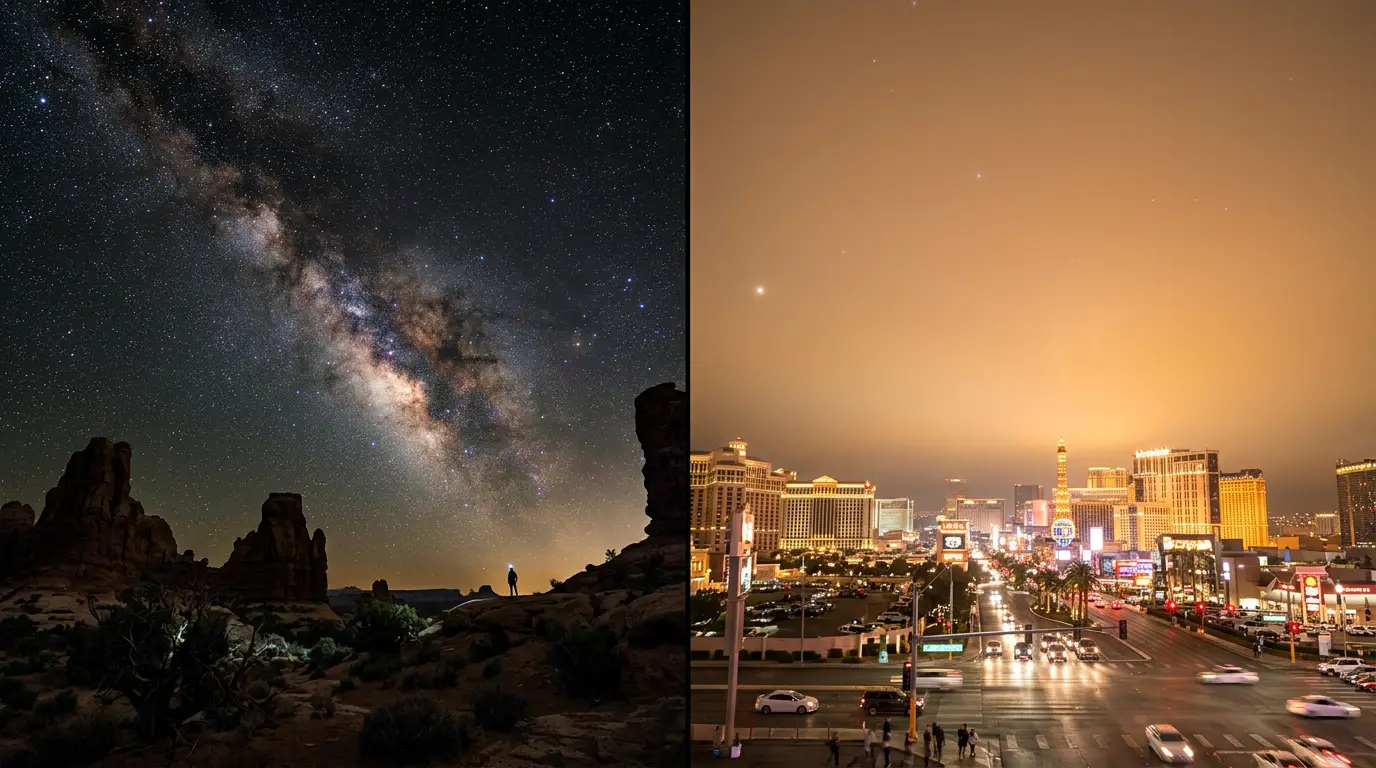

What the Bortle scale measures
The Bortle scale is a nine-level scale that measures how much light pollution washes out the night sky at a specific location[1]. Class 1 is the darkest sky achievable on Earth; Class 9 is the permanent orange glow sitting over a city center. Unlike a simple guess at how many stars you can count, the scale grades a sky by several specific, checkable markers: the visibility of the zodiacal light, the gegenschein, airglow, and how much structure survives in the summer Milky Way.
Amateur astronomer John E. Bortle created the scale and published it in the February 2001 issue of Sky & Telescope[2], designing it to replace vague adjectives with a number stargazers could actually compare across locations and trips. Bortle based his descriptions on decades of his own visual observing, which is why the scale reads less like a lab instrument and more like a field guide to what you can and cannot see.
A Bortle Class 1 sky isn't just dark. It's a different sky entirely, one with objects most stargazers will never see because most stargazers will never stand under one.
A Bortle Class 1 sky isn't just dark. It's a different sky entirely, one with objects most stargazers will never see because most stargazers will never stand under one.
Bortle Classes 1–3: pristine and rural dark skies
These three classes are what most people picture when they imagine a truly dark sky, though in practice only Class 1 delivers all of it.
Featured · Destination
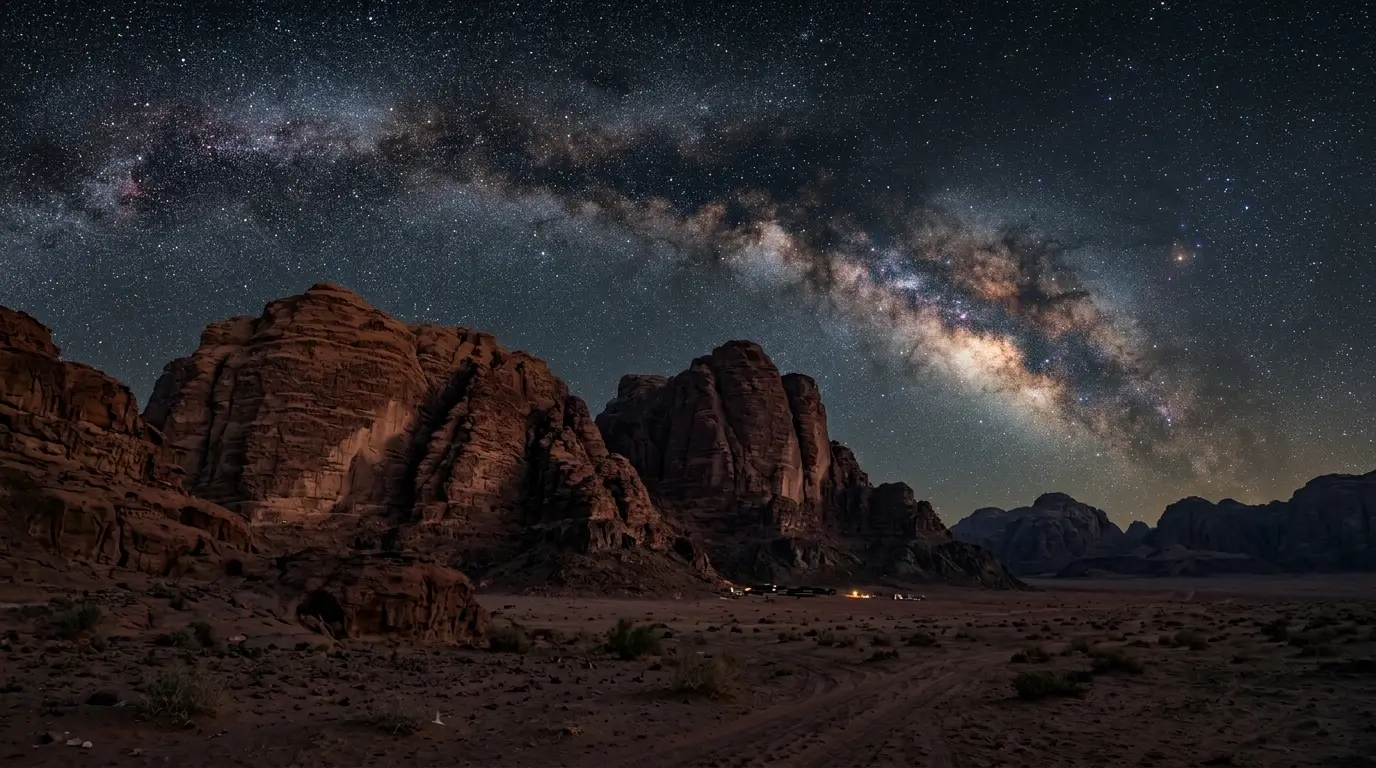
Wadi Rum
See the Wadi Rum night sky from a Zalabieh Bedouin camp in Jordan's UNESCO desert: bare tents to glass domes, Bortle 2-3 skies, and year-round stargazing.
Class 1: excellent dark-sky site
A true Class 1 sky carries a naked-eye limiting magnitude of 7.6 to 8.0 and a sky brightness of 21.76 to 22.0 magnitudes per square arcsecond, dark enough that the zodiacal light is visible and colorful[3]. At this level the zodiacal light, gegenschein, and zodiacal band are all visible, the zodiacal light to a striking degree[4], and airglow near the horizon is readily apparent[5]. This is the sky above the emptiest deserts and the most isolated dark-sky reserves on Earth, among them Wadi Rum and NamibRand Nature Reserve on a clear, new-moon night.
Class 2: typical truly dark site
Step down to Class 2 and you lose surprisingly little. The Triangulum Galaxy (M33) is rather easily seen with direct vision, and the summer Milky Way is highly structured[6]. The zodiacal light turns distinctly yellowish and, at dusk or dawn, is bright enough to cast shadows[7], an effect almost nobody living within a few hours of a city has ever witnessed.
Class 3: rural sky
Bortle Classes 4–6: rural to suburban transition
By Class 4, the sky is transitioning out of dark-sky territory into something more familiar to most travelers: a decent, non-urban night that is no longer untouched by artificial light on the horizon.
Class 4: rural/suburban transition
The zodiacal light is clearly evident at Class 4, but it no longer reaches even halfway to the zenith[10]. The Milky Way, well above the horizon, is still impressive, but it has lost the fine detail that made Class 1 through 3 skies remarkable[11]. This is the level where a genuine Milky Way photo is still possible without heavy post-processing.
Class 5: suburban sky
Class 5 is a suburban sky, with naked-eye limiting magnitude of 5.6 to 6.0 and sky brightness of 19.25 to 20.3 magnitudes per square arcsecond, dim enough that only hints of zodiacal light are seen on the best nights[12]. The Milky Way is very weak or invisible near the horizon and looks rather washed out overhead[13]. This is roughly what most suburban backyards deliver on a clear night once the streetlights are behind a fence.
Bortle Classes 7–9: suburban to inner-city skies
Below Class 6, the conversation stops being about what is visible and starts being about what is left.
Class 7: suburban/urban transition
Class 8: city sky
At Class 8, the sky glows whitish gray or orangish, bright enough that you can read newspaper headlines without difficulty[18]. Only the brightest stars and planets punch through.
Class 9: inner-city sky
Class 9 is the inner-city ceiling: the entire sky is brightly lit even at the zenith, and many of the stars that make up familiar constellations are simply invisible[19]. This is the sky above most downtown cores after dark, one where a stargazing trip means leaving town, not looking up.
How to find your own sky's Bortle class
The fastest way to find your own Bortle class is a light-pollution map. Interactive tools plot satellite-measured sky brightness over an actual map, so you can drop a pin on your backyard, your campsite, or next month's hotel and get an approximate class instantly, with no equipment required.
For a more exact number, a handheld Sky Quality Meter (SQM) measures sky brightness directly in magnitudes per square arcsecond, the same unit the Bortle scale itself uses. Point it at the zenith on a clear, moonless night and the reading translates fairly directly to a Bortle class. If you do not own one, the stargazing gear guide covers where an SQM meter fits into a beginner's kit and when it is actually worth buying one.

Featured · Article
Uluru Cultural Significance and Visitor Etiquette
Uluru is Anangu land under joint management. Here's why the 2019 climb closure is settled policy, what you can't photograph, and real visitor etiquette.
The simplest test needs no gear at all. Can you make out the handle stars of the Little Dipper, or count more than a handful of stars inside the bowl of the Big Dipper? If the answer is no, you are probably at Class 6 or worse. If the summer Milky Way shows real structure rather than a faint smudge, you are likely in Class 3 territory or better. It is rough, but it takes thirty seconds and costs nothing. Run that test on a night close to new moon; check the full moon calendar first, since even a genuine Class 2 sky reads closer to Class 4 or 5 under a bright moon.
Why the Bortle scale matters when you're planning a trip
A destination advertising "dark skies" can mean anything from a genuinely pristine Class 2 to a merely tolerable Class 5 an hour outside a city. The Bortle class is the fastest way to cut through that marketing and know, before you book anything, whether a trip is worth the drive.
That Class 4 line isn't a rounding error, either: most of the world now sits well past it, which is why the Milky Way has vanished from most of the planet's skies rather than just faded a little.
Recommended tours
Tours are selected for quality, not commission. I earn a small fee if you book — at no extra cost to you.



The jump that actually matters most is the one between Class 4 and Class 3. Below Class 4, the zodiacal light reappears, the Milky Way regains real structure, and an evening under the stars stops being nice and starts being memorable. Above Class 5, you are mostly trading a slightly better view for a slightly longer drive, sometimes worth it, sometimes not, depending on what you are actually there to see.
| Class | What you'll see |
|---|---|
| Class 1 | Zodiacal light strikingly colorful; gegenschein and airglow both visible |
| Class 2 | M33 visible to the naked eye; summer Milky Way richly structured |
| Class 3 | Zodiacal light striking in spring and autumn; Milky Way still complex |
| Class 4 | Zodiacal light evident but faint; Milky Way impressive yet detail-poor |
| Class 5 | Only hints of zodiacal light on the best nights; Milky Way washed out near the horizon |
| Class 6 | Zodiacal light gone; Milky Way visible only near the zenith |
| Class 7 | Sky glows light gray; Milky Way barely a smudge |
| Class 8 | Sky whitish-orange; bright enough to read a newspaper headline outdoors |
| Class 9 | Sky brightly lit at the zenith; familiar constellations missing stars |
When you are comparing dark-sky destinations, check the published Bortle rating rather than trusting the phrase dark sky on its own. The dark-sky destination guides list a class for each location, so you know exactly what you are driving toward before you commit a night to it. Once the destination's settled, the 2027 night sky calendar helps line up the date itself against meteor showers, eclipses, and other events worth a Class 1 or 2 sky.