Astronomical seeing vs transparency vs darkness: three ways a night fails
A night can fail in three separate ways, and only one of them shows up on a light-pollution map. Darkness is how much artificial glow brightens the background. Transparency is how much starlight survives the trip through the air. Seeing is how sharply that surviving light lands in your eyepiece or on your sensor.
Transparency is the easy one to picture, because you can see what spoils it: clouds, smoke, dust and haze all cut the view.[2] Seeing is stranger, and a single star separates the two. In poor seeing it smears into a larger disc while its total brightness barely changes; in poor transparency it dims while its blur stays largely unaffected.[3]
A clear forecast tells you little about steadiness: bad seeing can occur in perfectly clear weather, and good seeing often turns up during poor transparency.[4] The Bortle scale grades only the first failure, and a site's grade barely moves from one night to the next, while the other two can change by the hour. So the useful question is not how dark a place is. It is which of the three your target cannot survive.
Seeing: the blur that decides what a telescope can show
Seeing is turbulence. Warm and cold air mix and swirl, bending the path of light on its way down, the same roiling you see above a hot car or a grill.[5] A star viewed through that churn dances and swells instead of holding as a point.
Astronomers put a number on the blur: the width of the star's smeared disc at half its peak brightness (the FWHM), in arcseconds. At the premier observatories in Hawaii, Chile and the Canaries the typical figure falls between 0.5 and 1.0 arcseconds.[6]
Gemini's published median for its Mauna Kea site is 0.43 arcseconds at a wavelength of 0.55 microns.[7] Different wavelengths, instruments and eras make such figures poor material for a league table, so read them as a sense of scale.
Who pays for bad seeing
Seeing matters most for the targets that need high power: the Moon, the planets and narrowly separated double stars.[9] Planets suffer worst, since the fine detail they offer is exactly what turbulence smears. Galaxies mostly shrug it off, so an unsteady night is not a wasted one for a deep-sky observer.[10]
What drives it from high above
Some of the turbulence starts far above any mountain. Vernin's 1986 work deduced a threshold of 20 meters per second at the 200 millibar level, the jet stream aloft, for good total seeing.[11] A night can look flawless from the ground and still blur because a fast current is passing overhead.
Transparency: water vapor, haze and the thickness of the air
Transparency is how much starlight reaches you at all, and the number a forecast model works from is the total amount of water vapor in the air,[12] which is why it can be poor on a night with hardly a cloud. Dust, smoke and haze pile on top, and none of it appears on a Bortle map.
Height in the sky matters too. Transparency decreases from the zenith toward the horizon because you are looking through a thicker column of air, an effect called atmospheric extinction.[13] A galactic core that hangs low over the southern horizon from mid-northern latitudes pays that toll in full, so Milky Way photography from there depends on dry, clear air as much as on a dark site.
Featured · Destination
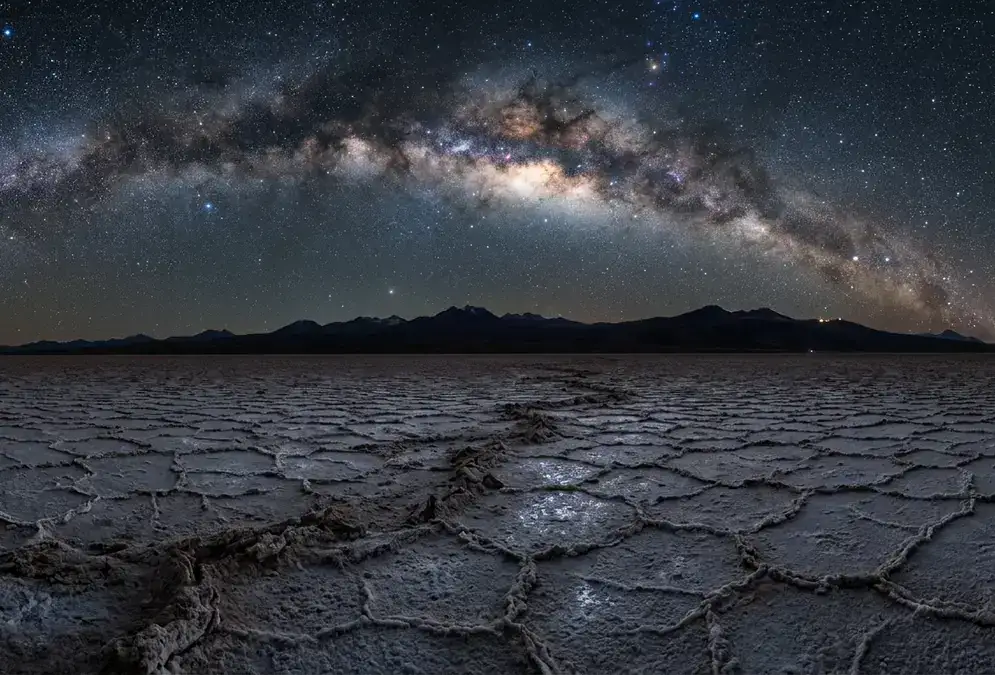
Atacama Desert Stargazing
Earth's driest desert delivers Bortle 1–2 skies, 330+ clear nights a year, and the galactic core almost overhead. Guide: tours, lodges, season, getting there.
A Little Dipper check for transparency
A quick field check is the Little Dipper's seven stars. If all seven show, your naked-eye limiting magnitude is about 6.[14] The catch is that this single count folds darkness and transparency together, so it cannot tell you which one is failing. Bortle himself called limiting magnitude a "totally subjective and idiosyncratic" measure of sky darkness.[15]
Why the darkest site is not always the best night
Put the three together and the Bortle number starts to look like a floor, not a forecast. A night of exceptional seeing is often accompanied by poor transparency, and vice versa,[16] so even a flawless site asks you to choose between steady air for sharp detail and clear air for faint objects.
My planning rule is to pick the target first, then ask which failure it cannot survive. For the Moon and planets I would take a site a notch brighter with a drier, steadier climate over a darker one without those advantages. For faint galaxies I would do the reverse. The darkest site answers one of the three questions.
In practice the split looks like this.
- Moon, planets and tight double stars need steady air; haze dims them without blurring them.
- Faint galaxies and nebulae need transparent air and a dark horizon, and mostly ignore bad seeing.
- Wide-field Milky Way frames need darkness and transparency; seeing hardly enters into them.
- A 10 cm telescope's diffraction limit is about 1 arcsecond,[17] already at the soft end of what premier sites deliver. Past that aperture, an ordinary night buys you brightness, not detail.
Site planners make the same trade at scale. An infrared project, for which cloud matters less, may accept a cloudier mountain in return for drier air.[18]
Reading a forecast without being fooled by it
On the CMC-based Clear Sky chart as Martz Observatory presents it, one row is labeled Seeing, another Transparency, and a third darkness.[28][29] The first two are model output rather than measurement, and the models only reach the next several nights.[19] Treat them as a first cut. I would look the day before for the pattern and again near dusk, because the row that matters for a planet night is not the row that matters for a galaxy night.
The darkness row is not a sky-quality score
A forecast's darkness row is not a weather forecast.[20] It shows when the sun and moon are down and ignores light pollution, so a good score there says nothing about the glow from the nearest town.
Even the best-known seeing predictor has limits. The 200 millibar rule is a useful guide, not a law: a later study found that wind speed alone is not a good indicator of median total seeing on a global scale.[21]
The sky itself is the better check. Seeing is commonly rated from 1 (terrible) to 5 (ideal) by watching a bright star at high magnification.[22] Do that at dusk before you commit the evening to a planet session.
Recommended tours
Tours are selected for quality, not commission. I earn a small fee if you book — at no extra cost to you.
If you want arcseconds instead of a 1 to 5 rating, one software vendor, Deep-Sky Planner, maps the classic Antoniadi and Pickering scales onto numbers; those bands are the vendor's assignment, not the scales' own definitions. Good is 1.0 arcsecond or better, Moderate up to 2.5, Poor up to 4.0, and anything above 4.0 is Very Bad.[30][31][32] A backyard Good night therefore tops out where the 0.5 to 1.0 typical range of the premier observatories ends, and those sites are playing a different game.
Timing matters as well. Subaru's seeing record on Mauna Kea shows a trend toward better seeing as the night goes on,[23] one more reason to treat an early look at the sky as provisional. Moon phase and season still make the first cut, as the best time to stargaze shows, and seeing and transparency only choose among the nights that survive it.
Why observatories are built on mountain tops
Science-grade telescopes go high to get away from much of the light pollution and the lower-level atmospheric turbulence.[24] Marc Sarazin, the European Southern Observatory physicist in charge of site monitoring, describes the order of work: find a place clear enough, then look for one with little turbulence.[25]
Mauna Kea adds a trick of its own. When the inversion layer drops below the summit, usually before dusk, the clouds fall below the telescope site and leave the whole sky open for the rest of the night.[26] That is why the summit can be clear while the cloud deck sits beneath it, and why Mauna Kea stargazing is judged from the mountain, not from the coast.
Dry air does the same job in the desert. ESO credited Paranal's edge over La Silla to the Atacama's most arid, stable climate,[27] and that dry stability serves transparency and seeing together, which is the logic behind the observatories of the Atacama.
Featured · Article
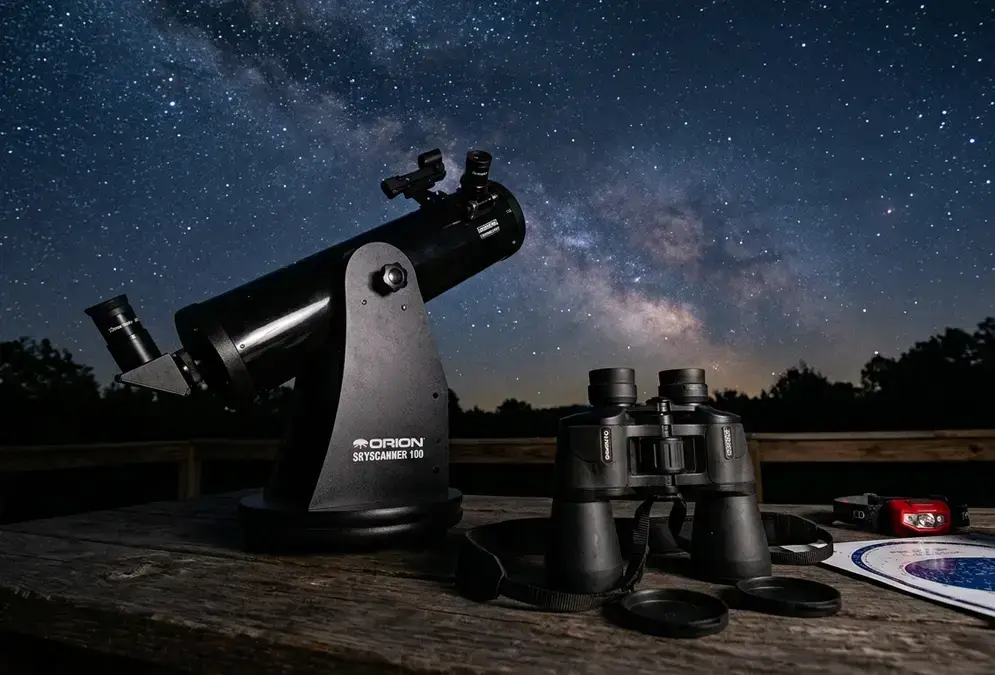
Stargazing Gear for Beginners: Binoculars to Telescopes
New to stargazing gear? This guide breaks down binoculars, telescopes, and smart telescopes, so you know what to buy first and what to skip for right now.
For a traveler the lesson is not to chase summits. A lodge selling altitude should be able to say what that altitude buys. Above the cloud deck and above the lowest turbulence is worth a long drive; a modest rise over a hazy valley, under the same jet stream, is not.