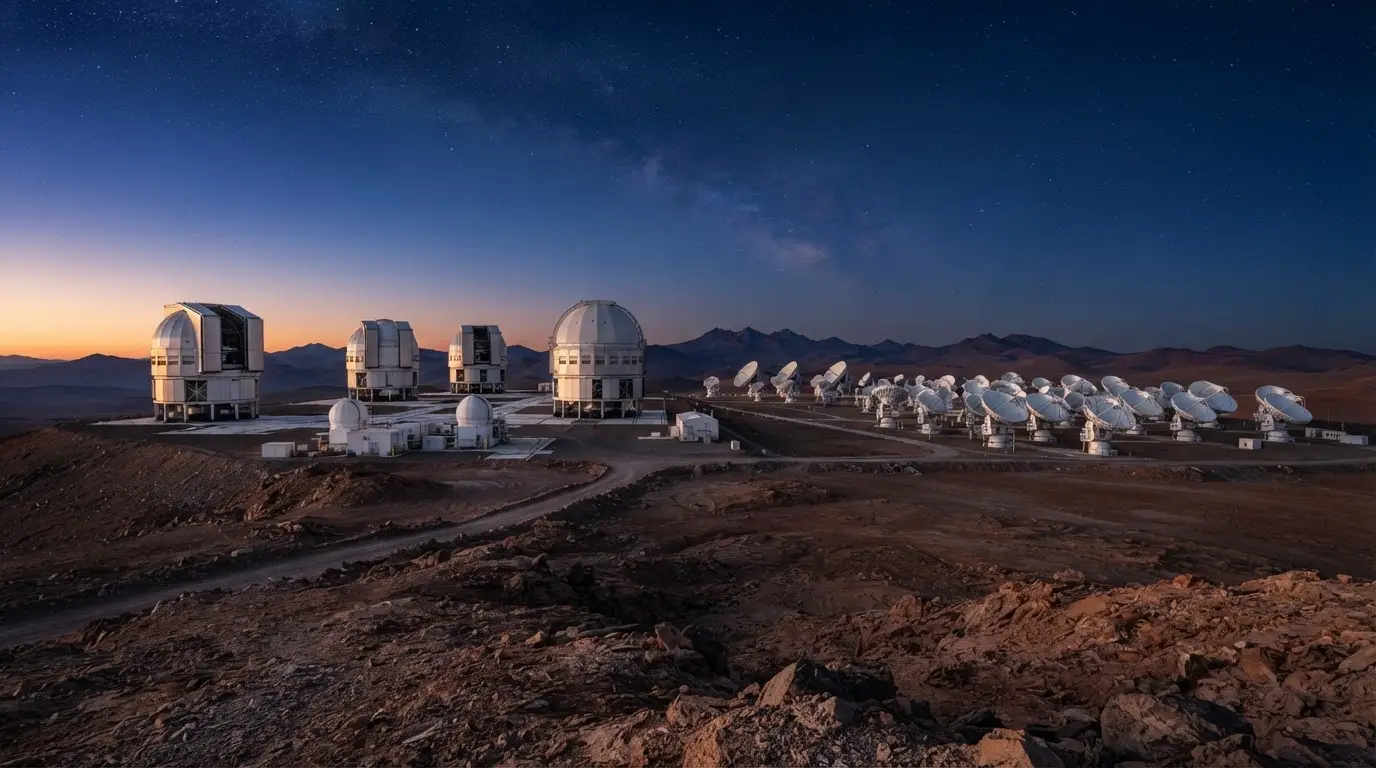

Why Chajnantor and the Atacama Are Astronomy's Best Real Estate
Altitude is the first reason any of this got built here. The Chajnantor plateau, where ALMA sits, tops out at 5,000 metres[1], among the highest points anywhere astronomers have ever put a telescope. At that height there is simply less atmosphere between an instrument and the sky it's trying to see through, and far less water vapour to absorb the radio and infrared wavelengths professional astronomy depends on.
5,000 m
The rest of the corridor sits lower, but every site shares the same basic recipe of altitude and dryness:
The Extremely Large Telescope, still under construction, occupies a ridge higher than any of these except Chajnantor itself, a fact this article gets to in its own section below.
Together these sites form a roughly 700-kilometre stretch of high, dry ridgeline, each hosting a different facility, run by a different organization, built for a different kind of astronomy. Part of that corridor answers to the European Southern Observatory (ESO); another part answers to the US-led NOIRLab/AURA partnership instead, and the two operate independently of each other despite sitting a few hundred kilometres apart. Why the Atacama is the driest desert on Earth covers the climate mechanics behind all of it in more depth than this article needs.
ALMA: The World's Largest Radio Telescope Array
ALMA is not one telescope but 66 of them, working together, spread across distances of up to 16 kilometres and combined into what ESO calls the largest ground-based astronomical project in existence[7].
It's also the most international project on this list: a partnership between ESO, representing Europe, the US National Science Foundation and NRAO, and Japan's National Institutes of Natural Sciences, operating in cooperation with Chile. Early scientific observations began with a partial array in 2011, and the full observatory was formally inaugurated in 2013.
What that hardware buys is submillimetre astronomy: observing the cold gas and dust that optical telescopes cannot see through. ALMA's images of the protoplanetary disk HL Tau, rings of dust and gas caught mid-collapse into planets, rewrote the accepted picture of how planetary systems form. It has also detected complex organic, pre-biotic molecules inside distant protoplanetary disks, the kind of building blocks that, on Earth, eventually led somewhere interesting.
Featured · Destination
Atacama Desert Stargazing
Earth's driest desert delivers Bortle 1–2 skies, 330+ clear nights a year, and the galactic core almost overhead. Guide: tours, lodges, season, getting there.
Paranal and the VLT: ESO's Flagship Optical Observatory
Where ALMA collects radio waves, the Very Large Telescope (VLT) at Paranal works in visible and infrared light, the wavelengths a stargazer would actually recognize. It consists of four 8.2-metre Unit Telescopes plus four movable 1.8-metre Auxiliary Telescopes that can combine as an interferometer[8], letting astronomers synthesize the resolving power of a far larger single mirror when the science calls for it.
The four Unit Telescopes carry names drawn from local heritage rather than acronyms or sponsor plaques:
- Antu: the Sun
- Kueyen: the Moon
- Melipal: the Southern Cross
- Yepun: Venus
Antu, the first of the four, went into routine scientific operations on 1 April 1999; today all four Unit Telescopes and all four Auxiliary Telescopes are operational.
By output, the VLT is arguably the most productive single ground-based facility on Earth, generating an average of more than one peer-reviewed scientific paper per day from its results. That includes genuine firsts: the first direct image of a planet orbiting another star, and tracking individual stars as they loop around the supermassive black hole at the centre of the Milky Way.
| Observatory | Signature instrument | Altitude |
|---|---|---|
| ALMA | 66-antenna array | 5,000 m |
| Paranal (VLT) | Four 8.2 m Unit Telescopes | 2,635 m |
| ELT (Armazones) | 39 m primary mirror (under construction) | 3,046 m |
| La Silla | 3.6 m telescope + HARPS | 2,400 m |
| Cerro Tololo (CTIO) | Victor M. Blanco 4 m + DECam | 2,200 m |
The Extremely Large Telescope: A 39-Metre Mirror Taking Shape
About 20 kilometres from Paranal, on a ridge called Cerro Armazones, ESO's Council selected the site for its next flagship instrument on 26 April 2010: a 3,046-metre summit some 20 kilometres from Cerro Paranal itself[9]. That proximity is no accident: Cerro Armazones and Paranal share the same prized observing conditions, including more than 320 clear nights a year[2]. The Extremely Large Telescope (ELT) now taking shape there will carry a 39-metre primary mirror, roughly four times the diameter of today's largest optical telescopes, gathering about 15 times more light and producing images some 15 times sharper than the Hubble Space Telescope. Nights up here get bitterly cold; see what to pack for cold, high-altitude nights in the Atacama before you plan any visit to this part of the desert.
When I did my first Atacama trip, altitude hit me harder than expected and cost me a rough first night in San Pedro, and that town sits noticeably lower than either Paranal or the ELT's ridge at Armazones. If you're planning to get anywhere near these altitudes, don't schedule it for day one.
Scale costs money, too. The full baseline construction is estimated at around €1.45 billion at 2023 prices, with roughly €50 million a year to run once it's operating[10].
As of ESO's most recent public schedule update, from March 2025, the ELT is targeting technical first light in March 2029, with scientific first light following in December 2030[11]. That date has already moved more than once since the project's original targets. Treat any specific month on this project as provisional until ESO confirms it again closer to the date, rather than something written today, including this article.
A moving target
This is at least the second public delay to the ELT's construction schedule. If you're planning coverage or a visit around 'first light,' check ESO's own announcements page for the current date rather than trusting any single article's numbers to still be accurate months later.
La Silla and Cerro Tololo: The Older, Separately Run Sites
Not every Atacama observatory is ALMA or ESO's newest hardware. La Silla, ESO's original Chilean site, sits at 2,400 metres, 600 kilometres north of Santiago[5], and has operated two of the world's most productive 4-metre-class telescopes since ESO established itself there in the 1960s. Its New Technology Telescope (NTT), a 3.58-metre instrument, was the first in the world to use a computer-controlled main mirror, active optics, technology now standard on most of the planet's large telescopes.
That same hardware is why La Silla still matters for exoplanet science: its HARPS spectrograph is the instrument most exoplanet hunters treat as the gold standard for precision radial-velocity measurements, and it found the first rocky exoplanet ever discovered inside its star's habitable zone, along with planets orbiting Proxima Centauri, the closest star to the Sun[12].
Cerro Tololo Inter-American Observatory (CTIO) is a different animal entirely. At 2,200 metres, it is not run by ESO at all: CTIO is operated by the US National Science Foundation's NOIRLab, managed by the Association of Universities for Research in Astronomy (AURA)[13]. Its flagship instrument is the Victor M. Blanco 4-metre Telescope, fitted with the Dark Energy Camera built for the Dark Energy Survey, and it also runs the 4.1-metre SOAR Telescope on the adjacent Cerro Pachon ridge.
Cerro Pachon is also home to the Vera C. Rubin Observatory, and it's worth being precise about this because the two get confused constantly: Rubin is a separate facility from CTIO, built around an 8.4-metre Simonyi Survey Telescope for the decade-long Legacy Survey of Space and Time[14]. Same ridge, different observatory, different mission. CTIO runs its own free guided daytime tours every Saturday, year-round, booked through a separate channel from ESO's Paranal and La Silla visits.
Featured · Article
Uluru Cultural Significance and Visitor Etiquette
Uluru is Anangu land under joint management. Here's why the 2019 climb closure is settled policy, what you can't photograph, and real visitor etiquette.
Visiting the Observatories: ESO's Free Saturday and Night Tours
You don't need a research grant to walk into most of these facilities. Paranal and La Silla both run free public tours every Saturday of the year, and the tours themselves cost nothing; the catch is capacity, since registration is compulsory and fills up[3]. ALMA works differently, and it's more open than its reputation suggests: when the programme is running, free guided tours visit ALMA's Operations Support Facility (OSF) at 2,900 metres[19] — comparable in altitude to Paranal's 2,635 metres — on a similar free, weekend basis[20]. Only the antenna array itself, up on the Chajnantor plateau at 5,000 metres[1], is closed to the public, since the altitude and thin air up there are a genuine safety limit rather than a policy choice. Right now there's nothing to book, though: ALMA's own visits page lists the programme as suspended, with the observatory 'working to reopen it soon'[18].
Paranal's Saturday tours book exclusively through the online reservation form; phone and email bookings are not accepted. La Silla's Saturday tours run on the same weekly schedule[15]. Both go through the same channel, reservasobservatorioseso.cl, which also lists occasional shuttle services: a monthly run from Taltal to Paranal, and holiday-season buses from Antofagasta to Paranal and from La Serena to La Silla[16].
March 2026 added something new: ESO's first-ever programme of public night tours at Paranal and La Silla, timed to Chile's Astronomy Day and building on a public visits programme that already draws more than 7,000 people a year[17]. The night-tour programme offers at least eight visits a year, each one showing the telescopes opening at sunset and naked-eye stargazing under some of the darkest skies on the planet, and each tour runs about three hours, including a look at the observatory control rooms and, conditions permitting, the VLT at Paranal or the NTT at La Silla.
Night tours work differently from the daytime version. Sign-ups are announced on ESO Chile's Instagram and Facebook rather than through the standing reservation form, spots are capped at 40 people per shift on a first-come, first-served basis, and there's no showing up under your own steam: access is bus-only, round trip, from designated pickup points. This is a new enough programme that the details are worth reconfirming close to your date rather than assuming a page written months ago, including this one, still matches exactly what ESO is running.
Getting to either site starts the same way most Atacama stargazing trips do: fly into Calama, then continue toward San Pedro de Atacama or Antofagasta depending on which observatory you're visiting. If you haven't sorted that leg yet, getting from Calama to San Pedro de Atacama covers it, and altitude is worth taking seriously here too; see altitude acclimatization in the Atacama before you go. Most visitors fold an observatory tour into a longer stargazing trip rather than a standalone day; how many days to spend in the Atacama is the place to start planning that.