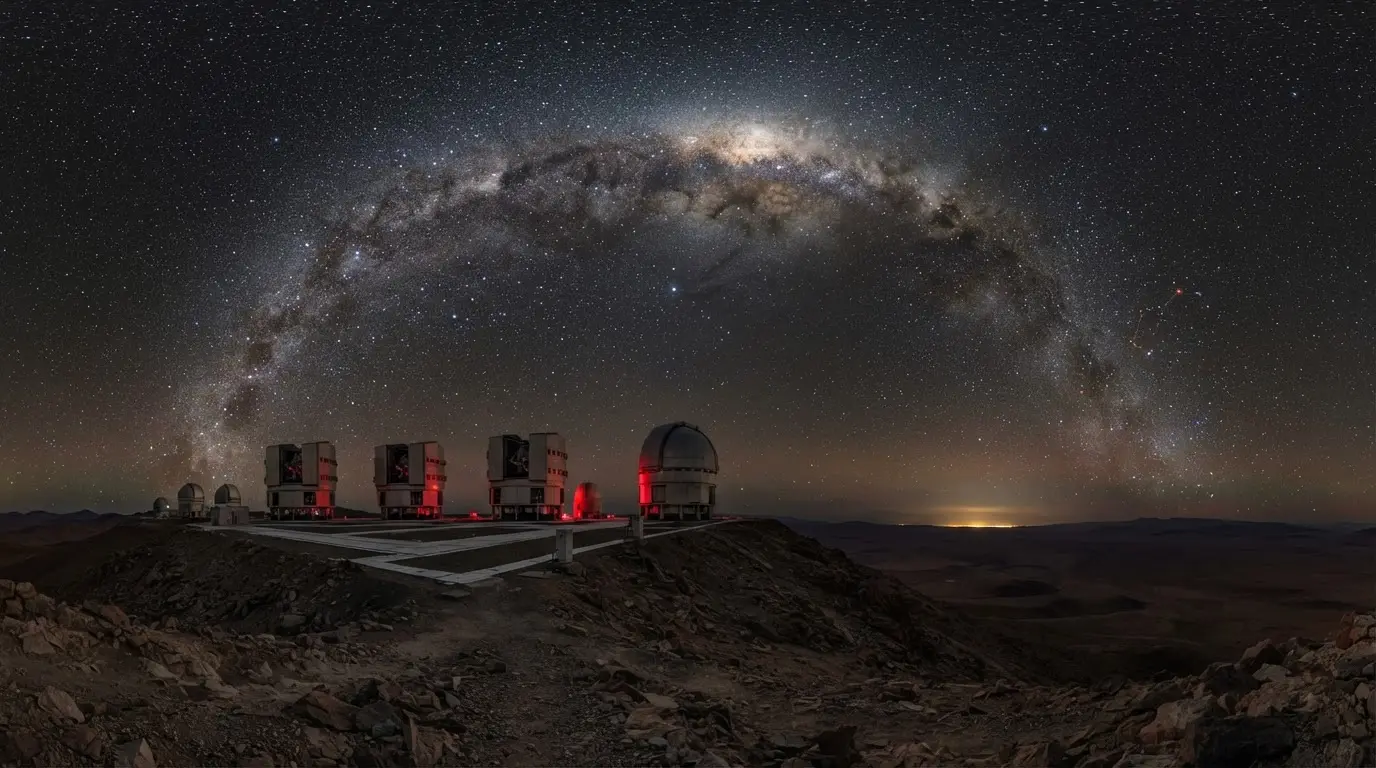

What INNA was and where it would have stood
INNA was a green hydrogen and green ammonia project. AES Andes, a subsidiary of the US power company AES Corporation, submitted it for environmental impact assessment on 24 December 2024[1]. It was no small plant: the plan included a port, ammonia and hydrogen production plants and thousands of electricity generation units[2].
The problem was the address. The complex was planned just 5 to 11 kilometres from the telescopes at Paranal[3]. A 2023 comparison of light pollution at all 28 major observatories found Paranal the darkest of them[4]. Putting industry that close does not add a bright spot to a compromised horizon. It adds one to the best horizon on the list.
For what the telescopes there actually do, see Atacama observatories explained. For why glow matters at all, what is light pollution has the basics, and I won't repeat them here.
What ESO said INNA would do to the sky
ESO's technical analysis did not stop at glare. It named four separate mechanisms: light pollution, micro-vibrations, dust and an increase in air turbulence in the area[5]. Two of them came with numbers:
- Light: ESO's assessment put the rise in light pollution above the Very Large Telescope at 35% or more, and above the southern site of the Cherenkov Telescope Array Observatory at more than 50%[6].
- Turbulence: separate from the lamps, ESO tied a loss of up to 40% in the best seeing conditions to air disturbed by the project's wind turbines[7]. Sharp images depend on steady air, and no lamp shield protects that.
- Vibrations and dust: named, without a figure in anything I could check.
A telescope can be shielded from a lamp. It cannot be shielded from air it does not control. That is why a lighting rule alone was never going to be enough here.
Featured · Destination
Atacama Desert Stargazing
Earth's driest desert delivers Bortle 1–2 skies, 330+ clear nights a year, and the galactic core almost overhead. Guide: tours, lodges, season, getting there.
ESO was also careful not to frame this as industry against astronomy. Its position is that the two can coexist at "sufficient distances"[8]. The objection was to the map reference, not to hydrogen.
How INNA ended, and what nobody can claim
AES Andes announced on Friday 23 January 2026 that it would discontinue INNA to focus on its renewable energy portfolio[9]. A letter to the environmental assessment service, SEA, on 6 February asked for INNA to be withdrawn from evaluation, which ESO said formally confirmed the project was not going ahead[10].
The reason AES gave was a review of its project portfolio, ending in a focus on renewables and storage[11]. It was a corporate reason, and nothing in it engages with the telescopes. Astronomy.com is blunt that it is "not clear" the pressure from ESO and the wider science community caused the decision[12].
The pressure was real, though. Astronomer Reinhard Genzel recalls he and colleagues asking the Chilean government, "How about just moving 50 kilometers?"[13]. Scientific American also calls the later public opposition from president-elect José Antonio Kast a "potential breakthrough"[14]. So the honest line is after a year of pushback, not because of it.
The overlap is the uncomfortable part. Empty, dry, high-altitude land is what astronomers want, and it is attractive to developers of large energy projects too. Why the Atacama is the driest desert on Earth explains the climate half of that overlap.
Why Chile's lighting decree would not have stopped it
Chile does have a lighting regime aimed at astronomy, and it is older than most people assume. The original standard was Supreme Decree No. 686 of 1998, aimed at protecting the future of astronomy in northern Chile[15]. Decree 43 of 2012 followed, for the regions of Antofagasta, Atacama and Coquimbo[16]. The current text, Supreme Decree 1/2022, revises it and extends the rules to the entire country[17].
What it regulates is emission. It places limits on the average light levels that industrial and other emitting sources can produce[18], and it imposes stricter restrictions on blue light such as that from LEDs[19]. It came into force on 19 October 2024[20].
- 1998
Decree 686
The original lighting standard for northern Chile.
- 2012
Decree 43
First update, for the Antofagasta, Atacama and Coquimbo regions.
- 2023
Decree 1/2022 published
Second update; extends the rules to all of Chile.
- 19 Oct 2024
In force
The current decree takes effect.
That is the right instrument for a floodlit yard or a municipal streetlight. It is a blunt one for INNA, whose harm ESO described as four mechanisms, only one of them light. A lamp limit says nothing about turbine-driven turbulence, and the description of the decree I have read sets no distance from an observatory either.
ESO's own conclusion was that the case shows "the urgent need to establish clear protection measures in the areas around astronomical observatories"[21].
The decree is under review: what to watch
The decree took effect in October 2024 and is already being reopened. On 31 July 2026 the Environment Ministry opened a review after municipal associations asked, among other things, to postpone its entry into force[22].
In August the ministry approved a draft amendment for public consultation. The draft proposes no changes to the limits themselves[23]. What moves is the clock: existing municipal lighting outside Special Protection Areas would only need to comply at its first replacement after a five-year period[24].
Featured · Article
What Is Light Pollution? Definition, Types, and Solutions
Light pollution is artificial light brightening the night sky, affecting 80% of the world. Learn the 4 types, wildlife and health effects, and how to fix it.
Read that carefully, because a headline will not. Slower streetlight replacement in towns is a different thing from weaker protection for an observatory sky, and the limits stay as written. But the draft, as the notice describes it, does not add what INNA exposed as missing either: protection for the land around a telescope.
That protection is being pursued elsewhere. Scientific American reports astronomers working with Chile's senators on legislation meant to "permanently protect" those skies[25]. I could not verify any bill text or timetable, so I would treat it as intent, not law.
You may have come here for the mining angle. I looked for a documented dispute over mine or lithium lighting near Paranal or ALMA and found none I could verify, so I won't invent one. If such a dispute exists, the decree above is the instrument that would govern it. I also could not confirm whether the consultation is still open as of 30 September 2026.
For a trip, none of this moves your dates. Start with the best stargazing spots in the Atacama Desert, and if you are still deciding, is Atacama worth it is my blunt answer.