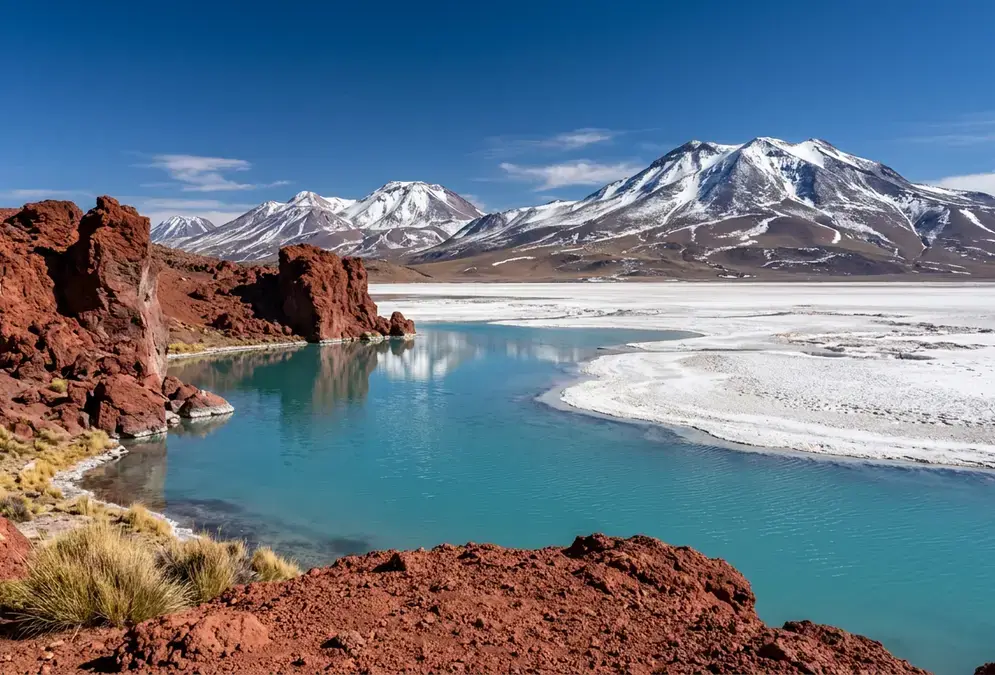
Piedras Rojas red rock formations above a white salt flat and turquoise lagoon at 4,200 m, volcanic Andes peaks under a cobalt sky, Atacama Desert Chile
Night-Sky Experience

Piedras Rojas and the Altiplanic Lagoons: a full day at 4,200 metres

Full day — typically 10–11 hours door-to-door
Early morning departure from San Pedro, typically 07:00–07:30. Return mid- to late afternoon, approximately 17:00–18:30.
Most operators offer accommodation pickup from San Pedro de Atacama. Confirm exact departure time when booking — morning starts are early and the circuit is long.
All activities

The altiplanic lagoon circuit is the Atacama at its most extreme. You leave San Pedro at first light in a 4WD, and over the next 110 km southeast the landscape tilts steadily upward. By the time you reach Piedras Rojas the air is noticeably thin, the sky a shade of cobalt you won't see at sea level, and the iron-oxide boulders above a white salt flat look like something deposited by a different planet.

Piedras Rojas: what you actually see

The rust-coloured rock formations contrast sharply against the white salt crust below and the deep blue of the lagoon behind them — a composition photographers plan entire trips around. The site sits at roughly 4,200 m on an ignimbrite plateau, the result of Pleistocene volcanic activity that left this stretch of altiplano in dark red and ochre. The short walk from the vehicles to the viewpoint is where altitude announces itself most clearly. Take it slowly. The views reward a pause.

The cobalt intensity of the sky up here has a practical explanation: at 4,200 m you're looking through roughly a third less atmosphere than at sea level, which improves atmospheric transparency — less haze, less scatter, more contrast. It's why astrophotographers prize this altitude even in daylight.

Laguna Miscanti, Laguna Miñiques, and the flamingos

Laguna Miscanti is the largest of the altiplanic lakes. The turquoise colour comes from fine mineral particles suspended in glacial melt — runoff from the surrounding stratovolcanoes, including Volcán Miñiques, whose 5,910 m cone often carries a fresh cap of snow on the northern shore. Laguna Miñiques sits close by against the same volcanic backdrop. The colour shifts slightly between the two lakes depending on depth and mineral composition.

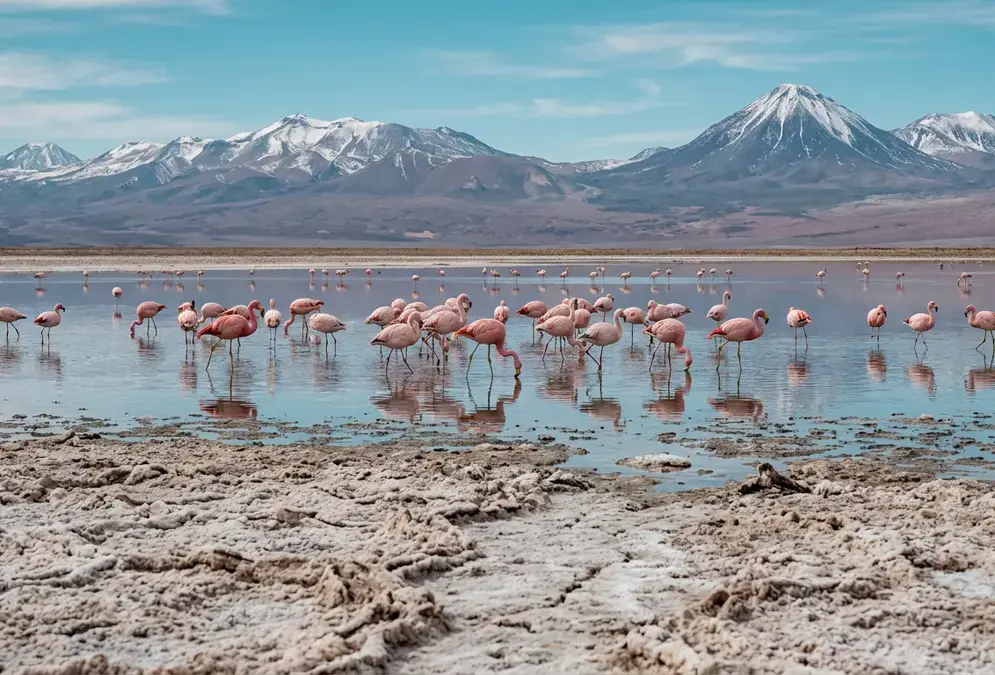
Flamingos forage along both shorelines. Chilean and Andean flamingos are the most reliable sightings; a third species, James's flamingo, is also documented at altiplanic lakes in the region. Vicuña herds — typically 15 to 40 animals — graze the grey-green tola shrubs above the waterline. The contrast between turquoise water, low altiplano grasses, and white volcanic summits makes this one of the few places in the Atacama where you genuinely struggle to choose what to photograph.

The dark-sky angle at 4,200 m

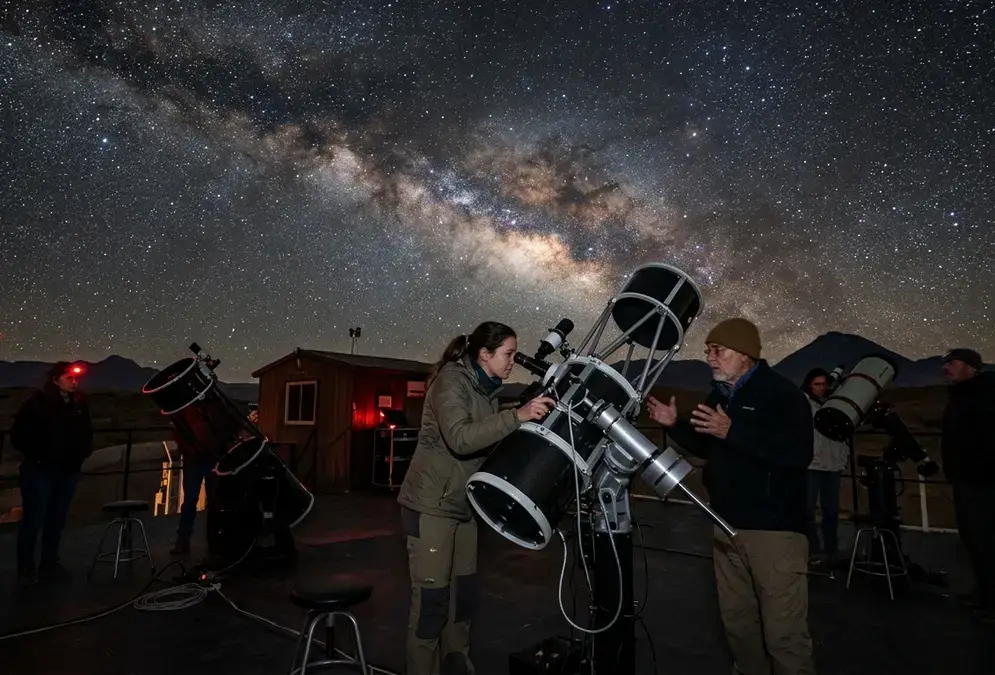
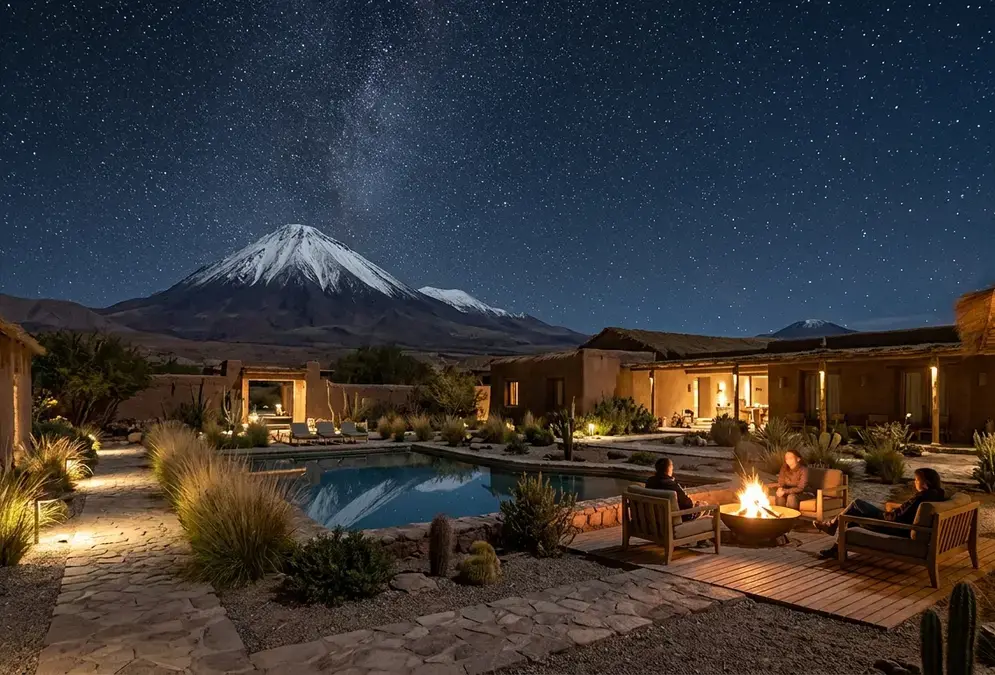
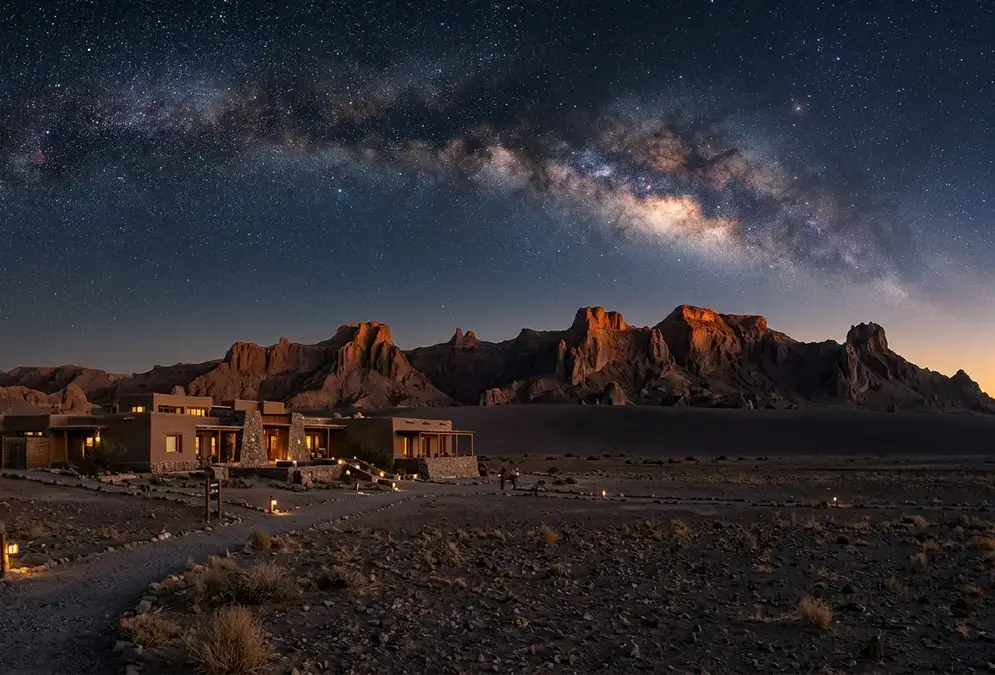
This is a daytime tour — it returns before nightfall. But the same geography that makes the altiplanic lagoons photogenic by day makes them exceptional for astronomy by night. The area sits at Bortle scale Class 2 to 3: no cities within 200 km, no agricultural light sources, and the thin atmosphere at altitude produces superior seeing conditions. Astronomical twilight is also shorter here — the sun drops below the −18° threshold faster relative to sea level — which extends the usable dark window.

If you're building a stargazing trip around San Pedro, the altiplanic plateau is where the best conditions concentrate. The standard tour doesn't stay after dark; book a dedicated night-observation operator separately if that's your objective. The optimal window is a new-moon window in the dry season (April to November), when lunar interference drops out entirely.

Socaire village and the return leg

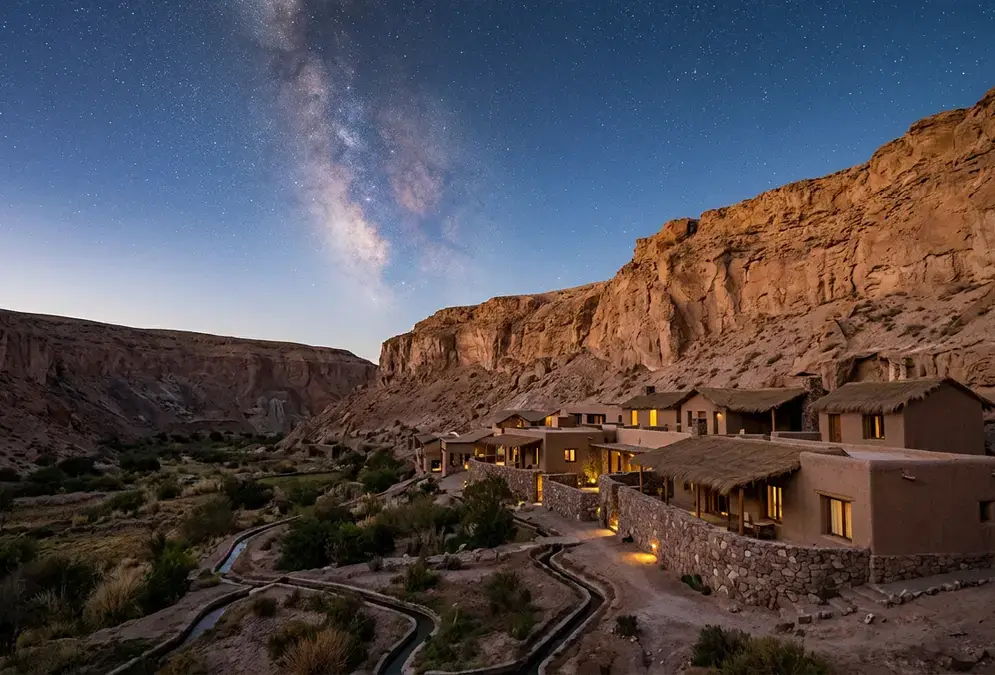
Most tours stop at Socaire on the way back — one of the better-preserved altiplano communities in the region, with pre-Hispanic irrigation canals still running and adobe architecture intact. It sits at 3,440 m, low enough that the descent from the lagoons feels like a physical relief. A brief stop grounds the day in human history rather than geology alone.

Altitude: the practical numbers

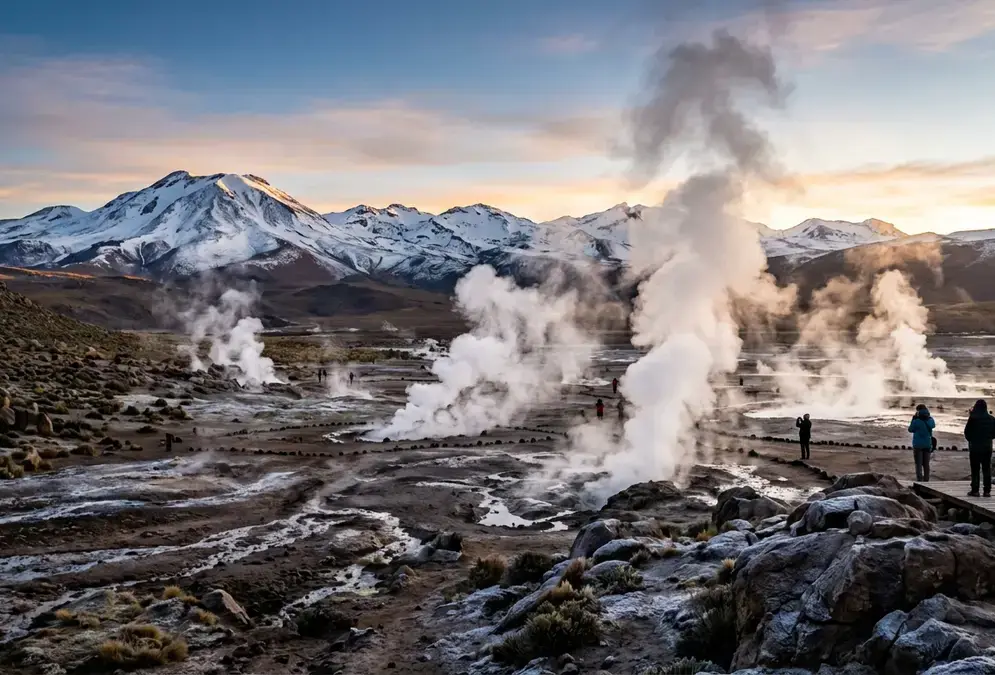
This tour reaches the highest elevations of any standard Atacama day excursion, tied with El Tatio. The gain from San Pedro (2,443 m) to Piedras Rojas (around 4,200 m) is roughly 1,750 m of vertical in 110 km — gradual in distance, steep in effect on an unacclimatized body. Puna (altitude sickness) is common even among fit visitors who handled San Pedro without trouble.

Two to three nights in San Pedro before attempting the circuit is the standard recommendation. Responsible operators carry supplemental oxygen. If you are scheduling both this tour and El Tatio, do not do them on consecutive days — give your body a lower-altitude day in between. The salt flats or Valle de la Luna at 2,300 to 2,900 m work well as recovery options. See the Atacama altitude acclimatization guide for how to plan.
Highlights

  • Piedras Rojas: iron-oxide red boulders above a white salt flat and cobalt lagoon — one of the Atacama's most-photographed viewpoints
  • Laguna Miscanti: the largest altiplanic lake, turquoise water against the snow-dusted cone of Volcán Miñiques (5,910 m)
  • Flamingos foraging at the lagoon edges against a backdrop of volcanic altiplano
  • Socaire village: pre-Hispanic irrigation canals and intact adobe architecture at 3,440 m
  • Full-day 4WD circuit through some of the highest terrain accessible by standard Atacama excursion

Included

  • Round-trip 4WD transport from San Pedro de Atacama accommodation
  • Bilingual guide (Spanish and English)
  • Snacks during the excursion
  • Passenger insurance
  • Supplemental oxygen (responsible operators — confirm when booking)

Not included

  • CONAF entrance fees to the altiplanic lagoon area (CLP 20,300–28,750 per person depending on nationality — payable in cash at gate; confirm whether included with your operator)
  • Meals (bring food and water for a full day)
  • Personal travel insurance
  • Gratuity for guide

Practical information

Availability

Year-round, weather permitting. The Bolivian winter (January–February) can bring afternoon cloud and occasional snow at altitude — tours may be modified or cancelled. Confirm conditions before booking.

Languages

Spanish, English

Group size

Small groups typical — most operators run 6–15 people per vehicle. Private tours available.

Good to know before booking

  • Minimum 2–3 full nights acclimatization in San Pedro de Atacama (2,443 m) before the tour
  • Warm, windproof layers — temperatures at 4,200 m can be well below 10°C even in summer; wind chill intensifies this
  • High-SPF sunscreen and sunglasses — UV exposure at altitude is severe
  • Sturdy closed shoes for short walks on volcanic and rocky terrain
  • Cash in Chilean pesos for entrance fees if not included (CLP 20,300–28,750 per person)
  • Individuals with cardiac or respiratory conditions should consult a physician before booking

Prices & Booking

From €54 approx.

From ~CLP 55,000–85,000 per person, depending on operator and group size — confirm at booking. CONAF entrance fees (CLP 20,300–28,750 per person depending on nationality) are sometimes additional; verify when booking.

Early morning departure from San Pedro, typically 07:00–07:30. Return mid- to late afternoon, approximately 17:00–18:30.

An editorial guide to this experience. Book directly with the operator when you plan your trip.

Tags

altiplanic lagoons piedras rojas miscanti miñiques high altitude flamingos atacama full day 4wd guided tour

Frequently asked questions

How high does the Altiplanic Lagoons and Piedras Rojas tour go?

The highest point of the circuit is around Piedras Rojas and the nearby lagoons, at approximately 4,200–4,300 m (13,780–14,100 ft). That is roughly 1,750–1,850 m above San Pedro de Atacama (2,443 m). The altitude gain is gradual over 110 km of road but significant — comparable to El Tatio. Allow at least 2–3 nights in San Pedro before attempting this excursion.

What is Piedras Rojas and why do people visit it?

Piedras Rojas ('red stones') is a viewpoint in the Chilean altiplano where iron-oxide rock formations in shades of orange and rust sit above a white salt flat with a turquoise lagoon behind them. The colour contrast against the volcanic Andes skyline is one of the most striking natural compositions in the Atacama. It is a short, flat walk from the vehicle stop and accessible to most visitors who are properly acclimatized.

Is this tour suitable for stargazing or dark-sky astronomy?

The tour is daytime only and returns before dark. But the altiplanic lagoon area sits at Bortle Class 2 to 3 — among the darkest skies on Earth — thanks to 4,200 m altitude, minimal light pollution, and excellent atmospheric transparency. If you're specifically planning astronomy, book a dedicated night-observation operator in San Pedro. The best conditions are during a new-moon window between April and November.

Are there flamingos on this tour?

Yes. Chilean and Andean flamingos are regularly present along the edges of Lagunas Miscanti and Miñiques. Numbers vary by season but the lakes are considered reliable flamingo habitat year-round. Vicuña herds are also common on the altiplano between stops.

Why are the lagoons turquoise?

The colour comes from fine mineral particles suspended in glacial melt — runoff from surrounding volcanoes including Volcán Miñiques (5,910 m). These particles scatter light in the blue-green range. The exact shade varies slightly between Miscanti and Miñiques depending on water depth and mineral composition.

What is the CONAF entrance fee and do I need cash?

CONAF charges an entrance fee to the altiplanic lagoon area: CLP 20,300–28,750 per person depending on nationality. Payment is in cash at the gate — cards are not accepted. Some operators include this in the tour price; others collect it separately. Confirm with your operator before departure and carry the correct amount in Chilean pesos.

Should I do this tour before or after El Tatio?

Not on consecutive days. Both tours reach similar altitudes (~4,200–4,300 m), and doing them back-to-back puts repeated altitude stress on your body before it has recovered. Put a lower-altitude day in between — the salt flats or Valle de la Luna at 2,300 to 2,900 m work well as recovery options. The [Atacama 3–5 day itinerary](/articles/atacama-itinerary-3-5-days) maps out a practical sequence.

How long is the drive from San Pedro to the lagoons?

The altiplanic lagoon area is approximately 110 km southeast of San Pedro, around 1.5 hours each way on Andean roads. The return route often passes through Socaire village. Budget the full day — tours typically run 10–11 hours from departure to drop-off.

Further reading

Sources