
What altitude sickness actually feels like at 2,443 m
Soroche is what Andean locals call acute mountain sickness (AMS). At San Pedro's altitude of 2,443 m, most travellers from sea level will notice something within a few hours of arrival: a dull headache that starts at the temples, a sluggishness that does not match how much sleep you had on the plane, and air that feels thinner than it is. Some people feel nothing at all on Day 1 and wake up with a splitting headache at 3 am.
The standard symptom checklist runs to headache, fatigue, loss of appetite, mild nausea, dizziness, and poor sleep quality. None of these is dangerous at town altitude. They are your body telling you that the partial pressure of oxygen is about 25% lower than at sea level and that it needs time to boost red blood cell production. That process takes 24 to 72 hours at a stable altitude.
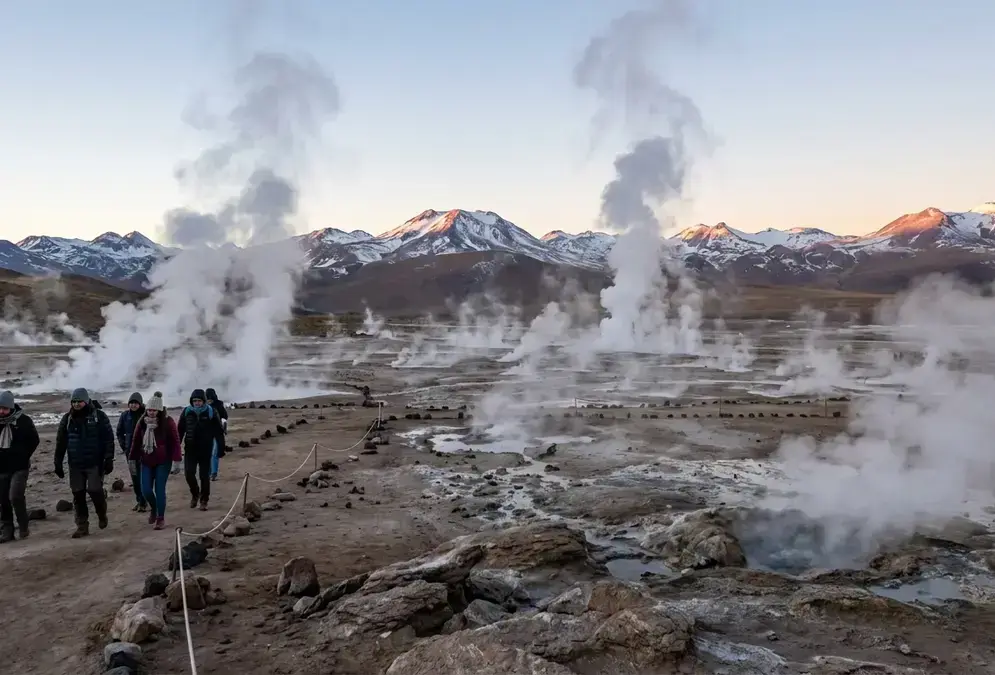
What makes the Atacama more demanding than most 2,400 m destinations is the excursion landscape. Calama, where your plane lands, sits at about 2,260 m, so you arrive already at altitude with no sea-level buffer. Then the most popular tours (El Tatio, altiplanic lagoons) climb nearly 1,900 m above the town in a single morning. The soroche you might have shaken off by Day 3 in town returns hard when you are standing on a 4,300 m geyser field at dawn.
The two-tier altitude problem: town versus excursions
Understanding the two distinct altitude bands is the single most useful thing you can know before you arrive.
Tier 1 — town-level sites (2,300–2,500 m): Valle de la Luna (~2,400 m), the SPACE observatory (~2,450 m), Laguna Cejar (~2,300–2,450 m), and the Salar de Atacama salt flats (~2,300 m) all sit at roughly the same elevation as San Pedro itself. If you can walk around town without symptoms, you can visit these sites. They are not altitude-neutral (you are still at 2,400 m), but there is no additional elevation gain to contend with.
| Site | Altitude | Acclimatization needed |
|---|---|---|
| San Pedro de Atacama (town) | 2,443 m (8,015 ft) | Baseline |
| Valle de la Luna | ~2,400 m (7,874 ft) | None beyond town adjustment |
| SPACE observatory | ~2,450 m (8,040 ft) | None beyond town adjustment |
| Laguna Cejar | ~2,300–2,450 m | None beyond town adjustment |
| Salar de Atacama / Laguna Chaxa | ~2,300 m (7,545 ft) | None beyond town adjustment |
| Puritama hot springs | ~3,450 m (11,319 ft) | 1–2 nights in town recommended |
| Altiplanic Lagoons (Miscanti/Miñiques) | ~4,200 m (13,780 ft) | 2–3 nights minimum |
| El Tatio Geysers | ~4,300 m (14,107 ft) | 2–3 nights minimum |
Tier 2 — high-altitude excursions (4,100–4,320 m): El Tatio Geysers at approximately 4,300 m and the altiplanic lagoons circuit peaking at around 4,200–4,300 m require a proper acclimatization window. The vertical gain from San Pedro to El Tatio is close to 1,900 m, equivalent to driving from Denver to the summit of a Colorado 14er in under two hours.
The practical consequence: your first full day in San Pedro should involve only Tier 1 activity or rest. The urge to cram El Tatio in on Day 2 (it departs at 04:00 am, so you could technically do it on your second morning) is a common mistake. Tour operators carry supplemental oxygen precisely because visitors do this routinely and suffer for it.
How to acclimatize: a practical day-by-day approach
Day 1 is not a rest day by accident. The physiology requires it. When you fly from sea level to 2,443 m, your body needs roughly 24 hours at minimum before it begins producing enough extra red blood cells to compensate. Pushing into strenuous activity or high altitude on Day 1 short-circuits that process.
Here is what the evidence-based guidance actually looks like for the Atacama:
- Drink 3–4 litres of water per day. The Atacama air is extremely dry; relative humidity often drops below 20% in town, and moisture loss through breathing accelerates dehydration without you noticing it. Dehydration worsens every soroche symptom.
- Eat lightly on arrival day. Your appetite suppression is a physiological response, not a quirk. Go with it. Heavy meals before your digestive system has adapted increase nausea.
- Avoid alcohol for the first 48 hours. Alcohol acts as a respiratory depressant and masks early symptoms. This is not a warning you need to follow forever (San Pedro has decent pisco), but the first two nights matter.
- Coca tea (mate de coca) is available everywhere in San Pedro and widely drunk. The evidence for coca leaf as an altitude remedy is mixed in peer-reviewed literature, but it has a long history in Andean communities and may ease mild symptoms. Treat it as a cultural ritual worth having, not a medical protocol.
- Sleep as much as you can. Your body does most of its adaptation work overnight. Poor sleep is both a symptom and a cause of slower acclimatization.
Acetazolamide (Diamox) is the prescription drug used to speed acclimatization. It works by stimulating faster breathing, which raises blood oxygen. At 2,443 m most healthy adults do not need it, but if you have a history of altitude sickness or plan to ascend directly to El Tatio within 48 hours of arriving from sea level, it is worth discussing with a doctor before travel. The dose and timing matter; it is not something to take on arrival without preparation.
Tour sequencing: the order that works
The most important acclimatization decision you will make is not about medication or hydration. It is which tour you book on which day.
The sequence below is what experienced guides in San Pedro consistently recommend. It is structured around the core principle: spend your first two to three days at town-level altitude, then move into Tier 2 excursions once your body has had time to adapt.
Arrival day: Check in, walk the Plaza de Armas, eat something light. Optional: Valle de la Luna at sunset (same altitude as town, easy walk, returns early evening). This is a good first afternoon.
Day 2: Salar de Atacama and Laguna Chaxa in the morning (2,300 m, slightly lower than town). Afternoon rest. The SPACE astronomy tour departs at 21:00 in summer. If your new-moon window aligns, this is an excellent evening activity that requires no elevation gain.
Day 3: Laguna Cejar in the afternoon (2,300–2,450 m). You are still at town altitude. Your body has now had 48+ hours at 2,443 m.
Day 4 or later: the pre-dawn geyser tour. This is the moment you can attempt 4,300 m with a reasonable chance of enjoying it. Most guides consider three nights in town the minimum before El Tatio. The tour departs at 04:00 am; being well-rested (and well-acclimatized) matters more than usual.
Day 5 or later: the high-altitude lagoon circuit. The full day at 4,200 m. After El Tatio, most travellers find this altitude more tolerable, having already spent time above 4,000 m at El Tatio.
This sequence keeps all Tier 2 excursions toward the end of the trip. If your schedule compresses everything into three days, the honest advice is to skip El Tatio entirely and replace it with a second evening at the observatory or a sunset at Valle de la Luna. A bad El Tatio experience (hunched over in cold and altitude fog at 4,300 m) ruins the whole trip retroactively.
When to see a doctor: recognizing serious altitude sickness
Mild soroche is uncomfortable but not dangerous. Severe altitude sickness is a medical emergency, and the line between the two matters at 4,300 m on a pre-dawn El Tatio tour.
1,857 m
Mild symptoms (manageable, stay at current altitude):
- Headache that responds to ibuprofen or paracetamol
- Fatigue and reduced appetite
- Mild nausea without vomiting
- Difficulty sleeping
- Slightly faster breathing than usual
Moderate symptoms (stop ascending, consider descending to San Pedro):
- Persistent headache unresponsive to painkillers
- Repeated vomiting
- Increasing shortness of breath at rest
- Feeling significantly worse rather than better after 6–12 hours at the same altitude
Recommended tours
Tours are selected for quality, not commission. I earn a small fee if you book — at no extra cost to you.

Severe symptoms — descend immediately, seek medical care:
- Confusion or disorientation. Altitude cerebral edema (HACE) causes cognitive impairment before the person affected notices it. If a member of your group seems confused or irrational, this is a red flag.
- Ataxia — loss of coordination, stumbling. Walk-the-line test: ask the person to walk a straight line heel-to-toe. Inability to do this at altitude is a serious HACE warning sign.
- Persistent dry cough or gurgling sound in the chest at rest. These can indicate high-altitude pulmonary edema (HAPE), which is life-threatening.
- Extreme breathlessness at rest that does not improve when sitting up.
Responsible tour operators at El Tatio carry supplemental oxygen canisters and are trained to recognize these signs. If a guide offers you oxygen and recommends returning to the vehicle, take the advice. The standard treatment for all forms of severe altitude sickness is immediate descent. San Pedro has a Centro Médico (medical clinic). The nearest hospital is in Calama, about 100 km away.
For most visitors, this section stays theoretical. At 2,443 m the town-level risk is low. The key is not to make unnecessary decisions that put you at 4,300 m before your body is ready.
Stargazing and altitude: the night-sky visitor's advantage
There is a useful side effect of taking altitude seriously: the acclimatization schedule aligns almost perfectly with the stargazing calendar.
The SPACE astronomy tour at the SPACE observatory operates at town altitude (~2,450 m) and starts in the evening. It is appropriate from Day 1 if you are feeling well: no elevation gain, no cold pre-dawn wake-up, a flat observatory site. Book it on your arrival night or Day 2 evening. That leaves El Tatio for Day 4 or 5, which is exactly where it belongs.
The new-moon dependency adds another layer of planning: the SPACE observatory cancels all tours for approximately seven nights around the full moon. Booking the stargazing tour during the new-moon window, then scheduling El Tatio toward the end of your stay, effectively solves both the altitude-sequencing and the moon-phase problem simultaneously.
Cold is the other variable at the high-altitude sites. El Tatio at dawn in July can reach -15°C. Even at San Pedro town level, pre-dawn temperatures drop below 0°C in June and July. The dry Atacama air makes cold feel sharper than the thermometer suggests. Warm layers are not optional on night stargazing tours, and they are critical on the El Tatio trip; altitude-related cold stress compounds soroche symptoms.
A rough gear list for both the observatory and the high-altitude excursions:
- Insulated jacket (down or synthetic, rated to at least -10°C)
- Thermal base layer
- Warm hat and gloves
- Wind-resistant outer layer for El Tatio's exposed geyser field
- Sunscreen and sunglasses (UV exposure at 4,300 m is significantly higher than at sea level)
The Atacama stargazing gear guide covers equipment choices in more detail if you are planning for astrophotography.