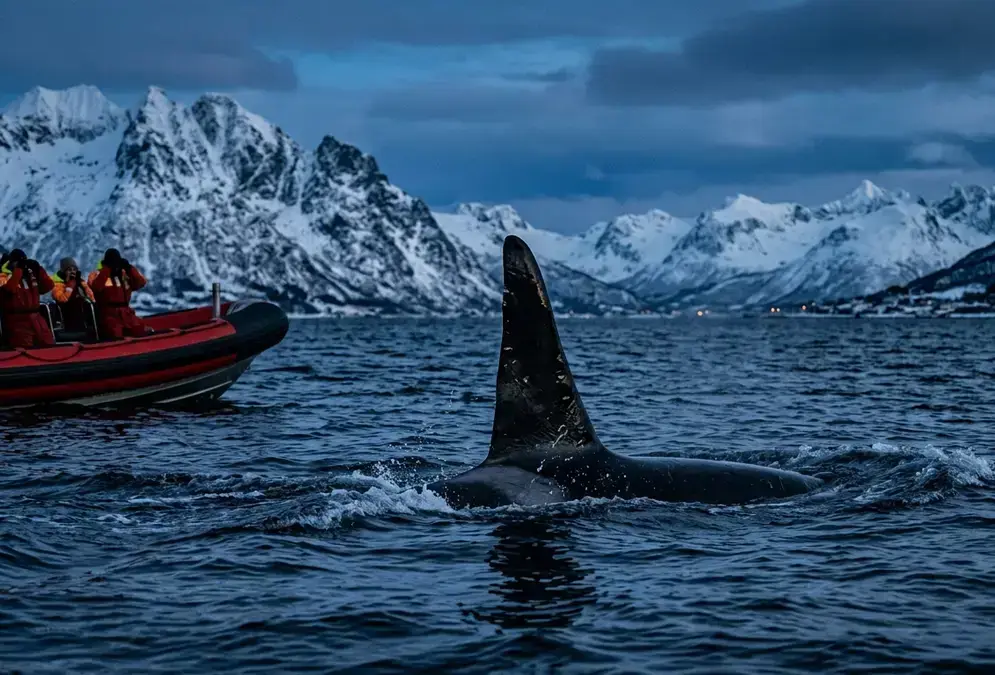

Whale watching in the Tromsø fjords
Whale watching season in Tromsø runs from November through January, when orca and humpback whales follow dense herring shoals into the fjords around Skjervøy and the surrounding archipelago[1]. At peak season, pods of orca can number in the dozens, and humpback whales surface close enough to the boat that you can hear them exhale. Arctic Whale Tours, which partners with active whale researchers to locate pods, reports roughly a 99% sighting rate during this window[2].
Book before you arrive. Demand outpaces supply on good weather days, and smaller boats with naturalist guides fill weeks ahead. The most ethically run operators prohibit encircling pods or using hydrophones to attract animals. The Green Gold of Norway certification marks which operations have committed to those standards, separating responsible outfitters from the volume-tourism end of the market. If your trip falls in November, sightings are less consistent as the herring aggregations build; by mid-December the concentrations are typically at full density.
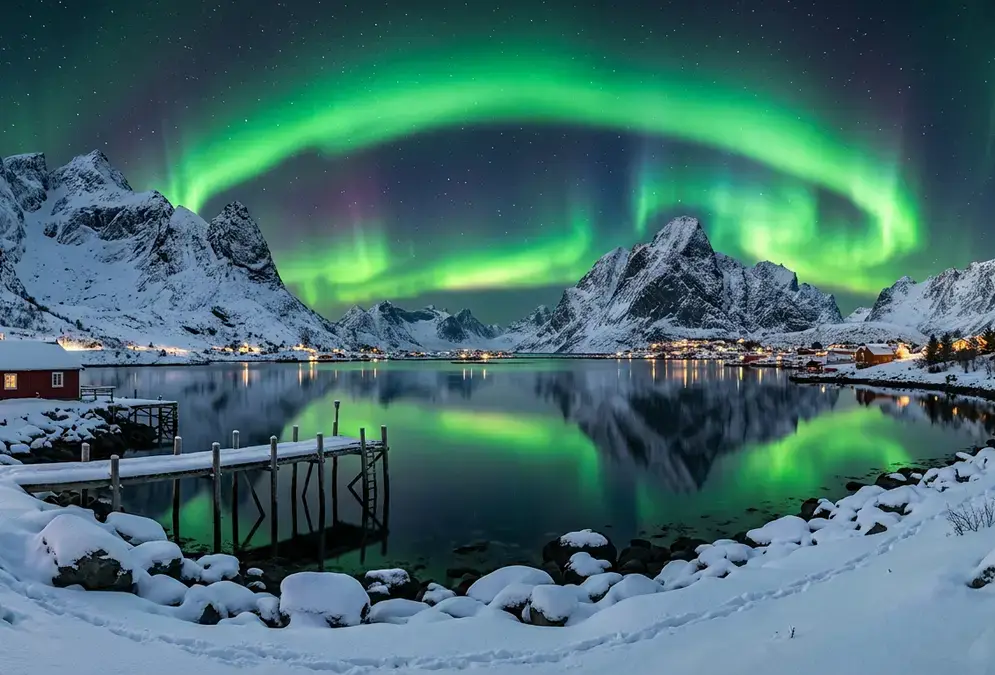
Featured · Destination
Northern Lights in Tromsø
At 69.6°N inside the auroral oval, Tromsø sees aurora at Kp 2. Peak season November–February. Best viewing spots, tour advice, and aurora forecast strategy.
A whale watching tour Tromsø is one of the few Arctic wildlife experiences that genuinely does not depend on clear skies. Cloudy nights become irrelevant once you are on the water.
Husky sledding and Sámi reindeer tours
Husky sledding runs from December through March[3]. The best operations run through the birch forest valleys east and southeast of Tromsø, where guides manage the dogs while you ride, then rotate so each passenger handles the sled for a portion of the route. Moving through Arctic birch forest at dog speed, with the only sounds being paws on packed snow and occasional commands from the guide, is a different category of experience from standard winter tourism. Half-day trips typically cover three to four hours on the trail.
The Sámi reindeer experience is a separate and distinct category. Tromsø is one of the main hubs for Sámi culture in Norway, and several operators run traditional reindeer sled tours with cultural interpretation by Sámi guides. These cover the reindeer husbandry cycle, traditional joik singing, and the relationship between the Sámi people and the Arctic landscape they have managed for centuries. Hot lingonberry tea by an open fire is usually part of the package. A Sámi reindeer experience Tromsø runs morning and afternoon departures through most of the winter season, and it pairs naturally with an Arctic husky safari Tromsø on a multi-day visit. Sámi National Day on February 6 adds cultural context that individual tours alone cannot replicate.
Read next · Tour
Tromsø Sami Reindeer Experience — Camp Tamok
Evening reindeer sledding tour from Tromsø into Tamok Valley. Sami family guides share their heritage around the lavvu fire; full three-course dinner included.
Arctic Cathedral and Polaria
The Arctic Cathedral (Ishavskatedralen, meaning Cathedral of the Arctic Sea) is Tromsø's most recognized building. The structure's white triangular aluminum panels mimic the shape of glacial crevasses; the east-facing stained glass mosaic, one of the largest in Europe[4], floods the interior with diffused Arctic light on clear winter days. Concerts run through the winter season, and the acoustic properties reward a visit beyond the usual photo stop. The cathedral is a 20-minute walk from the city center, across the Tromsøya bridge.
Polaria is the world's northernmost aquarium[3], housed in a building whose irregular profile was designed to suggest ice floes drifting ashore. The permanent exhibition covers Arctic and sub-Arctic sea life, polar bear ecology, and the environmental history of the Svalbard region. Seal feeding demonstrations run daily. Family tickets for two adults and up to three children start from NOK 925[6], and the visit runs about 90 minutes at a relaxed pace. On a poor-forecast afternoon, it fills time well.
For visitors arriving primarily for the aurora, both sites reframe what a Tromsø winter actually contains. Ishavskatedralen and Polaria are ten minutes apart on foot.
Fjellheisen and the city on foot
The Fjellheisen cable car runs from the east side of Tromsøya island to the Storsteinen summit at 421 meters, a four-minute ride to an unobstructed panorama over the city and surrounding fjord[7]. Winter hours typically run from 10:00 to 22:00, though these shift seasonally; verify on the day of your visit. On clear nights, the summit is a legitimate aurora-viewing platform with a 360-degree horizon and no direct city light interference. On cloudy nights, going up can sometimes place you above the coastal cloud layer, though this is not a reliable workaround.
Recommended tours
Tours are selected for quality, not commission. I earn a small fee if you book — at no extra cost to you.

Tromsø city center is compact enough to cover on foot in an afternoon. The harbor district groups the main cultural sites close together:
421 m
- The Polar Museum (Polarmuseet) covers Arctic exploration history
- The Arctic University Museum spans geology, natural history, and Sámi heritage
- The Troll Museum covers Norwegian folk tradition and regional mythology
- The Tromsø War Museum, housed in a WWII bunker, covers Operation Catechism and the sinking of the Tirpitz
The Tromsø Pass bundles these alongside Fjellheisen and Polaria[5], and pays for itself quickly on any day that poor cloud forecasts rule out outdoor activity. Activating it on an overcast day rather than a clear-sky day, when outdoor time is genuinely valuable, gets the most from the purchase.
Arctic cuisine and Mack Brewery
Reindeer meat appears on Tromsø menus from November through March, and ordering it here is not novelty dining. Reindeer steak runs lean and slightly gamey, closer to venison than beef, and the traditional preparation with lingonberry sauce and juniper berries reflects centuries of Sámi cookery. Skarven, near the harbor, does a reliable version alongside a fish soup that sets the standard against which other versions in the city are measured. Mathallen Tromsø focuses on reindeer stew with foraged Arctic herbs.
Mack Brewery (Macks Ølbryggeri) was founded in 1877 and held the title of the world's northernmost brewery for over a century, until production moved to Nordkjosbotn, ending that record[8]. The historic Mack quarter in central Tromsø still houses the administration, a microbrewery, and the Ølhallen bar. Mack Bayer, the brewery's dark lager, is the pairing locals reach for alongside reindeer, and the Ølhallen is where you find it on draft in a room that has barely changed in decades.
Both reindeer and the Mack Ølhallen are worth treating as food tourism in their own right rather than filler between outdoor activities.
Planning for cloudy nights
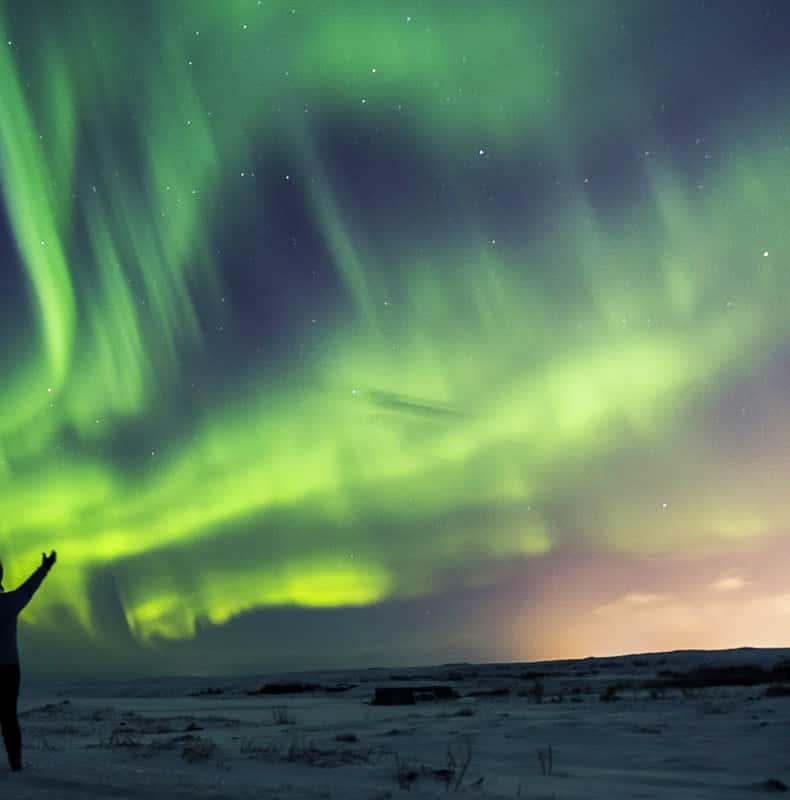
The honest framing: some nights in Tromsø will be overcast and the aurora will not appear. Polar night, which runs from November 26 to January 15, means the sky is dark enough for aurora viewing across most of the day during deep winter[9]. But cloud cover overrides geomagnetic activity every time, and it cannot be forecast reliably more than 48 hours out. The northern lights in Tromsø destination page covers what to track, when to check it, and how to position yourself when cloud gaps open across the fjord valleys.
A three-night minimum is the baseline for a dedicated aurora trip; five nights gives substantially better odds. If your schedule allows flexibility, build that flexibility explicitly into the booking so that whale watching, husky sledding, and city activities fill the overcast gaps rather than compete with clear nights. For a detailed breakdown of how trip length changes your probability of a sighting, see how many days in Tromsø for northern lights.
The Tromsø Pass makes most sense when activated on a day that poor cloud forecasts rule out outdoor activity entirely[5]. An afternoon covering three museum-level attractions alongside a cable car ride is not a consolation prize. Visitors who plan backup activities in advance leave Tromsø satisfied regardless of cloud cover; those who plan only for the aurora, and get cloudy nights, rarely do.
| Activity | Season | Weather dependent | Book ahead |
|---|---|---|---|
| Whale watching | Nov–Jan | Runs in all weather | Yes, weeks ahead |
| Husky sledding | Dec–Mar | Snow needed, not clear sky | Recommended |
| Reindeer / Sámi tour | Nov–Mar | Runs in all weather | Recommended |
| Arctic Cathedral | Year-round | No | No |
| Polaria | Year-round | No | No |
| Fjellheisen cable car | Year-round (seasonal hours) | Better with clear sky | No |