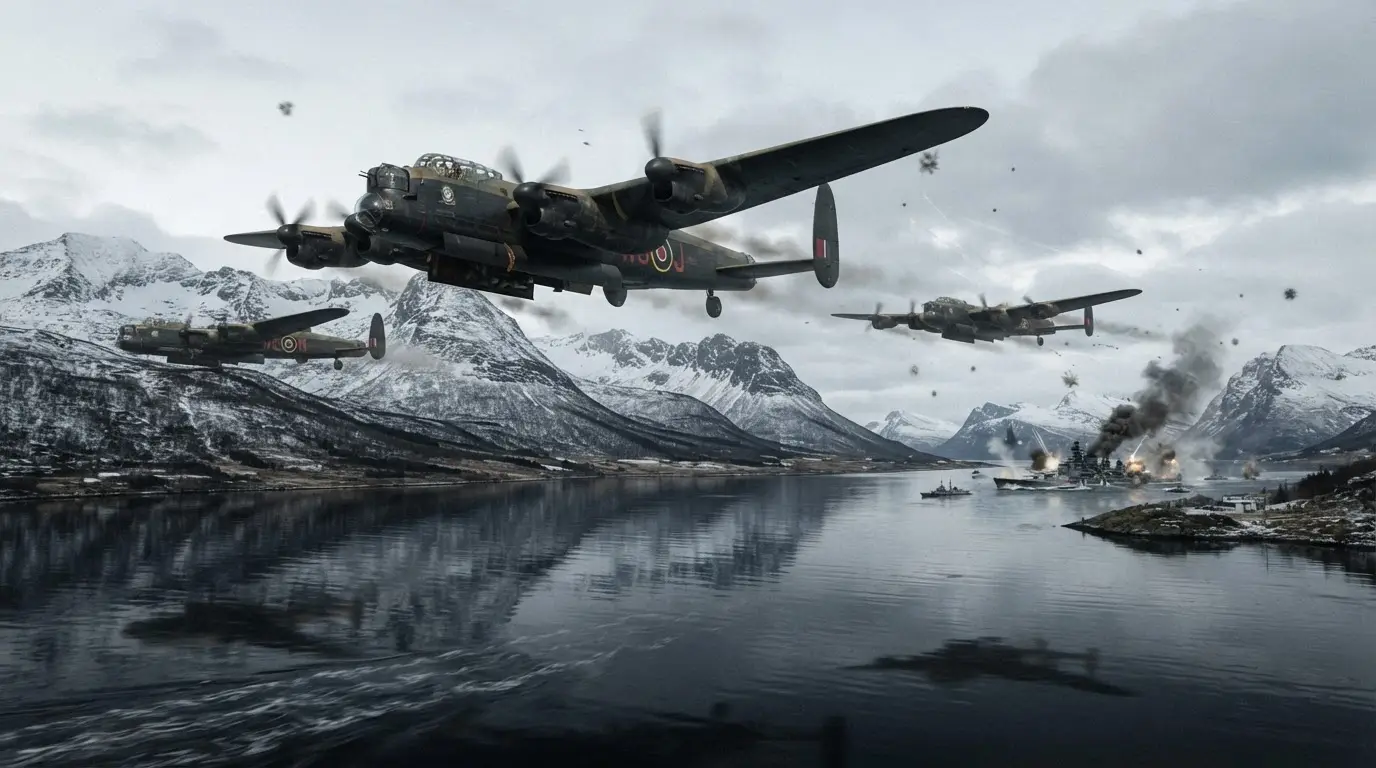

Why Tirpitz was worth six failed raids
Tirpitz was the sister ship of the Bismarck and, by 1944, Nazi Germany's last operational battleship — 251 metres long, displacing more than 50,000 tons fully loaded, armored with 30 cm of hull steel, and carrying eight 38 cm guns[6]. She rarely needed to fire a shot to matter. Stationed in Norway to threaten the Arctic convoys hauling tanks, ammunition and other war materiel from Britain and the United States to the Soviet port of Murmansk[7], her mere presence tied down Royal Navy units that could otherwise have sailed elsewhere.
That single fact is why the Allies spent more than a year on operation after operation trying to sink her. By November 1944, the fjord where she now sat, near Tromsø, was about to lose its daylight for the winter — and the RAF had a dated, narrowing window to finish the job before the dark made accurate bombing impossible[3].
Six attempts, one battleship: from midget submarines to Tallboy bombs
Getting to November 1944 took nearly fourteen months and a run of operations that mostly failed. In September 1943, Royal Navy midget submarines slipped under Tirpitz's defenses at her long-time anchorage in Kaafjord, near Alta, and planted explosive charges on her hull during Operation Source[2]. The damage put her out of action for months, but she stayed afloat.
Over the next year, the Allies kept trying:
- Operation Tungsten (3 April 1944) — Fleet Air Arm aircraft flying from Royal Navy carriers struck Tirpitz and inflicted further damage[8].
- Operations Mascot and Goodwood (July–August 1944) — further carrier strikes failed to finish the job, after which planners judged the Fleet Air Arm's aircraft and armament simply inadequate for the target, and handed the job to RAF Bomber Command[9].
- Operation Paravane (15 September 1944) — the first raid to use the Tallboy bomb against her; a single hit wrecked her bow and left her unfit for combat[10].
- Operation Obviate (29 October 1944) — flown by the same two RAF squadrons on the same route Catechism would later fly; cloud rolled over the target seconds before the bomb run, and all 33 Tallboys dropped that day missed[11].

Featured · Destination
Northern Lights in Tromsø
At 69.6°N inside the auroral oval, Tromsø sees aurora at Kp 2. Peak season November–February. Best viewing spots, tour advice, and aurora forecast strategy.
Six operations, six failures — and Tirpitz was still afloat, still armed, and still tying down ships the Allies wanted elsewhere.
Why Tirpitz ended up at Håkøybotn, not Kaafjord
Tirpitz's last anchorage is where a lot of accounts trip up. She spent most of the war at Kaafjord, near Alta — that's where Source, Tungsten and Paravane all hit her. By October 1944 she could no longer be repaired, so Grand Admiral Karl Dönitz, commander of the Kriegsmarine, ordered her moved to open water near Tromsø and used as an immobile battery instead of a fighting ship[12].
The move turned out to be a serious miscalculation. The water at the new mooring was deeper than expected, and Tirpitz's own torpedo nets took up so much room that she couldn't be brought in closer to shore[13]. That left her floating in water deep enough to capsize in, rather than settle onto the seabed, if she were ever hit again — which is what happened five weeks later off the island of Håkøya, in Håkøybotn[14].
Tromsø War Museum, housed in a wartime bunker, is the site that tells this story: the final sinking, not the years Tirpitz spent up north at Kaafjord[15].
The 23-day deadline: racing the Arctic dark
Tirpitz's move to open water bought the Allies a second chance, not an unlimited one. In early November 1944, a Naval Intelligence report set a hard limit: any further attack had to happen within 23 days, because the coming near-total darkness of the Arctic winter would soon make it impossible to bomb the target accurately at all[3]. Tromsø's winter darkness is a selling point for aurora travel today; in November 1944 it was the RAF's deadline.
- Early Nov 1944
23-day deadline set
Naval Intelligence orders one last attempt before the polar night
- 4 Nov 1944
Weather watch begins
Mosquitoes fly daily sorties from RAF Sumburgh[18]
- 11 Nov 1944
Lancasters move to Scotland
9 and 617 Squadrons stage at Kinloss, Lossiemouth and Milltown[19]
- 12 Nov 1944
Operation Catechism flies
32 Lancasters take off for Tromsø
Getting a Lancaster to Tromsø and back meant stripping out the mid-upper gun turret and pilot's armor plate to fit extra fuel tanks, a modification that let the raid fly directly from Britain rather than staging through a Soviet airfield[16]. When the forecast finally cooperated, 32 Lancasters from 9 and 617 Squadrons lifted off for northern Norway[17].
Operation Catechism: the morning Tirpitz capsized
The 32 Lancasters — 18 from 617 Squadron, 13 from 9 Squadron, plus one film aircraft from 463 Squadron RAAF[17] — rendezvoused over Lake Torneträsk in northern Sweden before turning for the target[20]. Wing Commander James "Willie" Tait, 617 Squadron's commanding officer, spotted Tirpitz from 20 miles out.
“"lying squat and black among her torpedo nets like a spider in her web, silhouetted against the glittering blue and green waters of the fjord"[21]”
By the time Tirpitz's crew realized what was coming, it was already too late to do much about it. She radioed Bardufoss airfield for fighter cover around 9:15 am, but the call came too late for any fighter to reach Tromsø before the bombers did[22]. Shortly after 9:40 am, two Tallboys struck her port side amidships, with four more near-missing the hull[23]. She was struck by two Tallboys that penetrated her armored deck[24], and by 9:52 am she had capsized[25].
Within two hours, 596 of her crew had swum to shore or been pulled from the water[26]. None of the attacking aircraft was seriously damaged, and every Lancaster made it home[27]. Estimates of the total dead vary, with the most commonly cited range running from 940 to 1,204[5] — a naval-history operational log puts the figure at a more precise 971[28].
After the sinking: a freed fleet and a war grave
Tirpitz's destruction did more than end one ship. It freed more than half of the Royal Navy's Home Fleet for other theatres, including reinforcements sent to fight Japan in the Pacific[29]. Air Commodore Ralph Cochrane, commander of No. 5 Group RAF, recommended Tait for the Victoria Cross for his part in the raid[30].
On the German side, the failed defense had a cost of its own. Major Heinrich Ehrler, the fighter wing's temporary commander at Bardufoss, was court-martialled over the failed scramble, convicted, sentenced to three years, and released within a month, demoted[31].
The wreck itself stayed in the fjord for years. A Norwegian scrap company bought salvage rights in 1948 and worked the site until 1957, by which point most of the battleship had been cut away and removed[32]. What's left is registered as a protected area and treated as a war grave[14] — a status that echoes the German salvage crews who, on the day itself, cut a hole near the starboard propeller shaft to reach trapped survivors[33].

Featured · Article
What Causes the Northern Lights? The Science Explained
Solar wind collides with Earth's magnetic field, funneling charged particles toward the poles, where they excite oxygen and nitrogen into glowing color.
Eighty years on, the fjords that framed Tirpitz's last morning are known for a different kind of light. Tromsø's aurora science now draws travelers to the same winter darkness that once counted down the RAF's deadline, and anyone chasing displays over Håkøybotn today is standing where the last of Hitler's battleships went down. The region's best aurora viewpoints are within reach for a trip built around it.