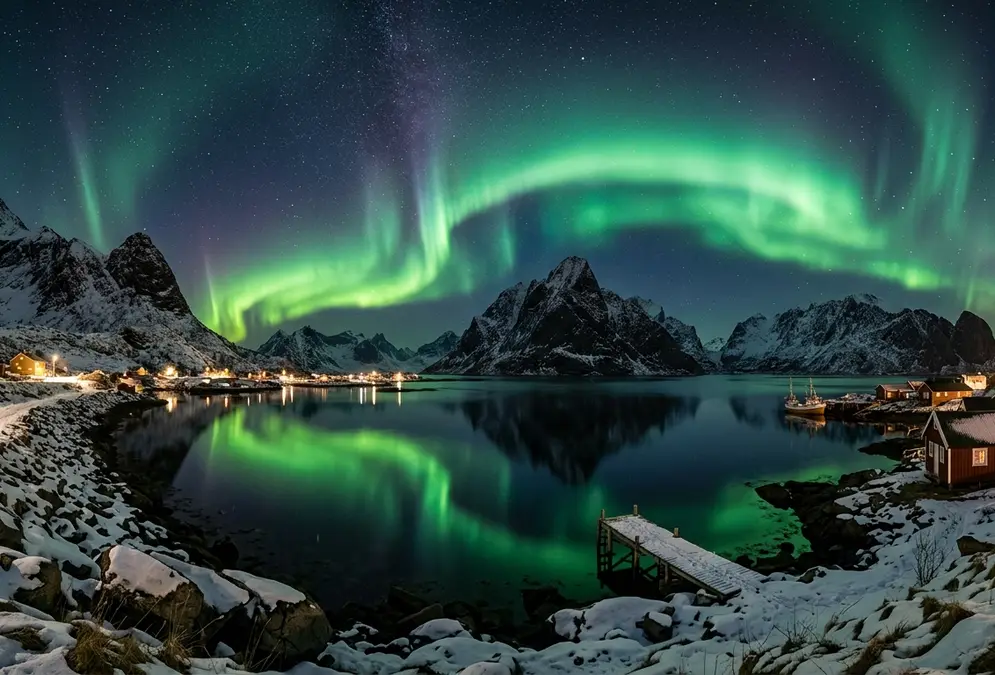




Panoramic aurora borealis above a snow-dusted fjord near Tromsø, Norway, broad green curtains arching overhead reflected in calm dark water, mountain silhouettes framing the scene, best northern lights spots near Tromsø

Best Northern Lights Spots near Tromsø: Complete Guide

Seven aurora viewing spots ranked near Tromsø, rated Bortle 2-6, from a 25-30 minute walk to Telegrafbukta to a 90-minute drive to Lyngenfjord's clearer sky.

Our top pick

Ersfjordbotn

Best overall

Ersfjordbotn is the most consistently recommended first-time spot because Bus 425 gets you there in about 30 minutes with no rental car or studded tyres required, and the Bortle rating drops to 3-4 inside a full fjord bowl that frames the sky with mountains on three sides. It works as both a first-timer's spot and a repeat-visit default. The one real limit is the bus timetable: the last service back leaves before a late-developing storm has time to build.

Bortle 2 to 6 across seven ranked spots, from a 25-30 minute walk to a 90-minute drive east.

Runner-up: Kvaløya Island circuit, the best pick once you have a rental, for flexible cloud-chasing along a long coastline.

Tromsø sits at roughly 67° magnetic latitude, well inside the auroral oval, where even a mild Kp index reading can put a visible arc on the northern horizon. That is the reason almost every serious aurora itinerary in Norway starts here rather than further south. The city itself sits under light-polluted, city-centre skies, a suburban glow that hides all but the brightest displays, but you do not have to travel far to change that: thirty minutes gets you to Bortle 3-4, and ninety minutes gets you to Bortle 2.

The seven spots below are ranked for how well they turn that gradient into a real evening out, weighing sky darkness against how easily you can actually reach them. Some need nothing more than a city bus and a fixed return time. Others need a rental car, studded winter tyres, and a willingness to reposition when cloud moves in. Aurora season runs late September through late March, with October through February offering the longest dark windows and, in most years, the best odds against cloud.

Ranked list

How we chose

The places on this list were selected against the following editorial criteria.

  • Access: whether the spot is reachable by city bus, by car in under an hour, or needs a longer drive east
  • Bortle-scale sky darkness at the specific location, not the general region average
  • Reliability under variable cloud cover, including how easily you can reposition if the sky doesn't cooperate
  • Foreground and composition value for aurora photography, where it's a genuine differentiator

All picks at a glance

  • Ersfjordbotn

    Best overall
    Access
    Bus 425 ticket · ~30 min from downtown
    Why it makes the list
    Bus 425, ~30 min, Bortle 3-4, full fjord bowl for foreground
  • Kvaløya Island circuit

    Best for flexible cloud-chasing
    Access
    Requires rental car · 30 min to shore, ~1 hr to Kvalsund
    Why it makes the list
    Long fjord coastline at Bortle 3, reposition 10-15 min to dodge cloud
  • Lyngenfjord valley

    Best for beating Tromsø's cloud
    Access
    Requires rental car or guided tour · 90-120 min via E6
    Why it makes the list
    Bortle 2-3 behind mountain ridges that often block Tromsø's coastal weather
  • Oldervik

    Best sky darkness under an hour
    Access
    Requires rental car · under 1 hr via E8
    Why it makes the list
    Bortle 2, airglow visible, under an hour by car via the E8
  • Skibotn

    Best easy parking on a long drive
    Access
    Requires rental car · 70-80 min via E6/E8
    Why it makes the list
    Bortle 3 at the E6/E8 junction, flat gravel pull-in, 70-80 min out
  • Telegrafbukta

    Best walk from downtown
    Access
    Free · 25-30 min walk, no bus timetable
    Why it makes the list
    Bortle 4-5, 25-30 min walk, fjord reflections light up at Kp 3+
  • Fjellheisen cable car

    Best cloudy-night backup
    Access
    Ticketed cable car · ~10 min from center
    Why it makes the list
    421m summit clears low haze, but city lights stay directly below

When to go

Aurora season runs late September through late March, with October through February offering the longest dark windows and, in most years, the best odds against cloud.

  • Jan: Good
  • Feb: Peak — Most repeat visitors recommend February: cloud cover improves and solar maximum keeps activity elevated
  • Mar: Good — Season winds down by late March
  • Apr: Off-season
  • May: Off-season
  • Jun: Off-season
  • Jul: Off-season
  • Aug: Off-season
  • Sep: Fair — Season begins late September, with a statistical uptick around the autumn equinox
  • Oct: Peak — Best combination of adequate darkness and favorable cloud cover
  • Nov: Good
  • Dec: Good — Longest nights of the season but the cloudiest month

Reporter notebook

Insider tips

Best time

Check cloud radar before you check Kp

Open Yr.no or the Norwegian Meteorological Institute's cloud-layer map before you look at the Kp forecast. A uniform gray sky across all quadrants means conditions are the same everywhere; a clear wedge east of the mountains means the Lyngenfjord drive is worth it. Check again at 9 p.m. and 11 p.m.; cloud moves faster than hourly updates suggest.

Money tip

Bus 425 gets you to Bortle 3-4 for the price of a ticket

Ersfjordbotn, reachable on Bus 425 in about 30 minutes, gives you a genuine two-category jump in sky darkness over the city center without a rental car, a guided tour, or a taxi. Save the car rental and the guided-tour budget for the nights you specifically want to reach Oldervik or Lyngenfjord.

In this guide

7 places
  1. Ersfjordbotn

    Best overall

    Bus 425 ticket · ~30 min from downtown

    Ersfjordbotn is the spot almost everyone recommends first, and for good reason. Bus 425 runs from central Tromsø in around 30 minutes, so you don't need a rental car or studded tyres to get here. The Bortle rating drops to 3-4, a real step down from the city's light-polluted skies, and the village sits inside a full fjord bowl: mountain silhouettes on three sides, open sky overhead, flat ground for a stable camera. It works as a first-timer's spot and as a repeat-visit default, since it's close enough to check on every clear evening of a longer stay without spending a car-rental day on it.

    The catch is the timetable. If a storm is still building at midnight, the last bus back has already left, and a taxi or a prearranged pickup is the only way home. Anyone planning to wait out a late Kp spike should drive instead.

    Pros

    • No car or studded tyres needed
    • Bortle 3-4, a real step down from city skies
    • Full fjord bowl gives mountain-framed foreground
    • Close enough for repeat visits without a rental

    Cons

    • Last bus leaves before midnight
    • Need a taxi or prearranged pickup for late storms
  2. Kvaløya Island circuit

    Best for flexible cloud-chasing

    Requires rental car · 30 min to shore, ~1 hr to Kvalsund

    Kvaløya has no single viewpoint. What it has is a long stretch of fjord-facing coastline at Bortle 3, reachable by car across the bridge west of Tromsø, which makes it the best option once you have your own transport. Aurora forecasting here is mostly a cloud problem, not a Kp problem: on most nights, patches of cloud drift across parts of the sky, and a driver can reposition 10-15 minutes along the shore road to stay under a gap rather than sitting still and hoping.

    The eastern-shore pullouts start at the 30-minute mark from Tromsø center. Continuing to Kvalsund at the northern tip takes about an hour and opens a clean north-facing view with almost no ambient light. Troms county permits studded winter tyres from 16 October through 30 April, a wider window than Norway's national default; confirm your rental has them before leaving the airport lot, since not every agency fits them by default.

    Pros

    • Bortle 3 along a long stretch of coastline
    • Easy to reposition around patchy cloud
    • Kvalsund offers a clean north-facing view with minimal ambient light

    Cons

    • No single named viewpoint, requires driving to find a spot
    • Needs studded tyres confirmed at rental pickup
  3. Lyngenfjord valley

    Best for beating Tromsø's cloud

    Requires rental car or guided tour · 90-120 min via E6

    When Tromsø's sky is gray and the Kp index still reads 3-4, this is where local guides go. The city sits exposed to marine weather off the Norwegian Sea; the Lyngenfjord valley, 90-120 minutes east along the E6, sits behind mountain ridges that often block or redirect the same weather system. It's not a guarantee, when cloud runs deep and inland, both places are overcast, but the gap shows up often enough that regulars treat the drive as routine.

    The payoff is real: Bortle 2-3 skies, the Lyngen Alps rising past 1800m along the fjord wall for foreground, and genuine dark adaptation within 20 minutes of stepping out of the car. Driving yourself means watching cloud radar and committing to 90 minutes each way on the E6. If you'd rather not make that call at midnight, a guided chase tour drives east and repositions based on live conditions instead of a fixed itinerary.

    Pros

    • Bortle 2-3 skies with Lyngen Alps foreground
    • Mountain ridges often block the marine weather that clouds out Tromsø
    • Dark adaptation within 20 minutes of stepping out of the car

    Cons

    • 90 minutes each way on the E6, no shortcut
    • Both sides can be overcast when cloud runs deep and inland
    • No public bus, self-drive or guided tour only
  4. Oldervik

    Best sky darkness under an hour

    Requires rental car · under 1 hr via E8

    Oldervik is a small fjord hamlet reachable from Tromsø via the E8 and a smaller coastal road in under an hour, and it's among the darkest skies you can reach without committing to the longer drive east. Bortle 2: airglow is visible on clear nights, the Milky Way core resolves into distinct dust lanes, and the village itself has almost no street lighting. The northern horizon opens cleanly over the fjord with nothing in the way.

    The limiting factor is the approach road, an exposed coastal stretch that can close temporarily after heavy wind or snowfall. Check current conditions on vegvesen.no before you commit. If it's open, this beats Skibotn and Kvaløya on raw darkness. If it's closed, Skibotn is the next-best trade of distance for sky quality.

    Pros

    • Bortle 2, the darkest reachable sky under an hour
    • Milky Way core resolves into distinct dust lanes
    • Clean northern horizon over the fjord, almost no street lighting

    Cons

    • Exposed coastal road can close after heavy wind or snowfall
    • Check vegvesen.no before committing
  5. Skibotn

    Best easy parking on a long drive

    Requires rental car · 70-80 min via E6/E8

    Skibotn sits at the E6/E8 junction, 70-80 minutes from Tromsø at the inner end of the Lyngenfjord, and it's the easiest of the longer drives to actually park at. A flat gravel area beside the road gives a clean, straightforward view north over the water. Bortle 3, with the Lyngen Alps closing off the western horizon but the north and east wide open. In Kp 4 and above, displays here extend from the horizon to overhead.

    The E6 is a priority-maintained road, so conditions at Skibotn are usually manageable whenever Tromsø's own streets are passable, which isn't true of Oldervik's side road. South of here, the Tamok Valley is mostly guided-tour territory: local Sámi operators run aurora evenings with open-fire cooking and reindeer, worth booking once but not a self-drive dark-sky stop in its own right.

    Pros

    • Easiest of the longer drives to actually park at
    • Priority-maintained E6 stays passable when other roads don't
    • Displays extend overhead at Kp 4 and above

    Cons

    • Lyngen Alps block the western horizon
    • Still over an hour each way
  6. Telegrafbukta

    Best walk from downtown

    Free · 25-30 min walk, no bus timetable

    Telegrafbukta is a city beach at the southern tip of Tromsøya, a 25-30 minute walk from the center, and it's the closest no-car option on this list, with no bus timetable to work around. Bortle 4-5: city glow still sits on the northern horizon, and open water adds real wind chill on a still night. When conditions are calm and Kp is active, fjord reflections off the water add genuine visual drama that the more remote spots can't offer from a beach.

    The trade-off is directional. Aurora at moderate activity anchors low on the north horizon, exactly where Telegrafbukta's light dome interferes most. This spot earns its place when a Kp 3 or higher storm pushes the arc overhead, not as a default pick for a quiet night.

    Pros

    • Closest no-car option, no bus schedule to work around
    • Fjord reflections add drama on calm, active nights

    Cons

    • City glow sits exactly where aurora anchors at moderate activity
    • Only earns its place at Kp 3 or higher
    • Open water adds real wind chill
  7. Fjellheisen cable car

    Best cloudy-night backup

    Ticketed cable car · ~10 min from center

    Fjellheisen rises 421m to the Storsteinen plateau in a four-minute cable-car ride, about 10 minutes from the center by car or bus first. It ranks last because the light-polluted, city-centre skies follow you up: the city lights sit directly below no matter how high you go. What you get instead is a 360-degree unobstructed horizon and enough elevation to clear low coastal haze, so on nights when cloud sits at 200-300m over Tromsø, the summit can be clear while the streets below are socked in.

    Tickets and operating hours are required and limited, so check before building a night around it. Treat this as a secondary option for a city-and-aurora composition or a cloudy-night backup, not a primary dark-sky destination; the no-car options at Ersfjordbotn or Telegrafbukta beat it on a genuinely clear night.

    Pros

    • 360-degree unobstructed horizon
    • Can clear a low cloud layer sitting at 200-300m over the city

    Cons

    • Light-polluted skies follow you up, city sits directly below
    • Tickets and hours are limited, check before building a night around it
    • Beaten by the no-car options on a genuinely clear night

None of these spots guarantees anything on a given night. The decision that matters is how you read the sky in the 30 minutes before you leave, not which viewpoint you picked in advance. Check a cloud-layer map, not just the Kp index, at 9 p.m. and again at 11 p.m.: a uniform gray sky means conditions are the same everywhere, but a clear wedge over the mountains east of the city is the signal to drive for Skibotn or Lyngenfjord instead of waiting in town.

Kp sets the baseline for how far you need to travel. At Kp 1-2, Ersfjordbotn or the near Kvaløya pullouts are enough. At Kp 4 and above, the drive to Oldervik or Lyngenfjord pays off in overhead structure the closer spots can't match under city glow. And if you'd rather not make that call yourself at midnight, a guided evening like the guaranteed-sighting aurora tour handles the driving and the cloud-reading for you. One thing worth repeating: Bortle 3-4, visited on four clear nights, beats Bortle 1 visited once. Don't skip Ersfjordbotn every night chasing a marginally darker sky further out.

Frequently asked questions

Can you see northern lights from Tromsø city centre?

You can see aurora from the city center when activity is strong (Kp 4 and above), but the light-polluted, city-centre skies significantly reduce what you can see at moderate Kp levels. A 25-30 minute walk to Telegrafbukta or a 30-minute bus ride to Ersfjordbotn both make a measurable difference in sky darkness. For Kp 1-2 displays, the city itself is too bright to show anything.

Do you need a car to see northern lights in Tromsø?

No. Bus 425 runs to Ersfjordbotn (Bortle 3-4, around 30 minutes), and Telegrafbukta (Bortle 4-5) is a 25-30 minute walk from the center. Both are usable no-car options for evening aurora hunting. The trade-off with the bus is a fixed timetable: you cannot stay until 2 a.m. chasing a late-developing Kp storm without arranging a taxi. A car gives you Kvaløya's long coastline for flexible repositioning and the option to drive east to Skibotn or Lyngenfjord when cloud patterns favor it.

What is the best spot for northern lights near Tromsø?

Ersfjordbotn is the most consistently recommended first-time spot: Bortle 3-4, accessible by Bus 425 in 30 minutes, with a full fjord view and good foreground. For car users, Kvaløya Island offers the best cloud-chasing flexibility, while Oldervik (Bortle 2, under an hour by car) delivers the darkest sky within easy reach. When Tromsø is clouded but conditions look better inland, the Lyngenfjord valley 90 minutes east is where local guides go.

How far is Lyngenfjord from Tromsø?

The Lyngenfjord area is roughly 90-120 minutes by car from central Tromsø along the E6 southeast. Skibotn, at the inner end of the fjord near the E6/E8 junction, is about 70-80 km and reachable in around 80 minutes. The further fjord shores that offer Bortle 2-3 skies and Lyngen Alps views add another 20-30 minutes. The drive is on maintained main roads, but you need a car: there is no public bus serving the Lyngenfjord valley for aurora hunting.

What Bortle scale are Tromsø aurora viewing spots?

The range runs from light-polluted, city-centre skies to Bortle 2 at the best remote sites. Telegrafbukta sits at Bortle 4-5. Ersfjordbotn reaches Bortle 3-4. Kvaløya Island and Skibotn read Bortle 3. Oldervik and the deeper Lyngenfjord valley drop to Bortle 2, where airglow is visible and the Milky Way shows detailed structure. The Fjellheisen cable car summit stays just as light-polluted despite the elevation, since the city lights remain directly below.

When is the best time to see northern lights in Tromsø?

Aurora season runs late September through late March. October typically offers the best combination of adequate darkness and relatively favorable cloud cover. February is the month most repeat visitors recommend: cloud cover improves from the January low, dark nights remain long, and the current solar maximum keeps geomagnetic activity elevated. December and January offer the longest nights but are the cloudiest months of the season. Late September has a statistical uptick in geomagnetic activity around the autumn equinox.

Is the Fjellheisen cable car good for aurora viewing?

It is a useful secondary option rather than a primary aurora site. The 421m elevation puts you above some low coastal haze and gives a 360° unobstructed view, but the skies stay just as light-polluted because the city is directly below. On nights when thin cloud sits at 200-300m over Tromsø, the summit can clear the layer. For dedicated aurora photography requiring dark sky, the no-car options to Ersfjordbotn or Telegrafbukta outperform Fjellheisen on a clear night.

Can I see northern lights without a rental car in Tromsø?

Yes, with limitations. Bus 425 runs evening services to Ersfjordbotn (Bortle 3-4), and Telegrafbukta (Bortle 4-5) is reachable on foot in about 25-30 minutes. The practical constraint on Bus 425 is the return schedule: the last bus back to the city leaves before midnight, which cuts off access to late-night Kp storms. Guided tours that include transport are the other no-car option; they handle driving, cloud monitoring, and repositioning, and usually run to darker sites (Bortle 2-3) that bus routes do not serve.

Further reading

Sources